Come visit these videos

tourisms

[Today, I fly off for several days in my hometown, the District of Columbia. While I am away, instead of giving my blog a vacation, I will steal some old posts (all featuring videos) from my archives. Enjoy. Back next Wednesday.]

Chris Michael of the Guardian assembles the 10 worst city tourism spots in history – they go back as far as 1960 (Vancouver). These were great fun, some of them were actually impressive in a macabre modernist way. Atlanta and Miami are a hoot. You will not believe Astana (capital of Khazakstan). Get sexy in Amstermadam! (Actually Riga, but who could resist?) Get sexy (guys) in (gay) Stockholm! Sexual innuendo galore! But the most consistent fun are Michael’s blurbs for each video, describing their sins, which one then waits with bated breath for. Enjoy!

Posted in Architecture, Video | Tagged , , , , | Leave a comment

I-195 eastern front heats up

Screen Shot 2018-05-10 at 9.09.45 PM.png

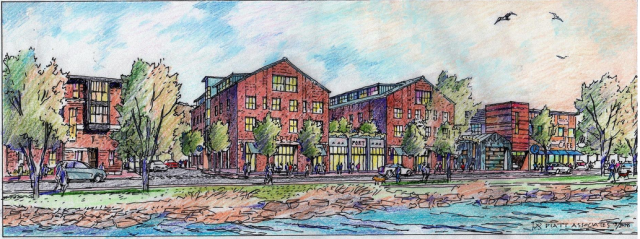
Rendering of Spencer Providence plan for three parcels of 195 land east of river. (Providence Journal)

The I-195 Redevelopment District Commission hosted the latest skirmish in the war among three developers to win the commission’s approval to build on the east bank of the Providence River. I arrived at the public hearing but had to leave early, but from what I’ve read since, not much has changed.

My spies are working to get the deep poop on what happened.

At any rate, feeling for and against the projects seems to be solidifying, as Paul Edward Parker of the Providence Journal reported today. His story, “Three developers vie for Rte. 195 lots in Providence,” features this passage:

Public comment during the meeting was split roughly into two camps: neighborhood and nearby residents, who favored the middle-sized project, whose architectural theme mimics the 19th-century Providence waterfront, and construction labor union representatives, who favored the largest project, with a more modern theme that included the research and development labs.

Parker did not indicate whether the comments split evenly or otherwise.

Neighbors prefer the Spencer Providence proposal, which seems inspired by Fox Point’s architectural history, at least to some degree. (Parker for some reason used the pejorative word “mimics”). Construction union officials prefer the Carpionato proposal because it takes up all three development parcels compared with the Spencer proposal’s two, and would require hiring more construction workers. Nobody seems much interested in the Post Road Residential proposal, a suburbanish apartment complex with ground-floor retail that would take up only one of the three available parcels.

Parker described the Carpionato plan as having “a more modern theme,” but I’m sure he was referring not to its style but to the fact that research labs are among its features. My spies will no doubt inform me of any major design shifts in the Carpionato project, which has shown traditional aesthetic tendencies since its 2013 unveiling, and quite lovely, but has suffered backsliding in the gradual replacement of gabled roofs with flat roofs.

So far as I can tell, none of my usual journalistic sources have provided any new illustrations from last night’s event. I am traveling to Washington, D.C., tomorrow, and hope to have more to go on when I return next week. (I have pre-scheduled a host of videocentric blog posts from the past to assure readers that my blog has not taken a leave of absence.)

Posted in Architecture, Development | Tagged , , , , , | 2 Comments

Bugs remember the Alamo

Screen Shot 2018-05-09 at 9.26.49 PM.png

Screenshot of Clint Eastwood in scene from “Far Alamo,” by Fabrice Mathieu. (YouTube)

What would happen if giant insects from the future attacked an Alamo defended by the stars of the greatest westerns of Hollywood?

We have an answer.

Yeah! That’s what happens in “Far Alamo: Your Western Heroes vs. the Bugs from Starship Troopers.” Cinematographer Fabrice Mathieu has achieved something amazing. Think of those video mashups of masterful film editing in which Hollywood stars strut, stroll, streak or sneak through the old Penn Station (“Penn Station, But Deliver Us from Grand Central“), or in which Rita Hayworth dances, through clips spliced into the more recent hit song “Stayin’ Alive” from the movie “Saturday Night Fever.”

The folks at the website Kuriositas write:

Well, this is cool.  Fabrice Mathieu has done it again.  Known for his unusual (and unlikely) movie mashups, this time Fabrice takes us to the Wild West and to the far-flung edges of our galaxy.  A host of western heroes (John Wayne, Yul Brynner, Clint Eastwood and so on!) face off with the horde of bugs from the movie Starship Troopers.  How he does it I don’t really want to know but this latest mashup is one of his best!

Enjoy! (Shudder!)

And check this out: Click on the Fabrice Mathieu link and scroll down to “Darth by Darthwest” – a mashup of Lucas’s Star Wars and Hitchcock’s North by Northwest in the famous scene that has Cary Grant, alone amid farmland, attacked by … well, it’s just … wowie! zowie! (Really!)

Posted in Video | Tagged , , , , , , | Leave a comment

Village blog or baluster blog

Screen Shot 2018-05-07 at 5.51.24 PM.png

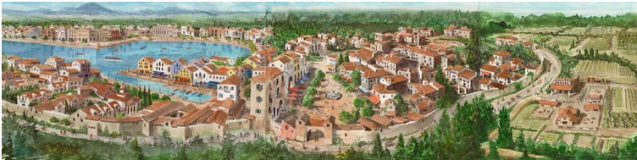
The delightful LeveVeg blog – meaning “way of life” in Norwegian – replied to my recent expression of pleasure at the illustration on top of the Village Forum blog. It is a painting of a distant village, reproduced at the top of this post but not at the top of this blog, which features a balustrade. The LeveVeg blogmeister is Øyvind Holmstad, who in kindness suggested that I might want to take down my balustrade and put up the splendid village instead. He said Village Forum, which hails from New Zealand, would appreciate it.

All this gratification took place in the comment sections of my recent two blogs on Christopher Alexander:

Screen Shot 2018-05-07 at 5.46.47 PM.png

The motto of the LeveVeg blog is “We Can Build Compact Walkable Towns Instead of Suburban Wastelands.” The Village Forum embraces a similar set of ideas. The motto of my AHAT blog, however, is “Style wars: Classicism vs. modernism.” To place a village atop my blog instead of my balustrade would be an act of misrepresentation, however pretty.

I would tut-tut Mr. Holmstad for his understandable suspicion that the balusters atop my blog “don’t say much.” I protest! They have a lot to say. My blog is an architectural blog that occasionally comments on urban policy. My balustrade, which is fairly typical of the form, sits in front of the Providence Public Library. It states that buildings can be very beautiful and enchanting. Maybe that’s not saying much. But look at the balustrade below and visit my post “An evocative balustrade,” atop which the balustrade below sits. Then try to argue that balustrades are mute!

Screen Shot 2018-05-07 at 6.13.24 PM.png

Posted in Architecture | Tagged , , , , , , , | 12 Comments

Fine wrinkles on Alexander

Screen Shot 2018-05-06 at 4.17.26 PM.png

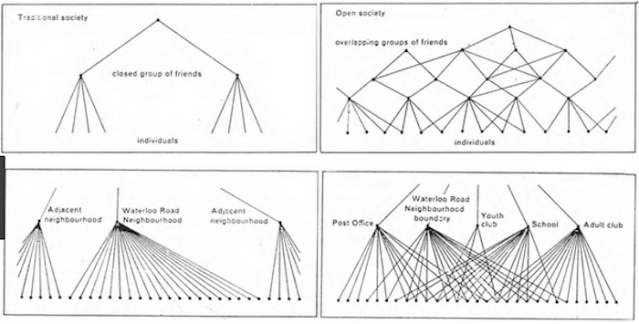
From A City Is Not a Tree,” another pathbreaking work by Christopher Alexander.

Some very interesting commenters have responded to my post “Chris Alexander’s cosmos.” The title of Alexander’s most celebrated book, A Pattern Language, spoke so directly in a mere three words to my nascent views on architecture long, long ago that I lodged him in my pantheon of heroes. But all of my heroes seem to have clay feet, or at least a couple of clay toes.

For me, Alexander’s Achilles heel was not his written but his built work, which to me seemed generally less exalted than his philosophy might imply. I see no need for a new way of building, or even an old way if it minimizes ornament – merely a return to all that was abandoned in the middle of the 20th century, a return and a recommencement of its centuries and millennia of evolution. Although I did not mention that in my recent post, I have mentioned it in past posts, as some commenters seem to recall.

So for that and other excellent points they bring out, I would suggest revisiting the post to read the comments. I will extract here only one, from Steven Semes, of Notre Dame’s architecture school. And I would point to his last sentence, which is so keen. Here is his comment:

What Nikos is describing in perhaps more specialized language is precisely what you and most people intuitively understand about architecture and the built world. First, no individual building can be designed or judged in isolation, but must connect with whatever is around it or preceded it. Buildings must compose cities and landscapes, not be individual works of sculpture. Secondly, ornament is functional because it draws our attention to other connections, not physical ones but cultural and spiritual ones. Ornament connects us with the things we use, draws us in, and (not to be undervalued) gives us pleasure. I think what Nikos and Alexander are doing is making a more intellectual case for our participation in what Alexander calls “Life” – and that term should be a give-away that it is not an elitist concept but something fundamental in the way the world and our own brains work. In this case, the theory is something we have to invent when we’ve forgotten how to do automatically what the theory describes. [Emphasis added.]

Posted in Architecture, Urbanism and planning | Tagged , , , , , | 4 Comments

Chris Alexander’s cosmos

Screen Shot 2018-05-04 at 10.46.37 PM.png

A scene at Christopher Alexander’s Eishin Campus, in Japan. (Pinterest)

Screen Shot 2018-05-04 at 11.01.16 PM.png

Chistopher Alexander

Christopher Alexander has been an enigma to me for a long time. He is famous not just for his architectural theories but for his work in computer technology, and how its patterns resemble the patterns of biological life. Common/Edge, the quirky website that features essays on both sides of the style wars, has just run a piece on Alexander and his thinking by Nikos Salingaros, one of my favorite architectural theorists.

I’m not sure what to make of “The Legacy of Christopher Alexander and a New Conception of the Universe.” It is beautifully written, and I cannot say that it is not perfectly and indeed ringingly clear. Still, I’m not really sure I quite understand it. I’m afraid it may be above my pay grade. I invite readers to dive in. I will quote a couple of what I thought were the most interesting passages. In the first, he suggests that designers who want to create “living” architecture should:

Evolve and shape what you’re making so that it is connected to everything else it can possibly connect to. But this idea underlines the basic incompatibility with current architectural culture, where each design shouts “look at me.” This is the opposite of life, where something blends in perfectly well with the world. The desire to be separate sabotages the creation of life.

Coincidentally, this passage reverberates with a quote in my last post, “Why 15 CPW makes moola,” in which a writer shows his dislike for new classical architecture by contrasting it with modern architecture, which, he says, is “often meant to stand out with striking designs, [while] 15 CPW and its ilk are meant to blend in.” (The “of its ilk” is a dead giveaway.) Blending in is exactly what Salingaros says Alexander is talking about, although I think Alexander’s conception of what that means hovers way above my own.

Soon after, Salingaros expresses Alexander’s sense of the unity of ornament and function. Modernists condemn ornament as the opposite of utility, but I (and Alexander, apparently) think that gets it wrong. In addition to being functional in the usual sense (such as a gargoyle guiding rainwater away from a façade), ornament is useful in a deeper sense because it creates affection for a building, so that it is more likely to be maintained and repaired and hence “live” longer. I think that is something like what Salingaros and Alexander have in mind:

Of immediate and profound relevance to architecture is the unity of ornament and function. Ornament connects us viscerally to a structure or surface, helping to establish an inclusive overall wholeness. This effect is just as important as our connection to this place, object, or space through using it. Therefore, there is no distinction in living structure between ornament and function. Creating art and life is essential to our spiritual development. We have something like a religious obligation to create life whenever we make something.

Someday I expect to read Alexander’s four-part magnum opus, The Nature of Order, though first I should read the book he’s most famous for, A Pattern Language, in which I have grazed with pleasure and edification without reading it from first page to last. Maybe then I will understand better.

Posted in Architecture | Tagged , , , , | 22 Comments

Why 15 CPW makes moola

Screen Shot 2018-05-02 at 9.58.52 PM.png

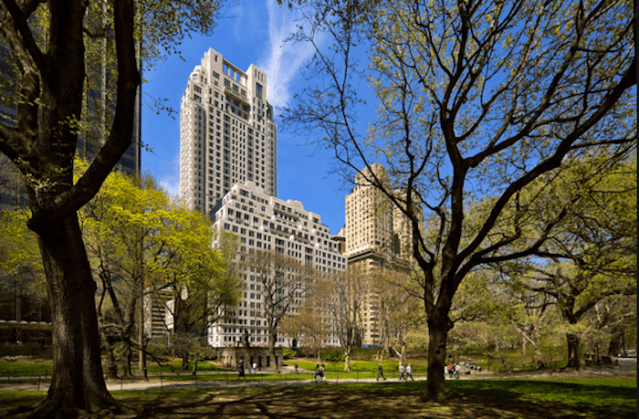
15 Central Park West (center left), by Robert Stern Architects (Manhattan or Miami)

Why Copies of 15 Central Park West Are Taking Over Manhattan,” by James Tarmy in Bloomberg Businessweek, exaggerates the phenomenon of a “takeover” and doesn’t even answer his own question.

The answer is obvious: 15 Central Park West, designed by Robert Stern Architects and completed in 2008, has made money hand over fist for its developer, the Zeckendorfs (for whom my father once worked). Other developers naturally are eager to copy a successful business model.

In 2007, Sanford Weill, then chairman of Citigroup Inc., set a city record by paying more than $6,400 a square foot for his $43.7 million penthouse. Celebrities, including Alex Rodriguez, Robert De Niro, and Sting, filled its halls. In the initial frenzy, apartments were being flipped just months after they were bought. During the financial crisis, when the rest of the real estate market floundered, the building became its own overheated market. In 2010, Min Kao, the executive chairman of Garmin Corp., paid almost $10,000 per square foot via an LLC for his 41st-floor condo.

But why has 15 CPW made so much money? Tarmy pretends not to know, but I think he knows perfectly well.

Screen Shot 2018-05-02 at 9.56.36 PM.png

Top of 15 CPW. (dailycaller.com)

It is clearly because very rich people have become tired of glass and steel modernism, and they have enough financial clout to demand that developers cater to their taste. They would like the traditional look and quality that was typical before World War II, at least for the buildings they inhabit. Stern provides that.

The fact that rich people like to live amid beauty is less extraordinary than the fact (if we can trust Tarmy’s research) that only Stern’s firm is being hired to design beautiful traditional residential buildings in Manhattan.

Screen Shot 2018-05-02 at 11.43.02 PM.png

Ralph Lauren, Madison Ave. (6sqft.com)

Remarkable – if true. But maybe not so remarkable if there is an industry prejudice against traditional buildings so strong that it can withstand such a powerful gust of market forces on the demand side. Remember when the powers that be in New York architecture, even preservationists, came down like a ton of bricks on Ralph Lauren for proposing a classical new shop on Madison Avenue? (He built it anyway.) Tarmy’s article, in a Bloomberg publication, suggests that the design establishment’s prejudice against beauty is indeed that strong.

Screen Shot 2018-05-02 at 10.21.03 PM.png

20 East End Ave., supposedly a copycat of 15 CPW. (Hayes Davidson)

Tarmy refers to the “faux pre-war style” of 15 CPW. Faux? Why faux? Its style is merely a blend of the Neoclassical and Art Deco. It is not a copy but a genuinely creative mixture of styles that characterized Manhattan apartment buildings during the first half of the 20th century. The author’s derogatory phrase is followed by other smears in his description of how Stern’s “copies” of 15 CPW are “taking over” Manhattan, as if they are some sort of alien space invader, and indeed they do a great job of putting the modernist nose out of joint. Tarmy describes the 15 CPW clones: all five of them.

Five? Wow, what a take-over.

Why the slurs and the overheated rhetoric? Probably because Tarmy wants to make sure that readers – mostly in the building design and development industries – understand that Tarmy (or, rather, Bloomberg) does not approve of Stern and his old-fangled apartment buildings. At last, toward the end of his article, Tarmy lets the cat out of the bag:

Manhattan isn’t even close to saturated with Stern condos. Unlike buildings by other starchitects such as Frank Gehry or Jean Nouvel, which are often meant to stand out with striking designs, 15 CPW and its ilk are meant to blend in. And that’s why Stern is building more of them than his peers. “The genre of [starchitec- ture] is defined by creating something unique,” he says. “The multiple versions of 15 Central Park West are a conservative version of something new.”

A little bit of honesty seems to creep out here, revealing that Tarmy’s “takeover” was an exaggeration and that maybe Stern’s “peers” are, in fact, building versions of “15 CPW and its ilk.” And its ilk? He even reluctantly admits that they aren’t just copycats. Clearly something irks Tarmy about Stern. Doubtless it is Stern’s refusal to play by the rules of establishment modernism. Doesn’t Stern realize that modern architecture is the brand of the one percent? Tarmy is sending Bob Stern to re-education camp.

My guess: Stern will ignore him and keep on keeping on with his great work.

Screen Shot 2018-05-02 at 9.55.03 PM.png

Entrance to 15 CPW. (financialpost.com)


Posted in Architecture, Development | Tagged , , , , , , | 5 Comments

My Jane’s Walk this Saturday

Screen Shot 2018-04-30 at 10.44.05 PM.png

On tour in 2016, near Washington Street Bridge. (photo: Caroline Nye? Victoria Rogers?)

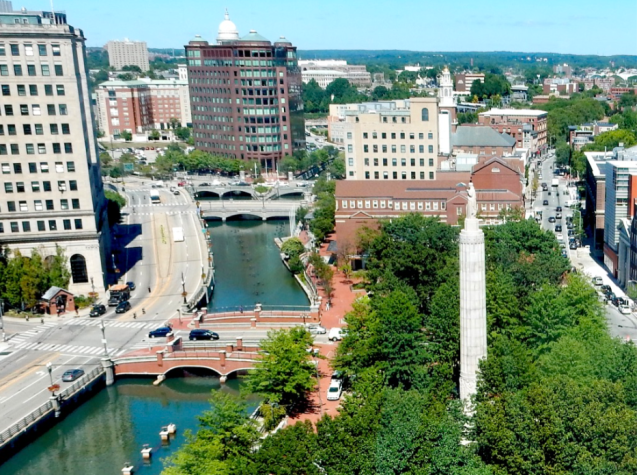
My fourth Jane’s Walk tour of the waterfront along the Providence River takes place at 4 p.m. this Saturday, May 5. We will meet at the Crawford Street Bridge near Hemenways in the Rubik’s Cube and stroll north, heading west around the curve of the Woonasquatucket River to Waterplace Park.

Visit Doors Open RI to learn of other Jane’s Walks this Friday-Sunday.

Screen Shot 2018-04-30 at 10.53.47 PM.png

Jane Jacobs (David Levine/New Yorker)

Since our tour is about waterfronts, read what Jane Jacobs wrote of waterfronts in Fortune magazine in April 1958, three years before her pathbreaking The Death and Life of Great American Cities was published in 1961.

Waterfronts are a great asset, but few cities are doing anything with them. Of the dozens of our cities that have riverfronts downtown, only one, San Antonio, has made of this feature a unique amenity. Go to New Orleans and you can find that the only way to discover the Mississippi is through an uninviting, enclosed runway leading to a ferry. The view is worth the trip, yet there is not a restaurant on the river frontage, nor any rooftop restaurants from which to view the steamers, no place from which to see the bananas unloaded or watch the drilling rigs and dredges operating. New Orleans found a character in the charming past of the Vieux Carré, but the character of the past is not enough for any city, even New Orleans.

Today, many cities have built waterfronts, including New Orleans, and an overwhelming majority of them are junk. The Waterfront Center, a nonprofit advocate of development on civic embankments, has a pair of picture books and a set of booklets recognizing three decades of awards in the Waterfront Center’s annual competition. The center’s illustrations record the generally modernist and experimental design conceits embraced by almost all of the new waterfronts around the world since 1981, when TWC was founded. These waterfronts demonstrate how sadly unusual is the level of design beauty embodied by the Providence waterfront.

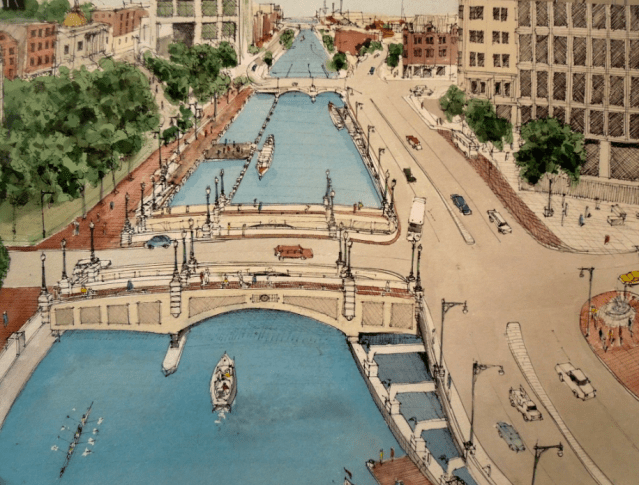
Our waterfront’s design uses traditional architecture as a tool to turn infrastructure into beauty. The design work (see below) was performed by the late William Warner and his firm. The new I-195 bridge taking the relocated highway over the Providence River should be named for Bill Warner, who understood that our bridges, parks and river walks should be as traditional in appearance as the city itself. Providence is lucky in its new waterfront because Providence is lucky in its architectural legacy – which was not destroyed by urban renewal as in so many other cities.

Consider Jacobs’ curious last sentence in the passage above, in which she declares that “the character of the past is not enough for any city.” That is no doubt true of cities that have destroyed their own historic characters, as almost happened here in 1959 and again in 1960. By then, the destruction wrought across civic America by urban renewal and modern architecture was well under way. Providence dodged that bullet.

So on Saturday at 4, come see why Providence and its residents are so lucky, and why its visitors so astonished, by the city’s waterfront. Gape in wonder at plans by city officials to try, yet again, to destroy Providence even after all we supposedly have learned over the past half century. What is most surprising? The city’s beauty, or the desire of the city fathers to kill the beauty?

Screen Shot 2018-04-30 at 11.28.38 PM.png

Screen Shot 2018-04-30 at 11.26.29 PM.png

Screen Shot 2018-04-30 at 11.27.14 PM.png

Screen Shot 2018-04-30 at 11.25.13 PM.png

Screen Shot 2018-04-30 at 11.23.34 PM.png

Screen Shot 2018-04-30 at 10.29.08 PM.png

Posted in Architecture, Urbanism and planning | Tagged , , , , | 4 Comments

Partying with the Bulfinches

Screen Shot 2018-04-29 at 8.56.04 PM.png

Yale residential colleges that won a Bulfinch last night. (Robert A.M. Stern Architects)

On Saturday evening the region’s classicists held a big bash at the Harvard Club of Boston, after two lectures by eminent classicists that morning and afternoon. The lectures will soon go onto the website of the New England chapter of the Institute of Classical Architecture & Art. But there was no secret taping of the table talk of classicists around Table No. 10 at the evening gala banquet.

The gala to celebrate the 2018 Bulfinch laureates pulsated with joy last night. The evening was a delight, and I heard more than one attendee gush that it was like the Oscars. Masters of ceremony David Andreozzi and Sally Wilson, chapter prez and veep respectively, moved the graphically sophisticated awards presentation briskly forward. The winners thanked the chapter for their awards and their associates for inspiration under the chandeliers that illuminated the filet mignon and shrimp that slid gently down everyone’s throat as good wine sparked conversation among attendees who, now and then, had to guess what their table-mates were saying.

Such is the hubbub of a successful party in the glitzy nonprofit world, increasingly the measure of success, on top of or, indeed, in place of actual accomplishment itself. Or is that merely as it always has been – old hat, that is: traditional, or even classical. Huh? Come again? I didn’t quite catch that! Oh, yes, I agree! This was a great night for the chapter!

Much of the talk was of classicism and how it is defined – a ticklish subject among classicists from time immemorial, or at least from the outset of the organization itself, which has debated the topic for decades. At Table No. 10 sat the lecturer of the morning, Christine Franck, who has occupied posts of leadership at the national level of the ICAA for decades. She, with me and my fellow chapter board member Robert Orr, were joined at table by Melissa DelVecchio, Graham Wyatt, Kurt Glauber and Jennifer Stone of Robert Stern Architects, leaders of the design team that created Yale’s extraordinary pair of new residential colleges, which opened last fall. It was an honor to have been seated at their table. They received a Bulfinch for a project that, until Penn Station is restored to its glory, may reasonably be considered the major achievement of the classical revival in America to date.

The classical revival? Classical? How does that word relate to the word traditional? Each has a different meaning for everyone, or so it seems. Is the classical revival going to peter out if it lacks a more precise definition of the classical? Is the ICAA going to suffer such a fate? Does the ICAA really need to decide whether, say, the Gothic is in or out of what we define as classical? Maybe. Or maybe not. After all, the Yale campuses are Collegiate Gothic in style. Yet who will say they did not deserve a Bulfinch? Still, can anyone deny that a more precise definition of classical would be helpful?

I’m not sure that I endeared myself to my table-mates by suggesting that to tiptoe around precision might be the better part of valor. For readers of this post, I’m sure the question was untangled with more erudition in the day’s lectures by Christine Franck and Aric Lasher, president and director of design at the Chicago firm of HBRA, who was project designer of the recent, and extraordinarily classical, temple of a federal courthouse in Tuscaloosa, Ala. His lecture was titled “‘Lies that tell the truth’: Negotiating the subjectivity of expression in contemporary practice.” Now that’s a topic that tantalizes the hell out of me.

I missed Christine’s 10 o’clock (a.m.!) lecture, and arrived in time, that afternoon, to catch Aric’s concluding remarks. And so I totally agree with laureate Ronald Lee Fleming, who was granted this year’s award for august patronage. In his acceptance remarks, he urged the chapter to make an even higher priority of these Bulfinch lectures. Thankfully, the chapter videotaped both lectures, and I will be the first to connect readers to them as soon as they arrive online.

Screen Shot 2018-04-29 at 8.52.15 PM.png

New federal office building and courthouse in Tuscaloosa, Ala. (HBRA)

Posted in Architecture | Tagged , , , , , , , , , , , , , | 3 Comments

Wee wow for Bauwauhauses

Screen Shot 2018-04-27 at 1.39.07 PM.png

Kennel at auction, designed by artist Eileen Goldenberg. (theguardian.com)

Mutts-have: Architects create luxury kennels for charity auction” is the headline of this story by Guardian critic Oliver Wainwright. “Mutts-have”? … I’m sorry, that really does not cut the mustard. Mutts-have ≠ must-have. And if you glide down the complement of luxury dog houses at auction yesterday in London, you will find that most are far from pooch palaces. The event was actually called the Bow-Wow Haus Auction.

Indeed, most of them either reek of the cutsie-wootsie or stink of the Bauhaus. In short, they are dogs, not kennels. Okay, a few are nice, like the one on top by artist Eileen Goldenberg. The late Zaha Hadid’s office has an entry, which I will refrain from trying to describe. A photo of it is included with the story. To see all of the doghouses, scroll to the end of Wainwright’s story and click on “… more on the kennels here.”

What are we to make of the idea of auctioning off doghouses donated by professional designers? Critic Phineas Harper tried to let the dog out of the bag:

One in every 200 British people is homeless. But it’s okay – because Zaha Hadid Architects have made a bespoke dog kennel to raise money for a pet charity. A pet charity with assets of £60.7 million and an annual income £18.5 million.

Boo-hoo! If not bow-wow! Doubt he cares what the kennels look like. But because we like dogs so much, it is worth noting that, assuming any actual dogs show up to pose with the kennels, the auction was held at the gorgeously restored St. Pancras Renaissance London Hotel.

Screen Shot 2018-04-27 at 1.59.36 PM.png

The St. Pancras Renaissance London Hotel, at St. Pancras Station. (Wikipedia)

Posted in Architecture | Tagged , , , , , , | 1 Comment