Rebuilt riding hall in Buda

Screen Shot 2018-12-30 at 6.36.54 PM.png

The royal riding hall at Buda Castle in Budapest, Hungary. It is almost complete. (Skyscraper City)

Photographs of progress on the riding hall and stables of Buda Castle, on the Buda side of the Danube in Budapest, raised my spirits this holiday season. Almost complete, the reconstruction seems a good way to express hope in the future as we enter the new year. The riding hall was designed by Alajos Hauszmann and built in 1899–1900, heavily damaged in World War II and demolished during the communist era. Its reconstruction is part of a larger plan under Hungarian premier Viktor Orbán to restore the Buda Castle, which contains the national gallery, history museum and library today, but still features the dubious renovations by the communists in the 1950s.

Critics of Orbán say he wants to turn the Castle District into a sort of Kremlin on the Danube. An anonymous article expressing skepticism of the huge project ran in 2014 on the Hungarian Spectrum website. Another anonymous post there yesterday reported that Orbán will move his office into the Castle Theater on Jan. 1, the day after tomorrow. The first article, whose author’s name I could not locate, said:

A few days ago [in 2014] the Hungarian public learned that billions of forints, part of which will of course come from Brussels, will be spent on the reconstruction of the Castle District (Várnegyed) and the Royal Castle. The whole project might take twenty years. László L. Simon, the undersecretary in charge of culture, is responsible for the project, named the National (what else?) Hauszmann Plan. The plan is grandiose and, in my opinion, unnecessary. Fueling it, I suspect, is Viktor Orbán’s megalomania.

Another more gentle article, “Budapest: From Rubble to Remarkable,” by Heather Hall on the tourist-oriented website ferretingoutthefun.com, is historical in tone. Hall notes that Budapest (originally twin cities, Buda and Pest, straddling the Danube and joined under the Hapsburg administration in 1873) was largely destroyed in the war but has been rebuilt to such a degree that one might never guess. Hall writes:

Like much of Eastern Europe, Budapest took a beating during World War II. Bombs rained down like a proliferation of hailstones and left smoldering piles of rubble in their wake. Then, in a final act of desperation, German troops blew up the city’s bridges during their retreat from the advancing Soviet army. By war’s end, a staggering 75 percent of Budapest lay in ruins.

Walking around Budapest today, it’s difficult to believe that so much of it is newly built. The Hungarians have slowly and painstakingly reconstructed their beloved city, from the Hapsburg palace atop a Buda hill to the iconic domed Parliament building standing proudly on the Pest side of the Danube. Looking at photos of the destruction, I am astounded at the transformation. Budapest has truly risen like a phoenix from the ashes. The city’s rebirth is made even more amazing given the fact that the Soviets took over Hungary after the war and tried to impose communism on the reluctant population.

After forty years of Soviet rule, Budapest could be chock-full of squat grey concrete structures but, mercifully, it is not.

Hall’s article contains lots of lovely photos of Budapest today. Please read the whole thing.

Returning to the riding hall, I support its reconstruction regardless of the politics that drive it. Any society after such a massive interruption of its society and its culture should be striving for reconstruction. Hall does not reveal whether the city’s reconstruction was initiated under the communist regime – presumably after the Hungarian popular revolt in 1956 – or after the end of the Cold War in the late 1980s. Either way, when the strides taken by Budapest to rebuild after World War II are considered, the excellent idea here in America of rebuilding Pennsylvania Station in New York City seems positively quaint by comparison. As described by Hall, the work in Budapest seems well beyond the extensive rebuilding in such places as Warsaw, Berlin and Dresden, of which I am much more familiar.

I expect to visit Hungary someday. I am a quarter Hungarian and my wife, Victoria, is 100 percent Hungarian. Her parents fled Hungary together in the back of a truck after the failure of the revolt and, after a few years in Canada, ended up as welcome emigrés to America, first in Houston, where Victoria was born, and then in Providence. Whatever one may think of Orbán and his policies, his continuation of Budapest’s reconstruction is unassailable. It is constantly resisted by modernists whose worldwide architectural train wreck is shamed by every stone used in any reconstruction, wherever it takes place, be it in Budapest, Berlin, or New York City. Budapest is another example of a growing popular revolt against modern architecture and modern urbanism. Bravo, Hungary!

Screen Shot 2018-12-30 at 6.37.49 PM.png

Detail of the riding hall reconstruction in Budapest. (Skyscraper City)

budacastlebudapest.com.png

Artist’s conception of riding hall reconstructon, at center left. (Buda Castle Budapest)

Screen Shot 2018-12-30 at 8.10.54 PM.png

The current national riding hall in Budapest, in the International Style. (csiobudapest.hu)

Screen Shot 2018-12-30 at 8.18.44 PM.png

Hungarian Parliament (1896), designed by Imre Steindl and rebuilt after WWII. (Oddviser)

Screen Shot 2018-12-30 at 8.47.29 PM.png

Street scene in Budapest. (ferretingoutthefun.com)


Posted in Architecture | Tagged , , , , , , , | 11 Comments

New blog page on ‘Dystopia’

Screen Shot 2018-12-28 at 10.11.35 PM.png

This post serves as the official announcement that I have posted on my blog a new page – as in the “Home” page or the “About the author” page or the “Lost Providence” page. That is, I posted it but it is not a post. Rather it is a permanent section of the blog itself. It concerns the book Making Dystopia, a comprehensive history of modern architecture by the architectural historian James Stevens Curl, published in 2018 by Oxford University Press. The page reflects the importance I place in the prospects for this book and the shift it might initiate in the revival of traditional architecture.

On the Making Dystopia page there is an introduction to the book and there are links to sites where the book can be purchased, and then there is a list of reviews of the book. Readers may feel free to send me news of reviews that I have left off the list, or suggest other material that might be of interest to readers. I may be reached at this email: dbrussat@gmail.com.

I will forgive any reader who, on his way to the Making Dystopia page, stops in at the Lost Providence page. When you are finished reading the Making Dystopia page, feel free to plunge back into the Home page and read more posts, many of which lately have been about Making Dystopia. No doubt they will help you fill up the down time between Christmas and New Year’s.

Posted in Architecture | Tagged , , , , , | 3 Comments

Blessings be upon readers

Screen Shot 2018-12-25 at 1.51.32 PM.png

Church of the Nativity, in Bethlehem. (Islamic Landmarks)

Most if not all of the scene above was built since the birth of Christ in a Bethlehem manger long ago. The Church of the Nativity, erected to celebrate that holy birth, still contains, in its basement, the site of the legendary virgin deliverance. At Christmas, celebration takes its many forms. Architecture is one, and through it we celebrate traditions that uphold human hopes for the future, which rely on surmounting challenges to those traditions that have arisen in the recent past. This blog celebrates those traditions year round, several times a week, but today it celebrates its own readers.

I would like to thank all readers of the this blog, including those who might retain, if that can be imagined, some skepticism toward the classical revival, and who, as they keep on reading, may begin to see the reason behind the prospect that a return to tradition in the design and construction of houses, buildings, cities and towns can assist an efflorescence of traditional cultural revivals, artistic and otherwise,  musical, both classical and folk, figurative sculpture and painting, along with the rise of a more humane back-to-basics sensibility, a smaller scale in every human endeavor, and a greater humility in the advancement of science and technology – that all this could actually bring a happier, lovelier world of greater fulfillment, greater sustainability and greater capacity to come together and solve, in an atmosphere of hope uplifted by beauty, the local, regional, national and global problems that we all face, and ponder at this time of year.

This is a tall order – oops, a tall expectation. But this year has seen the emergence of a book of hope, a volume called Making Dystopia whose intention is quite the opposite: to reverse the dystopia already upon us. Its author, James Stevens Curl, has written a history – the most comprehensive on record – of a catastrophe that many believe to be at or near the root of the gathering crisis in the affairs of humanity. By exalting sterility, utility and technology in a plan to turn society into machinery, modern architecture has stifled the spirit that had accomplished great progress for humanity. Stevens Curl wants us to get our humanity back, and since acceptance is the first step to a cure, his book could be the medicine we need.

So I will be setting up a third page in my blog dedicated to Making Dystopia, where readers can go to buy the book and read reviews by writers who have read and understood it, many criticizing establishment critiques by reviewers whose misunderstanding, oftentimes, seems emboldened by their resolute refusal to read the book. Maybe other things will be posted there too. Look for that page soon. Meantime, merry Christmas and a joyous season for all.

Screen Shot 2018-12-25 at 2.14.37 PM.png

“The main access to the Church of the Nativity in Bethlehem is this Liliputian and simple door in the main façade known as “Door of Humility.” It dates back to the Ottoman period, its size meant to prevent carts being driven in by looters, and to force even the most important visitor to dismount from his horse as they entered the holy place. The doorway was reduced from an earlier Crusader doorway, the pointed arch of which can still be seen above the current door.” (Flickr)

Posted in Architecture | Tagged , , , , , , , , , | 1 Comment

Save the carriage house, too

Screen Shot 2018-12-17 at 6.05.28 PM.png

William Beresford Carriage House (1925), 315 Slater Ave., view heading north.

The carriage house and servants’ quarters at 315 Slater Ave. is among the outbuildings that would be demolished along with the Beresford-Nicholson house, on the East Side of Providence, if the city approves a proposed major subdivision of the estate along Blackstone Boulevard. (See “Meanwhile, on Blackstone“) Whatever happens to the mansion itself, this dear example of vernacular architecture designed by Clarke, Howe & Homer for stockbroker William Beresford but not built until 1925 after the property was sold to Paul Nicholson, veep of Nicholson File, must be saved.

Perhaps it can be cut out of the larger development proposed by the Bilotti Group, or maybe the Bilotti Group itself can be put on a rocket and blasted off to Mars. I don’t know. But for years I’ve been rounding that curve where Slater bends twice and turns into Cole Avenue. If you head north on Slater, you follow a stone wall on your right into the second bend, where the stone wall is taken over by a large, rough-hewn cottage with red-framed windows and dormers, a slate roof, the whole covered with moss, vines and ivy, and entered through a big red door in the wall.

Nobody who lives in or traverses this area regularly can fail to recognize it. It is a landmark, even more so than the fine Nicholson house at 288 Blackstone itself. Whenever I drive by, I am momentarily a-swoon at this most romantic of structures. I have no idea what the far side looks like from the Nicholson grounds, let alone what it is like inside. It looks worn down and dilapidated. If it is saved and restored, the effort should be taken to maintain the graceful patina of its long dance with nature, as is done with marvelous old properties in Charleston and New Orleans.

Anyhow, the fate awaiting the carriage house must be fought vigorously at a hearing this afternoon of the City Plan Commission at the Department of Planning and Development, just across Empire Street on Westminster. The meeting, with a hearing at which the public can speak, is set for 4:45 p.m. I apologize for being so late in posting this. I was not even aware until yesterday that this carriage house was part of the Nicholson estate.

Screen Shot 2018-12-17 at 5.35.24 PM.png

View of the carriage house, on Beresford-Nicholson estate, view heading south.

Posted in Architecture, Development | Tagged , , , , , | 9 Comments

Meanwhile, on Blackstone

Screen Shot 2018-12-17 at 2.13.15 PM.png

The Nicholson estate, 288 Blackstone Blvd., proposed for demo and division into ten lots.

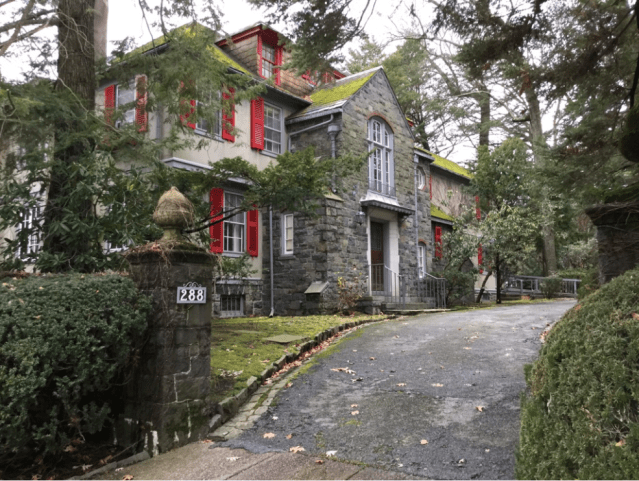
A third effort to transform a historic Providence estate into a collection of big cheesy houses has emerged along Blackstone Boulevard. Readers will recall when neighborhood opposition in 2014 thwarted a division of the Granoff estate into ten lots, at least for now, but failed in 2016 to block a division of the Bodell estate just behind the Granoff estate. Its new houses, cheek by jowl, serve as a warning. But at least those two efforts did not imagine demolishing the two historic mansions involved.

Not so the Beresford-Nicholson estate, a bit farther south at No. 288 on Blackstone. Developers want to tear down the 1910 house built by William Beresford, a stockbroker, and expanded in 1919 by Paul Nicholson, who was a vice president of the Nicholson File Co., once among the international powerhouse manufacturing firms whose wealth build Providence in the late 1800s. The developer wants to put ten new houses on the property, which also features a great stone wall, which would be punctured for driveways.

Below is the actual entry in the survey of the East Side (not College Hill) by the Rhode Island Historical Preservation & Heritage Commission:

Screen Shot 2018-12-17 at 12.21.00 PM.png

The developer’s idea is to gut the Nicholson land so that new houses can go up according to the wishes of the supposed house buyers. This means that anything could happen on the site, including the landing of an alien space ship that would wreck the resale value of however many of the houses are already built or signed for by the time that happens. It might not happen. But it might. It has on the Bodell site. (See below.) Under this sort of scheme, the early house buyers might never know until the final house is built.

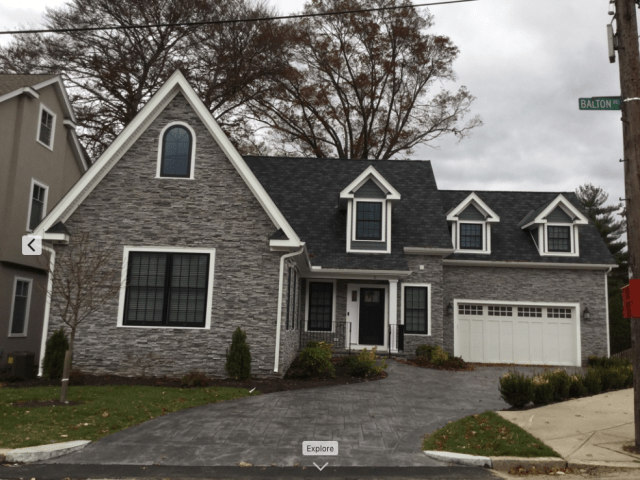
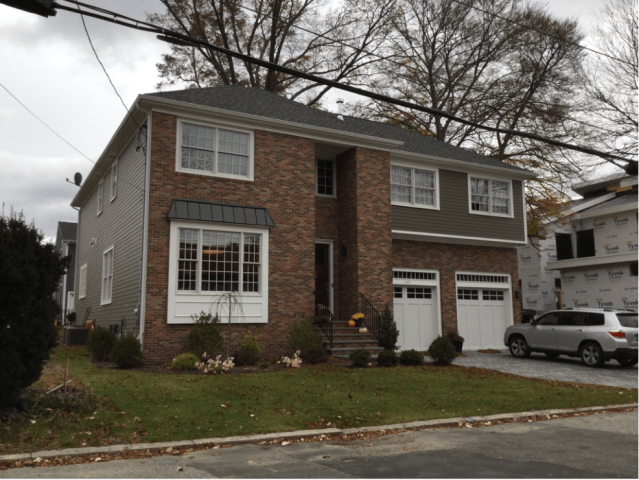
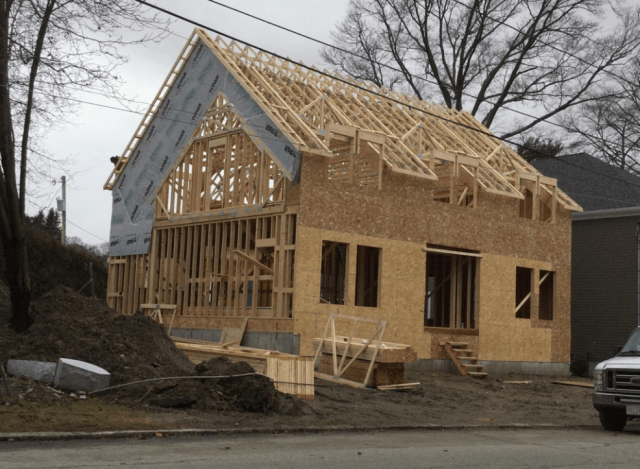
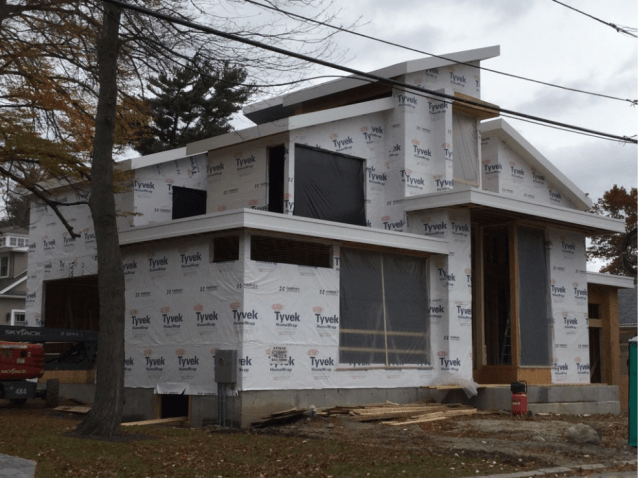
This is the same strategy used by the same developer (the Bilotti Group) to build out the Bodell estate, where four of five houses seem to be at or near completion. They are shamed by the beauty of the surviving Bodell mansion, which may be why this time the mansion will be sacrificed. The new houses on the old Bodell estate are pictured below, all taken recently. The first house is the best of the lot. One is just being framed. The last looks to be a good example of an alien spaceship and a hoary modernist cliché to boot. They are followed by a shot of the Bodell mansion, which has been preserved.

The first public meeting on this subdivision, continued from November, will be held tomorrow by the City Plan Commission, at 4:45 p.m. at the city planning department, 444 Westminster St. A public hearing at the same meeting, where citizens can address the panel, is not mentioned on the CPC agenda but I have heard there is one scheduled. Nor are the proposed demolitions of the mansion and at least one spectacular out-building mentioned on Item 3 of the agenda.

Screen Shot 2018-12-17 at 11.54.53 AM.png

Screen Shot 2018-12-17 at 11.54.08 AM.png

Screen Shot 2018-12-17 at 11.54.22 AM.png

Screen Shot 2018-12-17 at 11.55.29 AM.png

Screen Shot 2018-12-17 at 2.14.36 PM.png

Screen Shot 2018-12-17 at 11.55.51 AM.png

Screen Shot 2018-12-17 at 12.08.18 PM.png

Posted in Architecture, Development | Tagged , , , , , , , | 12 Comments

The path now against Fane

Screen Shot 2018-12-14 at 7.24.38 PM.png

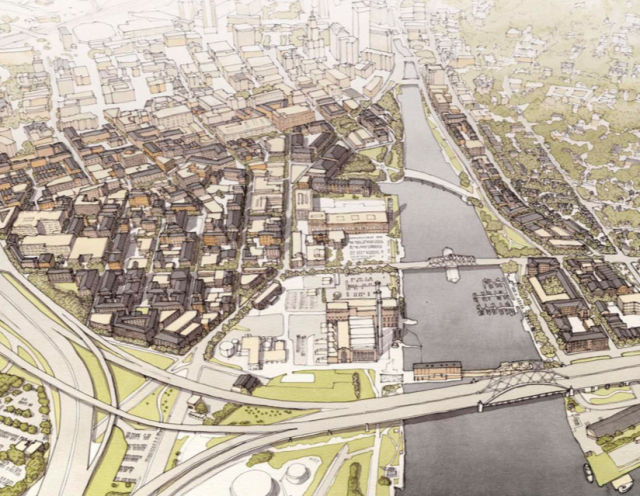
Map of Jewelry District by grad students at School of Architecture, University of Notre Dame

The Providence City Council has overridden Mayor Elorza’s brave veto of a bill to allow developer Jason Fane to proceed with a tower that plainly violates city zoning law.

The building would no longer violate the height limit for Parcel 42, which has now been legally amended. But the building would still violate Section 600 of the city zoning code, passed in 2014, which reads that “[t]he purpose of the D-1 District is to encourage and direct development in the downtown to ensure that new development is compatible with the existing historic building fabric and the historic character of downtown,” which now officially extends into the Jewelry District according to the city’s zoning map.

Going forward, opponents of the tower can still try to block it. They can urge the state to back out of hefty development incentives by arguing that the I-195 commission itself has questioned the project’s financial viability. A lawsuit is possible. Or a recession might frighten off its private financing before construction begins. Opponents can pray for that, if they wish.

Those are possible ways to trip up the Fane tower. But they are unmoored to any coherent strategy of opposition, which must seek to leverage the city’s comparative economic advantage and strengthen its brand. If the opposition does not link its case against Fane to opposing the sustained erosion of the historical fabric, then that opposition will be seen as a fit of pique, and it won’t matter very much whether the Fane tower is built or not.

So now it is time for opponents to separate the men and women from the boys and girls. It is time to grasp the nettle of why the Fane tower is bad for Providence. It is bad not because it would be too tall but because it would continue the longstanding erosion of the city’s beauty. Many opponents claim to oppose it because it doesn’t fit into the city’s historic character, but do they really? The Fane tower is no more of an insult to the city than the Wexford project nearby, or the two dormitory buildings next to the renovated 1912 Beaux-Arts power plant at South Street Landing, which have arisen with no opposition from anyone who is against the Fane tower today.

If that misunderstanding of Providence, its past and its future persists, embracing false ideas of what the future must look like as gospel, then it doesn’t matter if the Fane tower adds to the list of buildings that have pulled the city down little by little for decades.

At some point, without any clear tipping point, what remains of Providence’s beauty will be overwhelmed by its new ugliness. Development incentives, however large, will no longer be able to offset the cost of doing business in Providence. This city will go down the tubes like so many other cities in the Northeast already have, and for the same reasons – except that Providence delayed going ugly for half a century longer than other cities.

If the Fane tower goes up, Providence’s decline will be inevitable – unless civic leaders are shocked into trying a free and easy solution they now appear bound and determined to resist. Maybe the opposition to Fane represents a turning point. If so, “Hope Point Tower” may turn out to be prophetic.

(Illustrations above and below are from a study of the I-195 and Route 6/10 projects in Providence performed on-site by the Graduate Student Design Studio under Prof. Philip Bess in the School of Architecture at University of Notre Dame. The study, “Building Durable Wealth: Redeveloping In-City Freeway Corridors,” won an award at the 2017 annual convention of the Congress for the New Urbanism.)

Screen Shot 2018-12-14 at 7.25.23 PM.png

New background buildings for I-195 corridor drawn by Prof. Philip Bess’s grad students.

Posted in Architecture, Development | Tagged , , , , , , , , , | 10 Comments

Politics of the Fane override

Screen Shot 2018-12-12 at 11.29.41 PM.png

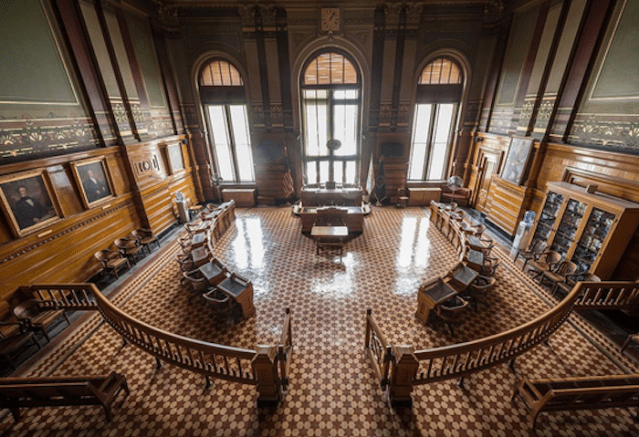
Council Chambers at Providence City Hall. (We the Italians)

When a pro-Fane tower councilman called in sick for Tuesday’s vote on whether to override Mayor Elorza’s brave veto of the Fane tower legislation, the council postponed the vote until tomorrow, Thursday, Dec. 13. Having spouted my opposition to the tower many times this past two years, maybe it’s time to have some fun with the politics of the tower imbroglio.

I am, of course, assuming that the ill council member, Wilbur Jennings, was really ill. To imagine otherwise is to imagine an unimaginable perfidy in a sitting council member. But minds more cynical than my own must wonder whether Jennings’s absence was motivated by perceptions that the alleged swing-vote councilwoman Mary Kay Harris was showing some reluctance to swing to the pro-Fane faction, which needs 10 votes to override but has only nine. How to get a postponement? But not too much of one! A pro-Fane member is scheduled to fly out of the city on vacation before Christmas and won’t be back till after the override deadline of Dec. 31, so too long a delay will be too long.

A hospital visit? Perfecto!

Nah. This theory violates the principle of Occam’s Razor – the simplest explanation is likeliest one. Bank on it. The man was ill.

Nevertheless, at a party on Saturday evening, before the postponement, I heard that some of Councilor Harris’s colleagues were jealous of what, according to news reports, she’d been promised to change her vote. My source at the party told me he could imagine, if she did flip, or swing, this would set off a round of flippers seeking still more goodies – excuse me, public benefits. The vote could become as crazy as a pinball machine, with council members careening from one side to the other, with Fane and his cronies trying to flip the flippers back and forth, back and forth in the smoke and mirrors of the back rooms of the Third Floor of City Hall, breathing heavily and swiftly losing track of the cost of their promises.

All this seems a bit far-fetched. Every council member (pro-Fane or con) is very much aware that Fane is already hard pressed to make the project work financially. Even the I-195 commission’s financial consultant’s eyebrows rose beyond his hairline months ago when he ran the numbers on the project. No way Fane can check off the public benefits on the wish list of a single council person, let alone a chorus line of them – all above and beyond the state tax incentives to which the Fane project will be entitled, whatever they may be.

So we’ll just have to wait and see whether the swing vote is strong enough to take her swing based on principle. Mayor Elorza has already made the one argument that she needs to keep in mind. “Today,” he asserted in his veto statement, “we have approximately 70 projects either completed, under construction, or in the pipeline. With more investment and development than we’ve seen in over a decade, Providence is a city on the rise. As a growing and vibrant city, we see increasing interest from people who want to invest in our future.”

In short, Fane opponents need not worry that voting against the tower will cost jobs and taxes. Providence has been attracting investment lately because the city had the foresight to put in place zoning that developers could trust. That way, the city won’t become an OK-Corral, Wild-West urban shoot-out of developers over who can offer the most payoff for the most variances. If zoning that can change by a factor of six is approved in the face of so much public opposition, then the city automatically will become the kind of zoning sink hole that developers tiptoe around on their way to other cities.

In short, far from costing jobs and tax revenue, a vote against Fane will reaffirm the zoning stability that has caused an influx of jobs and revenue. Just look around you, and you can feel free to vote your conscience.

Posted in Architecture, Development | Tagged , , , , , , , | 7 Comments

SpongeBob HouseFancy

Screen Shot 2018-12-09 at 9.03.44 PM.png

Scene from “House Fancy” episode of Spongebob Squarepants.

Screen Shot 2018-12-09 at 9.09.07 PM.png

The other day my son Billy replayed for me an episode he had just watched of “SpongeBob SquarePants” (a cartoon that takes place at the bottom of the ocean). Billy, who is 9, thought I would like it, and he was quite right. In it, SpongeBob’s friend Squidward, a squid, turns on his television to see his old high-school rival Squilliam’s house (left) being featured on the TV show “House Fancy.” Squilliam shows the host around. With its solid-gold door knobs, it looks as if it must be a cartoon version of a certain president’s Fifth Avenue penthouse. Except that the episode was filmed in 2007.

Squidward angrily contacts the show to say his house is fancier. The show’s host, Nicholas Withers, says okay, he’ll be over in half an hour. To make a short, nine-minute story mercifully shorter, Squidward asks SpongeBob to help neaten up his house. Instead, he blows it sky high in a vacuum accident. When host Withers arrives with Squilliam a moment later, they see that Squidward’s house is now a smoking ruin.

Host: Hello, and welcome back to “House Fancy.” We’re arriving at the house of Squidward Tentacles, who claims that his house is far fancier than that of Squilliam Fancyson. Let’s take a look. [Pauses as he sees scene of destruction.]

Well, I-I-I’m not quite sure how to say this.

Squilliam: Go ahead! Say it!

Host: Squidward Tentacles, you seem to have ushered in an entire new era in house fanciness.

Squilliam: Huh?

Squidward: I have? I have!

Host: What you’ve done harkens back to the illustrious post-primitive movement popularized by famous designer Saul Impkins. Say, was he a big inspiration to you?

Squidward: Why … uh, yes! I’ve studied him for … years!

Squilliam: Arghh!

Host: I would like to announce that Squidward’s house will be featured in an hour-long commercial-free “House Fancy” special. And, Squidward will be crowned House Fancy Prince of the Year, an honor that was originally to be bestowed upon Squilliam.

[Squilliam collapses in horror.]

The Encyclopedia SpongeBobia, whose very existence is a comment on our culture, has a summary of the episode, whose analysis holds that host Withers considers the wrecked house “a work of abstract art.” And of course that’s a comment on our culture as well. Likewise, the episode mocks the likes of cable shows such as HGTV. By the way, if any reader knows who, if anyone, “Saul Impkins” alludes to, please communicate. Also, Squidward’s house is the middle house below, next to SpongeBob’s house (right).

(Press to see full SpongeBob “House Fancy” episode. The “May I use your bathroom” scene is worth the price of admission.)

Screen Shot 2018-12-09 at 10.18.22 PM.png

Posted in Architecture, Art and design, Uncategorized | Tagged , , , , , , | Leave a comment

The Journal’s ‘R.I. Memories’

Screen Shot 2018-12-06 at 8.39.52 PM.png

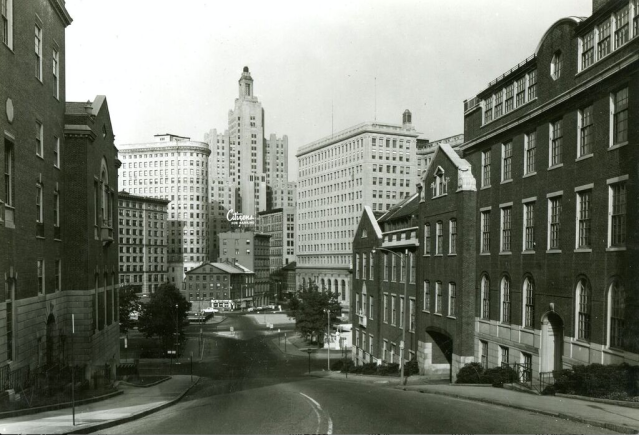
View of downtown Providence from the base of College Hill in the 1930s. (Providence Journal)

Black and white photography bears the stamp of history, a ratification of the long-ago. One might wish that photos from, say, the 1890s were in color. That would convey a different authenticity, a satisfaction that today’s colorization processes generally fail to deliver. But then why not just go the whole hog and wish that photography was around to record the founding of our dear republic – or, for that matter, of the Roman republic?

The Providence Journal, in producing its newly published Rhode Island Memories: The Early Years, chose not to tinker with history. Its 322 photos over 180 pages, not including a caboose with 14 pages of business profiles (ads), span about six decades from the 1880s to the late 1930s. Partly because of the unwieldy and fleeting nature of cameras and film through most of that period, there are few photos of “the news in action,” and many are not from the Journal’s photo archive but from the archives of organizations such as the Rhode Island Historical Society or those of individual families, whose members were invited by the Journal to submit images for the book. The first of ten chapters, “Views and Street Scenes,” offers an abundance of buildings. Later chapters increasingly feature groups of employees standing in front of their bosses’ buildings (“Commerce”) or police, firefighters and soldiers posing diligently, or farmers’ families and hands standing near fences with their sheep (“Agriculture and Industry).” Toward the end, chapters such as “Education” and “Community” feature group shots almost entirely. But while these shots were officially tedious to me as a lofty and mission-focused architecture critic, their sheer human interest won me over in the end.

Those group photos and shots of individuals posing against backgrounds of broader interest are fascinating studies of how different people looked a long time ago. Almost all of the group shots are of working people, except those of athletic teams, school class photos, and scenes of crowds listening to FDR in Exchange Place (now Kennedy Plaza, as we are often reminded in photo captions). Many of the faces are haunting, others hilarious. Seems as if folks then had more expressive features, at least in black and white. Did posing cause physiognomical exaggeration? The book will remind some readers of how white Rhode Island used to be. I wish there had been photos of the old Hardscrabble and Snowtown neighborhoods of Providence, where race riots broke out in 1824 and 1831, before all but the earliest photography. If the collection had had a “High Society” chapter – as it should have – visages of a more conventional, aquiline but less expressive beauty might have offered readers a mixture of fascination and boredom. Almost as interesting as the faces was the clothing people used to wear. Check it out!

Screen Shot 2018-12-06 at 8.40.15 PM.png

Crew on Block Island. (Memories)

A photograph on Page 39 that appeared in ads for the book captures eleven male members of a beach crew posing, circa 1905, on Block Island, all but one of them in hats. The book’s editorial staff seems to have found something intriguing in their demeanor, and I agree, but can’t put my finger on its source. Still, it is somehow a most endearing shot.

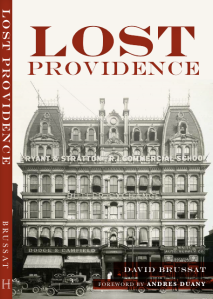
In my last post, “A Lost Providence Christmas,” I noted how Rhode Island Memories works well with my own book, Lost Providence, in tracing the architectural history of downtown, its message of traditional styles’ elegant cohesion of design in the pre-modern age (more of which survives in the capital of Rhode Island than in almost every other American city today) and in its relation to current events in the city’s development.

For example, Page 6 shows a view of downtown at dusk seen from just across the still-covered-up Providence River at the bottom of College Hill. Offices in the buildings are lit, displaying the angularity of regular rows of fenestration against the largely rectangular shapes of their massing. (A lighted billboard advises “Save Sight with Light.”) Only the pyramidal shape of the then-new Industrial Trust Bank Building breaks the pattern, engagingly so. Recent commentary amid the Fane tower imbroglio suggests that the ITBB (now widely known as the “Superman Building”) served, in its supposedly solitary upward thrust, as proof that the luxury shaft will not be a “sore thumb.” Not so! The photo shows how the Industrial Trust seems not the least bit isolated but rather gently gathers together the crescendo of Financial District towers that might otherwise have seemed more of a jumble.

And yet not much later, on Page 28, a picture of the Financial District taken from the opposite direction, near PPAC on Weybosset Street, shows the Industrial Trust as rising higher in the skyline than it does in the earlier picture. Still, it’s no sore thumb, and its shape again serves to emphasize its role in the downtown crescendo of architecture. This shot features a similar “variation on a theme” in the symphonic beaux ideal of a city skyline, a role it would not play as effectively if it rose up straight rather than stepping in as the ITBB does. Most of the modern architecture of downtown today lacks that sublety of design. Indeed, this shot is a useful exercise to demonstrate that modern architecture’s chief characteristic is the lack of the subtlety that classical architecture accomplishes almost by second nature. Examples of this can be seen throughout Memories.

(That photograph, below, is actually not the one from Memories but from my book, Lost Providence, where it forms a collage, performed for me by Noah Schwartz, of the photograph in Memories with the addition of an airship docking at the top of the Industrial Trust Building, which was originally designed as a bank building with an airship docking station on top.)

It would be an enjoyable task to complete this review by describing the interesting aspects of every photograph in a wonderful book, one by one. However, that would try the patience of readers and take until Christmas, possibly cheating some people of an excellent holiday gift. But I will take the time to say, again, that Memories + Lost Providence would make an excellent gift package (for others or for oneself) this holiday season.

Screen Shot 2018-12-06 at 10.21.24 PM.png

Industrial Trust from Weybosset Street in 1933, with airship docked. (Collage by Noah Schwartz)

Screen Shot 2018-12-06 at 10.07.41 PM.png

Financial District from Benefit Street. (Providence Public Library, also in Lost Providence)

Posted in Architecture, Lost Providence | Tagged , , , , , | 11 Comments

A Lost Providence Christmas

Screen Shot 2018-12-03 at 8.14.27 PM.png

The Industrial Trust Bank Building arises, circa 1927. This is a photograph I wish I had published in my book Lost Providence. It shows how a tall new building can be inserted into a city skyline.

Just as the Providence Journal has published its magnificent collection of old Providence and Rhode Island photographs, it is time to go out and get (if you don’t have it) my book Lost Providence. The two books would work well as a Christmas gift package, and they also work hand-in-glove as an example of how the rivalry between traditional and modern architecture has played out in one medium-sized American city. The book I have been blogging about much of late, Making Dystopia by James Stevens Curl, is a history of modern architecture in the 20th century. It would also be an excellent companion on this topic. I will be reviewing the newspaper’s book, Rhode Island Memories: The Early Years, a Pictorial History, very soon.

Posted in Architecture, Lost Providence | Tagged , , , , , , , , , | 1 Comment