

House by New Haven architect Duo Dickinson, featured on his website. (www.duodickinson.com)
Duo Dickinson is an architect in New Haven whose work, primarily private houses, is creative yet overwhelmingly traditional in appearance. I like his architecture very much. His firm’s portfolio and productivity are impressive. However, when writing and speaking about architecture he seems to diss his own work by asserting that all design inspired by tradition misappropriates history. His career seems to embody an inexplicable personality split.

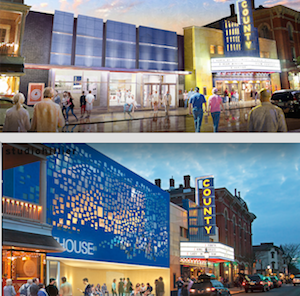
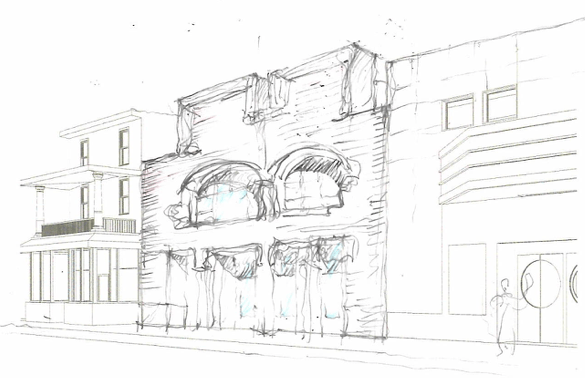
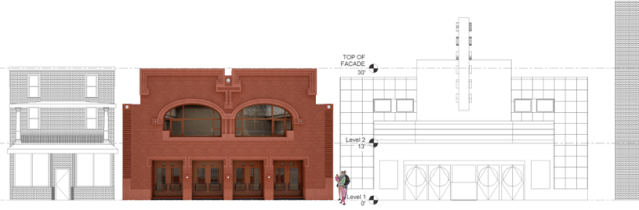
New theater in Doylestown, Pa.. (Ranalli)
He and I have gone back and forth on this in the comments section of my recent blog post, “Eyed by Ranalli’s theater.” He approves of New York architect George Ranalli’s two projects seeking a “third way” between modern and traditional architecture, and so do I, though I think it makes more sense to revive the traditions interrupted in the 20th century. I applaud Ranalli for departing from his modernism, however rarely he has traveled his third way. Dickinson’s belief that he also seeks a third way is mistaken. Why he insists on that I do not know.
In Dickinson’s first comment on my post, he urged me to visit his website. I did, and at its top was a lovely, rambling, asymmetrical traditional house (see above) that he described as “Too Mod for Trad; Too Trad for Mod.” I wrote back saying the house was in fact too trad for mod but not too mod for trad, and indeed not mod at all.
He replied that I was supposed to look at his whole website, not just at that one house. So I did look at his whole website, and with very few exceptions I found that it was all very creative and yet highly traditional, not bending in the least toward modernism, or at all seeming to advocate a third way. Duo urged me and other readers to watch a video he linked to of a recent lecture he gave to the New Haven Preservation Trust entitled “Lost New Haven: Traveling Through Time.”
I watched it last night. It is 45 minutes, and is very engaging, but to me it was confusing. Dickinson’s eloquence enables him to express confusion in terms that seem, in passing, to be logical and straightforward.

Yale Art & Architecture Building.
I am not going to address his lecture point by point. But he begins by asserting that history is not a style – an assertion nobody has ever made, and whose meaning, now that he has made it, seems obscure. He admires buildings from New Haven’s past, but scorns buildings erected recently that have been inspired by tradition, yet admires modernist buildings that scorn tradition. He describes the Brutalist Yale Art & Architecture building, by Paul Rudolph, as “incredibly beautiful.” Huh? Just look at it.
To me, this is baffling. He opposes the proposal to rebuild Penn Station as it was originally designed by Charles Follen McKim in 1910. He casts aspersions on Yale’s beautiful new Collegiate Gothic residential colleges by Robert A.M. Stern. Again, Dickinson’s work is traditional, but most of his thinking favors modernism, though occasionally he sniggers at it. Go figure.
Dickinson says he does not care about style, but whether he does or does not care, he cannot escape having a style. His style is traditional. The fact that much of it is also very creative does not mean it is any less traditional. Traditional and classical architecture have featured the widest range of creativity for thousands of years. By the same token, modern architecture can be entirely lacking in creativity; anyhow, modernists like to think that rejecting the past is by definition creative. It is not.

Project proposed by Mies van der Rohe.
Dickinson looks back wistfully at projects in New Haven by modernist founder Ludwig Mies van der Rohe (“Elysian fields of universal buildings in space”) and postmodernist Charles Moore (“intricate and perspectival that actually deals with words from the Renaissance”). Even he admits these were failures. But of the years of thinking and planning that went into them, he gushes: “It was that level of heroism, that level of ‘we can make things better’.” Not likely. The very names of modernist styles – Brutalism, Blobism, Deconstructivism, for example – seem to affirm their disruptive nature.
Dickinson’s lecture was accompanied by slides, and even though I was not there, I can assure readers that a groan rolled through the audience whenever he showed one of New Haven’s lost historical buildings. And a groan laced with laughter rumbled whenever he showed the modernist building that replaced it. You can hear some of it on the video. Over three decades I’ve been to countless slide lectures featuring the old and the new (and even given a few myself). This happens at all of them.
Such reactions reflect a ubiquitous sensibility that most of the profession, including Duo Dickinson, refuses to acknowledge: the past was dominated by beautiful architecture, which is being replaced all too swiftly by modern architecture, almost all of it ugly. The replacement of the old by the new is inevitable – “make, kill, make, kill, make, kill,” as Dickinson puts it. But the ugliness he seems so willing to accept (occasionally with some regret) is not inevitable at all. Beauty is not necessarily a thing that has been lost to the past; it seems so only because the ideology of modernism is so well and so widely publicized by know-it-alls like Duo.
There has always existed a broad, intuitive respect for conventional beauty; all people feel it at some level. No amount of fancy rhetoric – and Duo Dickinson can serve up the fanciest – can evade this truth. It is a universal fact of history, however eloquently it is denied. Because indeed history is not a style. It is the story of style. All architects should be listening and learning.
Most, alas, are not. Dickinson listens and learns when he builds but when he speaks, his wisdom goes in one ear and out the other.
Will the real Duo Dickinson please stand up!















 Architecture Here and There