Zaha in Baghdad? Not.

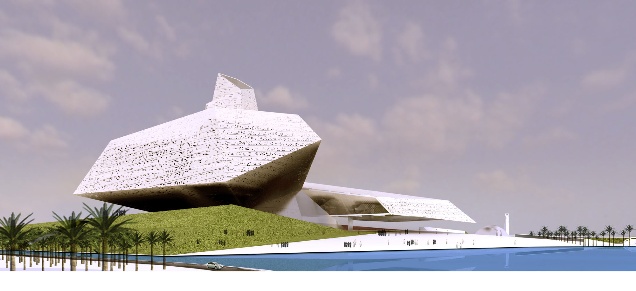
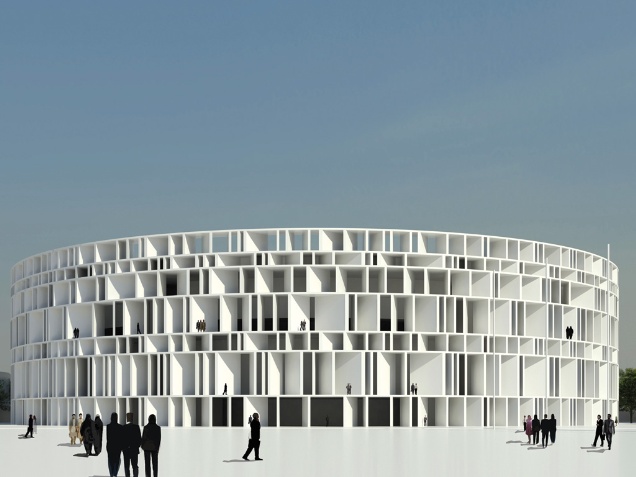
Winning design proposed for new Iraqi parliament.

Winning design proposed for new Iraqi parliament.

Second-place design for proposed Iraqi parliament.

Second-place design for proposed Iraqi parliament.

Zaha Hadid’s come from behind victory in the international competition to design the next Iraqi parliament building probably also wins the prize for projects not likely to happen. Zaha somehow received the contract although Assemblage, of the U.K., won for what seems to me a much nicer building – a circular design with syncopated fenestration that I can almost feel myself liking. The second place finisher’s Capita Symonds design looks almost like something by Zaha. Hadid’s design is for some reason still secret – that may have something to do with the famous corruption under the soon to be ex-Iraqi prime minister Nouri al-Maliki. Next stop, the capital of the Islamic State of Iraq and Syria, or whatever it’s called. Its parliament, or whatever it might actually be (a huge mosque?), could easily be called Decapita House, and who better to design it than one of the two firms edged out under Maliki’s highly transparent deliberative selection process!

Posted in Architecture, Other countries | Tagged , , , | 3 Comments

Blast: Ah, the sandbox!

RISD Canal Wak, across Providence River from downtown. Built in 1996.

RISD Canal Wak, across Providence River from downtown. Built in 1996.

Ah, here is that long lost column, from July 1996, in which I mentioned to a friend that a sandbox for the modernists might be an appropriate thing for her neighborhood, whereupon she kicked sand in my face. Someone just called and asked me to step out for a drink, so I’ll put a picture on this later. Here it is:

More modernism downtown?
July 11, 1996 

NOT LONG AGO, the Rhode Island chapter of the American Institute of Architects met at the Downcity Diner, in Providence, to discuss the relocation of Route 195. Moving the highway to the south, beyond the Hurricane Barrier, would reconnect downtown to the Jewelry District and create many acres for new parks and business development.

Discussing this plan with a friend at the AIA meeting, it occurred to me that this might provide a ” sandbox” for modern architects. It could rechannel the threat posed by “progressive” design away from the historical character of downtown. It might also turn out to be an interesting experiment, where all designs are created equal, where a thousand theories bloom – a sort of AS220 [local arts cooperative] of architecture.

Since then, I’ve mentioned this idea to several people. Tuesday night, for example, I was sitting at Cafe Nuovo watching Barnaby Evans’s fires light up the rivers. I described my own inner conflict regarding such a ” sandbox” to a friend who lives at Corliss Landing and works in the Jewelry District. “Why inflict this on my neighborhood?” she asked.

Good question. Earlier in the day, Arnold Robinson of the Providence Preservation Society had mentioned the idea of increased public participation in planning the Route 195 relocation. We were in the lobby of the Fleet Center, considering what “public participation” actually means for a project whose design has so far been the product, mainly, of meetings attended by public officials, civic leaders and private contractors. That is a public process, but its openness has not equaled, say, the nine public workshops that helped to design Providence Place. Assuming that its commitments are met, the mall will be traditional, in keeping with the historical character of downtown.

The public has a considerable stake in new architecture, not only in the waterfront areas opened by moving Route 195, but in other areas of downtown where new construction is likely. One such area is along the Woonasquatucket River near Waterplace, where a few good buildings could usefully block the view of buildings that were planned before the public got more involved in architectural design. However, weak public involvement could enable modernists to inflict even more bad buildings on the area.

Another area is on and near the new waterfront campus of the Rhode Island School of Design. RISD has been praised for the openness of the process that led to its proposed master plan. It is installing decorative facade lighting on the East Embankment. RISD also recently restored Market House (1773) and is restoring the 1854 factory on South Main Street that it bought after Roitman’s Furniture closed in 1993. It has been very sensitive to its historical context.

Like Providence Place, which will receive considerable public assistance, RISD is a private institution. Within its institutional zone and subject to city regulations, it has the right to construct what it pleases. But, because it is receiving a free waterfront for its campus, it now has, I would think, a moral obligation to be even more sensitive to its historical context.

Imagine, then, my horror when I read the following from the master plan: “Require new construction and renovations to respect the spirit and character of the contexts into which they are built by promoting design excellence and construction quality [so far, so good], not iconographic or historic mimickry.”

The last five words, I fear, cancel out the admirable sentiments that come before. Modern architects often dismiss as “mimickry” the recent and popular neo-traditional styles, which would fit very well into RISD’s context. (For example, at left are two pavilions being built on, and across the river from, RISD’s Canal Walk.) However, the neo-traditionalists do not “mimick” anything, any more than Beethoven “mimicked” Mozart. If, in fact, this phrase is meant to discourage design based on the architectural principles that prevailed for centuries before modernism, then RISD’s alleged respect for context is bogus, and the fabric of its historic campus is seriously at risk.

RISD disputes that, of course. Drawings from the tentative master plan seem to confirm this danger, but they are only conceptual, so I have reprinted none of them. RISD believes they do not reflect any buildings it would like to see. That is good, because if RISD really did think such buildings “respect” their context, then it would be difficult to imagine a building RISD might deem a violation of their context.

That such language could make it into RISD’s master plan shows the power still wielded in academia and in the architectural profession by the discredited modernists. It also shows the need for greater vigilance and involvement by a public interested in protecting the character of our built environment.

And that modernist ” sandbox”? I say put it at the proposed North Smithfield campus of Fidelity Investments [newly lured from Massachusetts].

* * *

David Brussat is a Journal-Bulletin page design editor, editorial writer and columnist. His e-mail address is: davidbrussat@ projo.com.



Posted in Architecture, Development, Providence, Uncategorized, Urbanism and planning | Tagged , , , , | Leave a comment

Blast: Seeking the sandbox

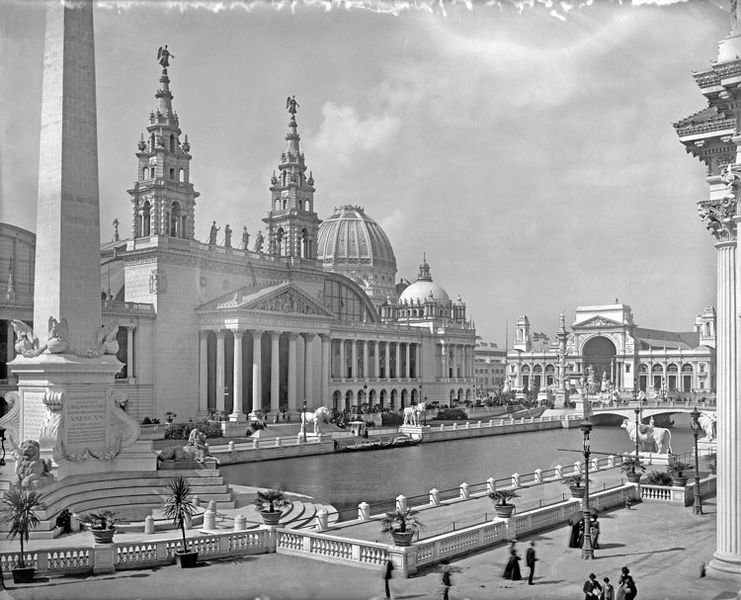
The White City at the World's Columbian Exposition, ;in 1893, in Chicago. (Wikimedia Commons)

The White City at the World’s Columbian Exposition, ;in 1893, in Chicago. (Wikimedia Commons)

Yesterday’s column referred to the “sandbox for the modernists,” notifying readers that I had once promised Providence modernists a sandbox they could play in on that distant tomorrow when land vacated after Route 195 was relocated would be vacant and seeking developers. In return, they would have to stop building crap in the Capital Center, the city’s then new section of downtown. Well, they refused to keep their mitts off Capital Center, so the deal is off, as I reminded them in the column.

This afternoon I looked around the Journal’s archives for my first use of the “sandbox” meme. I found it, but before that I found another column from the same year using the sandbox concept in a different way. Since that column was called “The economic case for beauty” and actually addresses the same general theme as yesterday’s column about the latest flap on the vacant Route 195 land, I will run it first and then run the other one, which is perhaps more entertaining, in the following post.

The economic case for beauty
January 11, 1996

TOWARD THE END of the last century, the nation’s greatest architects met in Chicago to design the pavilions of the World’s Columbian Exposition. Daniel Burnham imposed architectural guidelines designed to reflect in the New World the glory of the Old. His model was the Paris of Baron Haussmann, who under Napoleon III transformed its medieval tangle of narrow streets into the famous symphony of grand boulevards we know today.

Burnham’s plan was ambitious, so much so that the exposition opened in 1893, a year late, 401 years after the arrival of Columbus. But as photographs attest, the “White City” was a triumph. The fair’s Beaux Arts style instituted a movement in American architecture, the City Beautiful, whose civic centers remain among the crown jewels of urban America.

Many big cities hired architects to redesign their civic centers in the new mold. Some went farther in carrying out those plans than others. Modern architecture and urban renewal have since then watered down the opulence of the Beaux Arts achievements of some cities, or swallowed the less significant achievements of others. As for Chicago, its model civic center was demolished at the conclusion of the hugely successful 1893 exposition: It was only made of clay. (Or, to be exact, plaster of Paris!)

In downtown Providence, the City Beautiful movement inspired the new Union Station (1898), the Providence Public Library (1900), the State House (1904), the Federal Building (1908), and a refashioned Exchange Place. It is surprising today to be reminded of how long and thin Exchange Place once was. Separated by only 120 feet were the old Union Station (1848) and the Butler Exchange (1873). The latter was eventually torn down to make way for the Industrial Trust Building (1928). Today’s Kennedy Plaza includes City Hall Park and Burnside Park, space for which was made by placing the new Union Station 450 feet closer to the State House.

(I have done these calculations by applying a ruler to a plat map of downtown in 1908, which hangs in my office. The owner of each piece of property is named on this fascinating document. By the way, the Butler Exchange was founded by Cyrus Butler with the profits from his Arcade, built in 1828. The downtown holdings of the Butler Exchange in 1908 make Johnson & Wales – widely and wrongfully assumed to be the owner of everything not owned by [the late] Joseph Paolino Sr. – look like the owner of a sandbox.)

As an exemplar of the orderly grandiosity of the City Beautiful, the trapezoidal Kennedy Plaza falls short. Yet, the wealth of Providence at the turn of the century was such as to ensure a certain grandiosity of disorder, and that has served us quite well. Downtown Providence is alluring not because its design is orderly, but because its buildings are beautiful and plentiful. Not only did most of its pre-Depression architecture avoid the urban renewal craze after World War II, but its skyscrapers, from the 1928 Industrial Trust to the 1985 Fleet Center, form a skyline that is modern architecture at its best – to be appreciated not individually but collectively. Huddled together on the old street grid of the previous century [the 19th], our new buildings at least look great from a distance.

Now we gather to consider Rhode Island’s future, and many of the ideas suggested at last Saturday’s session of Vision Rhode Island sought to improve the aesthetic charms not only of its capital, but of its other cities, towns and villages. “What has this to do with creating jobs?” came the inevitable rejoinder.

I yield the floor to Daniel Burnham, whose 1909 plan for Chicago, as opposed to his ephemeral White City, was largely implemented. In his Plan of Chicago, he argued the economic case for beauty:

“The changes brought about [by Haussmann in Paris] made that city famous, and as a result most of the idle people of great means in the world habitually linger there, and I am told that the Parisians annually gain in profits from visitors more than the Emperor spent in making the changes.” As for Chicago: “What would be the effect upon our prosperity if the town were so delightful that most of the men who grow independent financially in the Mississippi Valley, or west of it, were to come to Chicago to live?”

Today, Japanese conglomerates are moving factories to Korea. Every nation in the world and state in the union seeks to chop the usual factors – energy costs, tax rates, etc. – down to increase their ability to compete. If the globalization of the economy means anything, it means that at some point, differences in the factors of production will have diminished to relative inconsequence. Decisions on where to live or to locate a factory will depend increasingly on where one wants to be. In such a race, the loveliest and most delightful places win. Case closed.

* * *

David Brussat is a Journal-Bulletin page design editor, editorial writer and columnist. His e-mail address is: davidbrussat@projo.com.

Posted in Architecture, Blast from past, Development, Providence, Urbanism and planning | Tagged , , , , | Leave a comment

A corkscrew of a day!

clemson-m

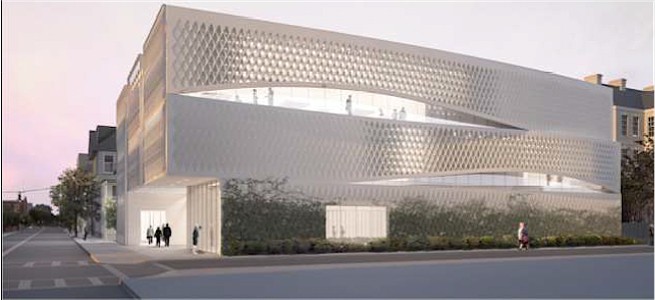
The School of Architecture building proposed by Clemson for Charleston’s downtown historic district.

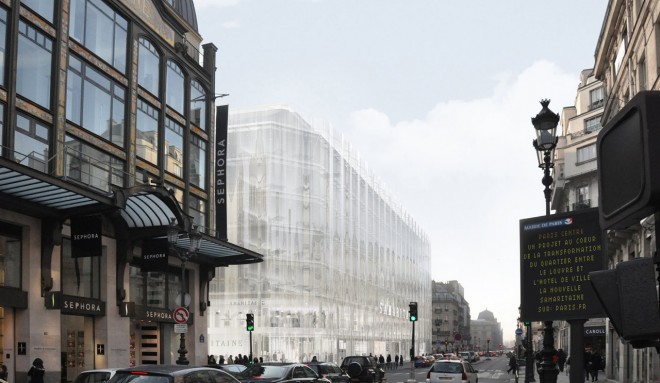
Got vile news today that the Board of Architectural Review in Charleston has approved Clemson’s design, by Brad Cloepfil, of Allied Works in Portland, Ore., for a modernist School of Architecture building in the middle of Charleston’s historic district. Remarkably stupid but, alas, not the least bit unexpected, given the confusion of the preservationists these days. (Here’s the Charleston City Paper story.) Then news came from Paris, courtesy of Mary Campbell Gallagher, that the SPPEF (a municipal tribunal) had revoked a construction permit for the famous department store La Samaritaine to erect a guazy screeny cliche, by the Pritzker-winning Japanese firm (in)SANAA – sorry, could not resist – on the store’s facade facing the beautiful Rue de Rivoli. (Its facade facing the Seine is intact.) As if my head were not already sufficiently a-spin, I then learned through TradArch comments on the BAR’s decision that it had approved the design for a traditional building in Charleston’s Courier Square by Robert A.M. Stern Architects. Good news, but how does it square with the same body’s Clemson decision? Both are in historic districts, right? Then I read that Charleston’s Mayor Riley, a hero who had long seemed to be a bulwark against preservation folly, supports the Clemson monstrosity. How the worm doth turn! What a corkscrew of a day!

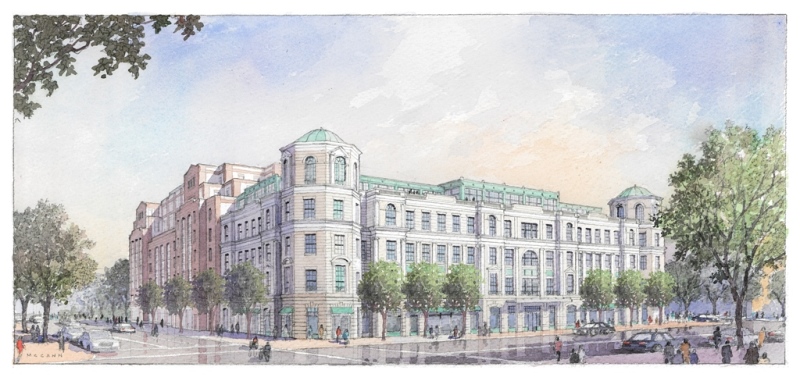
The top image is of the Clemson proposal. The second and third images, below, are of the RAMSA proposal and the thankfully rejected proposal by La Samaritaine in Paris. In regard to the latter, you can tell from the architect’s rendering that to communicate a sense of what the final structure will look like is the last thing they want. I think someone ought to do a psychological study of the field of architectural illustration – although the RAMSA drawing suggests that there remain some outposts of sanity in that community of artists.

Design for a building on Charleston's Courier Square by RAMSA.

Design for a building on Charleston’s Courier Square by RAMSA.

The proposed facade of La Samaritaine, in Paris, facing the Rue Rivoli.

The proposed facade of La Samaritaine, in Paris, facing the Rue de Rivoli.

Posted in Architecture, Urbanism and planning | Tagged , , , , | 1 Comment

Column: No need for preservation veto on 195

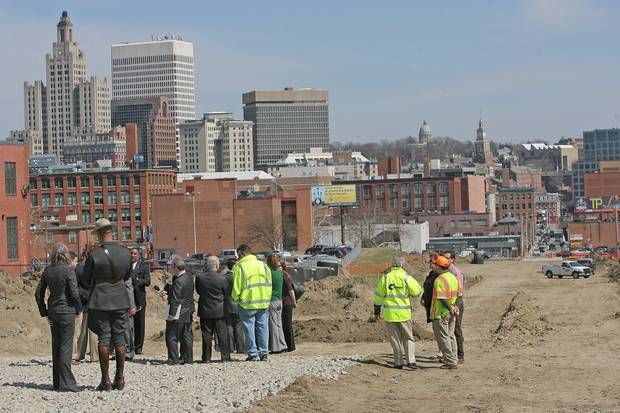
Route 195 land hosts official delegation in April 2013. (Journal archives)

Route 195 land hosts official delegation in April 2013. (Journal archives)

Should Rhode Island’s state office of historic preservation have a veto over the design of buildings proposed for the land I once described as a “sandbox for the modernists”?

Yes, it should. But no, it shouldn’t.

A memorandum of agreement with the apparent force of law, written in 2000, says new buildings on the vacant land overseen by the Route 195 Redevelopment District Commission must be carried out “under the review and approval” of the Rhode Island Historical Preservation & Heritage Commission.

So, yes, this means that RIHPHC has a veto; but no, it won’t actually use the veto.

[To read the rest of this column, please visit The Providence Journal.]

Posted in Architecture, Development, Providence, Urbanism and planning | Tagged , , , , | Leave a comment

No kookhouse for Koolhaas

Rem KoolhaasSpeaks for itself:

SPIEGEL: Some people say that if architects had to live in their own buildings, cities would be more attractive today.

Koolhaas: Oh, come on now, that’s really trivial.

SPIEGEL: Where do you live?

Koolhaas: That’s unimportant. It’s less a question of architecture than of finances.

SPIEGEL: You’re avoiding the question. Where do you live?

Koolhaas: OK, I live in a Victorian apartment building in London.


http://www.spiegel.de/international/spiegel/spiegel-interview-with-dutch-architect-rem-koolhaas-evil-can-also-be-beautiful-a-408748-2.html

“The whole interview is worth reading,” adds the director of the National Civic Art Society, Justin Shubow, who sent the exchange in an e-mail to the TradArch list. I’m sure it is! Okay, so the interview took place eight years ago. He might have moved. But he did what he did. Can’t erase that, and no one is really sure he would want to. Koolhaas is directing this year’s Venice Architectural Biennale, which has featured a little too much traditional and classical imagery to conduce to the comfort of most architecture critics who have reviewed it. Ha ha!

Posted in Architecture, Humor | Tagged , , | Leave a comment

The first Palladiophiliac

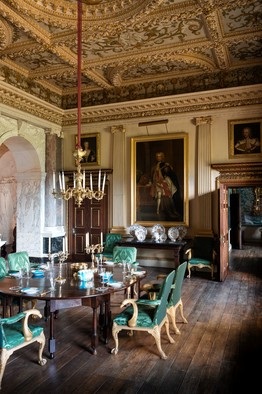
OD-BC720_HOUSE__DV_20140617155915Sir Robert Walpole is said to have been Britain’s first prime minister, a fact that many people know. How many people know that he was also Britain’s first Palladiophiliac? The Wall Street Journal has a fascinating piece, “The Singular Style of England’s Houghton Hall,” by Sarah Medford, that argues in essence for the pleasures of sticking to one style. Eclecticism, she writes, is easier and cheaper these days, and is not without its own joys. But she takes us through Houghton Hall room by room (well, through five of its 106 lovely rooms), each with a photo that is sure to turn readers into instant Palladiophiles. Some of us haven’t the money or the patience to stick to anything in such a didactic manner, but after reading this essay we can at least aspire to be Palladiophiliaphiles. Or should that be Palladiophiliophiles? Either way, here is a delightful paragraph to wallow in, just to get you started:

Like Thomas Jefferson’s Monticello, Frank Lloyd Wright’s Fallingwater or Ludwig Mies van der Rohe’s Farnsworth House, Houghton is an increasingly rare reminder that unforgettable dwellings are often the result of singular focus. The eclecticism we embrace today may be more affordable, adaptable and ultimately easier to pull off, but it’s also a missed opportunity. Houghton’s current resident heir, the seventh Marquess of Cholmondeley (pronounced “Chumley”), understands that. He’s now restoring Walpole’s lime hedges and the brick ha-ha, a level-changing landscape feature that separates the lawn from parkland beyond.

Brick ha-ha! Ya gotta love it!

Posted in Architecture, Architecture History, Art and design | Tagged , , , , , | Leave a comment

Modernism in retreat?

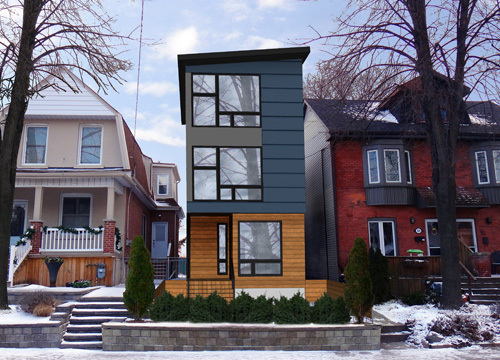
240302059

Modernist infill in Toronto. (urburbia.ca)

Here is an e-mail sent by architect Marc Szarkowski to the TradArch listserv’s discussion thread, “CNU is burning,” about modernism being invited further into New Urbanism at its recent conference in Buffalo. Marc disagrees, and though I’m not buying into it 100 percent, to say the least, he makes some very interesting points on how modernism has moved toward tradition in urbanism and architecture.

I do not think, for example, that Art Nouveau is early modernism but rather unusually exuberent classicism. Marc also does not address some of the rougher, even totalitarian aspects of the modernist establishment’s effort to prevent any classical or traditional revival, in part by thwarting efforts to even the playing field in the competition for building commissions (except for single-family housing). In any event, it is refreshing to hear the case that modernism is in retreat on at least some aspects of design. Here is his e-mail in its entirety.

Okay, I’m late [to this thread], but burning?! It’s not burning! Contrary to surface appearance, modernism isn’t infecting the Congress for the New Urbanism; it’s actually the other way around.

First the modernists thought existing cities should be scrapped entirely and replaced with Villes Radieuse [towers in parks crisscrossed by highways, proposed by Le Corbusier]. This myopia was admittedly defeated before CNU came along, but that was their first concession – that you can’t erase our built history, no matter how distasteful it may be.

Then CNU convinced the modernists that, if we are going to be building downtown again, the infill [buildings built on empty lots] can’t turn its back to the street via blank walls or retreat from it [with setbacks from the property line]. That was the second concession: that Corb was a freaking anti-social nutball when he declared death to the street. So now I see a lot of excellent modernist infill that emphatically embraces the street – sometimes distressingly better than some putatively “traditional” infill that does nothing but greet the street with a Georgian-paneled doublewide garage door!

The third concession by the modernists, still unfolding, is that if we’re going to be moving on streets at pedestrian speed, then we’ll need to have pedestrian-scaled details to keep us awake, or we’ll die of boredom. That is, in those cases where – for various reasons – there still aren’t enough people to engage your eye yet, there needs to be something else or you simply won’t venture onward. (Every mall builder knows this.) More and more “modernist” architecture is incorporating what only can be called “ornament” again, and it’s only a matter of time before the original textured modernism – Art Nouveau – is legitimized for academic experimentation again. (In my modernist school there already was a studio that tried to study [Louis] Sullivan via digital scripting, and all the school seems to churn out now are sculptural baubles. Still a ways to go, sure, but ripe for infection if a traddie wants to move in!)

There’s still griping about CNU from a few of the orthodox modernist “do as I say, not as I do” academies, like Harvard, but who cares? They’re irrelevant and dying – which is why they gripe. Modernist practice, on the other hand, is thoroughly infected.

So … CNU has won back the following from the anti-urban dark ages of CIAM:
     – You can’t just scrub out the built stuff and start with a blank slate.
    – Now that you’re working within the built stuff, you can’t turn your back on it; you have to engage it.
    – “Engaging” means catching pedestrians’ interest at pedestrians’ walking speed, be it via balconies, storefronts, interesting patterns (digital, industrial-chic, figural, floral, whatever).

There’s just one last step, and it’s not up to CNU to push it, but for you guys to push it: that it’s perfectly OK for those interesting walking-speed patterns to be more ambitious than Speck’s Pompidou [?] and reflect motifs that go beyond the arbitrary founding-of-the-Bauhaus cutoff date. Use the “diversity,” “biophilia,” and “anything goes” culture among Millennials to push it if you have to!

My beefs with CNU are for it to get a bit more aggressive in tape-cutting [?] in a new era characterized by paralyzed government and do-it-yourself everything. Forget trying to reform the timid Federal Housing Administration and its urbanism-suppressing regs anymore – co-opt the Tea Party to kill it if you have to! Modernist or classicist, any architect will now tell us that form follows parking.

Additionally the CNU should re-examine a few of its own solidifying [stultifying?] orthodoxies – that all one-way streets are bad, that pedestrian malls don’t work, that all new streets come in the hypertrophic “two lanes + free curbside parking + free middle-of-the-block parking” format, and some of the other greenfield-garden city-new town practices that seem to be hitch along on some NU urban infill.

Posted in Architecture, Urbanism and planning | Tagged , , , | Leave a comment

Biennale beanball

(wallpaper.com)

(wallpaper.com)

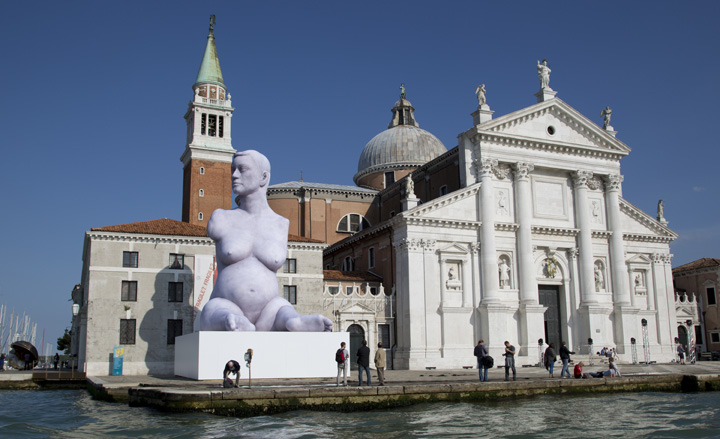
The 14th Venice Biennale opened June 7 and runs into November, the lalapalooza of world architecture, this year curated by Dutch starchitect Rem Koolhaas. The usual suspects of architecture criticism have had their go at it, and it has proved disappointing to some of them.

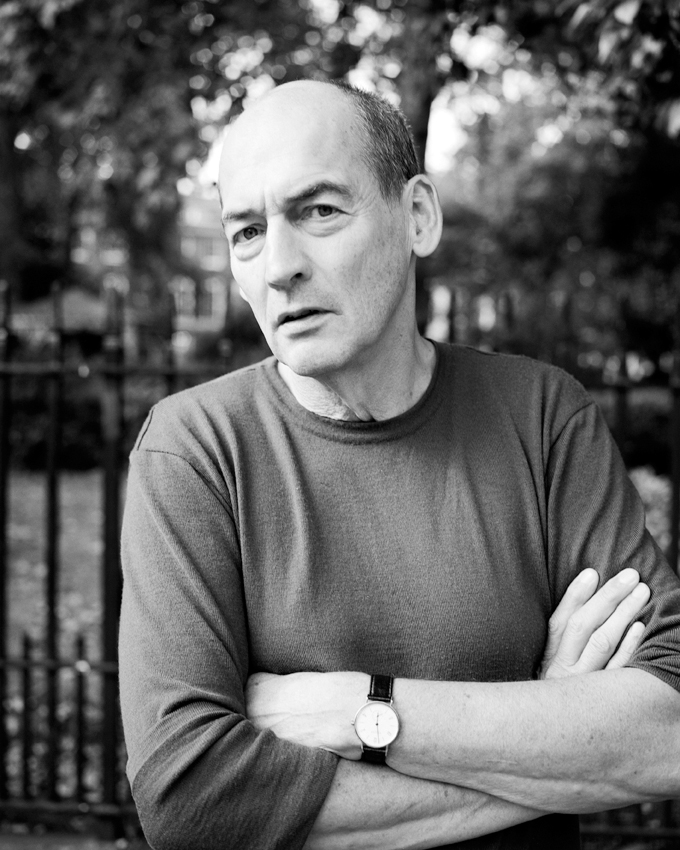
Rem Koolhaas. (scal-art.com)

Rem Koolhaas. (scal-art.com)

I grab for readers’ delectation three essayists from Archnewsnow’s ongoing bag of biennale coverage: Sarah Williams Goldhagen, who wrote “Critique: Rem’s Rules” for Architectural Record; Pulitzer winner Julie V. Iovine, who wrote “Just the Fundamentals” for the Wall Street Journal; and Aaron Betsky, who wrote “I Went to the Venice Architectural Biennale and All I Got Was This Elegy” for Architect magazine.

Rem Koolhaas’s theme for the biannual event was that modern architecture had replaced the national characteristics of our world’s collection of built environments with a globalized sameness. He wanted each nation with a pavilion to analyze that truth from its own regional perspective. The biennale is usually just a glorified runway for the strutting of the latest in architectural fashion, but Koolhaas is architecture’s intellectual bad boy, often allowing home truths about modern architecture to “slip” out of his discourse, and this year’s biennale theme was typical.

(archdaily.com)

(archdaily.com)

Koolhaas seems to draw architecture critics to put their depth chops on display, and so I will let readers plunge into these three critiques on their own. They are all deeply amusing. I will only say that Iovine let the cat out of the bag when she revealed the depressing fact that so many of the exhibits at the biennale were about the past! – as I suppose you would expect from an event whose theme is about how style has evolved as a representation of national character. To me it seems obvious that Rem’s big crime this year was to introduce a lot of traditional architecture. This posed the risk of allowing visitors to feel the inevitable charm of traditional and classical styles over the usual tedious, sterile, ugly modernist styles that visitors are expected to pretend to drool over. Apparently, this was just a little too obvious for our three critics to bear, and they have grumbled accordingly, not without some worthy insights, of course, but all sporting more than a mere soupcon of angst. So please enjoy each of them in their own way!

Posted in Architecture, Art and design | Tagged , , , , | Leave a comment

What young people want

Jenny Bevan w/larger image

David Brussat's avatarArchitecture Here and There

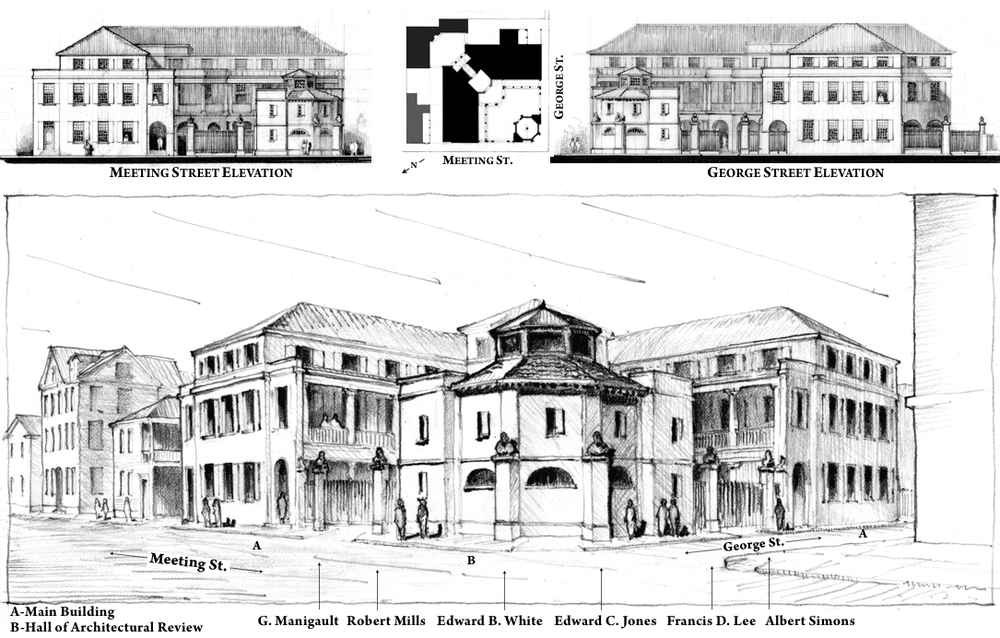
The first of two schemes presented by Bevan & Liberatos as counter proposals to the proposed Clemson building in Charleston. The first of two schemes presented by Bevan & Liberatos as counter proposals to the proposed Clemson building in Charleston.

Jenny Bevan, of the Charleston, S.C., architecture firm Bevan & Liberatos, has written a brilliant critique of the proposed new building for the Clemson University school of architecture in the historic section of Charleston. Bevan is a graduate of both modernist and classical architecture school programs. Here is her essay in the Charleston City Paper, and the following is what I consider an especially astute passage:

When the Lee Brothers adapt an old recipe for a new cookbook, when Shepard Fairey imitates old graphics to make new images, when Quentin Baxter improvises within a standard, when Jill Hooper works with fresh paints made from centuries-old recipes, they are exemplifying our generation’s return to an open-mindedness about tradition. And their achievements are lauded. Just as Charleston has a rich and…

View original post 55 more words

Posted in Uncategorized | Leave a comment