Trad building conference 3

600px-LowellMakes

Two recent phrases are new to me: Lean Architecture and Makers Space. Lean architecture seems to be what it sounds like, traditional work performed by the most simple methods that can be contrived, but that embrace tradition and ornament. The idea seems to be a reaction to the notion that traditional work, with its “frou-frou,” as the modernists like to put it, is too expensive for most projects in today’s era of modest means. The other phrase, makers space, was the subject of architect Steve Mouzon‘s presentation on Wednesday, first out of the box at Boston’s Traditional Building Conference.

Steve Mouzon, teaching as usual. (beaudesign.wordpress.com))

Steve Mouzon, teaching as usual. (beaudesign.wordpress.com)

A makers space is the latest version of what has long been called an incubator, a space where small, startup businesses can operate in their infancy – except that a makers space is for – drum roll! – people who make things. Makers making in a tight cheek-by-jowl space can share ideas and equipment, the essence of collaboration. You might make a robot or you might weave a basket of reeds, but you are not just making phone calls – as might be the case in an incubator where entrepreneurs in cubicles they yearn to rise above are trying to link themselves to capital. Maybe they share a secretary?

How this is of particular interest to traditional architects and artisans is that the places favored for spaces by makers are, at least to some extent, old mill and commercial buildings in or near downtowns, but with affordable rent. Mouzon points out that makers spaces require surroundings to walk in, and to think in, that suspiciously resemble traditional main streets and urban environments. The New Urbanism is big in Mouzon’s world, as in that of most workers in traditional architecture.

Mouzon was joined on the stage by two collaborators, Kamal Jain (founder) and Jay Mason (architect), in a makers space called Lowell Makes, in Lowell, Mass., who illustrated how the process of making a makers space has its ups and downs. They ended up in the basement of an old building right downtown whose absence of fenestration probably helps concentrate makers’ minds on their business.

Mouzon wrote The Original Green to explain how traditional architecture promotes sustainability better than what he calls the gizmo green that most most modernist architects use to achieve LEED ratings (the leading structure for bureaucratization of green architectural standards). He beats the drum for working on a smaller scale and with natural materials.

This seems to put him at odds, in some degee, with Gary Brewer, a partner in the largest American firm specializing (though not exclusively, I’m sad to say) in large classical houses and even larger classical institutional buildings, and Don Powers, whose growing firm in Providence has done a lot of public and affordable single- and multi-family work on relatively low budgets that – on the theory that the non-wealthy deserve beauty no less than the wealthy – require eschewing, say, columns of marble and toilets of alabaster.

I will unpack the triangulation of this situation in, I think, the next final post in this series.

Posted in Architecture, Development, Urbanism and planning | Tagged , , , , | Leave a comment

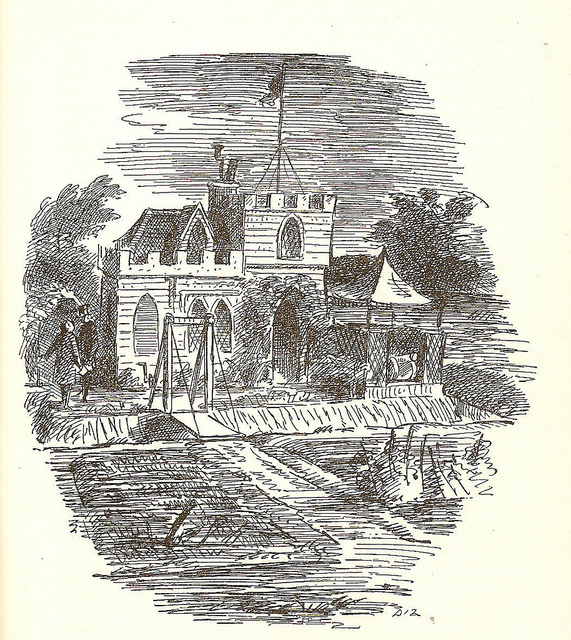
Mr. Wemmick’s castle

By Edward Ardizzone, 1952. (flickr.com)

By Edward Ardizzone, 1952. (flickr.com)

Here’s a great passage from Great Expectations, where Pip is introduced to the household of his guardian’s clerk, Wemmick:

Wemmick’s house was a little wooden cottage in the midst of plots of garden, and the top of it was cut out and painted like a battery mounted with guns.

“My own doing,” said Wemmick. “Looks pretty; don’t it?”

I highly commended it, I think it was the smallest house I ever saw; with the queerest gothic windows (by far the greater part of them sham), and a gothic door, almost too small to get in at.

“That’s a real flagstaff, you see,” said Wemmick, “and on Sundays I run up a real flag. Then look here. After I have crossed this bridge, I hoist it up – so – and cut off the communication.”

The bridge was a plank, and it crossed a chasm about four feet wide and two deep. But it was very pleasant to see the pride with which he hoisted it up and made it fast; smiling as he did so, with a relish and not merely mechanically.

“At nine o’clock every night, Greenwich time,” said Wemmick, “the gun fires. There he is, you see! And when you hear him go, I think you’ll say he’s a Stinger.”

The piece of ordnance referred to, was mounted in a separate fortress, constructed of lattice-work. It was protected from the weather by an ingenious little tarpaulin contrivance in the nature of an umbrella.

“Then, at the back,” said Wemmick, “out of sight, so as not to impede the idea of fortifications – for it’s a principle with me, if you have an idea, carry it out and keep it up – I don’t know whether that’s your opinion–“

I said, decidedly.

” – At the back, there’s a pig, and there are fowls and rabbits; then, I knock together my own little frame, you see, and grow cucumbers; and you’ll judge at supper what sort of a salad I can raise. So, sir,” said Wemmick, smiling again, but seriously too, as he shook his head, “if you can suppose the little place besieged, it would hold out a devil of a time in point of provisions.”

Then, he conducted me to a bower about a dozen yards off, but which was approached by such ingenious twists of path that it took quite a long time to get at; and in this retreat our glasses were already set forth. Our punch was cooling in an ornamental lake, on whose margin the bower was raised. This piece of water (with an island in the middle which might have been the salad for supper) was of a circular form, and he had constructed a fountain in it, which, when you set a little mill going and took a cork out of a pipe, played to that powerful extent that it made the back of your hand quite wet.

“I am my own engineer, and my own carpenter, and my own plumber, and my own gardener, and my own Jack of all Trades,” said Wemmick, in acknowledging my compliments. “Well; it’s a good thing, you know. It brushes the Newgate cobwebs away, and pleases the Aged. You wouldn’t mind being at once introduced to the Aged, would you? It wouldn’t put you out?”

I expressed the readiness I felt, and we went into the castle. There, we found, sitting by a fire, a very old man in a flannel coat: clean, cheerful, comfortable, and well cared for, but intensely deaf.

At this point in the Penguin edition, edited by Angus Calder, is a lengthy note that reads, “Sir Kenneth Clark’s The Gothic Revival (Penguin, 1964) makes it clear that Wemmick was eccentric only in constructing his miniature Gothic mansion out of wood, with his own hands. ‘By 1825, almost all Gothic mouldings or ornament could be bought wholesale.’ The craze for Gothic villas reflected the extreme plainness of the Regency alternatives” [compared with what, one would have to wonder today!], “as well as the interest in the ‘Picturesque,’ which the Romantic poets and novelists both indulged and promoted. The fashion was at its height at the period in which Great Expectations is set. Here, as in so many other places where Dickens’s imagination seems to have lured him into implausibility, he ‘does not,’ in fact, ‘overstep the immodesty of nature,’ to quote Bernard Shaw’s comment.”

Posted in Architecture, Books and Culture, Humor | Tagged , , , | 4 Comments

Trad building conference 2

Boston Public Library and Old South Church on Dartmouth Street.

Boston Public Library and Old South Church on Dartmouth and Boylston streets.

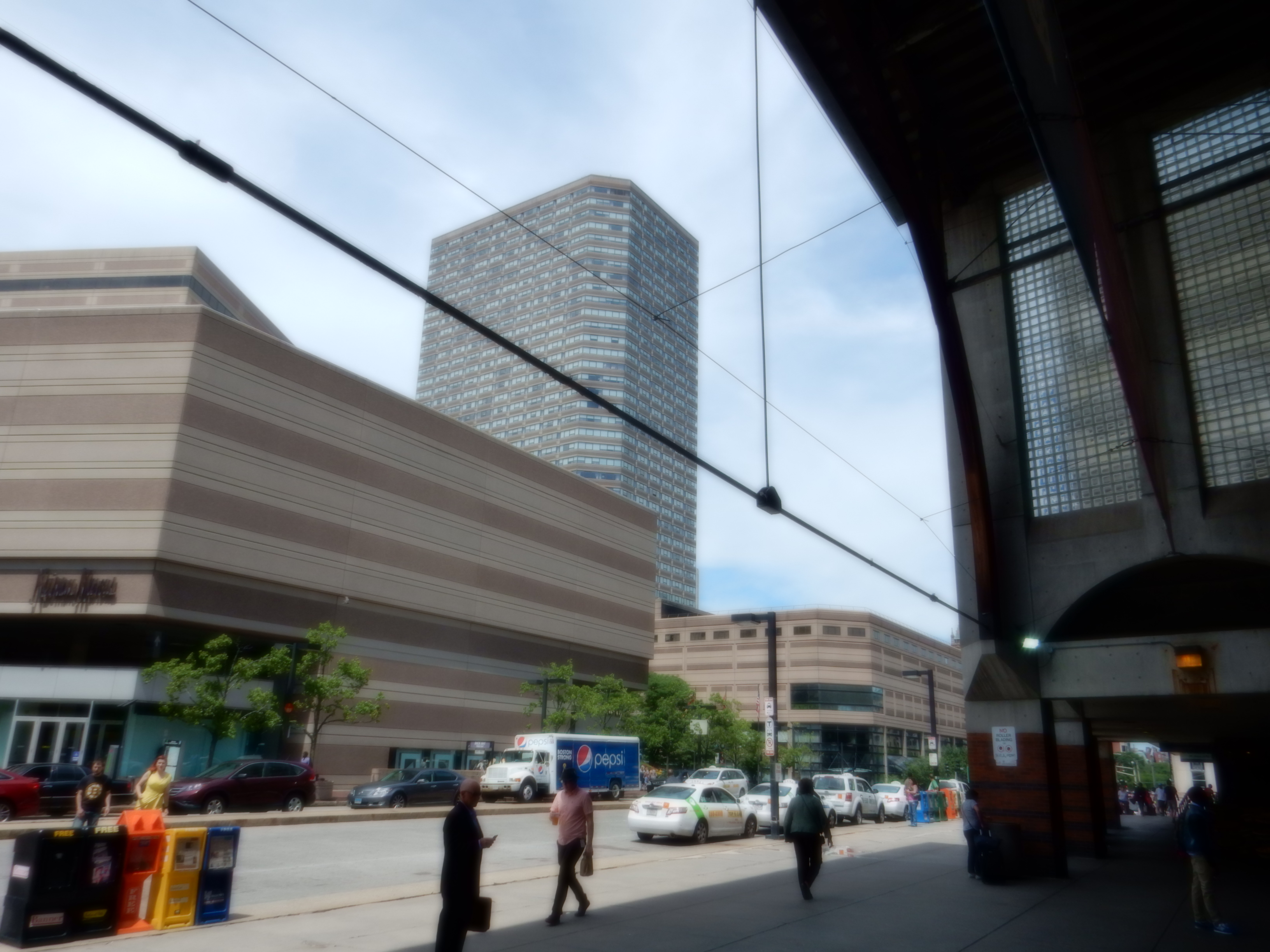
When you arrive at the Back Bay station of the MBTA (and the T) you emerge onto Dartmouth Street and head toward Copley Square. Before you turn down Stuart Street to the Traditional Building Conference you behold this stretch, above, of classical buildings that bookend Boylston Street at Dartmouth. But first you must behold a far less edifying stretch of facades, below, that represents one end, the dominant end today, of the arc of architecture. Boston’s beauty is marred by such juxtapositions. For example, take another. Peer down Huntington Avenue from Dartmouth, through the Copley Place complex and its associated modernist mash, almost a sinister experience, whereas to stand at the corner of the Copley Plaza Hotel’s al-fresco scene – merely looking in the opposite direction – is to behold a vision that takes your eye from the hotel itself, sweeping with joy across Copley Square and then back down to Richardson’s Trinity Church (whose tower was done by Charles Follen McKim before he started his own firm). In short, your eye travels from hell to heaven. Of course, the Hancock Tower obtrudes. And there are enough other obtrusions – the hyper-modernist garage structure that hovers ominously, with its concrete tower, over the entry to the Boston Common Hotel as you enter the conference – to make you wonder at the sanity of the city over the past several decades. It could have been so easy to continue to build architecture that represents beauty rather than ideology.

Desultory modernist structures across from MBTA's Back Bay station on Dartmouth.

Desultory modernist structures across from MBTA’s Back Bay station on Dartmouth.

It should not be difficult to bend society back toward the better end. But it will be. The Traditional Building Conference takes that as a given, and marshals considerable resources toward that goal. It is a blessing, and more architects and allied craftsmen and professionals should take advantage of it. (This is just an overture to the concerto of your correspondent’s reportage on the conference and its sessions, which I hope will adequately reflect their contribution.)

Posted in Architecture, Architecture Education | Tagged , , , | 1 Comment

Trad building conference

Boston Common Hotel and Conference Center. (boston.com)

Boston Common Hotel and Conference Center. (boston.com)

I’ve just returned to Providence from the Traditional Building Conference, at the Boston Common Hotel and Conference Center, in Boston, which is, alas, being eyed for demo, to be replaced by a 35-story tower – that info, from 2012, is hopefully outdated. I recall attending a TBC in Boston several years ago at the Navy Pier. The venue was larger when the conference was yearly. Now it has morphed into a series, with four every year around the country. Boston was its third this year. The last will be in St. Paul this September. The idea has been to tailor its seminars to more local interests and needs without neglecting the general approach. This makes sense as classical and traditional work grow more popular region by region, state by state, city by city, town by town, village by village, hamlet by hamlet.

I attended and enjoyed most of the seminars but missed the dinner for the winners of the Palladio awards. However, I did manage to find myself in close conversation with several sets of winners, including Diane and Michael Burch, who have done so much to help the Spanish Colonial Revival Revival (double-intended) in California.  Michael Burch Architects won for its Alta Canyada residence, in the category of Adaptive Reuse/Sympathetic Addition. Here is a video the firm created for the Venice Architectural Biennale of 2012 that reflects their thinking about Spanish Colonial, its history and recent prospects. They challenge architecture schools to rethink current and longstanding attitudes toward traditional architecture if they want to remain relevant. That’s the spirit!

The Traditional Building Conference was itself a masterfully crafted work of art, put together largely by Judy Hayward, its education director, and supported by a host of sponsors too numerous to list here (look below). The event sent me packing with a lot of thoughts that I would like to chop into more bite-sized pieces here on the blog. I will comment on presentations by Steve Mouzon, Gary Brewer, Phillip James Dodd and Don Power. I will do that, I expect, over the next couple of days, so please bear with me.

* * *

Here are the sponsors, primarily Home Group, which publishes such journals as Old House Journal and Traditional Building; Marvin Windows and Doors, of Warroad, Minn.; Timberlane shutters, of Montgomeryville, Pa.; Historical Arts & Casting ornamental metalwork, of West Jordan, Utah; Ludowici Roof Tile, of New Lexington, Ohio; Allied Window, of Cincinnati; Crownpoint Cabinetry, of Claremont, N.H.; The Unico System central heating and cooling, of St. Louis; HB&G Building Products, makers of columns, balustrades and other classical detailing, of Troy, Ala.; Connor Homes, makers of mill-built period houses, of Middlebury, Vt.; and John Canning Decorative Painting & Conservation Studios, of Cheshire, Conn. – to list only the gold and silver sponsors, the rest of this long list is available on the conference website.

Posted in Architecture, Architecture Education, Art and design | Tagged , , , | 1 Comment

Federalism

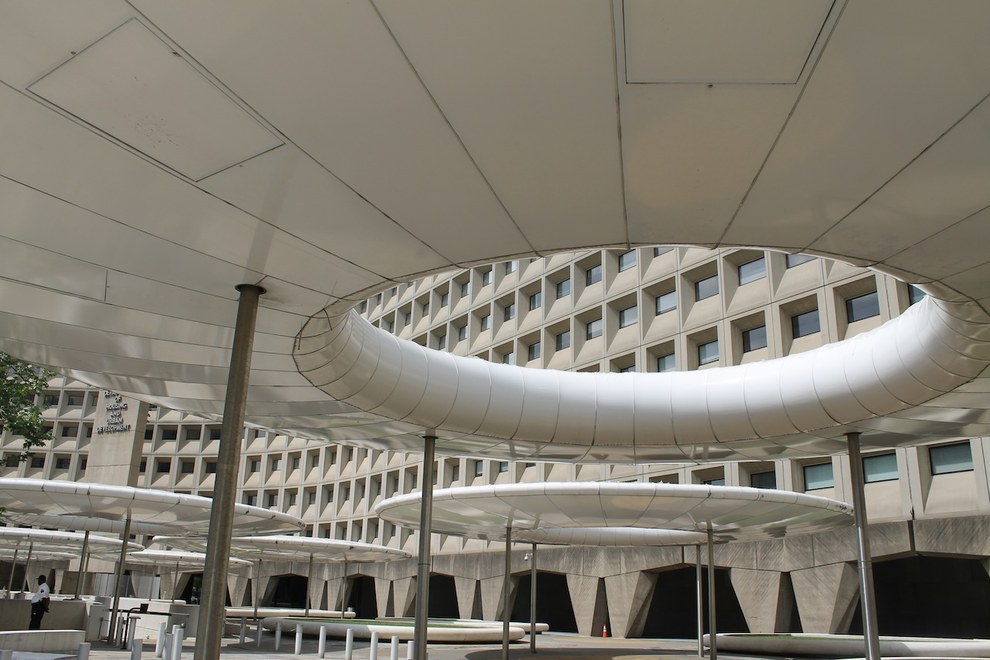
enhanced-buzz-wide-17608-1405461730-18The New Federalism, circa 1960-70 – the best modernism the most (of your) money can buy. Photographed and compiled by Benny Johnson. This, by the way, is sheer Brutalism (a style of modernism). Here is a comment from Erik Bootsma, who sent the piece to the TradArch list: “Also worth noting, this is on the ‘millennial’ BuzzFeed and has been viewed almost 100k times. Not true that the younger generation loves modernism.  Mostly it seems they hate it, but aren’t being given the alternative.”

Posted in Architecture, Architecture History, Humor, Urbanism and planning | Tagged , , | Leave a comment

Greater Kennedy Plaza

kenn7

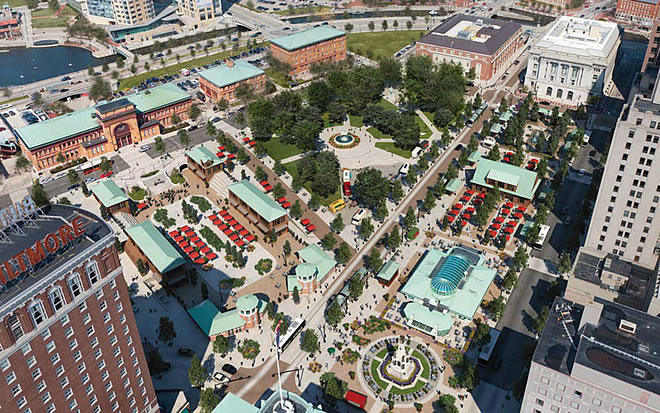
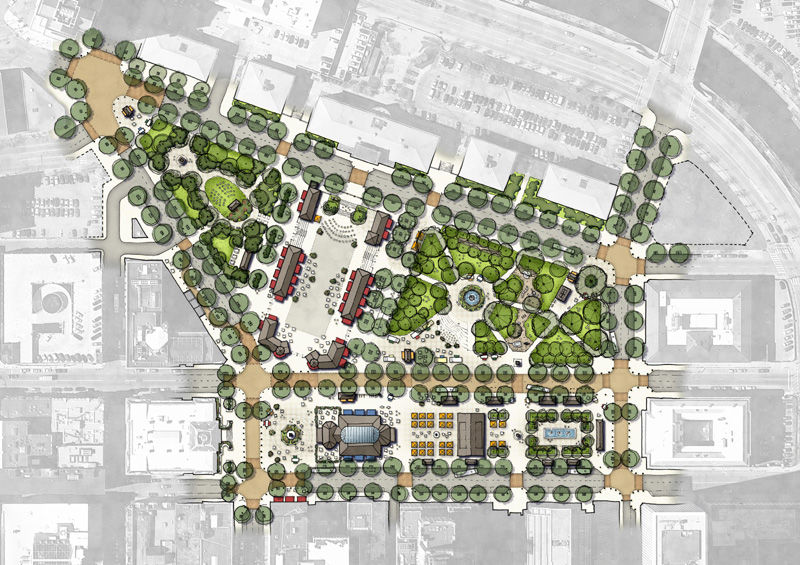
Kennedy Plaza design by Union Studio Architects for the city and the Downtown Providence Parks Conservancy.

Here is a column I wrote last year about the nice proposal being frog-marched out of the picture:

A greater Kennedy Plaza, yet again

April 25, 2013

On Monday morning, my bus was at least 20 minutes late. Tired of waiting, I returned home, got in the car and drove to work. Notwithstanding the ambitious new plan for Providence’s Kennedy Plaza, job one for the Rhode Island Public Transit Authority, which is listed as a “participating stakeholder” in the plan, remains running an effective bus system.

The plan was announced last Thursday afternoon to about 400 local movers and shakers jammed into the ballroom on the 17th floor of the Biltmore Hotel. Attendees squeezed near its tall, arched windows could see the plaza below. Mayor Angel Taveras quipped that he was glad that the fire marshal was not present.

The other three participating stakeholders, aside from RIPTA, are the Providence Foundation, the Biltmore Hotel and Cornish Associates, which is involved in redeveloping the Industrial Trust tower, the plaza’s “super” neighbor, of which nothing was said. The City of Providence and the Downtown Providence Parks Conservancy are the clients for what is being called Greater Kennedy Plaza. And it seems that if the plan is carried out, Kennedy Plaza will indeed be greater.

The plan would maintain the plaza’s primary role as a public-transit terminal and keep the intermodal station built in 2002, but it would push the bus kiosks out to the plaza’s edges to make more space for a wider range of public and private activities. The bus lanes would be eliminated, iron rails around Burnside Park removed, and the skating rink would be devoted to a wider range of things to do and given four new two-story buildings. More tables and chairs would be scattered around the plaza, which would also get a graceful new building for a café. It would be open to the air.

The plan owes an intellectual debt to the New Urbanist movement (that is, the old urbanism) and the pedestrian-friendly ideas of the Project for Public Spaces, a pathbreaking nonprofit in New York City.

The dream of improving Kennedy Plaza goes back a long, long way. It has been a center of traffic and transit, and a public square, since the 1840s. Back then, the entrance to the old Union Passenger Depot jutted well into what was called Exchange Place, all the way to the midpoint of today’s bus nexus. In 1860, Abraham Lincoln spoke near where the federal courthouse is today. By 1960, when John F. Kennedy spoke, the old Cove Basin (where Waterplace Park is today) had long since been filled in and the new Union Station, finished in 1898, was situated so as to make room for City Hall Park, Burnside Park and the space that, in 1964, was renamed Kennedy Plaza.

Back then, today’s bus nexus was a garden bounded by slant parking, around which teenagers used to circle in their parents’ cars. Back then, Francis Street carried vehicles from the State House through a sea of parking, over the Woonasquatucket River, under Union Station, emerging beneath its drab gray parking deck between Burnside and City Hall parks (where the skating rink is today). In those days, buses stopped at bus stops along the streets of downtown. No central bus terminal was needed, at least not then, and maybe not now.

Notwithstanding a comment at last week’s shindig by former mayor (now U.S. Rep.) David Cicilline, today’s Kennedy Plaza is among its loveliest versions. Please, Congressman, do not call it “ugly.” The intermodal station is attractive, extraordinarily so for a bus station developed in the late 20th Century. Its kiosks are as pleasing as any built in America in recent decades. The plaza has been kept clean, and is not the hotbed of crime that its detractors imagine, even though few of its denizens attended the plan’s announcement last week.

The plan’s lead designer is Union Studio Architecture & Community Design, based downtown. Its hire seems to represent the city’s recognition, at last, that traditional design is not out of place in the Creative Capital. Far from it. It builds upon the city’s architectural heritage rather than eroding it, hence strengthens the state’s economy rather than weakening it.

Indeed, the effort to revive Kennedy Plaza as the city’s main public square tacitly recognizes — even though few in the design community will admit it — that modern architecture has undermined the ability of Waterplace Park to serve that role, except on WaterFire nights.

Union Studio’s design is elegant, but the plan is not complete nor (to say the least) fully funded. And it is not without flaws, which I hope to consider soon. Still, it is a serious plan based on important new ideas about urban design. It carries forward the spirit of recent projects that have helped return life to the city.

So, very nice. But Greater Kennedy Plaza’s greatness is likely to remain elusive if, among other things, the buses that serve the city and the state are allowed to fail in their mission.

David Brussat is on The Journal’s editorial board (dbrussat@providencejournal.com). This column, with more illustrations, is also on his blog Architecture Here and There at providencejournal.com.

Posted in Architecture, Blast from past, Development, Providence, Urbanism and planning | Tagged , , , | 3 Comments

Aristocrification. Hilarious!

Report-Nations-R_jpg_250x1000_q85

Here’s a totally over the top piece from The Onion. What a sendup!

Posted in Architecture, Development, Humor | Tagged , , , | 1 Comment

Postcard from Providence 1997

View of Kennedy Plaza from the "Narragansett Plaza." (marriott.com)

View of Kennedy Plaza from the “Narragansett Plaza.” (marriott.com)

Here is the 1992 column mentioned in today’s post “Let’s ruin Kennedy Plaza” in which I suggest merging the plaza with Burnside Park to form a Central Park for Providence. I also placed the bus hub under “Kennedy Park.” On the whole this attempt to forecast the success of what was still being planned in 1992 is mawkish and unconvincing from the perspective of 2014. I cannot suppress my belief, however, that if Providence had continued to build revivalist architecture it had built in the 1990s rather than shifting to modernism as it has, the city would have done a much better job reflecting the success predicted in this postcard. And now they’re destroying Kennedy Plaza, too.

Postcard from Providence, 1997
March 4, 1992

FLEW INTO GREEN at about noon, grabbed a cab to Providence, and checked into the Biltmore (the convention center hotel, Westin’s Narragansett Plaza, was booked up after all), stowed my luggage, and went up for lunch in the hotel’s roof garden.

From my table, I could see the convention center down below, a block away. Looming above it (and above the Biltmore, for that matter) was the Narragansett. I was looking up at some folks looking down at us from its 24th floor when a fellow at the next table touched my shoulder and told me the taller building to its right, a jewelry trade center, was completed just last year. Lovely building. Art deco. I had assumed it was from the Roaring ’20s!

You’d like the view from up here on top of the Biltmore. Reminds me of our first anniversary. Remember our balcony overlooking Central Park? Well, Kennedy Park is surrounded by buildings, too. Though far smaller, the effect is much the same: a patch of green surrounded by buildings. In the distance, instead of Harlem, is a hill with domes and spires to the east. To the north is the state capitol, its dome guarded by a detachment of minor domes, sort of like the little gables surrounding the big ones on the Narragansett.

The fellow at the next table said Kennedy Park used to be a bus plaza, but was relandscaped as a park after two pedestrians in one week were killed by hurtling buses. Now, he said, the bus routes terminate in a station under the park.

Well, after lunch I registered at the first session. The convention center opened three years ago, and why it took us so long to book a meeting here is beyond me: Providence is architectural heaven!

Except for the buildings in the new downtown built this past decade, and the skyscrapers in the financial district the decade before, almost all of downtown was built before the Depression. The city could not afford urban renewal during the 1960s and ’70s, so today whole streets are lined with buildings that went up between 1870 and 1930, a veritable museum of American commercial architecture.

After the first session, ’round about five, I strolled to the new shopping mall next door. It looks like an ornate factory of the Gilded Age. I went into a jewelry shop to get you a gift, but the item was broken, so the manager sent me to their custom outlet four blocks away in the old business district. I walked to it, and was directed to a loft where the young lady who made your gift lives in a studio. As she worked she told me that many fancy jewelry and dress shops at the mall have outlets in this district, most with lofts for artisans. This, she said, was an arrangement cooked up by the mall developer, who agreed to set up a management plan for the old downtown in return for a city tax rebate that clinched private financing for the mall back in 1992.

She said the deal was blasted in the press at the time, but it had an eye-opening effect on the old men who own many of the old buildings downtown – and who’d believed, quite sincerely, that the mall would be the death of the old business district. But now downtown is filled with artists and students from RISD and Johnson & Wales University, whose graduates own, manage and often even live above many of the new restaurants, clubs and swank galleries here. There are groceries, laundries, delis, newsstands – it’s a bustling neighborhood now. It even has movie theaters competing with the mall’s videoplex.

And the old men? Well, they are rolling in cash like they never dreamed!

The silversmith conceded that the area has gentrified, and her rent has gone up. She said she and most other artisans can afford it. She said property values have escalated even more in the financial district: Many lawyers and accountants (“artist wannabes,” she called them) have discovered that the upper floors of the buildings they work in are even more fun to live in. So now the skyscrapers’ prestigious firms operate cheek by jowl with plush condos and penthouses overlooking Kennedy Park in one direction and Narragansett Bay in the other.

Well, after your trinket was repaired, I strolled around this extraordinary downtown and found that the ugly modern store fronts installed during the 1960s and ’70s had been stripped off and the facades beneath restored. Most of the buildings have plaques disclosing the dates of their construction, courtesy of the Providence Preservation Society. Tours of the “Downcity” begin hourly at the Rhode Island Museum of History, which used to be an abandoned department store facing the wrecker’s ball.

Downtown Providence may be the Williamsburg of the Industrial Age, but it is much more vibrant and commercial, spinning off tax revenues that are funding a neighborhood renaissance. Businessmen who attend meetings at the convention center are falling in love with the city and moving their businesses to Rhode Island in droves. Joblessness is under three percent for the first time since the Reagan years.

By the way, I’m writing this to you from an ornate pond encircled by granite walkways and an amphitheater, on one level of which is the cafe where I now sit. The view across the pond is the city skyline. It’s getting toward midnight. I ended up here by accident, but almost as if by design. While wandering downtown, I ran into a fellow conventioneer and together we ambled among the old buildings until we came to the Providence River.

On the far bank, between the river and a courthouse, was a park featuring a tall obelisk honoring the soldiers of World War I. We had dinner at an outdoor cafe overlooking the park from – imagine this – a cubic space cut from the upper stories of a building that was itself a cube, a Rubik’s Cube of neo-modernism we were thankful to be looking from, not at. We were eight floors up and could see that the river came to a fork a quarter-mile upstream. One branch flowed to the right by yet another park, the other curved to the left behind the skyscrapers of the financial district, which we decided to follow.

At dinner a waiter had told us we could either stroll the system of river walks or rent a paddle boat, which we did. After paddling past the confluence and under several lovely bridges (they were lit underneath!) we arrived at this pond, Waterplace Park, which is almost as wide as a football field and much more elegant. Along the way we saw water taxis that must have been built with Venetian gondolas in mind. We docked and parked ourselves at yet another outdoor cafe.

In fact, it took us a while after we sat down to realize how close we were to where we each had started, near the convention center and our hotels. After coffee, my fellow explorer offered to show me the view from her room at the Narragansett, but you will be glad to know I declined. So here I sit writing to you, wishing you were here. Indeed, I wish we lived here!

* * *

David Brussat is a Journal-Bulletin editorial writer.

Posted in Architecture, Architecture History, Art and design, Blast from past, Preservation, Providence, Urbanism and planning | Tagged , , | 4 Comments

Let’s ruin Kennedy Plaza

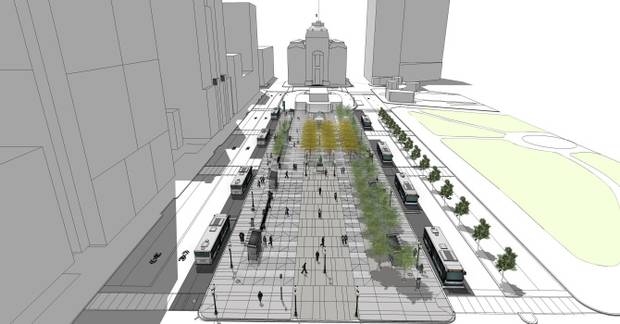
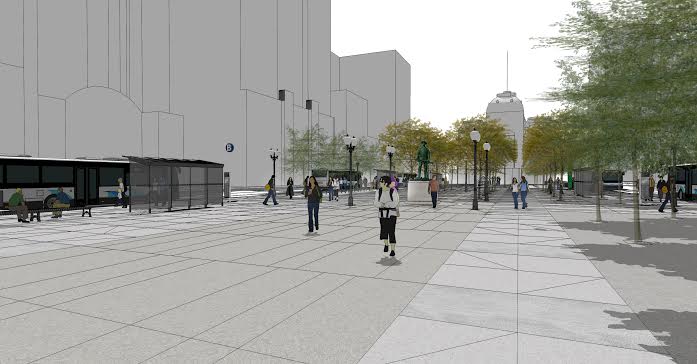
Kennedy Plaza renovation as pictured in a rendering provided by the Department of Planning & Development.

Kennedy Plaza renovation as pictured in a rendering provided by the Department of Planning & Development.

[This is not my weekly column in The Providence Journal. It is a post on my blog Architecture Here and There. I am on a week’s vacation.]

* * *

Rendering of latest Kennedy Plaza design. (City of Providence)

Rendering of latest Kennedy Plaza design. (City of Providence)

Rendering of latest Kennedy Plaza design. (City of Providence)

Rendering of latest Kennedy Plaza design. (City of Providence)

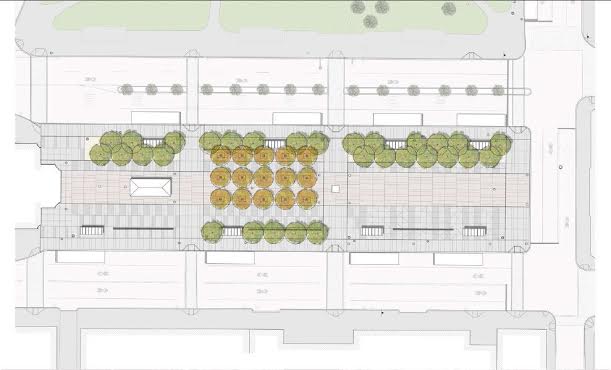
Plan of latest Kennedy Plaza design. (City of Providence)

Plan of latest Kennedy Plaza design. (City of Providence)

Rendering of Union Studios design of Kennedy Plaza.

Rendering of Union Studios design of Kennedy Plaza.

Bird's eye view of Union Studio's design of Kennedy Plaza.

Bird’s eye view of Union Studio Architects’ design of Kennedy Plaza.

kenn7

Bird’s eye view of Union Studio’s design of Kennedy Plaza.

Plan of Union Studio's design of Kennedy Plaza.

Plan of Union Studio’s design of Kennedy Plaza.

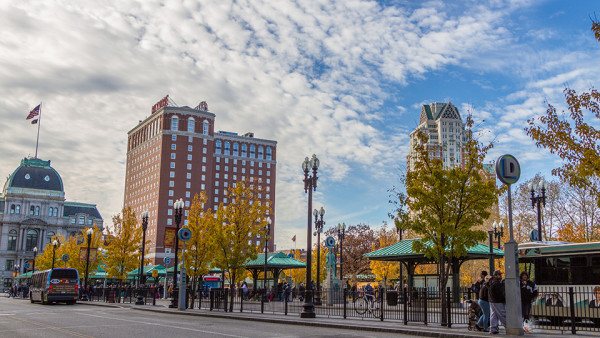
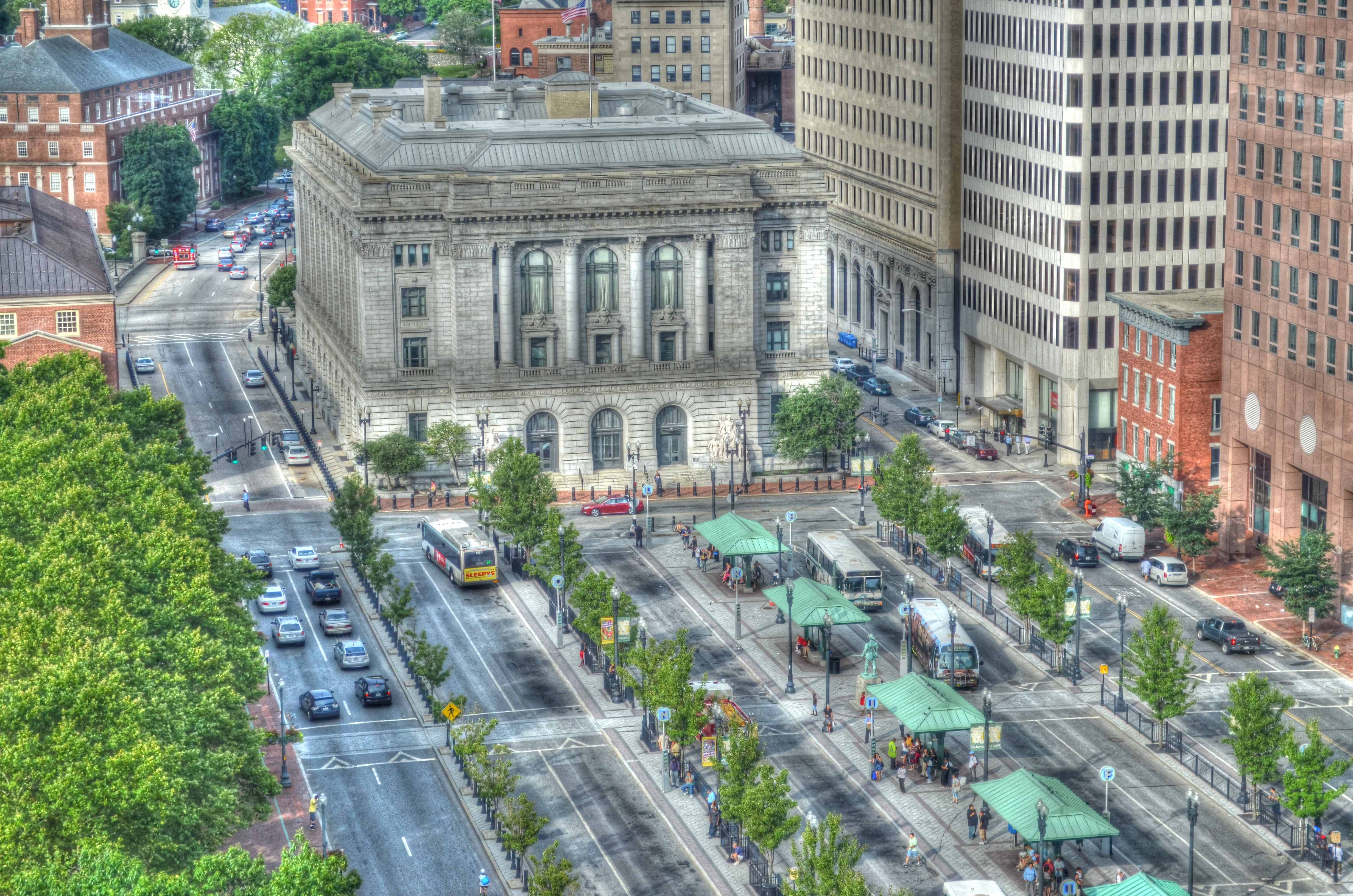
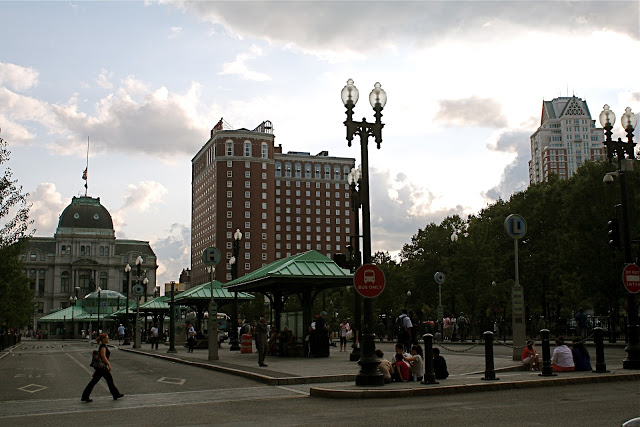
View of Kennedy Plaza as it exists today. (meetingsquest.com)

View of Kennedy Plaza as it exists today. (brendaleetroiaphotography.com)

View of Kennedy Plaza as it exists today. (brendaleetroiaphotography.com)

View of Kennedy Plaza as it exists today. (brendaleetroiaphotography.com)

For an urban city bus hub, Kennedy Plaza’s intermodal station, its five waiting shelters and its fancy pavement lined with black railings, bollards, period lampposts and delicate street trees beat the pants off most civic squares around the world for beauty, even those that do not serve double duty as bus hubs – and ours serves single duty as a bus hub. Providence has hosted its transit patrons, including me, in high style for just a dozen years.

Now it seems we can say good-bye to all that – and hello to the ugly urban duckling, pictured above, whose groundbreaking is to be sprung on us this week.

Outdated versions of this plan are still available on the website of the Rhode Island Public Transit Authority. The earlier versions at least retained the five lovely shelters. Their design brought a bit of Paris and its Art Nouveau, suitably understated, to downtown Providence.

In the latest plan, pushed by city officials, the shelters are jettisoned, though the lampposts survive, joined by new “minimalist” shelters that seem out of sync with the lampposts. A bosk of trees will be added. The two outside bus lanes will be filled in and the bus island will expand to make room for a central space that could become Providence’s version of Boston’s bleak and windswept piazza adjoining its Brutalist-style City Hall.

Observers pulling their chins in disbelief must be wondering what ever happened to the nice plan for a civic square designed by Union Studio Architects. Either that traditional plan is going to be shoehorned into a plaza purged of its charms by modernist design, or it has been frog-marched quietly out of the picture.

The visual allure of a civic plaza is of vital importance, but its purpose trumps even that consideration. Mayor Taveras, who is said to have been impressed by Union Studio’s vision, wants to turn Kennedy Plaza from a bus hub into a civic square. Swell. But city officials seem to think people will use the civic square without being turned off by its sterile new look, even as they are still quite literally surrounded by a bus hub.

An unspoken thought running through the long discussion of the plaza’s future is that the two groups of citizens – bus riders and users of the planned civic square – don’t mix very well. So, in obedience to an unacknowledged social agenda, the plan would move as many bus riders as far from Kennedy Plaza as possible, but leave enough behind to plausibly deny a motive that would understandably make planners, city officials and the mayor uneasy.

For four years I’ve stepped off the bus at Kennedy Plaza at least once or twice a week in the morning and waited for it almost as often in the evening. For 11 years before that I lived a block away from Kennedy Plaza. Maybe I’m an unusually unobservant journalist, but I’ve never seen the criminal activity so many seem to attribute to denizens of the plaza. They do not lack for scruffiness, but their usual good behavior entitles them to occupy the plaza no less than anyone else. They have as much right to benefit from changes in its operation.

City Hall posted a time-lapse video of Kennedy Plaza between 3 p.m. and 5:30 p.m. on Thursday, Nov. 1, 2012. The intent was apparently to suggest that the plaza is outmoded as a bus hub, since ridership on RIPTA has increased 11 percent. But in fact, condensed into about three minutes, the video shows the bus hub at peak efficiency, handling hundreds of riders with a minimum of fuss.

If it ain’t broke don’t fix it. Kennedy Plaza ain’t broke. A successful civic square already exists directly across Washington Street. It is called Burnside Park. Still, if the plaza must be changed for the civic good, the city should not adopt half measures. Here’s what to do:

Scrap the current Kennedy Plaza plan. End the plaza’s status as a bus nexus. Redraw bus lines through downtown so that riders get on and off the bus at bus stops up and down the streets of downtown, as in the past here and as in most other cities. Extend Burnside Park to Kennedy Plaza, creating a New York-style Central Park for Providence, one that looks like it belongs in the capital of Rhode Island.

I proposed this in a 1992 column (“Postcard from Providence, 1997”) published more than two decades ago. Nobody listened then, and with groundbreaking on Tuesday it may be too late now. This Kennedy Plaza project has changed its character very quickly, very quietly, and is now being rammed down the public’s throat well in advance of a public referendum on two new downtown bus hubs whose existence, if approved, would deeply affect its rationale. Why?


Posted in Architecture, Development, Providence, Urbanism and planning | Tagged , , , , , | 10 Comments

Kennedy Plaza video

Kennedy Plaza's intermodal bus terminal and five elegant waiting kiosks. (thepolisblog.com)

Kennedy Plaza’s intermodal bus terminal and five elegant waiting kiosks. (thepolisblog.com)

Here is a fascinating and extremely useful time-lapse video of Kennedy Plaza that, in two and a half minutes, shows buses and riders entering and leaving the plaza from 3:05 p.m. to 5:30 p.m. on Thursday, Nov. 1, 2012. To me it shows how well used the plaza is, and how effective it is for bus riders. The city hopes to convince the public that the plaza is inadequate. Maybe this video can be used to suggest that, but to me it suggests the reverse. It might have been more instructive if it had been shot from a window in the court house at the other end of the plaza, rather than from City Hall. After all, it is the crowding of the commuters at bus stops and the supposed congestion of the buses themselves that is at issue, and most of that takes place beyond the intermodal center at the center of the video.

I will address the changes proposed for Kennedy Plaza in my next column.

Posted in Architecture, Old Video, Providence, Urbanism and planning | Tagged , , | 2 Comments