Scruton’s lonely candlestick

Royal College of Art, with Royal Albert Hall just beyond. (guialomejordelmundo.com)

Royal College of Art, with Royal Albert Hall just beyond. (guialomejordelmundo.com)

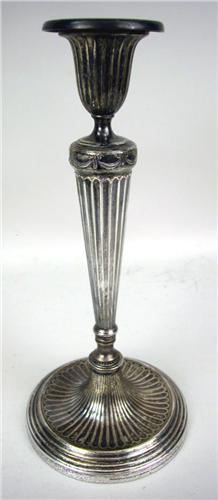
Roger Scruton’s 1995 collection of essays, The Classical Vernacular: Architectural Principles in an Age of Nihilism, begins with an essay, “Reflections on a Candlestick,” in which he describes an objet d’art sitting in a Brutalist conference room:

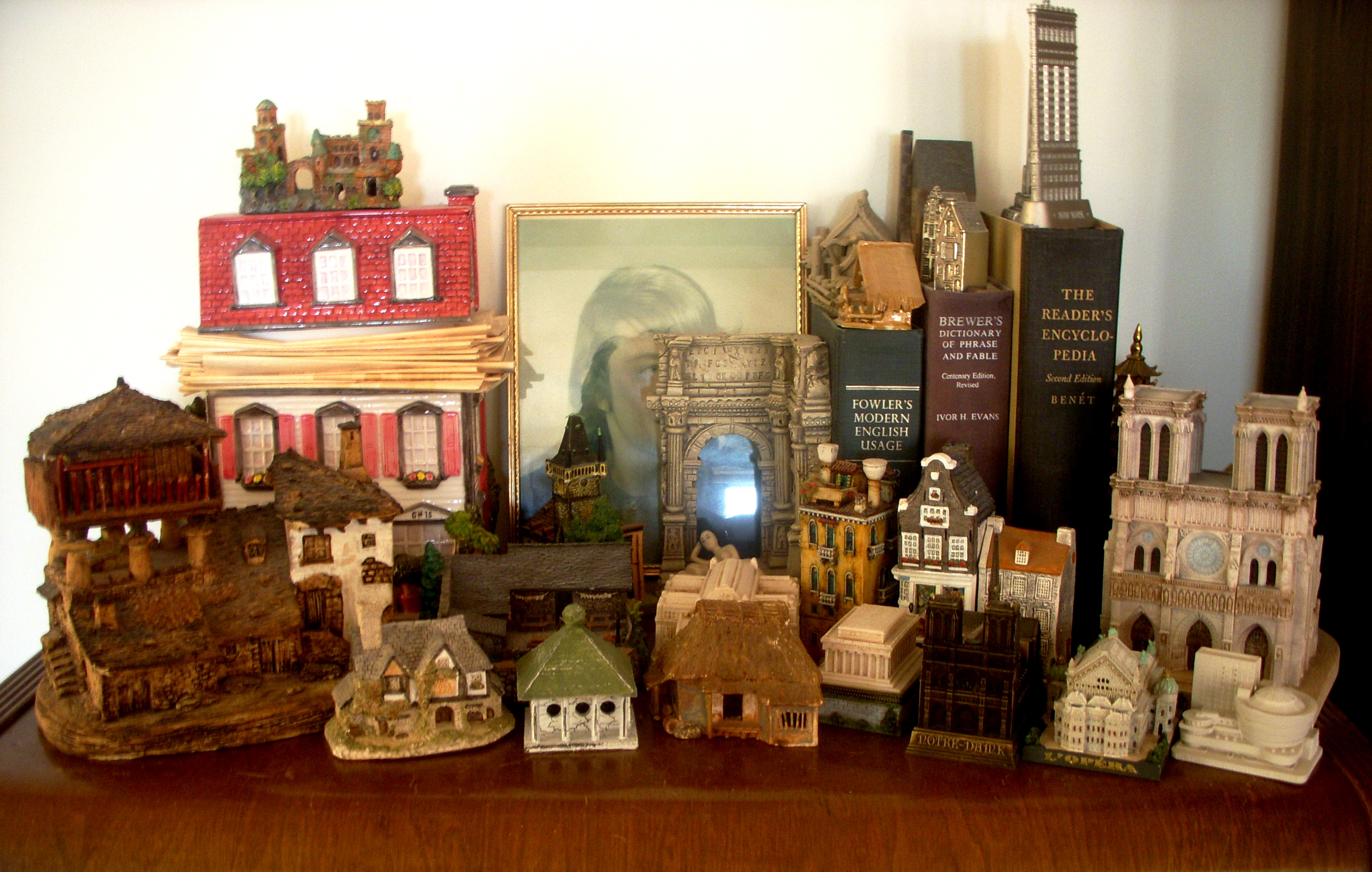
Not the same candlestick, but of the general idea. (icollector.com)

Not the same candlestick, but of the general idea. (icollector.com)

My eye came to rest on a Regency candlestick, part of the legacy of beautiful things which the [Royal] College [of Art, near London’s Albert Hall] is still able to display. … The ruling idea of the candlestick can be summed up in two words: dynamic and detail. Its form springs from the combination of bold movement and delicate ornamentation. The fluted oval column rises on a firm architectural base and supports an urn of exquisite outline, in which the candle rests. the beaten silver makes quiet reflections, while the innumerable lines and mouldings cast small soft shadows into every silver pool. There are no edges, only lips, where the structure, having extended itself in one direction to the limit of usefulness, relinquishes its claims to the neighboring space and folds over. The base, too, is without an edge: its oval rim is brought to a conclusion by a ridge of mouldings. It neither bites the surrounding space nor presses against it. The base of the urn is slightly pinched, marking the point where the vertical thrust of the column expires. At every pause and juncture some simple and effective embellishment provides a commentary on the underlying dynamic of form. The whole is harmonious and restful and at the same time energetic, confident in its movement, abundantly alive.

The surrounding architecture is the opposite of all that I have just described: static, harsh, without detail (except the arbitrary detail provided by the imprint of rough-hewn boards). It presents itself to the observer as a series of edges, without softness or movement. Its forceful denial of life, its absence of language, of correspondence, of drama, its inability to move, to yield, to dance – all this is experienced as a denial of the observer’s presence.
This is the difference between traditional architecture and modern architecture. Society has chosen to build the one and suppress the other. That is why the world is so ugly today. That ugliness has consequences, entirely inimical to joy and life, though science has not really set itself to examine those consequences. Nikos Salingaros and a few others have begun what deserves to be a much more comprehensive investigation. Whatever is discovered about the degree of negativity that oozes into our mood, our being, our spirit, from the harsh lines of modern architecture is, in its essence, a belaboring of the obvious to all who have not had their instinctive respect for beauty (and its positive influences) purged by a modernist education in what Scruton, wrinkling his nose, would call “design” (his quotes). Only by such purgation is modern architecture capable of being produced and appreciated.

That beauty has been expurgated from much of life around the world is the bad news. The good news is that compared with most other problems facing humanity, such as war, crime, poverty, hunger and disease, the solution to the problem of ugliness is easy. It is a simple replacement of the dominant aesthetic with a past aesthetic that is struggling to emerge from suppression. We know what to do because human societies did it for two or three millennia until not even a century ago.

The how of resuming a civilized architecture is more complex but still relatively easy compared with other challenges. However suppressed, traditional ways of forming our built environment remain as models. They are our nice neighborhoods, pricey because establishment architecture and planning regimes have made them difficult and often illegal to replicate, and our favorite places to go on vacation, in America and abroad. The traditional ways are gaining adherents, and more people are seeking to learn how to create beauty the old-fashioned way – a way that constantly grew and evolved, applying advances in materials and techniques to reflect the needs of society for thousands of years until the stillborn, lifeless revolution of modern architecture. Its vision of a lifeless civitas of blankness and edges survives the widespread natural resistance to its dominance only because of its establishment’s willingness to embrace a totalitarian cult business model. This cult may, at least in theory, be pushed over with a finger.

Perhaps the evil, stupid starchitect Frank Gehry’s own finger has sparked that push. It may light a candle to be set in the candlestick described above by Roger Scruton.

Posted in Architecture, Architecture Education, Art and design | Tagged , , , | Leave a comment

Shubow on Gehry’s finger

Frank Gehry's recent symbolic reply to journalist in Spain.

Frank Gehry’s recent symbolic reply to journalist in Spain. (theguardian.com)

Justin Shubow, president of the National Civic Art Society, in Washington, has a new gig writing a column at Forbes.com. Shubow, who will remain at the NCAS, has directed the society’s vigorous defense of the Nation’s Capital against the proposal by the nation’s world’s Greatest Architect to diss the memory of America’s 34th president. It is fitting and proper, therefore, that Shubow’s first column fingers Gehry’s finger – his recent shot of bird at the press, followed by his declaration that “98 percent of everything that is built and designed today is pure shit.”

Shubow delves deeply into this. He is a trove of fact, history and insight whose column is not to be missed. He has Gehry dead to rights. Read “Frank Gehry is Right: 98% of Architecture Today ‘Has No Respect for Humanity” in its entirety. Can’t wait for his next piece at Forbes’s online magazine. His blog may be visited here.

By the way, Justin is speaking at 8 p.m. on Thursday, Dec. 18, at the National Arts Club at 15 Gramercy Park South in Manhattan. His subject is “The Architecture of Democracy.”

Here’s Artsy.net’s Gehry link: https://www.artsy.net/artist/frank-gehry

Posted in Architects, Architecture | Tagged , , , , , | Leave a comment

Hell and Helsinki

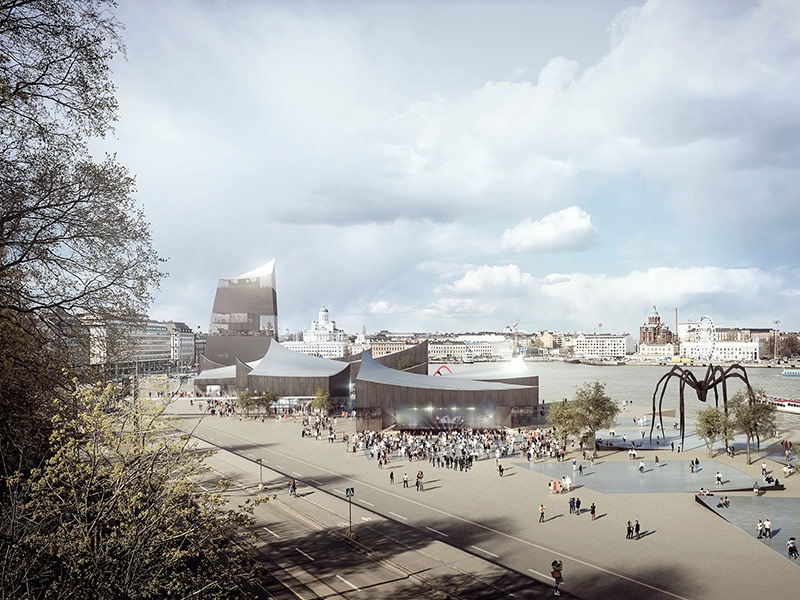
One of six finalists in the Guggenheim Helsinki contest. (Guggenheim Foundation)

One of six finalists in the Guggenheim Helsinki contest. (Guggenheim Foundation)

The 1,715 entries to the international design competition for a Guggenheim museum in Helsinki have been winnowed down to six, an entirely predictable six. I must admit I have not finished my cruise through the original entries. I have informed readers that an entry of traditional style was submitted. It is not among the finalists. Whether there were any other traditional entries seems likely just by dint of the law of averages.

Another finalist. (Guggenheim Foundation)

Another finalist. (Guggenheim Foundation)

But probably not. Anyway, the six finalists are what you would expect, no two of them seeming to hark from the same mind, or planet. Kriston Capps of Atlantic CityLab, in “Here Are the Top 6 Designs for the Guggenheim Helsinki, and They’re All a Bad Idea,” cites the arithmetic of Taller de Casqueria, a Spanish architectural cooperative, which figured that if the judges spent a paltry five minutes per entry, the deliberations would have taken 142 hours. That’s a lot of time for a panel of judges to spend together. Capps adds that the architects spent an average of $12,000 per entry, which means the Guggenheim Foundation snookered them into doing $23 million of work for free.

But Capps surprised me, and sent me to seventh heaven, by describing the gridded gallery into which the 1,715 entries were arrayed, then asserting that “the sum of the contest didn’t celebrate the diversity of design. It made a mockery of architecture.” That must be the understatement of the week! He quotes a Finnish organization that’s running a counter-competition, The Next Helsinki: “However different in detail, the starting point for the competition is the creation of a landmark building with little or no connection to the local context and the urban fabric as a whole.” The illustration on top of this post bears that out.

Capps had other astute criticisms of the contest and its results. The piece deserves to be read in its entirety. Of course, that means indulging in a bit of masochism, for the piece features illustrations of all six finalists.

Posted in Architecture, Art and design, Other countries, Urbanism and planning | Tagged , , , , | 1 Comment

Trad clearinghouse?

I owe readers an update on the idea for a clearinghouse for projects involving traditional architecture. Many readers reacted, urging me to attempt the idea. Unfortunately, looking for a job (as many readers know I am doing right now) is itself a fulltime job. I just don’t have enough time to do it, and probably not the technical know-how either. I don’t want anyone else contemplating such an idea to be deterred by the possibility that I am going to do it. I wish I could but it looks beyond reach for me. Sorry if I have been a tease!

David Brussat's avatarArchitecture Here and There

DSCN0134_2How about a clearinghouse for traditional projects? Prompted by a conversation this morning with the Washington, D.C., architect and planner Nir Buras, I am thinking of starting a new blog, associated with this ol’ Architecture Here and There blog, where architects, developers, planners and others could post (or allow me to post) their work, proposed, in progress or recently completed. The focus, as I imagine it at the outset, would be on projects larger than single-family houses, since that is where the classical revival needs most help, though they needn’t be classical and though even groupings of single-family houses in a project might very well be pertinent.

If anyone has any thoughts on the need for this, the desire for this, or how it might best be arranged, feel free to let fly.

View original post

Posted in Uncategorized | Leave a comment

Don’t maul the Mall

Master plan for southern end of Mall and Smithsonian. (BIG/Smithsonian)

Master plan for southern end of Mall and Smithsonian. (BIG/Smithsonian)

The National Mall in Washington has been undergoing renovation of its famous grass and the soil underneath. Decades of marches, concerts and festivals, not to mention the constant tramp, tramp, tramp of millions of tourists yearly on this hallowed ground of the nation, still largely based on the great classical McMillan Plan of 1901, have hardened and compressed the land. But with a sort of fluffing up of the large part of the Mall that lies under the grass, this is being fixed.

Southern portion of the National Mall. (brightspotstrategy.com)

Southern portion of the National Mall. (brightspotstrategy.com)

Fixed, it seems, to prepare the ground for an invasion by alien forms, invited not by some malign foreign power or interplanetary congress of villains but by the Smithsonian Institution itself. The Smithsonian’s museums, galleries and quaint headquarters building line either side of the Mall from the Washington Monument to the U.S. Capitol. A Danish firm based in New York, Bjarke Ingels Group, has been hired to produce a master plan for its older, southern portion over the next 20 years. At the top of this post is a disarmingly charming nighttime illustration of the plan.

Aaron Betsky praises the BIG plan for Architect, the journal of the American Institute of Architects, in “The Underground Museum Movement.” An early line well describes the work of BIG’s Bjarke Ingels, who has “married OMA’s [Rem Koolhaas’s] unabashed modernism with sculptural daring-do and a cartoon sensibility.”

Modernism popping up in BIG plan. (BIG/Smithsonian)

Modernism popping up in BIG plan. (BIG/Smithsonian)

The Mall and its interlace of spaces linking the country’s greatest national museums will indeed become a cartoon – a Jetsons cartoon – if this plan is carried out. The grand allée of America is our greatest public space. It has hosted many of U.S. history’s finest moments,  such as Martin Luther King Jr.’s “I Have a Dream” speech. On a day-to-day basis it offers Washington’s visitors, workers and residents alike a pedestrian paradise where flâneurs can sit or stroll as they observe the country’s character and characters tromp by in all their diversity.

Under the BIG plan, the Mall’s grandeur will be lampooned and its essential purpose as a promenade of democracy on which to meet and greet under the blue sky will be trampled. Much of the plan imagines new spaces and connections between museums underground, itself undermining the Mall’s essence. The recent new visitors center, largely underground, for the Capitol offers plenty of reason to avoid digging down to solve an entirely imaginary need for more space for people on the mall. The Mall may need an upgrade; it does not need a reconceptualization, a repurposing, a re-anything.

Smithsonian's administrative headquarters. (news.yahoo.com)

Smithsonian’s administrative headquarters. (news.yahoo.com)

You’d think that going below grade would help avoid one of the predictable hazards of remaining above grade. But no. BIG sees a lot of modern architecture raising its ugly head above ground, up from below. From illustrations provided by BIG and the Smithsonian, most of it is predictable sterile modernist extrusions from another galaxy. The main piece, and potentially least objectionable, is a lawn with cutely raised corners between the Smithsonian administration’s towered, crenellated castle and the round Hirshorn Art Museum.

Had the structures gently lifting the corners of the lawn featured traditional architecture rising from below, teasing visitors with elements of the Mall’s greatest classical buildings, this centerpiece might have mixed beauty and frisson with admirable panache, acceptable to all. But BIG could see no farther than to gild the turd, and so even this mini-mall will cringe along with the rest of the plan’s benighted architecture.

Bad modern architecture has been creeping up and down the Mall for decades. It has been chosen to house the latest national museums. The beauty that once reigned supreme as the nation filled out the McMillan Plan in the first half of the 20th century will suffer further erosion. The conversation among the most civilized structures will be further confused. While the Mall is unlikely to lose its status as the nation’s gathering spot, its sense of place and hence its ability to wreathe the civic life of the capital city in an uplifting grandeur and importance will continue to be diminished.

Corner of lawn viewed between Smithsonian HQ and Hall of Arts & Industries. (Smithsonian)

Corner of lawn viewed between Smithsonian HQ and Hall of Arts and Industries. (Smithsonian)

This plan is not BIG but small, very small, very orthodox, very ugly. Fortunately, in a nation of stretched budgets the plan will depend on big donations from the private sector, and we may hope that these do not materialize. Maybe the Smithsonian will be thrown back on its existing resources. Chief among these is the newly renovated Hall of Arts and Industries, which now stands empty, a waste waiting to embrace a new mission. It is well placed to lead the repulse of this ridiculous alien invasion proposed for America’s most sacred space.

But a building cannot lead a fight, and the Smithsonian cannot be expected to fight against itself. So this looks like a job for Justin Shubow and the National Civic Art Society.

Posted in Architecture, Art and design, Preservation, Urbanism and planning | Tagged , , , , | Leave a comment

Scoop on poop at Burj

Burj-Khalifa-HD-Wallpapers-Free-Download

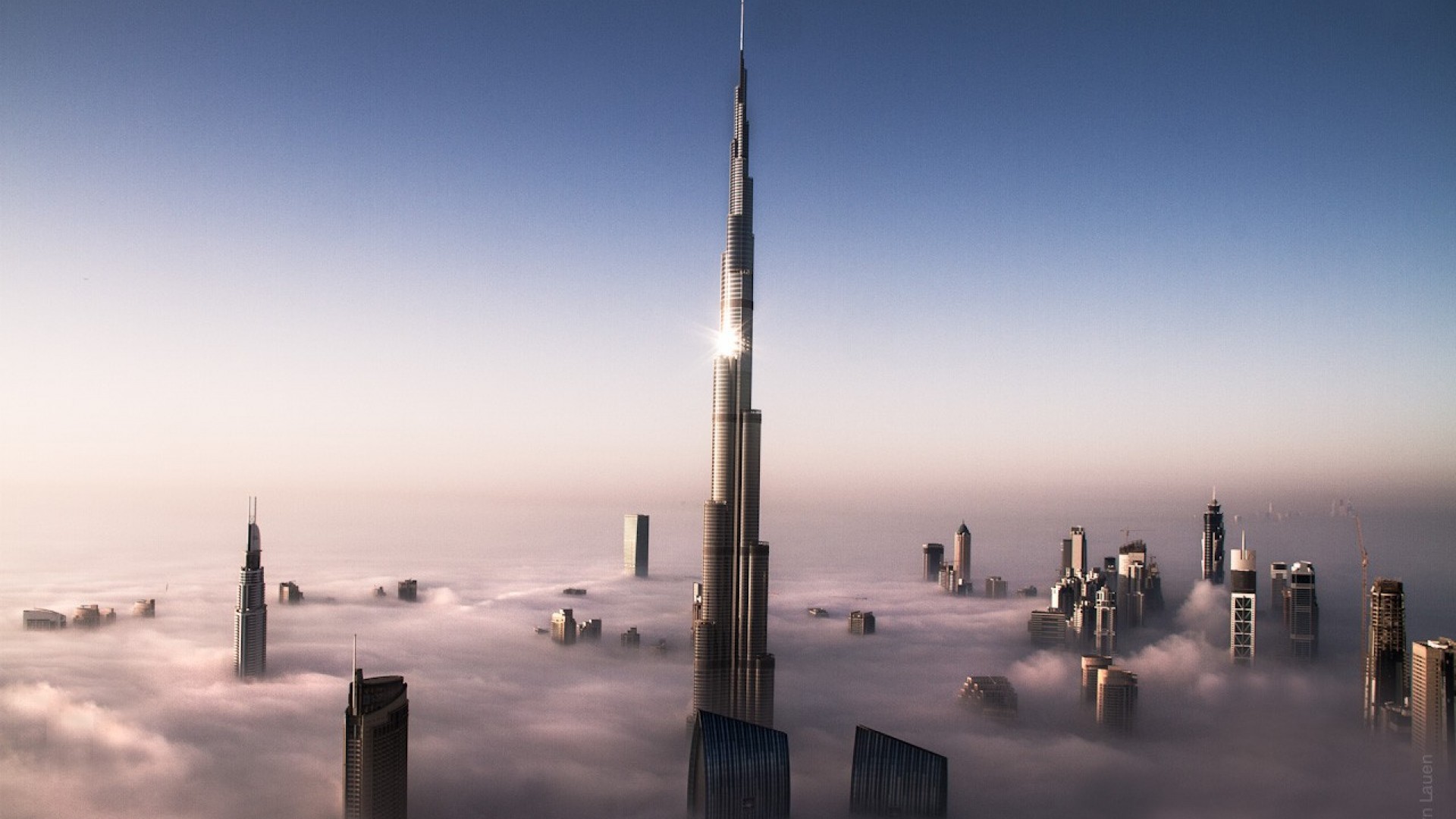
View of miasma at base of Burj Khalifa and other skyscrapers in Dubai. (hdnewwallpapers.com)

Not sure I want to touch this with a ten-foot pole, but inquiring minds want to know, I’m quite certain, despite my cautionary note, what the process of defecation entails at the world’s tallest building, the Burj Khalifa skyscraper in Dubai. It’s a long way down. Inhabitat, the online magazine about human habitation, has published an article that fills in the blanks of your curiosity, which will only grow when you learn that Dubai does not have a fully operational sewer system. So how does that work out? Well, read “The Incredible Story of How the Burj Khalifa’s Poop Is Trucked Out of Town,” by Bridgette Meinhold. Don’t say I didn’t warn you. (I was going to use Photoshop to tint the fog in the photo above. I did not have the internal fortitude to do it, and it did not need to be done.)

Posted in Uncategorized | Leave a comment

Another sharp eye . . . ?

Modernis addition to traditional house in Durban, South Africa. (dreamfunddesign.com)

Modernist addition to traditional house in Durban, South Africa. (dreamfunddesign.com)

Here’s a comment that just came in to the TradArch list by Andrès Duany. He helped found and has been the most active leader of the New Urbanism movement. Today, after winning the Driehaus Award of 2009, he is writing a treatise on classical architecture in which he seeks to “capture territory” for classicism from modernism. It has not been published yet, but from his comments on TradArch it is often reasonable to fear he will go too far, relabeling as classicist many forms that actually are modernist, and (if anyone pays attention) helping to dilute the crisp distinction the public recognizes between traditional and modern architecture. In a world where modernism dominates the architectural establishment, that distinction is the chief strategic asset of the classical revival.

Below, Andrès hits the nail on the head in regard to that distinction, but then seems to suggest that it really doesn’t matter and that you can like modern architecture if you understand it. Fine. But does that mean that continuing to build it helps humanize the world? Obviously not, and yet what is one to conclude from the last line in Andrès’s comment?

The one distinction is that traditional architecture expresses human habitation. Modernism does not. Those vertically proportioned windows and doors; those balconies and cupolas; those gardens and gates; those rooms – they are all dedicated to human habitation.

Modernist architecture  is equally able to express – but it is interested in expressing other things: circulation, cladding, function, how it is built, the ideas of the architect, an artistic idea, the relationship to society etc. It is rarely if ever interested in expressing human habitation, that which is intrinsic to the human condition. Therefore modern architecture can only be understood by those with advanced, specialized educations in the subject. It is mute to the regular folk, hence they dislike it. I like it because I understand it. As do many others who are not idiots.

Go figure. Is Andrès suggesting that the world’s population, in its billions, be sent to architecture school so that they, like Andrès, will understand and thus accept the world’s uglification? Few would argue that those who understand and appreciate modern architecture are “idiots” – often they are of very high intelligence – but their superior comprehension hardly improves the world. For all their Mensa street cred, they lack wisdom. The above quote from Andrès unwittingly expresses that truth to perfection.

Posted in Architecture, Architecture Education, Architecture History, Urbanism and planning | Tagged , , , | 3 Comments

A sharp eye into classicism

Fig.-2New_1Bruce Donnelly, an urban planner and design theorist from Cleveland, had two very interesting posts on the TradArch list yesterday. In the first passage, he is referring to comments from others about how classical architects can learn from modern architecture. In the second item he refers to the recent withdrawal by Clemson of its proposed modernist school of architecture in the middle of Charleston’s historic district after vigorous objections from the community. Here is the first:

In general, … I think we should channel what the Modernists insisted that our forefathers “un-learn.”

Put yourself in 1930, and imagine what most people thought. Many people, especially architects, were probably quite glad to get rid of the overly complicated rules, misapplied precision, and stylistic controversies [of classical architecture]. But when they tried to do modernist architecture, the vast majority of them simply built traditional buildings with chunky square window frames and plain, ungainly proportions. They didn’t really understand modern architecture. They were trying to lose the basic underpinnings of the way that they thought the world worked for architecture. They just couldn’t do it. At best, it produced Moderne. Basic, traditional, building is a knowable thing that once known is almost impossible to un-know. It is so intrinsic to human form-making that it takes conscious effort to peel away from it.

Now, we can take the position that such a deep connection is intrinsic to Nature or human nature, is divinely-inspired, etc. Or we can just accept that it’s just a flawed product of human evolution. Whatever works for you. But I don’t think that we can deny that it exists. I will stand by this: once the basic deep structure of traditional architecture makes it into the brain even the most committed designers can never quite shake it. Wright tried desperately, for instance, but look at a Usonian house’s pergola and you will see dim echoes of the ancients. Le Corbusier had to wean himself consciously over decades to get to Ronchamp. It is a mental ratchet that tends to get stuck in a halfway position.

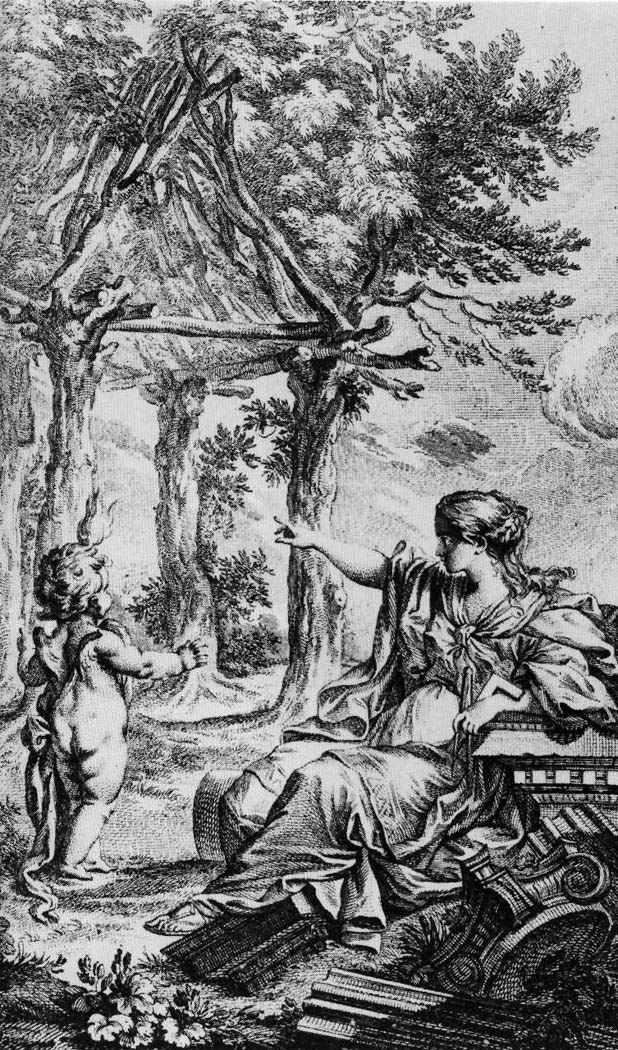
Mythology of the primitive origins of classical architecture. (esperdy.net)

Mythology of the primitive origins of classical architecture. (esperdy.net)

Traditional architecture’s deep structure starts with being made of walls and posts, frames and vaults. It is essentially cellular. Openings are holes punched in walls or infilled frames. It has visual centers that spawn visual centers relentlessly – and symmetries and so forth. It has all these qualities that have to be mastered to do well, but that still suffuse modern society despite a century of attempts at negation.  Now, classical architecture is a particular language from a particular region. It incorporates the deep structure and elaborates it into an art, by applying it again and again. For instance, if traditional architecture always makes some use of contrast, classical moldings elaborate that contrast into a multi-level, orchestrated system. But the same basic impetus for contrast exists even if you’re talking about logs sticking out of a mud-brick wall in Yemen.

The main thing that modernist architecture offers is a sort of slippery space that buildings and parts of buildings can float in. That is, it offers a spatial system that can enrich traditional architecture so long as it doesn’t take over.

A little while later, Bruce comments on the situation regarding public pressure leading to Clemson’s withdrawn proposal in Charleston:

The main reason they [the modernists] are vulnerable is that people instantly know the difference between traditional and not in a side-by-side comparison. The problem is that it takes a side-by-side comparison. If you put [modernist] House VI next to a ranchburger, the ranchburger wins. But put the ranchburger next to a drafty 1860 house with open-air dogtrot with a fake mantelpiece in the parlor nailed to ​a board wall papered with newspapers. A good number of people will want to fix up the drafty old house.

It’s actually kind of amazing that we’re in this position. It’s like a prize fighter who won with both hands tied behind his back and his legs tied to the ropes – because the other guy concussed himself on the microphone hanging over the ring.

Posted in Architecture, Architecture Education, Architecture History | Tagged , , , , | 2 Comments

Nod of the Royal Oak

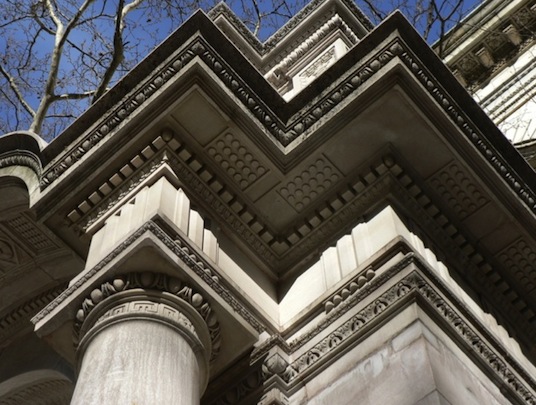
A reader has identified the location of the classical array atop this post. See its conclusion.

David Brussat's avatarArchitecture Here and There

10As a board member of the New England Chapter of the Institute of Classical Architecture & Art, I am greatly pleased to learn that the ICAA has received the 2014 Heritage Award of the Royal Oak Foundation. The Foundation is an American organization that supports the work of Britain’s top preservation organization, the National Trust of England, Wales and Northern Ireland. The Foundation promotes the values of classical architecture and its allied arts in America and in Britain.

The award is given “in recognition of institutions or individuals in Britain or the United States that have substantially advanced the understanding and appreciation of our shared cultural heritage.” This recognition was accepted by the Institute’s board chairman, Mark Ferguson, in a ceremony at the Foundation’s headquarters on West 35th St., in New York City. Here are the illustrated remarks of Chairman Ferguson, as recorded in the Institute’s Classicist Blog, on…

View original post 120 more words

Posted in Uncategorized | Leave a comment

Thanks for this parade!

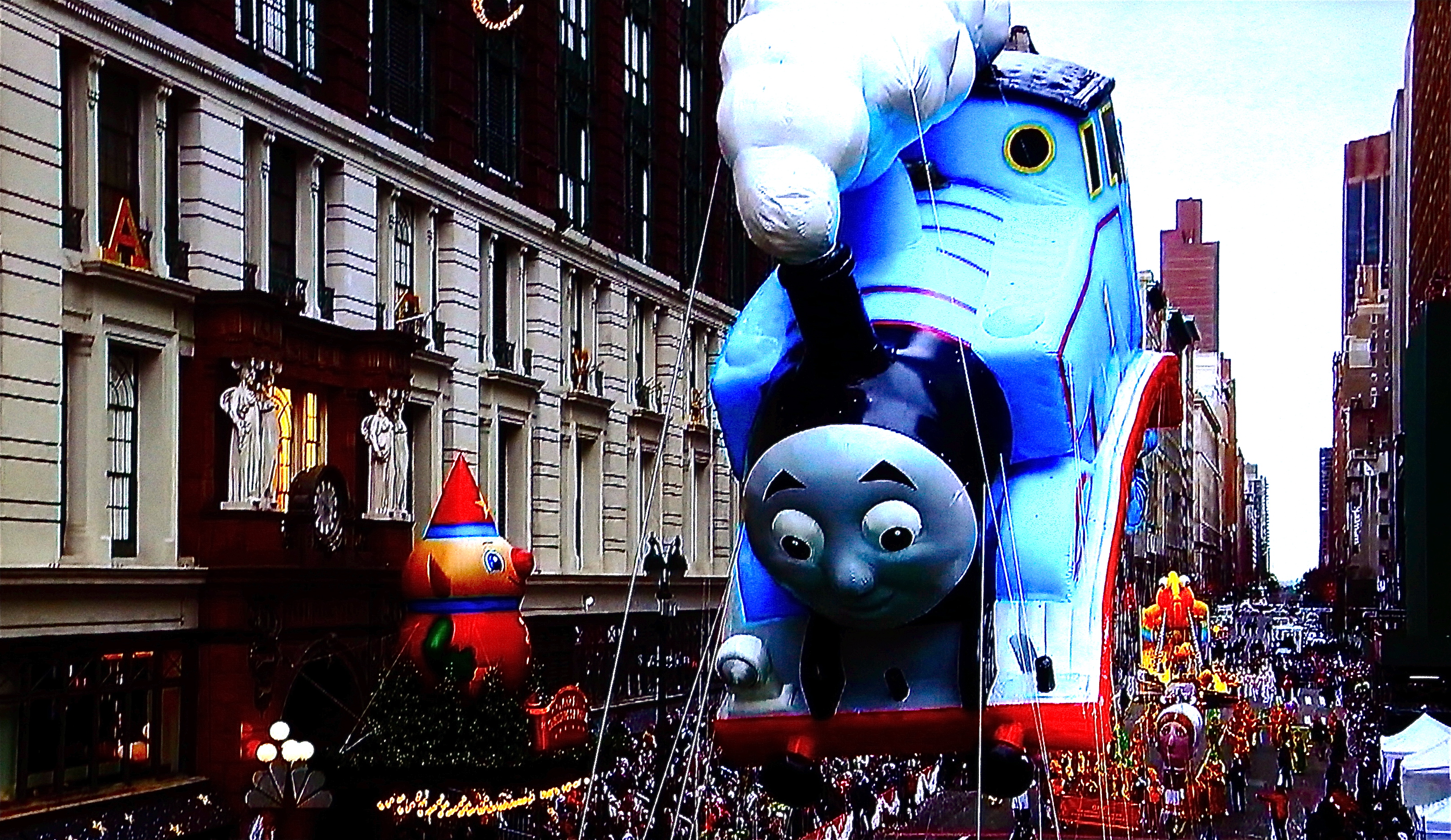
Thomas the Tank Engine in today's Macy's Thanksgiving Day Parade. (Screen Shot from NBC by David Brussat)

Thomas the Tank Engine in today’s Macy’s Thanksgiving Day Parade. (Screen shot by David Brussat)

Thanks for the Macy’s Thanksgiving Day Parade, that’s what I say. I have been watching it this afternoon, and after a while it occurred to me that NBC had placed every one of its cameras so that the backdrop for marching bands, floats, balloons and entertainers on the route would be one or more beautiful buildings, with nary a modernist edifice in sight. The producers of this annual extravaganza obviously don’t want viewers to be bothered by tedious glass slabs. Only classical architecture need apply. Accidental? I don’t think so, and I’m thankful for that. Made my day, and that of millions of others I’m sure. So now let’s sit down to a traditional turkey dinner. That’s my plan. Someday citizens will realize the evidence in front of them every day and rise up against the assault of modern architecture on civilization. Someday. But today, happy holiday, readers!

Posted in Architecture, Art and design, Preservation, Urbanism and planning | Tagged , , | 5 Comments