PawSox to Providence?

McCoy Stadium, in Pawtucket, R.I. (minorleagueballparks.com)

McCoy Stadium, in Pawtucket, R.I. (minorleagueballparks.com)

There once was a team in Pawtucket.

To consider the merits of moving the Boston Red Sox Triple-A team to Providence, one must first swallow the vile pill of stealing the team from neighboring Pawtucket, which needs economic stimulus more than does Rhode Island’s capital city. All other things being equal, the new owners should keep the PawSox in Pawtucket.

Lansdown Street next to Fenway Park, Boston. (wgbhnews.org)

Lansdown Street next to Fenway Park, Boston. (wgbhnews.org)

Camden Yards, in Baltimore. (charmcitywire.com)

Camden Yards, in Baltimore. (charmcitywire.com)

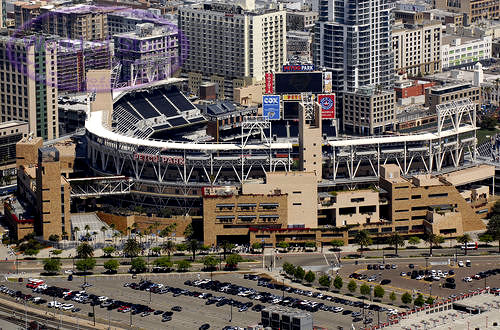
Petco Field, in San Diego. (keepitnerdy.com)

Petco Field, in San Diego. (keepitnerdy.com)

Yet, while McCoy Stadium is swell since its renovation in 1999, its well-hidden location amidst an industrial patch fed by a spaghetti of local streets near no major highway stinks. Minor-league ball teams have always had big-time wanderlust. Small cities have always faced the risk of team migration. The PawSox’s many years in Pawtucket are a rare exception. Alas, keeping the team in the Ocean State may require shafting the Bucket.

So they should at least keep the PawSox moniker. Just as holidays manage to survive relocation to Mondays, the team can still be called the PawSox after moving to Providence. No conceivable name could improve upon PawSox. ProvSox? Nah. ProSox? Nah. Rhode Island Red Sox? Yawn! PawSox is euphonious and pays homage to Pawtucket. It may not be much, but some sort of payback for kidnapping the team would be appropriate.

Although there is talk that little will be sought from the state to support the project (except maybe for free I-195 redevelopment land), talk is cheap. Either way, there is a large cloud dogging the proposal. It is 38 Studios, also hitched to baseball. In 2010, former Sox star Curt Schilling was given $75 million in state tax incentives to move his young computer game business here from Massachusetts, which had refused to offer subsides. It promptly struck out. Rhode Island taxpayers are still angry and skeptical. A poorly conceived stadium that fails could hurt the city and state for years, and it would be much harder to pull the plug.

The riverfront land eyed by the new PawSox owners for a new stadium is eyed by Rhode Island leaders for economic stimulus. A stadium would be a radical shift. And yet their high-tech vision has fared poorly thus far. The only project since the district’s conception in 2011 is for student housing – hardly high tech – and even that is tangled up in a quest for city subsidies. The district’s redevelopment potential is packaged in a Developers’ Toolkit that virtually ensures failure. Indeed, baseball next door (on land slated for an ugly public park) might well go hand in hand with high tech.

There is room for both. But a Providence stadium could prove a major boon for Rhode Island’s original plan for the 195 district whether the new PawSox succeed for its owners or not.

This would require the owners to model the stadium on Fenway. It and Lansdowne Street are beloved because they are old and charming. New PawSox owner Larry Lucchino of the BoSox helped develop Baltimore’s highly successful Camden Yards for the Orioles and San Diego’s Petco Field for the Padres. Both stadiums, with views of the cities’ downtowns beyond the outfield as Lucchino desires here, are elegantly retro in style.

If a new stadium in Providence embraces that aesthetic – rather than the alien-spaceship chic of many stadiums – it could give a lift to development prospects on the 195 land. For now, the land’s potential is stultified by the unsatisfying “models” that prospective developers see in the 195 Toolkit illustrations. These seem intended to avoid design controversies by mixing old and new in ways that may anger few but will disappoint many. If a new stadium pushes the 195 development commission in a more sensible design direction, the city and state will benefit regardless of how the stadium fares as economic stimulus. The commission should strive to learn the lesson whether a stadium is built or not.

In fact, research now increasingly demonstrates that traditional architecture appeals to people for reasons deeply connected to their human evolutionary neurobiology. So a retro stadium on the 195 land could turn out to be the real McCoy of scientific development.

One thing’s for sure. If politicians, financiers and engineers give it a green light, the ball field must not sit in a sea of parking. The team owners speak of a garage in partnership with Brown at nearby South Street Landing. Fine. But they should also consider having fans park at the Port of Providence and board ferries for the brief trip to the stadium.

The late Rhode Island architect and planner Bill Warner, who conceived and designed the very waterfront Lucchino finds so alluring, dreamed of water taxis ferrying commuters to downtown’s Waterplace Park. If they park at the port and commute to a stadium instead, that sounds like a home run, too.


Posted in Architecture, Art and design, Development, Providence, Urbanism and planning | Tagged , , , , , , , | 3 Comments

The classical vernacular

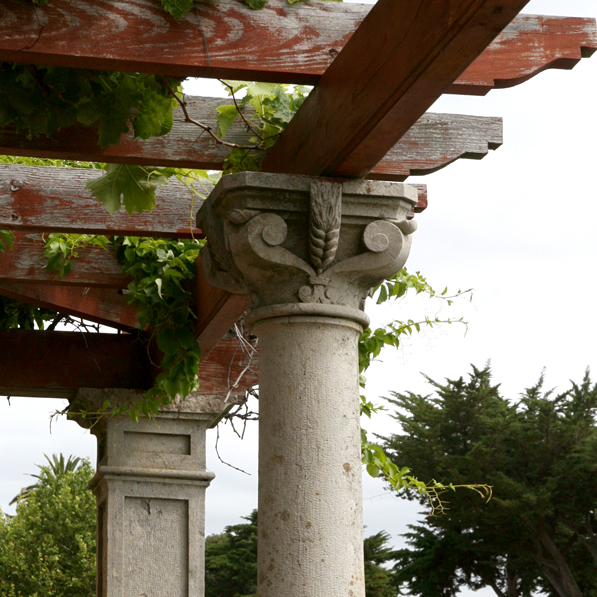
Pergola by Portuguese architect Raul Lino. (Old Portuguese Stuff)

Pergola by Portuguese architect Raul Lino. (Old Portuguese Stuff)

These capitals above by Portuguese architect Raul Lino (1879-1974), with more shots linked to down below, were sent by Malcolm Millais, author of Exploding the Myths of Modern Architecture (2009), as an antidote (I think) to the snow in Providence, of which I have complained. They were taken by his friends Alexandre Gamelas and Catarina Santos, who have a delightful blog called Old Portuguese Stuff, where they write:

The delights of traditional architecture designed purposely to look vernacular. Raul Lino is the master at this game; his houses could have never grown organically over time or been built by an unlearned master-builder. The ensemble is consistently designed throughout, using vernacular details as any American or British architect in the early 20th c. – as a means for Invention within Tradition.

This open porch, covered with a pergola, is such an example. All the elements, rails, paving, pergola, columns, door and window surrounds, come from an extensive catalogue of parts and styles, and are here combined to create an ensemble [that] is coherent, traditional and naturally “of its own time,” without ever aiming for it.

Ah, the snow’s already beginning to melt!

Posted in Architecture, Art and design, Blast from past, Other countries | Tagged , , , , | 3 Comments

On “Cognitive Architecture”

event-cognitive-architecture-254x400Ann Sussman will be in Boston on Tuesday evening to discuss her book Cognitive Architecture. She will speak at an event sponsored by the New England chapter of the Insitute of Classical Architecture & Art beginning at 6 in the College Club of Boston, at 44 Commonwealth Ave. More details and reservations are here.

Since I’ve been immersing myself in this subject via the work of Nikos Salingaros and Michael Mehaffy, whose recent book Design for a Living Planet I reviewed here, I am eager to hear Ms. Sussman, who wrote her book along with Justin Hollander. It is subtitled “Designing for How We Respond to the Built Environment.”

Here is how the ICAA chapter website’s event calendar describes the book, published by Routledge: It “reveals the subconscious tendencies at work when we navigate the world around us. These ‘hidden’ predispositions reflect our long evolutionary trip as revealed by recent research in psychology and neuroscience, and can help explain why we favor certain urban conditions and building configurations and shun others.”

I can’t believe I am unfamiliar with Sussman’s book. Well, not for long.

Dark cloud: Amazon has a blurb praising the book by Moshe Safdie. Uh-oh. I am braced. I read stuff that contradicts my views all the time, but I don’t expect that from the ICAA. Can it be that Safdie is broad minded or just wrote a blurb because he looked at the subject of the book and assumed that it reflects the fraudulent way modernists hitch their work to science when they know nothing about science at all. Well, again, Tuesday evening we shall see.

Posted in Architecture, Architecture Education, Art and design, Books and Culture, Urbanism and planning | Tagged , , , , , , | 4 Comments

Another battle in Charleston

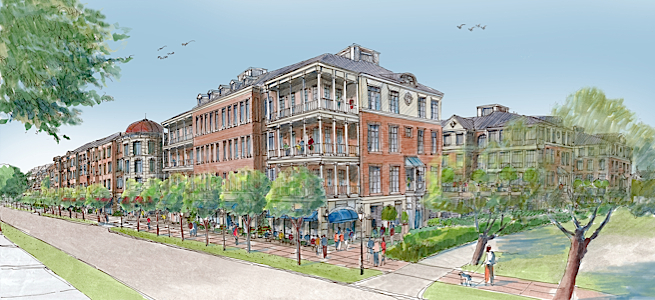
Proposed mixed use project on edge of Charleston's downtown historic district. (charlestoncitypaper.com)

Proposed mixed-use project on edge of Charleston’s downtown historic district. (charlestoncitypaper.com)

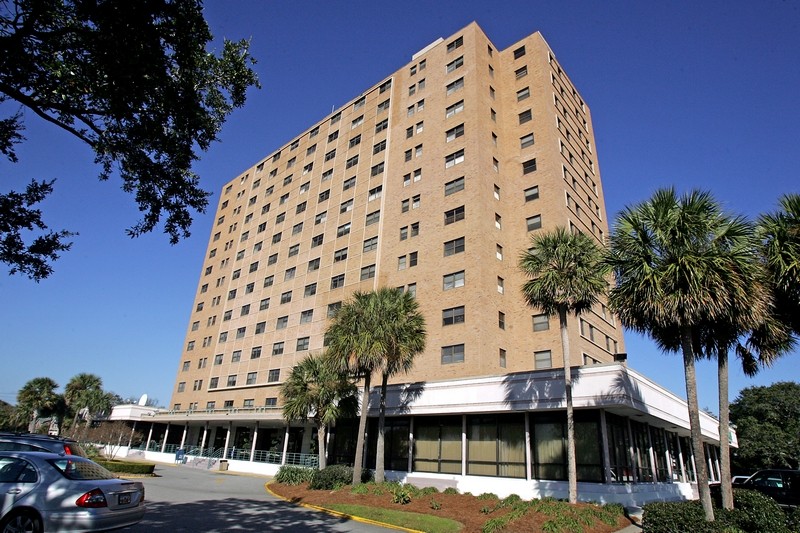
A developer in Charleston proposes to rip down an ugly modernist tower of 14 stories, built in 1949, and replace it with three mostly four-story buildings that reflect the city’s historic architecture. You’d think preservationists there would favor that. Instead, they’ve raised objections because while the Sgt. Jasper Tower is abandoned and empty, its replacement would have residents, and residents would have cars, and cars mean traffic and … etc., etc.

Sergeant Jasper Tower. (postandcourier.com)

Sergeant Jasper Tower. (postandcourier.com)

Good grief! The rendering above speaks for itself. So does the photo to the left. Does the Preservation Society of Charleston know what it is about?

Of course renderings can be deceptive, and the one above shows no hint of the portion of the project that is seven stories, set back from the street façade of one of three four-story buildings designed by Glenn Keyes Architects. And there’s no telling whether the actual work will reflect the elegance of the illustration. This is a key issue. In Providence, a design for grad-student apartments near Brown University that evolved toward great virtuosity under local pressure seems now to have been constructed with less of the beauty that seemed to inhabit the drawing by Union Studio Architects.

But replacing the existing Jasper Tower with something like what a local group called The Beach Company has proposed should be the chief goal of preservationists in Charleston, not preserving the exclusivity of a wealthy neighborhood. Density and parking concerns are very important, but they still are secondary in a situation like this. Having more people of a wider range of income, many of whom will work nearby, may even reduce the cars and traffic, since many of the new residents probably drive into the area now. The project also contains a possible 24-hour grocery store, which will help the entire neighborhood.

The only thing that would be more depressing than citizens trying to thwart such a lovely proposal because of concerns over traffic congestion would be for citizens to demand that the Sgt. Jasper Tower be preserved because of its ugly midcentury modernism. It is, after all, “historic” by preservationist standards. I hope this contingent of cranks remains mum!

The job of Charleston’s preservationists should be to help citizens maintain enough pressure on the developer to ensure that the project lives up to the rendering, which is gorgeous. And not just to the rendering but to the spirit of beauty that the rendering seems eager to convey. Craftsmanship and sensitive fabrication are key to the quality of the result.

Getting rid of abominations like the Jasper Tower is precisely job one for preservationists. It’s chief rival for that priority is to ensure that new development reflects and strengthens the historical fabric. The refusal of preservation authorities across the country to recognize this is one reason preservation organizations have trouble maintaining membership levels these days.

Posted in Architecture, Art and design, Development, Preservation, Urbanism and planning | Tagged , , | Leave a comment

Corbusier invades New York

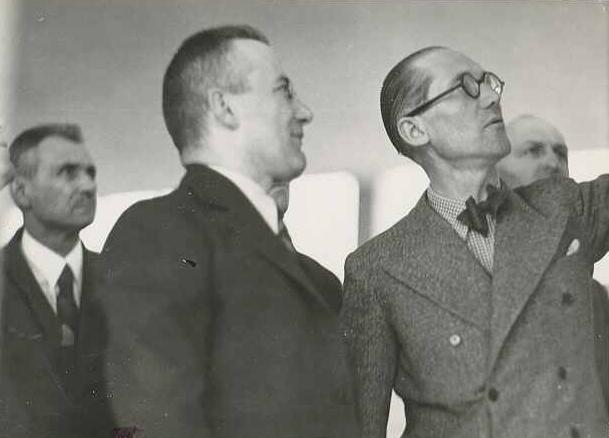
Le Corbusier in 1935. (fondationlecorbusier.fr)

Le Corbusier (right) in 1935. (fondationlecorbusier.fr)

Le Corbusier, a founder of modern architecture, traveled in 1935 on his first trip to America. A Frenchman born in Switzerland, he thought New York City would receive him like a god and was mistaken.

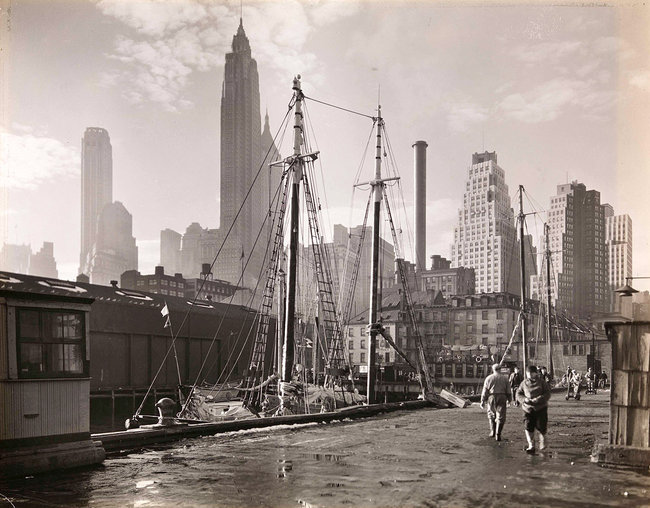
New York, Fulton Street docks, in 1935, by Berenice Abbott. (wirednewyork.com)

New York, Fulton Street docks, in 1935, by Berenice Abbott. (wirednewyork.com)

Here I am pleased to present a couple of excerpts from Modern Man: The Life of Le Corbusier, Architect of Tomorrow, by Anthony Flint, of the Lincoln Institute of Land Policy, in Cambridge. The prose crackles, the story hums, and I intend to review it at greater length after I’ve finished reading it. For now it is a roller-coaster ride as the author seems to sing veritable hosannas to my bête noire, nay, seems to eager to excuse by faint damnation the multiplicity of what Flint seems to consider Corbu’s foibles and peccadilloes – but then, time and again, the author is forced to lay bare the awful truth.

The nitty-gritty on that is to come, but I have to say I enjoyed the pain Flint seemed to feel at having to relate the details of Corbu’s visit to America. I like to think that Flint is setting his readers up, and that as the book reaches toward its conclusion the boom will be laid upon the truly nasty Corbusier. We will see. For now, enjoy his failed first trip to America:

“Skyscrapers Not Big Enough, Le Corbusier Says at First Sight,” read the headline in the New York Herald Tribune, above a picture of the architect looking up through Coke-bottle glasses, owlish and goofy, even slightly depraved. He later claimed the flash surprised him and couldn’t understand why the assembled photographers weren’t interested in his studio portraits from back in France, which he offered to them for the bargain sum of five dollars each. … Le Corbusier pocketed the pictures, looking slightly injured.

The accompanying article, by a young Joseph Alsop, an Ivy League-educated skeptic of modern architecture who would go on to become a noted national political columnist, described the visitor in unflattering terms and is thought to have coined the term “egghead” in the process.

Alsop, along with his brother Stewart, had already reached the pinnacle of the Washington commentariat and was heading down when I was a kid in the District of Columbia. Flint continues:

In the subheadline, Le Corbusier’s “Radiant City” was translated as the “Town of Happy Light,” like an absurd item on a Chinese takeout menu. With the dubious Alsop at the keyboard – who spoke perfect French, favored bow ties, and in later years wore round eyeglasses exactly like Le Corbusier’s – the outmatched Parisian didn’t stand a chance.

Ah! Knowing that the last laugh would be Corbu’s, the details of his disappointment in America early on warm the cockles of my heart. Thank you, Anthony Flint.

But I cannot abandon this post without quoting Mencken from an editorial called “The New Architecture” in The American Mercury three years earlier, in 1931. Very sad. How wrong, how dreadfully wrong, he was:

The New Architecture seems to be making little progress in the United States. … A new suburb built according to the plans of, say, Le Corbusier, would provoke a great deal more mirth than admiration.

Sigh.


Posted in Architects, Architecture, Architecture History, Urbanism and planning | Tagged , , , , | Leave a comment

“Design for a Living Planet’

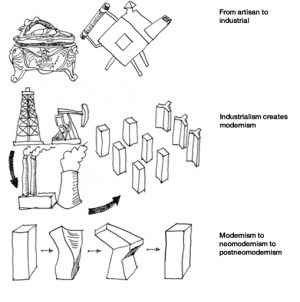
"The form language of nature is not mechanical in the 'modern' sense." (Carl Barks, 1948, redrawn by Nikos Salingaros)

“The form language of nature is not mechanical in the ‘modern’ sense. The only known exception: Donald Duck discovers square eggs” (Carl Barks, 1948, redrawn by Nikos Salingaros)
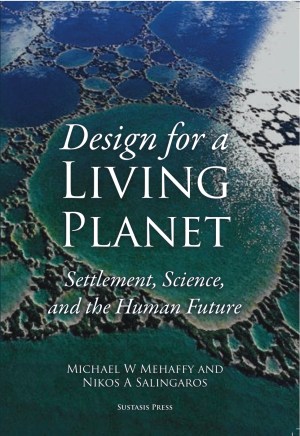
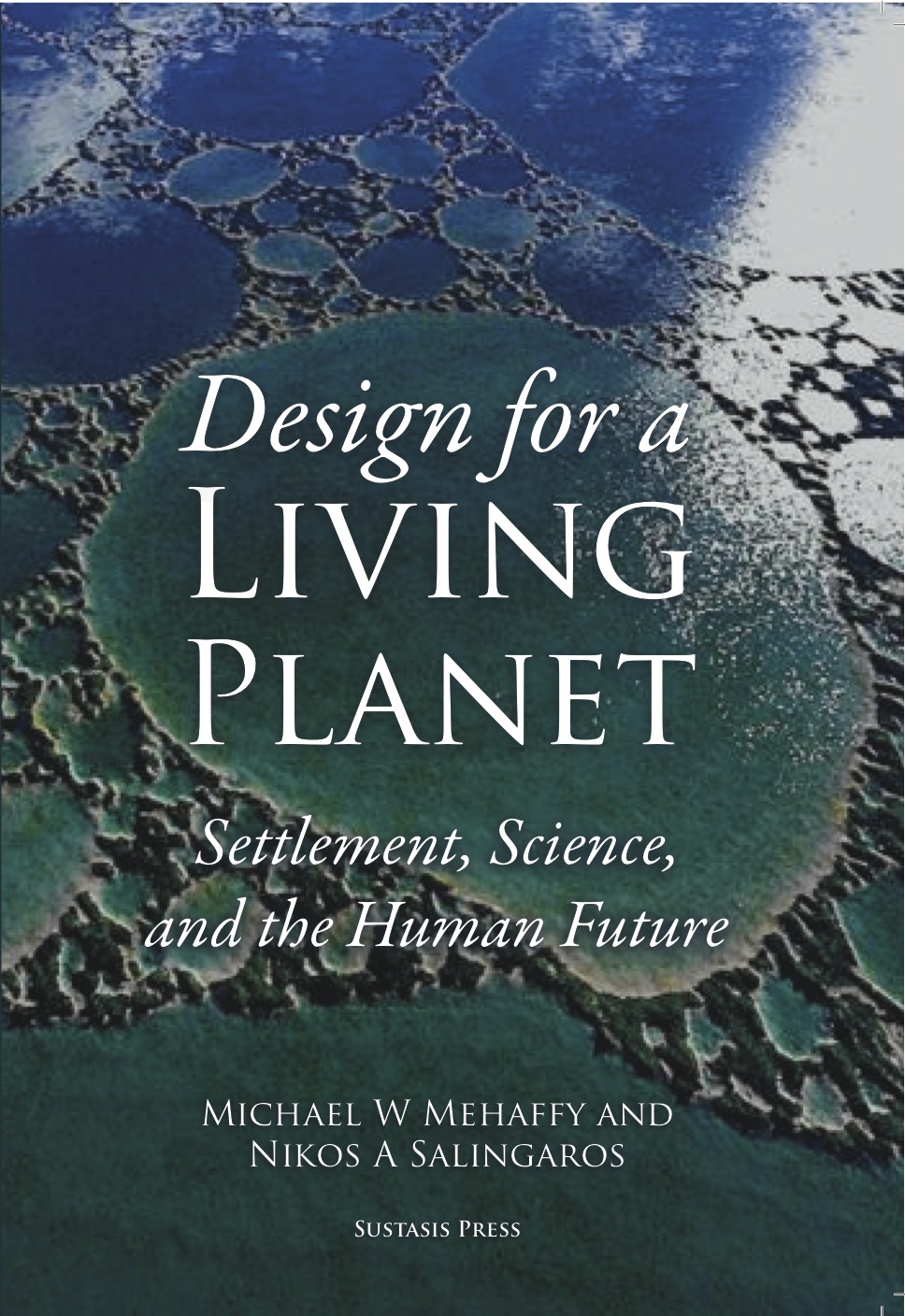
Published by Sustasis Press in 2015.
Published by Sustasis Press in 2015.

More Salingaros drawings (click to enlarge)
More Salingaros drawings (click to enlarge)

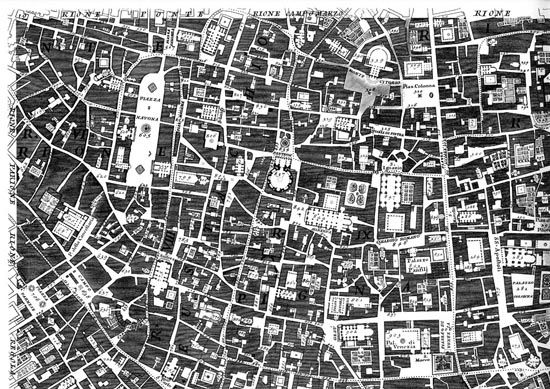
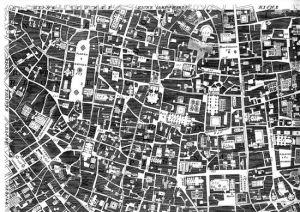
Nolli map of Rome. (rchitecture.wordpress.com)

Nolli map of Rome. (rchitecture.wordpress.com)

Fractal (highintelligenceoffice.com)

Fractal (highintelligenceoffice.com)

In their newly published book, subtitled “Settlement, Science and the Human Future,” authors Michael Mehaffy and Nikos Salingaros argue that human well-being, indeed survival here on Earth, requires replacing our overly mechanized, technologized way of life with patterns of living that better reflect … life.

That sounds like an easy bromide but Design for a Living Planet provides a roadmap for getting there, and argues persuasively why the attempt must be made. The hard part, unfortunately, is not how to remake our lifestyles and settlement patterns in the image of Mother Nature, the recipe for which is in this book. It is how to break away from a culture that may be heading toward epic fail but won’t face up to the need for action. That should be the subject of their next book.

Although worst-case scenarios are often pressed to service in Planet, readers needn’t buy entirely into climate-change alarmism to feel the need for drastic reform. The seas may or may not rise above higher and higher sea walls, but what persuades me that the book’s prescriptions are compelling is the rush of society toward the model exemplified by Blade Runner, not to mention 1984 and Fahrenheit 451. In short, the growing gap between elite and prole as the middle class evaporates, and the physical and intellectual breakdown this implies. The theme is not new and neither is the prescription, really. But this slender yet profound volume brings science into the equation more emphatically and comprehensively than ever before.

The world needs more resilience, argues Planet, and it strikes the authors as evident that trying to emulate nature will be more helpful than trying to defeat her.

Professor Salingaros is a mathematician and design theorist at the University of Texas at San Antonio, and teaches around the world. Mehaffy, also an urbanist, computerist and design theorist once associated with Prince Charles’s Foundation for Building Community, now leads the Sustasis Foundation in Portland, Ore., which processes new thinking about human habitation. Much of the book recasts essays the two have written for Metropolis magazine. Its editors’ willingness to publish the pair’s anti-establishmentarian articles is a good sign that honest doubts about the current regime are opening cracks within which a more sensible alternative may gather its strengths.

Salingaros and Mehaffy do not mince words when it comes to pointing the fickle finger of blame at modernism – especially its architectural and planning establishments:

The origins of architectural Modernism are closely affiliated with the progressive goals of the early Twentieth Century, and the humanitarian ideals – even the utopian zeal – of well-meaning visionaries of that day. Those individuals saw a promising capacity, in the dawning industrial technology of the age, to deliver a new era of prosperity and quality of life for humanity. At their most credulous, its leaders were clearly enraptured by the seemingly infinite possibilities for a technological utopia. From that they developed an elaborate – and in surprising ways, still poorly evaluated – theory about the necessary new tectonics and form languages of the civilization of the future. Their followers today still argue that it is, unquestionably, Modernism that is best positioned to don the mantle of sustainability.

In light of the association of the founding modernists with Nazi Germany it is fair to doubt some of that. Mies van der Rohe thought modernism should be the design template for the Third Reich. Le Corbusier wanted Paris to demolish its center city on the basis of theories so obviously inimical to the common good that a third grader could have defenestrated them, if any third graders had been listening. But even giving the modernists the benefit of the doubt, it turns out that they had merely fashioned an enticing new brand – “The Future!” – for a consumerist society, not a credible plan for improving it.

Like other thinkers (often writing in pairs), Mehaffy and Salingaros shrink from merely stating that the answer to present problems is the past. For example, John Massengale and Victor Dover wrote their excellent Street Design in 2014 to suggest a generally useful set of rules for animating streets, even though a trip through their illustrations suggests that if you line streets with traditional buildings, they will be loved and animated. In like manner, Mehaffy and Salingaros prescribe a set of rules for sustainable architecture and planning that resembles how biological systems grow and procreate, but then they turn around and argue that society produced essentially the same set of rules through the process of trial and error that caused sustainable cities to grow organically over centuries.

We can certainly use an adaptive design algorithm with a traditional form language to design very different buildings depending upon different initial conditions. The best classical and traditional architects have always known this, and have exploited it in the past to build the world’s most loved and sustainable cities by re-using much older form languages in their own day: Paris, London, Rome, and many others.

Not that the best classical and traditional architects thought in terms of adaptive design algorithms. You could almost say that the answer is just to build cities as we did before World War II. Almost, but not quite, because the designers of Paris, London, Rome, etc., did not need, first off, to dislodge an entrenched cult that dominated the power centers of the design and building arts of that or any prior era of architecture and city planning.

Sort of like sans serif typefaces, modern architecture and planning have drastically reduced the number of “cues” of how to read a building or a street that is the purpose of architectural detail, beyond the utilitarian purpose of directing rain away from building joints. Embellishment is not just ornamental or utilitarian; its attractive qualities help get our minds to pay attention to what buildings are saying to us:

Let us not underestimate the radical but unnoticed societal shift from experiencing our environment intimately yet subconsciously to requiring a constant conscious effort to navigate it [the infamous “Where’s the entrance?” problem of modern architecture] while keeping an intellectual and physical distance. It now appears this is carrying a tremendous if unrecognized cost to the quality of life.

And again:

Under a misguided theory of environmental structure that confuses simplicity with order, we have been stripping away the critical connected scales and fractal relationships within our environment. We have replaced a world of richly connected urbanism with a disordered geography of artfully packaged, catastrophically failing art-products.
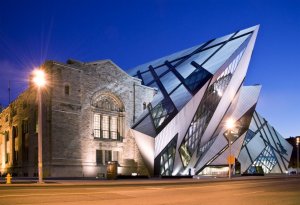
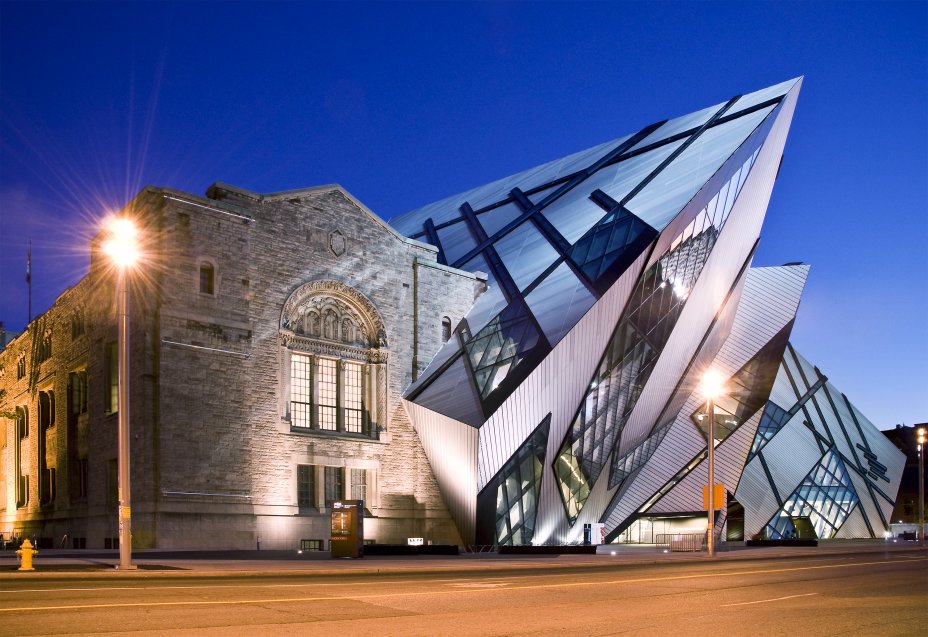
Royal Ontario Museum, Torono, by Daniel Libeskind. (blog.mycondommylife.com)

Royal Ontario Museum, Torono, by Daniel Libeskind. (blog.mycondommylife.com)

Part of the fraud of modernism is its claim to science. Today, starchitects claim to use fractals in their design when in fact they are using fractal shapes without understanding what fractals are. To modernists, as Salingaros has complained elsewhere, the apparent meaning of the word fractal is “broken.” And yet, how appropriate! Architecture today sees its highest goal as reflecting our broken society, not fixing it. A fundamental mistake. As the top architects are in the 1 percent, or at least sucking its tit, this should come as no surprise.

It is unlikely that a break from the present, as it were, is likely to come through a mere pining for beautiful cities, however widespread. Anecdotal and scholarly evidence amply demonstrate that most people have preferred traditional design for as long as traditional design has had a deeply (and purposely) obnoxious alternative. But even in democracies, as critic Aaron Betsky points out, rich and powerful people commission buildings, not the public. (Though in his latest version of orthodoxy’s defensive crouch, Betsky concedes this is not necessarily a good thing.)

Nor is it likely that the very sensible prescriptions in Planet will cause much of a stir in the academy or the profession. But the method has to be out there for architects, planners and other decision makers in our society to turn to when the tipping point comes (whatever form it may take). Not only do Mehaffy and Salingaros put it out there but they do so in the most brilliant way. I did not expect that Planet would be as amusing as From Bauhaus to Our House, but I was surprised at how accessible it was.

Most people will not leap with both feet into chapters entitled “Scaling and Fractals,” “The Meaning of Complexity,” “The Transformation of Wholes,” “Complex Adaptive Systems,” “Evidence-Based Design,” “Biophilia” and “Computational Irreducibility,” to name some chapters in parts II and III. But through a process of repetition, Salingaros and Mehaffy gently beat the science into your head. I wondered at first whether the book might be too redundant. But long before the end I felt relatively comfortable with the concepts involved. The book is 236 pages – wafer thin for a scientific tome.

This reviewer’s feeble understanding of the scientific processes he ignored in high school and dodged altogether in college was greatly assisted by reading Planet‘s constant iteration of its basic themes again and again and again. For example:

More recent scientific investigations reveal the richly complex geometry of living environments – including human ones. The geometries of those natural structures “evolve in context” as complex adaptive forms, through a process known as “adaptive morphogenesis.” As a result of that process, living geometries have particular characteristics. They differentiate into a range of subtly unique structures, and they adapt to local conditions, giving such environments stability and resilience. They achieve great complexity and efficiency through their evolution – and great beauty, in the form of a perceivable deeper order.

Toward the end of the book, after making continued reference to it, the authors devote Part IV to the work of Christopher Alexander, most famous in architectural circles for his book A Pattern Language. That book broke down the features of towns and buildings into conventional patterns handed from generation to generation because they encapsulated useful techniques for accomplishing specific architectural goals. Alexander’s architectural work speaks, in my opinion, less to beauty than to utility, but a utility whose beauty is more practical than the feigned utility on which modern architecture preens itself.

But Alexander’s ideas on how parts transform into wholes were discovered, almost accidentally, by early computer gurus. His first book, Synthesis of Form (1964), led to improvements in computer programming that generated such design movements as extreme programming and such unfathomable boons to humanity as the Wiki application invented by Ward Cunningham that led to Wikipedia. His work has led to computer games like SimCity and Spore. Salingaros has worked collaboratively with Alexander for decades.

Alexander’s fundamental insight is described in Planet as:

[W]e’re doing something wrong in the way we make things. We’re substituting an oversimplified model of structure-making – one more closely related to our peculiar hierarchically limited way of conceiving abstract relationships – in place of the kinds of transformations that actually occur regularly in the universe, and in biological systems especially.

Alexander is considered an architectural crank by most establishment architects who recognize his name. But his influence in the world of computers and the Internet is a model of conceiving today’s systems in more natural, organic ways, and provides a gravitas to his ideas that eventually must, and will, catch society’s ear.

Breakdown increasingly afflicts every society in small ways and large – from the inability to fill potholes and balance municipal budgets to the instability of nation-states around the globe (not to mention the climate). As the usual suspects’ solutions fail one by one to solve problems, the establishment will be forced to consider unconventional solutions that increasingly resemble those described in Planet. One needn’t call for a return to kings, castles and horse-drawn carriages to recognize that humanity has lost its way and may need to go back a few miles before it can reacquire the road forward.

We must return to building on the best practices of the past rather than rejecting them in favor of novelties. That the tried and true have been jettisoned by the establishment of one of the world’s oldest professions – with engineering taking the sloppy seconds of architecture’s fame and fortune for covering up its errors and literally preventing its absurd creations from falling down – is a phenomenon that beggars the imagination. How could this be so? That question, too, is addressed in Planet.

The built environment lacks the phalanx of defenders who speak up for the natural environment. Cities and towns are central to the lives of all people, and their design – or lack of it – influences the quality of life in ways that for many decades have been beneath the notice of the architectural community, but also the leaders of our democracy. The built environment must become an issue of no less importance than education, public safety, finance, justice, job creation and other matters on which reporters report, commentators comment, politicians procrastinate and voters decide.

How to remove the built environment from the inept hands of technocrats beholden to plutocrats and place it in the hands of those with the people’s well-being in mind is a challenge for another day. Meanwhile, Design for a Living Planet is an indispensable roadmap to understanding the ordered complexities society must master to survive.

Posted in Architects, Architecture, Architecture Education, Architecture History, Art and design, Books and Culture, Urbanism and planning | Tagged , , , , , , | 5 Comments

Laurel, Hardy and the girl

Adds new information on the featured singer, Ilhama Gasimova, the history of the song and a video on how the video was made.

David Brussat's avatarArchitecture Here and There

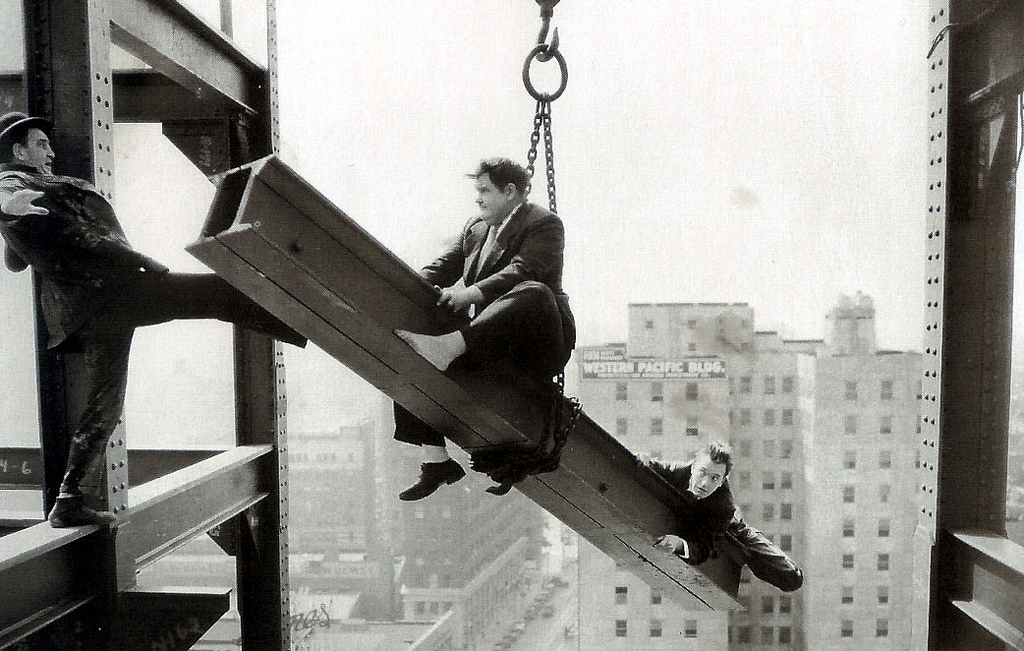
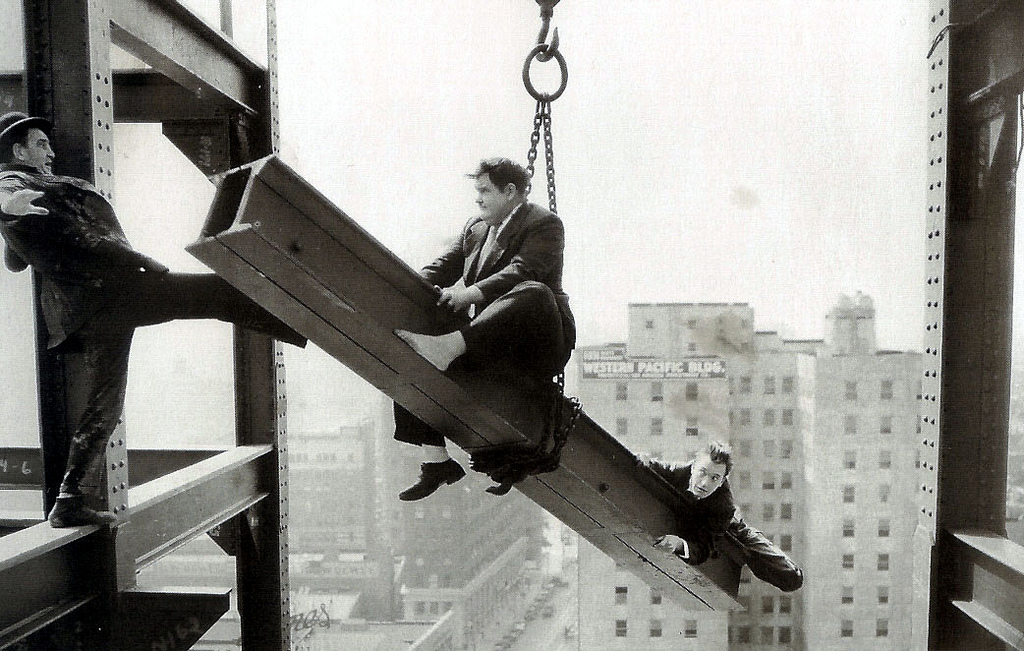
Note architecture in clip from Laurel and Hardy film. (emmanuelevening.org) Note architecture in clip from Laurel and Hardy film. (emmanuelevening.org)

My friend Lee Juskalian sent me a video that reminds me of a video from Gizmodo.com that I posted as “Painted girl evolves,” with the excuse that the stop-motion painting of the face of a girl named Elvis Schmoulianoff had something to say about art and beauty, if not necessarily architecture.

Lee’s video, ILHAMA feat. DJ OGB, (whatever that means), had similarly strange music and I think the girl may be the same, but I can find no conclusive evidence that she is Elvis. Still, the video is striking, sort of a mix between the Elvis girl opus and another video, a string of clips of Rita Hayworth dancing to the BeeGees’ “Stayin’ Alive.” Except that ILHAMA features clips from Laurel and Hardy films, with what might be the same Elvis girl dancing intermittently between L&H clips…

View original post 122 more words

Posted in Uncategorized | Leave a comment

Laurel, Hardy and the girl

Note architecture in clip from Laurel and Hardy film. (emmanuelevening.org)

Note architecture in clip from Laurel and Hardy film. (emmanuelevening.org)

My friend Lee Juskalian sent me a video that reminds me of a video from Gizmodo.com that I posted as “Painted girl evolves,” with the excuse that the stop-motion painting of the face of a girl named Elvis Schmoulianoff had something to say about art and beauty, if not necessarily architecture.

Lee’s video, ILHAMA feat. DJ OGB, (whatever that means), had similarly strange music and I think the girl may be the same, but I can find no conclusive evidence that she is Elvis. Still, the video is striking, sort of a mix between the Elvis girl opus and another video, a string of clips of Rita Hayworth dancing to the BeeGees’ “Stayin’ Alive.” Except that ILHAMA features clips from Laurel and Hardy films, with what might be the same Elvis girl dancing intermittently between L&H clips, with and without others, and a DJ scraping some disc in the hip-hop manner.

All this appealed to me and I hope it will to you. Maybe you can suggest who she is and whether they are the same girl. To illustrate this post I will try to find a clip with some sort of architecture in the backdrop of a shot of Laurel and Hardy. That’s my excuse and I’m sticking to it.

A tip of the hat to Malcolm Millais, author of Exploding the Myths of Modern Architecture (2009), for sending along this site, Jewish Humor Central, that gives the provenance of this swell video, including a video on how it was made. It stars Azerbaijani singer Ilhama Gasimova.

Posted in Architecture, Art and design, Humor, Old Video | Tagged , , , , , , | 2 Comments

Lurking behind this facade

Reposting to correct and clarify.

David Brussat's avatarArchitecture Here and There

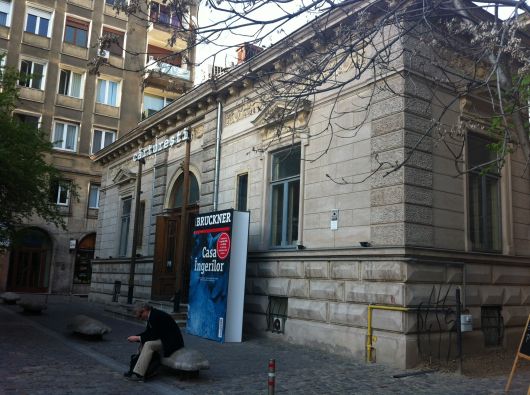
Old facade of a new business in Bucharest. (boredpanda.com) Old facade of a new business in Bucharest. (boredpanda.com)

Behind this stern but elegant classical façade – in Bucharest! – lurks one of the most astonishing and effective mixtures of the old and the new that I have ever seen. And the fact that it is a bookstore, restored to its former dignity after being confiscated by Romania’s communist regime, tops all things. Open the link to the new Carturesti (Carousel of Light) Bookstore. The interior design is by Square One, of Romania, most of whose work, aside from this one project, stinks of the usual orthodoxy. Tell me if you agree that this fine-grained contemporary treatment of a classical interior meets with your approval, and whether it embraces the aesthetic criteria of rhythmic complexity that I have long considered a requirement for modernism to fit with coherence into a traditional setting (interior or exterior). Most attempts to…

View original post 279 more words

Posted in Uncategorized | 1 Comment

Imber’s nimble AIA tag

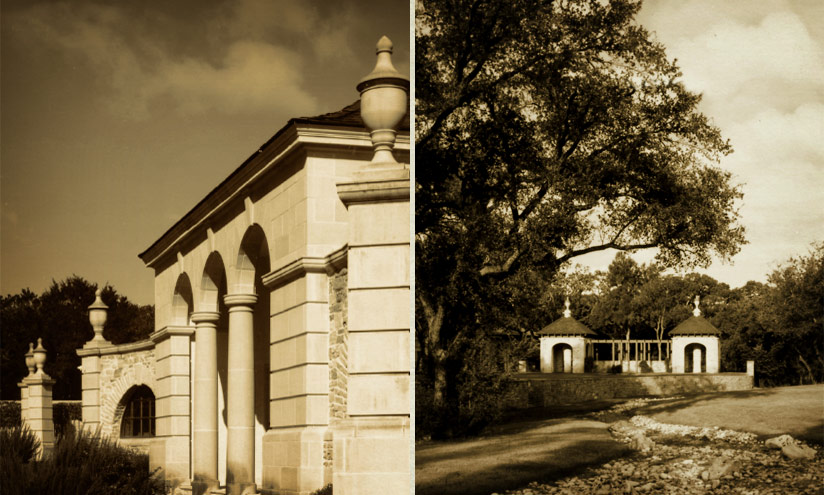
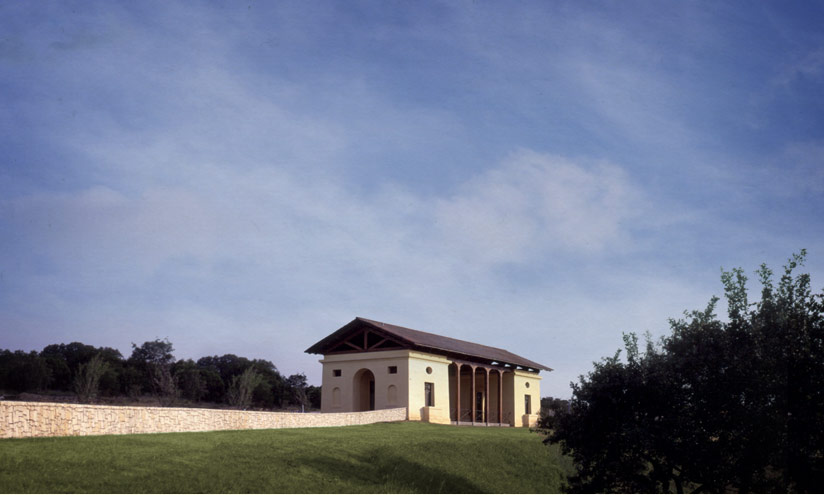
From the website of Michael G. Imber Architects.

From the website of Michael G. Imber Architects.

Architect Michael Imber is well known among classicists in America. His practice in Texas ranges from classicism touched with a coy creativity to a Mission style elegantly reflecting its Southwest influences. He has become increasingly perturbed at the state of architecture in America and the world, with its addiction to novelty above all else. Nothing wrong with innovation but, as Imber deftly points out, it must not stray beyond utility. How odd, and sad, that the quality of usefulness is so frequently the first aspect of this supposedly practical art to get the heave-ho from modernists.

The list of ways most architects fly in the face of the goals of architecture from time immemorial beggars the imagination, and much of it is contained in Imber’s crie de coeur, in which he points a cranky finger at the American Institute of Architects. Even the organization seems to sense that things have gone awry. It has instituted a “repositioning,” that, alas, seems very much to resemble a circling of the wagons. Clearly, the AIA has led architecture so far astray that it seems truly to have no idea what all the fuss is about.

In “The State of Architecture,” Imber tags the AIA for snubbing the ideals it was founded in 1857 to promote. He predicts that under current leadership, architects “are doomed to be continually hitting the reset button.” Imber’s editorial has been sent out by John Massengale along with a petition for reforming the AIA. It is here. Although directed at AIA members, let’s all sign it, and help bring architecture into the 21st century.

From the website of Michael G. Imber Architects.

From the website of Michael G. Imber Architects.

Posted in Architects, Architecture | Tagged , , , , | 2 Comments