

“Declaration of Independence” (1819), by John Trumbull.
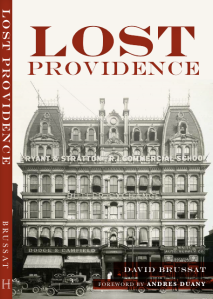
As a blogger, I am remiss in not having posted for a month and a half, nor have I explained that what I cannot attribute to laziness I may attribute to writing a book, my first since Lost Providence (2017). This second book is now 98 percent written.
Okay, having got that over with, I think it appropriate on Independence Day to refer to the meaning of the name of the city of Providence. Although we Rhode Islanders are more familiar with the name’s derivation from founder Roger Williams words “having a sense of God’s merciful providence unto me in my distress” (he had been banished from Massachusetts), I like to think of it in the sense of providential, either opportune or divinely inspired. The two are not contradictory.
Rhode Islanders take more pride from being the first colony to declare independence from England than from being the last of the 13 former colonies to ratify the constitution of 1789.
My sense of the meaning of Providence relates to the fact that Rhode Island is one of only two American states, so far as I know, that were independent countries before they became states. The other was Texas. I’m not sure how one would classify pre-statehood Hawaii, and I do not include the insurrectionists of 1861. I wonder how Rhode Island thought of itself during that period, after twelve of the rebel colonies had ratified the United States Constitution by 1789, but not Rhode Island.
In 2018, Rhode Island History Journal ran an essay by historian Robert W. Smith called “Algiers or St. Eustatius: Foreign Affairs and the Ratification of the Constitution in Rhode Island.” He writes:
Two paths seemed to lie before Rhode Island if it did not ratify the Constitution of the United States. A Federalist writer in the Newport Herald claimed that “the paper money leaders flatter themselves that their unfederal conduct in not sending Delegates to [the Constitutional] Convention and not permitting the people to meet to consider the new Constitution, may cause them to be thrown out of the Union, and then they will become the Algiers of America.” The Federalists made the idea of independent Rhode Island as a pirates’ den a recurring theme in their literature. [Of course, Rhode Island was already widely known as Rogue’s Island for accepting those banished from Massachusetts, from other colonies, and both religious and nonconformists generally.]
The writer went on to claim that, if necessary, Rhode Island’s leaders would seek British protection against the United States. Rhode Island’s fate would be sealed, as the United States would not permit that outcome. “Sooner than such an event should take place, we should see our country wasted with destruction, our fields drenched with blood, and our little territory parceled out among the adjacent states.”
In the limited amount of Anti-federalist literature, Rhode Island independence was more of an opportunity than a danger. An Anti-federalist under the name “Charlestoniensis,” who may have been Jonathan J. Hazard of the Country Party, responded to Federalist criticism. “I will observe that, in that case [that Rhode Island does not ratify], this state will not become an Algiers, as some malevolent scribblers in Massachusetts have impudently asserted, but a St. Eustatius.” St. Eustatius was a Dutch-owned island in the Caribbean that functioned as a free port – an “entrepôt for the trade between Europe and the United States.”
That is the argument for the sense of “Providence” as opportune. The other sense of divinely inspired we are all familiar with, so I will end here, not having finished this very long essay by Smith, and not certain where it leads.
Whether in the context of an “opportune” port such as Providence or in its sense of “divinely inspired,” the Declaration of Independence and the Constitution are worth celebrating today, and struggling, as ever, to protect.
We hold these truths to be self-evident, that all men are created equal, that they are endowed by their Creator with certain unalienable Rights, that among these are Life, Liberty and the pursuit of Happiness. That to secure these rights, Governments are instituted among mean, deriving their just powers from the consent of the governed.
Happy Independence Day.




 Architecture Here and There
David,
In the interest of historical accuracy, the Confederate States were secessionists, NOT insurrectionists. Admittedly, the latter word is one that gets thrown about with not a little abandon these days!
Milton
LikeLike
Publication date? I’m a buyer.
LikeLike
Enjoyed your Independence Day salutation David. I’m anxious to read your new book HURRAY! I am hopeful that Providence will look upon you and your book as divinely inspired as your usual subject is still in need of divine inspiration.
LikeLike
🇺🇸‼️
LikeLike