

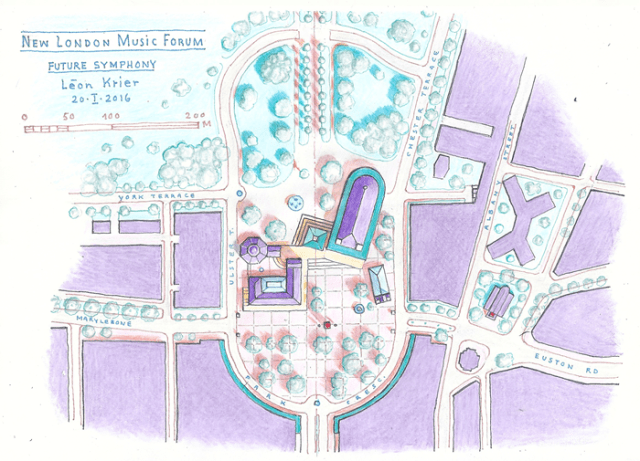
Proposal for a new concert hall and complex at Regent’s Park, London. (Leon Krier)
On my first trip to London in 1979 I took in a classical performance of the London Symphony Orchestra at the Royal Festival Hall on the Southbank embankment of the Thames. I felt the hall’s demerits as architecture even back then, more than a decade before I started writing about buildings. I consider the experience as evidence that people who do not think about architecture nevertheless feel, intuitively, the difference between modernist and traditional design. It is not impossible to like modernist buildings, but aside from an occasional “Wow! factor” of initial response and an even more occasional positive response to extraordinarily rare good modernist design, it is a learned as opposed to a natural feeling. Often, however, it is a response embraced, if not genuinely felt, for reasons having more to do with social status, careerism, politics and ideology. The innocent dislike I felt for the design of the Royal Festival Hall back then vindicates a lot of my thinking about attitudes toward architectural style today.
Sorry. Please excuse my digression. I write this post to heap praise and glory on Léon Krier for his proposal to build a new concert hall, which he calls the London Music Forum, that would sit between Regent’s Park and Crescent Square in the West End. This location brings to mind the phrase “hidden in plain view.” Why have Londoners had to wait decades for such an obvious solution to the even more obvious problems of the Royal Festival Hall at Southbank and another major London concert center at the Barbican?
It is because beauty and common sense are not favorites of the design establishment or, for that matter, of any government. Beauty and common sense are especially tedious if they bring success, for that could very well set a precedent that would (those in authority assume) be difficult to meet, and the result might cause the public to demand more.
Krier’s call for a London Music Forum, which he says would be an “act of redemption,” is proposed as an alternative to current flawed plans to build a new home at various other locations for the London Symphony Orchestra. After detailing his proposal, Krier writes:
Astute observers will notice that this very specific vision represents a departure from the orthodoxies that have lately governed civic and urban development – and that left their indelible scars upon the face of London in both the Barbican and Southbank. While the machinery of mega-project planning is already underway to impose on Londoners yet another soul-crushing, inhumane super-structure, it would be prudent to take a step back and consider just what were the mistakes of the halls we now need to replace, what should be done differently this time, and what are the priorities that follow from a broader, long-range goal of making a truly accessible and enduring home for the London Symphony.
Encore bravo, maestro!




 Architecture Here and There
Pingback: The good, the bad, the ugly | Architecture Here and There
Pingback: Krier: Politicians, take note | Architecture Here and There
Tell me more about this strange assumption nobody goes to the RFH?
LikeLike
I did not say and I do not think Leon Krier was saying that nobody goes to the Royal Festival Hall, only that its architecture hurts the experience of doing so, and possibly limits the extent of activities before and after a show that concertgoers want to undertake in its vicinity. Sometimes a poor option is the only option, so people do go there. Nobody is denying that.
LikeLike
Pingback: “Orchestrate a Renaissance” | Architecture Here and There