

Rose Window at Chartres Cathedral. (flickr.com)
Steven Bingler and Martin Pedersen, the architect and the writer who called on architects to pay more attention to public taste, do not seem to realize it, and would probably not admit it, but their essay in the New York Times last week was not just a critique of modern architecture or a call for traditional architecture. It was that at least, but so much more.
After noting in their piece “How to Rebuild Architecture” that the late architect Philip Johnson “and the proverbial little old lady from Dubuque could stand beneath the Rose Window at Chartres and share a sense of awe,” Bingler and Pedersen write:
To get back there, we must rethink how we respond to the needs of diverse constituencies by designing for them and their interests, not ours. We must hone our skills through authentic collaboration, not slick salesmanship, re-evaluate our obsession with mechanization and materiality, and explore more universal forms and natural design principles.
And if “their” tastes are traditional, which much of the essay implicitly suggests, then “universal forms” and “natural design principles” can have only one meaning.
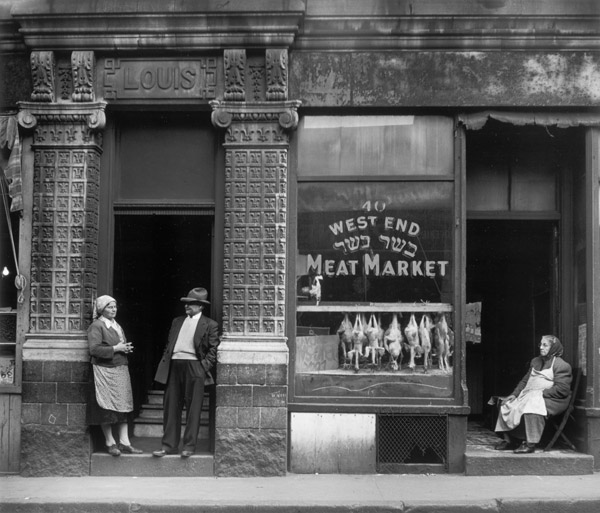
Fabric of West End, Boston, before demolition. (shutterbug.com)

West End, partially demolished. (youtube.com)
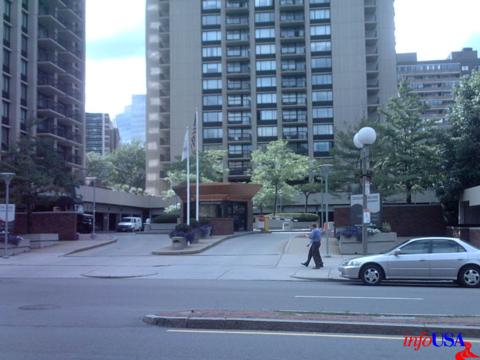
West End apartments today. (city-data.com)
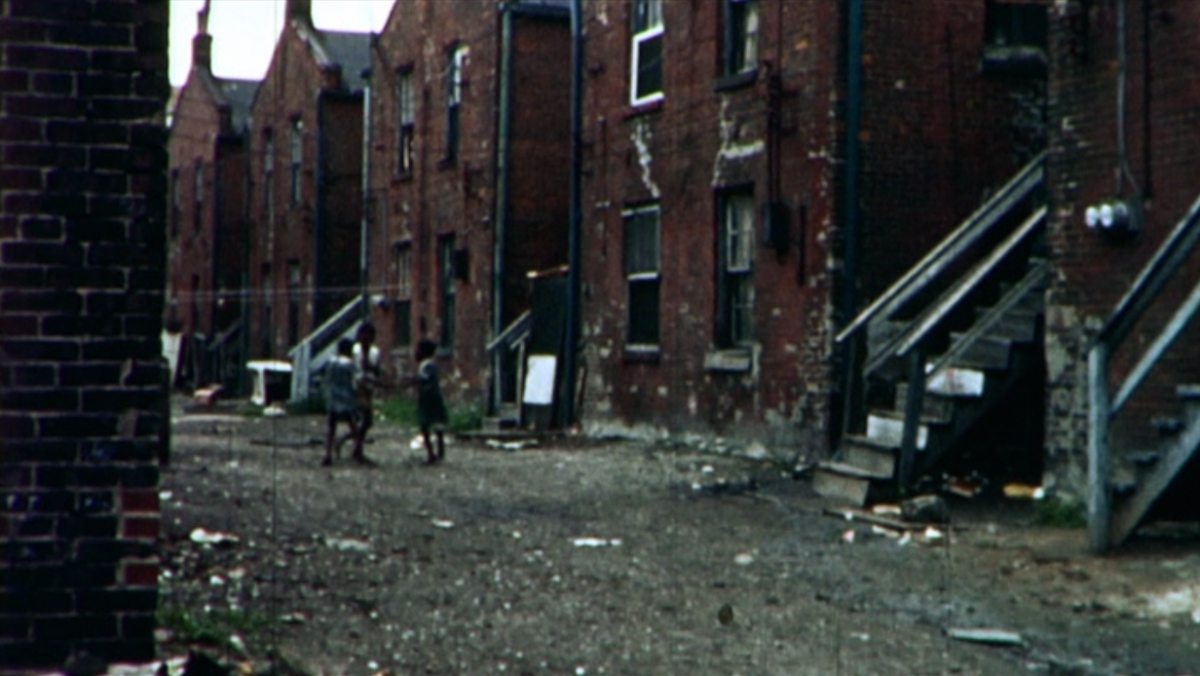
Neighborhood demolished for Pruitt-Igoe public housing, St. Louis. (businessinsider.com)
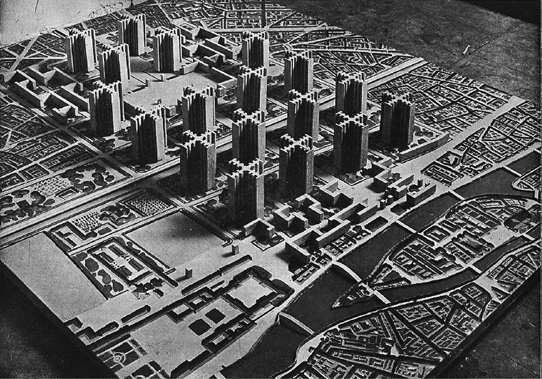
Le Corbusier’s 1925 Plan Voison was inspiration for Pruitt-igoe. (palgrave-journal.com)
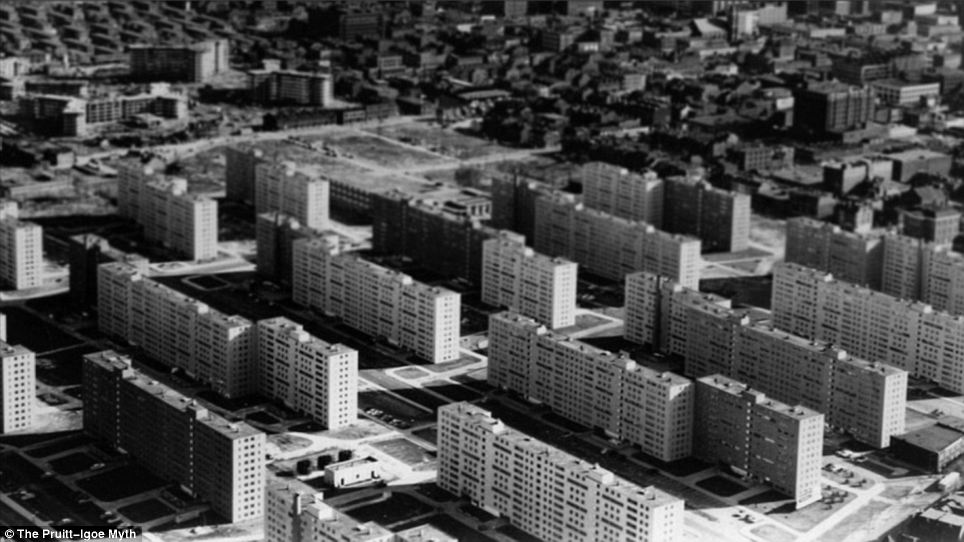
Pruitt-Igoe upon completion in 1956. (dailymail.co.uk)
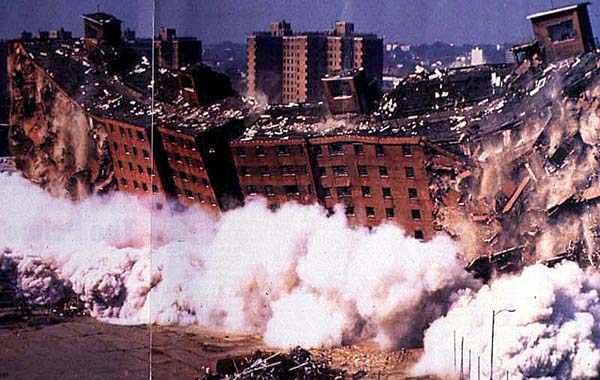
Demolition of Pruitt-Igoe, 1972. (rjdent.wordpress.com)
Andres Duany has pointed out many times that historic districts are merely regular neighborhoods built before World War II. In fact, until modernism took over, even slums were at least minimally attractive. Decay and weathering vied with shoddy and deferred maintenance and absentee ownership to achieve some balance in how beauty evolves as time ages traditional materials. You can see that in poor neighborhoods built before the war that survive today, often exacerbated by bad signage. In more affluent areas and civic centers, beauty often was par for the course.
That has all changed. In Jane Jacobs’s The Death and Life of Great American Cities (1961), she details the role of major private and government financing in urban renewal and public housing. After quoting a detail in the Panuch Report, describing a druggist who invested $40,000 in his shop taken by eminent domain for $3,000, Jacobs writes:
This is a sad and common story on housing or renewal sites and is one reason these schemes are fought so desperately by site businessmen. They are subsidizing these schemes, not with a fraction of their tax money, but with their livelihoods, with their children’s college money, with years of their past put into hopes for the future – with nearly everything they have.
We tend to think of those projects as saddling society with ugly, sterile places for poor people. They did, but the damage went so much deeper. We forget that much subsidized housing was initially intended for the middle class or veterans returning from World War II. We forget that the districts destroyed were often vibrant neighborhoods in the process of lifting themselves out of poverty – “deslumming,” as Jacobs puts it in the less frequently read later chapters of her great book.
To the residential populations displaced for such projects must be added, as she angrily notes, the many thousands of shopkeepers driven out of business. Urban renewal took a sledgehammer to American society where it could least afford it, and the American polity has never fully recovered from the blows not only to the livability of our cities but to the conditions of family life up and down the ladder of society, not to mention the fraying of the social contract. The decline of the middle class that we hear of today was triggered by this revolution in U.S. social and economic policy. All of these problems may be attributed in considerable degree to the dire and yet predictable impact of modern planning and design.
The government and the private sector cooperated to smother humans in large parts of all major American cities. Where did they get the idea? Well, urban renewal would have been inconceivable without the professional and academic propagation of the inhuman slabs of modern architecture, eventually practiced by almost every development and architectural firm, implemented and financed by all levels of governments and taught in all universities, and still the dominant template for city building in all three realms.
Bingler and Pedersen worry that public skepticism of modernism only grows “even as we talk about making [architects’] work more relevant with worthy ideas like sustainability, smart growth and ‘resilience planning.’ ” Why must architects concern themselves with those things? Because decades of education, scholarship and practice have been devoted to purging sustainability, intelligence and resilience from the profession.
Modernists get a kick out of insisting that modernism is not a style but a way of life. They are correct, and for having helped to inflict on society the vile stupidity of that way of life – the banality of evil, in spades – they should hang their heads in shame.
In short, thank you very much, Le Corbusier.
Much of this is latent in the essay by Bingler and Pedersen. It is unstated but right there between the lines of every commentary on the decline of our society. Efforts to recover, if recovery is even possible, must begin with the insights in “How to Rebuild Architecture.” To listen to conventional public sentiment on this matter and so many others is to acknowledge home truths that have been staring us in the face for half a century, ignored and if that’s not possible denied. The two authors merit commendation for their essay, which says a lot more than they intended, and so does the New York Times for publishing it.




 Architecture Here and There
Pingback: “Up from Ugliness” at NYT | Architecture Here and There
Very well said! I might add the other forces that contributed to the urban cataclysm, but without the ideas and plans of the modernists, it would have never been so destructive. I might also add as a designer, that modernism is a style. In fact, like any other style, it has it’s variations. Granted, modernism’s batting average is abysmally low, but it is, never the less, possible to design pedesrrian friendly and contextual modernism if one approaches its aesthitics liberally ( more visually, less conceptually).
But I quibble, the larger point of its impact to our civic life has been largely negative, and its continued academic dominance is spot on. The reaction to it proves this.
LikeLike