Rebuild Key Bridge as it was

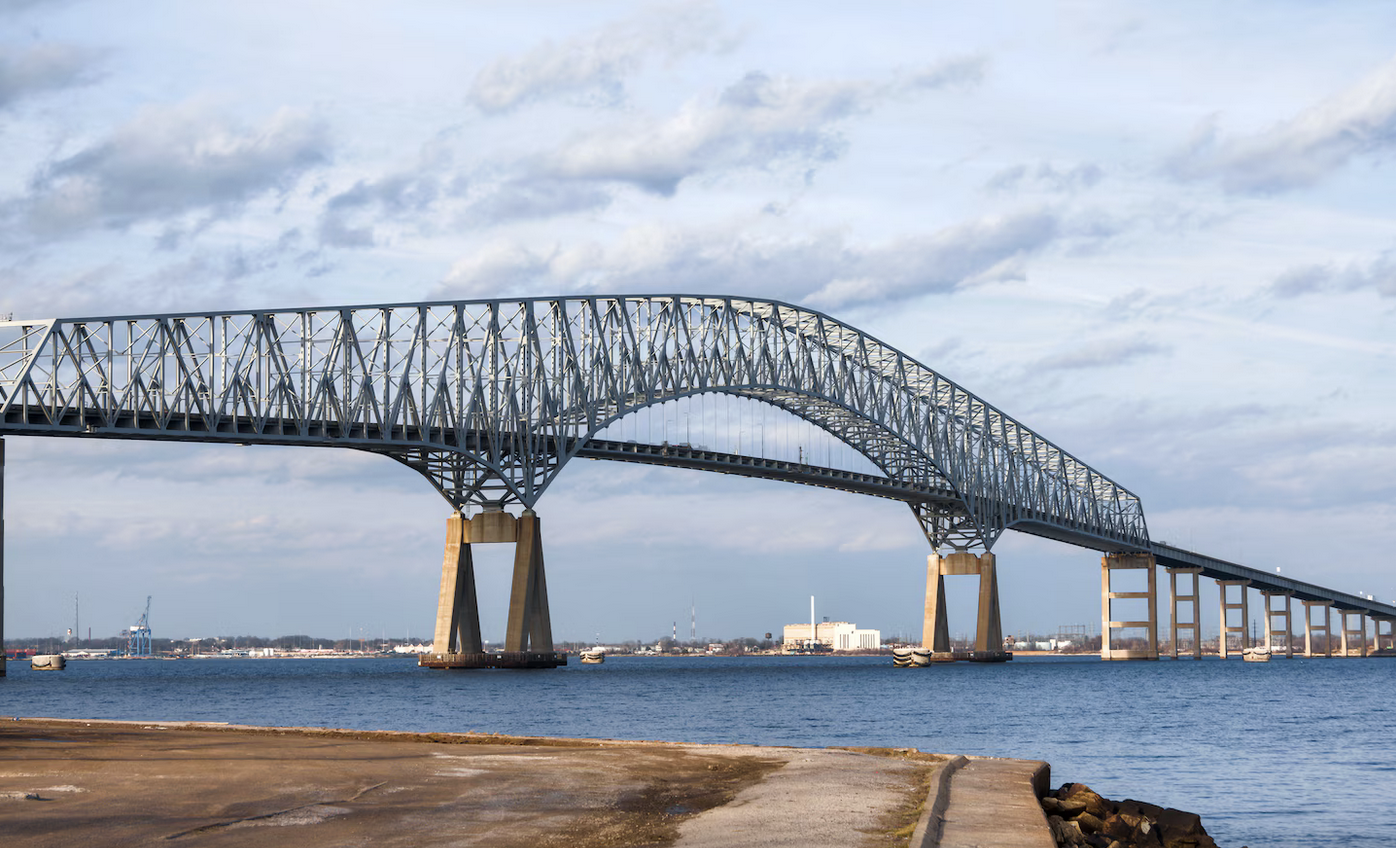
Key Bridge before it was struck by a huge freighter in March 2024. (William Sherman:Getty Images)

President Biden has said he will rebuild the collapsed Francis Scott Key Bridge, over the Papatsco River leading into the Port of Baltimore, at the mouth of the Chesapeake Bay. The bridge, completed in 1977, was hit by a freighter that lost its steering on Monday night. As of this writing, six men filling potholes on the bridge are still missing and, sadly, presumed dead. The Key was a queen of the art of infrastructure, a demonstration that utility can be beautiful. And so the president should see that it is rebuilt, as it was, to teach that very lesson.

As we all know by now, the bridge is named for Francis Scott Key, who wrote the words to what became our national anthem after seeing that our flag still flew after the failed British assault on Fort McHenry, in Baltimore Harbor, leading to the end of the War of 1812.

Curiously, the Key Bridge, 1.6 miles in length (not including some nine miles of access roads), reaching a height of 185 feet,  was built to take the overflow from the Baltimore Harbor Tunnel after the latter had reached its traffic capacity. The tunnel was completed in 1957, the bridge in 1977. The bridge cost $66 million, has four lanes, to the tunnel’s two. Now it is gone, and while vehicles, including freight-hauling megatrucks, still have alternative routes in and around Baltimore. The Port of Baltimore handled 847,158 cars and light trucks last year, leading all other ports in the nation for 13 consecutive years. Cargo ships, which of course carry far more than the most humongous of trucks, will not be able to travel in or out of the harbor for many months, probably years.

Transportation Secretary Pete Buttegieg, no doubt repeating the magnificent phrase of some rhetorician long past, referred to the Key Bridge as “a cathedral of infrastructure.” That no doubt it was.

Examine the interplay of the bridge’s steel strutwork. The intricacy of its design undermines the idea that modern structure needs to be ugly. The collapse of the bridge shocked the civil engineering community, for which its design is iconic. It is the second-longest continuous-truss bridge in the United States, the third-longest in the world. The longest is the Ikitsuki Bridge, in Japan. (A truss, in engineering, is a structure whose “members are organized so that the assemblage as a whole behaves as a single object”).

Its beautiful intricacy belies its strength, and speaks to that quality vis-á-vis beauty and commodity in the famous Vitruvian triad of utilitas, firmitas and venustas (stability, usefulness, and beauty). The bridge’s firmitas withstood the stress of its utilitas – all that traffic! all those huge mack trucks thumping along its tired pavement – until three days after its 57th anniversary. Its beauty, venustas, may have been an afterthought, but it will be in the memories of all who mourn the bridge’s loss.

Engineers have been designing beautiful bridges of iron and steel for more than a century and a half. I have seen no mention in any of what I’ve read to source this post of the designer of either the bridge below (Abraham Darby?) or of the Key Bridge itself.

Key Bridge failed yesterday after suffering the massive affront of a massive cargo ship, but that does not diminish the beauty of its glorious infrastructure – which should be rebuilt to its historic design by the Biden administration.

The Iron Bridge at Colebrookdale, 1780, by William Williams. (Mutual Art)

Posted in Architecture, Art and design | Tagged , , , , | 19 Comments

Providence Place: Still alive

Providence Place glimpsed between buildings in downtown Providence. (Photo by author)

I don’t have any deep inside knowledge (or shallow inside knowledge) of whether the downtown mall in my town, Providence Place, is going down the tubes soon. Still, my friend Will Morgan, who is also a local architecture critic, a rival of sorts, thinks it is, or thinks it might be. So, since I have a sentimental attachment to the thing, I wrote a reply to his piece on the GoLocalProv website. Here it is, with some minor changes:

***

Overall a very nice piece, Will. I agree that the mall has been through some shaky times, including new shops that are dubious. How many additional shoe stores are enough? Agreed! But some errors remain.

I think Adrian Smith’s early classical design (see way below) for the mall, circa 1994, was simply jettisoned in toto after Gov.-elect Almond came in the next year, with St. Florian starting afresh. The original anchors were Filene’s and Nordstrom. Lord & Taylor opened to the rear of the middle. I believe it came in a year or so after the 1999 opening. When it closed it was replaced by more parking.

Fane Tower, as I suspect you are aware, was proposed long after the Burj Dubai was completed. Adrian Smith had suggested a dome on his version of the mall, which was replaced by St. Florian’s Wintergarden, which along with his rooftop skylights spread considerable light into the mall’s shopping areas. That elegant flourish, the skybridge from the Westin, was not added until quite a bit later.

The Providence Arcade of 1828 was not the nation’s first indoor mall but its oldest surviving mall. The New York Arcade and the Philadelphia Arcade opened about a year earlier. Not sure which opened first. One of the two did not last long, the other lasted late into the 19th century, and possibly into the next. They were both modeled after the then recently opened Burlington Arcade, in London, which is alive and kicking, to say the least. Here in Rhode Island, there was an arcade that opened before 1828 somewhere north of Providence, but I don’t know its name, its appearance, or its town of location. It didn’t last long.

I think the design of our mall, whether St. Florian or the anchor architects, is relatively charming. Aspects of it – such as the Filene’s curve, when its lights are on (rarely, it seems) – are quite charming. Stacked against the typical suburban mall, ours is much better. But it is far from perfect. Nobody would fly to Europe to see it. Its exterior features tend to be clunky. Indoors it lacks the traditional detailing you’d expect when looking at it from the outside. This is an obvious design flaw and St. Florian needs to hang his head in shame. But then, how could he possibly look his fellow modernists in the eye if he had not modernized the interior to apologize for classicizing the exterior?

I think your ideas for what to do with the mall if it closes are a form of surrendering in advance. Its managers should continue to try to run it as a shopping emporium, perhaps with bits devoted to other ideas. Victoria, Billy and I occasionally go to a movie there, and sometimes even shop or dine, and we have never felt unsafe, or lonely. If only it had a book shop. (Victoria worked at the Borders there until she was pregnant, and before it absquatulated.)

One bright spot is that if you watch the groups of kids, you will see the racial integration the powers that be have long wanted to force on the schools taking place au naturel in the mall. Hurray! The mall is not all gang fights, and in spite of the mall (or because of it) downtown has survived the pandemic and is reasonably vibrant. Lots of new restaurants have opened. I had lunch at Ellie’s last Thursday with Buff Chace – who has led downtown’s revival with his lofts above ground-floor shopping – and he is still trying to start new projects downtown.

I think today I am closer to supporting your position that the mall stores should have been installed behind the façades of Westminster Street. I seem to recall a D.C. developer called Federated that came to Providence hoping to do that. But that was simply not going to happen. Too bad, I’d say. Buff  and others opposed the mall worked hard to try to make something else happen, but without success. Or perhaps something else did happen, and it is working!

I’m sure you have your ear closer to the ground than I do, Will, but I have not heard that Providence Place is about to be shut down. What are you hearing? (Will replied that he had heard nothing.)

Adrian Smith’s design for Providence Place, circa 1994, was highly classical, a rebuke to the conventional wisdom. (Skidmore, Owings & Merrill)

Detail of Adrian Smith’s design for Providence Place, circa 1994, before Friedrich St. Florian was called in by Gov. Lincoln Almond to design final concept. (SOM)

Providence place sits proudly amid its downtown neighborhood. (View from Governor’s Balcony, circa 2006; photo by author)

Posted in Architecture, Urbanism and planning | Tagged , , , , , , , | 6 Comments

Wake up, Little Compton

Adeline Slicer House (1887) still looks about the same as in 2003. (Photo by David Brussat.)

Little Compton’s town council will soon receive advice from this corner that was good when originally delivered in 2003, in my Journal column of Aug. 28 of that year as part of my “Outside Providence” series. The series looked at efforts in the other 38 cities and towns to maintain their historical character. Dr. Ara Sadaniantz asked me to offer the council advice on whether to adopt a proposed historic district for the Commons, along with a regime for rewarding good stewardship with plaques. I have done so, but since Little Compton is about as lovely as it has always been, my advice has not changed much since 2003. Below is a reprint of that ancient column. The photo at the top is of the same house more than 20 years later.

***

Wake up, Little Compton, wake up!

LITTLE COMPTON

Tracking down the origin of the name of the town of Little Compton on Tuesday evening took me even longer than driving there on Monday morning. Notes on Little Compton (1970), by Franklin Wilbour, was delightful but not helpful. Nor was the Rhode Island Historical Preservation & Heritage commission’s excellent 1990 survey of the town.

The Wilbour book does note that, in 1682, the General Court, in Plymouth, “graunted” that the place “shall from this time be a township, and have the liberties of a towne as other townes of this colonie and shall be called by the name of Little Compton.” But why? No reason is suggested.

Picturesque Rhode Island (1881), by Wilfred Munro, notes that Little Compton “probably took its name from Little Compton of Oxfordshire, England.” But the Encyclopaedia Britannica describes Oxfordshire as landlocked, and its long entry mentions no Little Compton. There is no separate entry for “Little Compton,” and the only entry under “Compton” is for a city in California. Founded in 1868, Compton’s 2000 population was 93,493 – 26 times that of Little Compton, which was 3,593.

Before its name was pulled out of the cocked hat of a magistrate in Plymouth, Little Compton was called Saconet, or Sagkonate – after the tribe led by Awashonks, queen sachem of the Sakonnets, a branch of the Wampanoag. It has since been known as Seaconnet, Saconnet, Sakonnet and, quaintly by the late Journal columnist David Patten, S’cunnet.

An irresistibly quaint bit of history is that Little Compton’s rights and privileges as a township had already been “graunted” by Plymouth in 1674, but nobody in Saconet realized it. This might be because King Philip’s War intervened in 1675. The war was won almost single-handedly by Capt. Benjamin Church (according to his diary). He was the first and possibly the only white inhabitant of Saconet to settle there before the war. He convinced Awashonks, of the Sakonnets, to break with King Philip, aka Metacomet, the Wampanoag sachem; he then led the force that tracked Philip down and killed him. (History suggests that Church’s diary did not exaggerate by much.) After the war, Church settled in Bristol but eventually returned to Little Compton. His descendants have since been ubiquitous in the town annals.

After 1663, Little Compton was claimed by both Plymouth and Rhode Island. But Little Compton favored Little Rhody. Twice in its early years, the town rejected Puritan civil authority. In 1683, it refused to pay a tax to support a minister. Ditto in 1692 – and to avoid the tax, it plotted to join Rhode Island. In both cases, Little Compton was brought to heel.

Still, the die was cast, and in 1746/1747 (the calendar changed from Julian to Gregorian that year), Little Compton became (with Warren) the 22nd (or 23rd) Rhode Island jurisdiction. Little has changed since then, and to this day little happens in town affairs that does not amount to resisting change.

My impression of Little Compton as a paragon of quaintness, a New England seacoast village preserved in amber, was only reinforced by my tour Monday with two leading citizens, Larry Anderson, of the Sakonnet Preservation Association, and Helen Bridge, of the Little Compton Historical Society.

Little Compton’s remoteness helped it to resist change, to remain lovely and wistful – “like the places one goes to on the way to sleep,” wrote Sarah Orne Jewett. In 1869, the Providence poet Sara Helen Whitman noted that “to journey by steamboat from Providence to Little Compton takes more time than it does to go by railroad to New York.” In 1886, as increasing numbers of wealthy summer residents arrived, Sarah Soule Wilbour noted, “I don’t think it adds to our happiness to have many city ways and fashions brought among us.”

This remains the town attitude, and attitude is the only force holding back the tide of modernity and its chief physical threat, modern architecture.

For a century, summer residents built summer houses that protected Little Compton’s charm. Most still do. But when, at last, the Thomas Marvell House (1940) reared its ugly head, the obstinate Yankees who have run the town refused to pass laws to protect Little Compton from modern architecture. To this day, only the town common, one house and the Sakonnet Point Light are on the National Register of Historic Places. The town has two monuments to the Rhode Island Red, but not a lick of historic-district zoning.

So attitude remains the only bulwark against modernism. One modernist house in plain view is derided as the “Third World Airport.” That’s the spirit! Most out-of-towners with modernist designs deflect scorn by building their clunkers out of view.

But this is changing. Precisely because change has come so slowly to Little Compton, the town will be surprised by how fast change can arrive. Modernity kills charm little by little, insidiously, like poison. Before anyone notices, it will be too late. Little Compton won’t look like Little Compton anymore.

Wake up, Little Compton, or else the place you go to on the way to sleep will be a nightmare.

Posted in Architecture, Blast from past, Preservation | Tagged , , , , , , , | 2 Comments

Save Pawtucket’s Ott Mansion

The Read-Ott Mansion, 97 Walcott St., Quality Hill, Pawtucket, R.I.

The headline of this post is the same as when I wrote it as my weekly column for the Providence Journal in 2008. The Read-Ott Mansion was at a most dire risk of demolition then, and remains so now. Its owner, the Assumption of the Virgin Mary Greek Orthodox Church of Pawtucket, is about to tear it down. True, it has had another 16 years of grace. In the name of the Virgin Mary, the church should cease and desist. Here is the conclusion of critic Will Morgan’s recent GoLocalProv piece, with more illustrations:

Sadly, this is a typical story. Likely too late now, alas, but one can imagine the house being repurposed for housing or some other income-producing solution for the church–a hospice, a Greek language school, apartments for parishioners? There would still be plenty of open space around the church for future expansion, such as a parish house, without letting the Read-Ott house disappear. One can empathize with the costs of supporting a congregation and maintaining its real estate in a city that is a ghost of its once hugely prosperous self. Nevertheless, this a loss that should not have happened.

I hope that Morgan is excessively pessimistic. I have, I think, demonstrated my credentials as the most optimistic of optimists. May the Read-Ott continue to grace Quality Hill. With apologies for any facts that may have been overtaken by events since I wrote 16 years ago, here is my exercise in optimism:

***

Save Pawtucket’s Ott Mansion

The Read-Ott Mansion has been for decades the prize possession of the Assumption of the Virgin Mary Greek Orthodox Church, on Walcott Street at the gateway to Pawtucket’s Quality Hill neighborhood. Walcott is still Pawtucket’s Benefit Street (it actually has its own street of the same name) as Quality Hill was Pawtucket’s College Hill before Oak Hill nudged it aside after its century on top – or so some might attest. Bar fights no doubt still break out between Bucketeers who stand up for one or the other as the city’s finest neighborhood. (We tend to forget how wealthy Pawtucket was back in the day.)

But I’d wager that no house in Oak Hill can match the Read-Ott Mansion for twists in architectural history. The house was built by tinsmith-turned-hardware merchant John Blake Read in 1842. The columns originally upholding the pedimental roof of its porch declared it a Greek Revival. In 1850, Read added bay windows over the door and a cupola on the roof that transformed his house (in the eyes of future architectural historians) into one of Italianate style.

By 1890 its ownership had gone from Read to Darious Goff to Joseph Ott, founder of the Royal Weaving Co. For Ott, an Italianate Greek Revival in a very fashionable district was not quite house enough. In 1915, working with architect W.G. Sheldon, he lopped off the cupola and added a third story and colonial details. In 1930, the Ionic porch was enclosed and an imposing Doric portico rising two stories was added. This turned the house into a Georgian Revival, according to the architectural historians, although my own research has not yet uncovered the point at which the house came to called a mansion.

In the early 1960s, Pawtucket’s Greek Orthodox congregation was evicted by “urban removal” from its George Street church to make way for Route 95. The congregation bought the house on Walcott. Next to it they built a new church in a St. George-meets-George Jetson style. It opened in 1967.

The Read-Ott served as the congregation’s parish house. Its interior was renovated in the ’70s with features that call to mind loud shirts, fat ties and wide lapels. To judge by its situation today, the effect may have been to doom its allure to the congregation. In any event, the new fire code has recently made any use illegal pending an upgrade to unrealistic standards.

Historical preservationists may pull their chins in quest of the correct point in time to restore it to. Neo-Georgian? Italianate? Greek Revival? The congregation simply wants to fix it up or tear it down. The latter option should, of course, be considered a last resort. At $80,000, it would be the cheapest. Yet the property is insured, unburdened by a mortgage, and thus about $2.5 million is available, more than needed to meet the fire code, restore it to a high standard and/or renovate it for most purposes.

The building has great bones – the structure is sound and the exterior remains enchanting, akin to Bristol’s Linden Place in potential for beauty. Inside, the errata of the 1970s are easily removed. They include wall-to-wall shag carpeting and, in the parlor, an odd, space-age staircase banister whose struts (you can hardly call them balusters!) jut at a 90 degree angle from the crook of every third riser. These have gotta go! Luckily, most of the Georgian details remain, including the lovely banisters on stairways in the less prominent parts of the house that might not have warranted the honor of modernization.

Joan Milas, a congregation member and well-regarded Smith Hill lobbyist leading the preservation effort, promises to rename it the Read-Ott-Brussat Mansion if this column attracts a millionaire’s attention. [Evidently it did not – db] But if an angel appears, shouldn’t it be named, say, the Read-Ott-Gates Mansion?

In addition to twisting the arm of this reporter to go to bat for the Read-Ott Mansion, Milas has, among other heroic accomplishments, gently cajoled free advice from local experts in the fields of architecture and historic preservation.

One idea generated thus far is for a senior center for the elderly members of various nearby Orthodox congregations. That would stroke the sense of communal benevolence. A more public use could be as an art museum, which might assuage the loss of the Pawtucket Children’s Museum, which left the Pitcher-Goff Mansion (also on Walcott Street) for Providence in 1997. This would burnish Pawtucket’s reputation as an arts mecca, one-upping archrival Providence, which let the Rhode Island School of Design use “art” [with its RISD Art Museum addition] to attack the beauty of its host city.

However it is used, the Read-Ott Mansion ought to be saved. To raze it would be shameful.

Posted in Architecture, Architecture History, Preservation, Rhode Island | Tagged , , , , | 4 Comments

Best trad buildings of 2023

Who can identify this city? It appears at minute 4:40 in the video linked below. (CPI)

It is past time for my annual roundup of best buildings from 2023. I confess, the time blew right past me. Maybe it is not too late now, but I am too busy (and lazy) to wrap it all up again for last year. Instead, I offer a video that should help to promote a best-building culture around the world. Once you’ve viewed it you will thank me for not inflicting on you another year of “best trad.” The video is from the the online platform The Aesthetic City, and is entitled “Build Like This Again?,” produced and narrated by Ruben Hanssen, founder of the platform. Click on that link. The link does not take you directly to the video, but to “Home.” Maybe that is my fault. You might have to scroll down a bit until you reach “Our Videos,” and click on the first of these, “Build Like This Again?” If you can find the online magazine again (I could not), you can read an interview Hanssen gives at the bottom. The one before it is excellent as well. All of this springs, in some way, from Michael Diamant and his New Traditional Buildings blog, and Nir Buras and his Classic Planning Institute, which is listed under “Other Initiatives.” There is much of value to read in this online magazine. If you can find it.

Enjoy. And enjoy your year, even without “Best Buildings of 2023.”

Posted in Architecture | Tagged , , , , , | 9 Comments

Gaza as we’ve never seen it

Destruction in Gaza, a place Palestinians cannot enjoy and cannot escape. (Reuters)

I occasionally devote a blog to cities devastated by war or natural disaster, showing how beautiful the place used to be (and to some extent may still be) as disaster consumes its ancient buildings. In most cases, the allure of places such as Beirut and Lviv, in Ukraine, is often well known by Western publics. Not so with Gaza, controlled by the terror group Hamas. Our mind’s eye – myself included – is taught to believe that Gaza is a hellhole and has been since the Israelis pulled out in 2005 (which is conveniently forgotten) – and of course now it is a hellhole, since bombing by the Israeli IDF has reduced much of it to rubble.

The video linked below is produced by the invaluable Middle East Media Research Institute. It will be an eye opener for most who have the courage to view it. MEMRI is devoted to exposing the lies that appear in most of the Middle Eastern media, which, alas, often includes mainstream Western media outlets, which have drunk the Kool Aid of Palestinian propaganda to the dregs. The propaganda asserts that Gaza is “occupied” by Israel, or that it is some sort of “concentration camp” from which Palestinians cannot escape. None of it is true. Here is the evidence:

https://www.memri.org/reports/parts-i-iv-face-suffocating-occupation-humanitarian-disaster-concentration-camp-and-prison

I cannot vouch for the architecture on display in pre-war Gaza. But I do believe that there is some sort of mental convergence between those who support modern architecture and those who support Hamas.


Posted in Architecture | Tagged , , , , | 11 Comments

Behold, NYC’s Tudor City

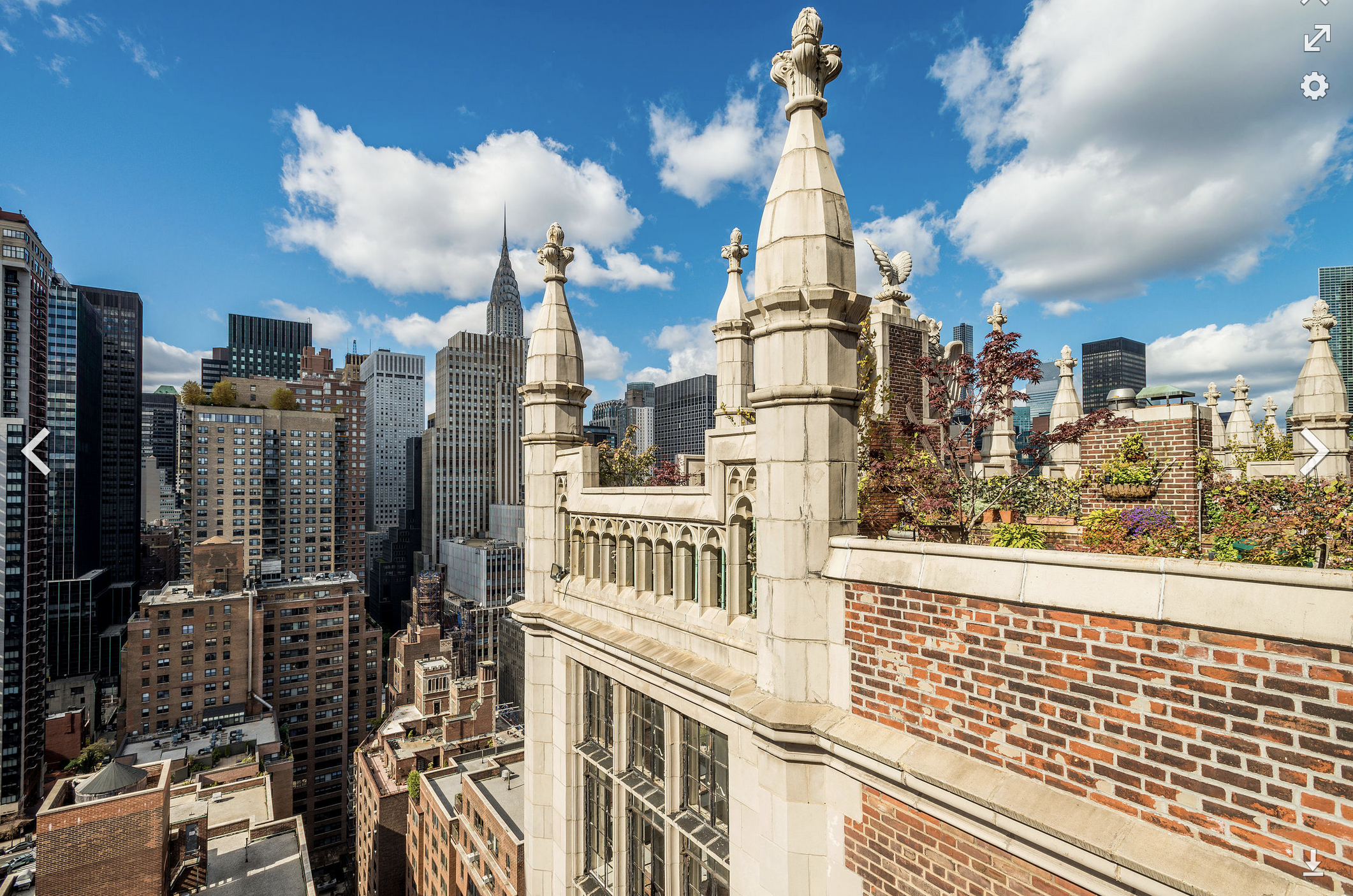
Top levels, including roof terrace, of Windsor Tower, one of 13 in Tudor City. (Wikipedia)

I had lunch today (by now, yesterday) at Maven’s, a newly opened Jewish delicatessen in that plaza just off Hope Street as it becomes East Avenue, in Pawtucket. I’ve eaten there once before with my wife, Victoria – delicious, though not without some small kinks to be worked out – and this time I was by myself and talked with my table neighbor. We spoke of Manhattan, and he told me he’d once lived in Tudor City, near the United Nations complex. I said I was familiar with the name but not with its appearance. So when I got home I looked it up on Wikipedia.

I am no longer abashed to mention that. I’ve spent a lot of time in Wikipedia, since I’m writing a book and often need a quick refresher, or to double-check my fading memory. It has been criticized as not unbiased, but most of its articles on many subjects seem to be quite objective. I think that, as an architecture critic, I can be trusted to spot bias in articles with architectural content, such as its in-depth treatment of Tudor City. I saw none in this article. But there was a heavy bias, if you can call it that, for detail.

Thirteen separate buildings make up the complex, 12 of which were completed between 1927 and 1930; Tudor Gardens, the 13th, was finished in 1956. They sit between 41st and 43rds streets on land mainly of tenements and slums, which were demolished. It was farmland until the mid-1800s, part of acreage known as Turtle Bay Farm. The United Nations complex sits just to its east. Grand Central Terminal is to its west. Tudor City is the first residential skyscraper complex in Manhattan, and one of the first in the world. The heights of the 12 original buildings range from several of ten stories up to 32 stories for the Woodstock Tower, with 454 apartments. The original complex featured two large parks, though what their status is today I have no idea. Wikipedia describes the exterior design fully. Its features hark back to the Tudor and Elizabethen periods of England. My term for this sort of embellishment-heavy architectural description is “architecture porn.” This is a good example, though it is partial:

Generally, the lower stories of each building were clad in sandstone and limestone, while the upper stories were clad in reddish-brown brick with terracotta trim.[28] The complex’s designers used a broad range of Tudor Revival details, including towersgablesparapetsbalustradeschimney stacks, orielsbay windowsfour centredarchespinnacles, quatrefoils, fish bladder moldings, Tudor rosesportcullises (a symbol of the Tudor sovereigns), and rampant lions carrying standards.

I have retained the links for readers’ pleasure and instruction. I wish there were a link for “fish bladder moldings.” And, alas, Wikipedia does not describe the decoration of the apartments, which could house up to 5,000 residents, many in studios, some with up to four or five bedrooms. The total population presumably includes those who stayed at the complex’s hotel, a separate building.

My familiarity withTudor City may be the result, exclusively, of its sign, reading “Tudor City,” atop Prospect Tower, which I’ve occasionally espied as I stroll along Manhattan’s streets on my occasional visits. Originally there were two signs; one was removed when it was blocked by another building, the company that owned Tudor City wanted to remove the second one as well. They were blocked by the landmarks commission – one of its few positive actions, in my recollection, though I probably don’t hear much about its no doubt many positive actions. I just hear about its mistakes, most of which are tremendously dissatisfying. Oh well, as they say, so it goes.

But I am happy to bring the Tudor City architecture porn to readers saddened by the declining pace of my posts.

View of two buildings in Tudor City, including one with its ubiquitous sign. (Wikipedia)

Posted in Architecture, Architecture History | Tagged , , , , , | 10 Comments

Losing Providence, bit by bit

Google street view of 151 Chestnut Street, site of a proposed multi-story apartment tower.

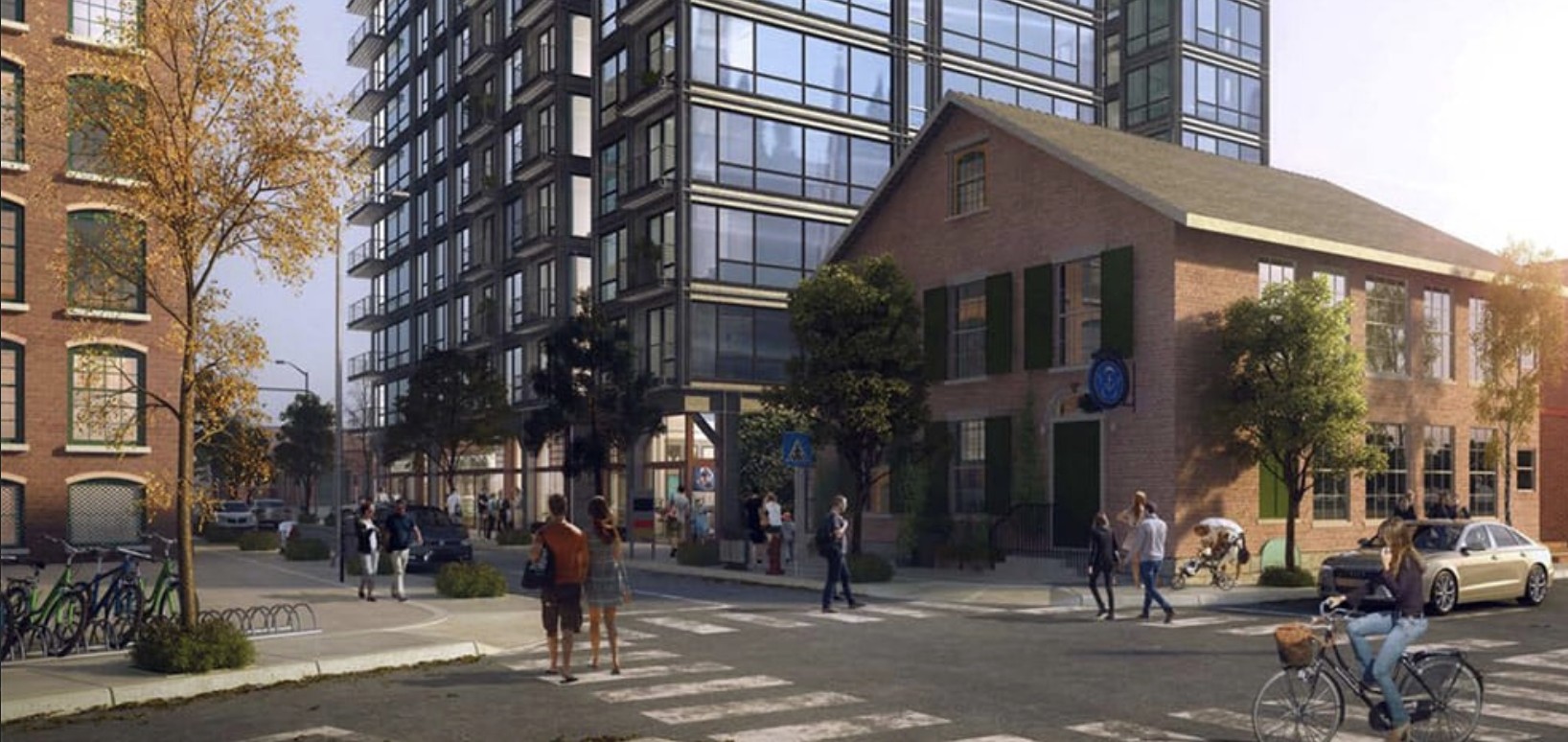
Rendering of lower portion of proposed “tower” in parking lot. Note, next door, the Samuel Lewis House, also known as the Thomas A. Doyle House for the city mayor who lived there.

The Downtown Design Review Committee met a couple of days ago to consider applications to demolish a couple of buildings on Chestnut Street and Richmond Street in the Jewelry District. I looked them up to see whether I should be concerned. They all seemed to be expendable: not so old, not so appealing.

On the principle that any demolished building is certain to be replaced by something worse, these buildings should probably all be preserved. But that would require a shift in ideals by a city that has lost its way and is unlikely to go with anything other than what would be worse. No campaign to save them or change city policy is likely to succeed.

Above is a Google street view of 151 Chestnut – a parking lot, or so it seems. On either side of the lot are buildings that probably displaced earlier buildings more attractive than what are there now. The heart aches at the thought of what was demolished to make way for this parking lot. The little house built in 1825, unseen off to the side next to the building to the right of the lot, but visible, although distorted, in the rendering (just below) of the proposed tower, seems to be where former Providence Mayor Thomas Doyle lived. His memory may account for its survival, and its immunity from the developers of the residential tower proposed for next door, which went before the DDRC for the latest design examination this week.

According to the Providence Business News, the proposed 12- (cut to 10) story residential tower destined for that parkiing lot was further downsized and presented again last month. The new proposal is down to five stories and down to 21 units from 138 in the initial proposal. It is now without the ground floor commercial space previously announced in 2019, which was granted several six-month extensions for covid and other reasons, possibly including opposition from locals, who rightly opposed even its latest shrunken five stories. At Monday’s meeting it was apparently delayed yet again.

PBN quoted an employee of ZDS, the cheesy local design firm that seems to have taken Providence by storm (and is responsible for the tedious hotel on Parcel 12 next to Kennedy Plaza). Scot R. Woodin described the architects’ so-called “analysis” as follows:

When designing the structure, which features mostly two- and three-bedroom apartments, Woodin noted they had done a “contextual analysis” of the surrounding area that features several historic buildings to understand what would be most appropriate for the site. However, the goal was not to replicate a historic building, but to introduce something more contemporary.

“Something more contemporary”? In historic Providence? Huh? Well, of course! Historical character be damned! Why do something admirable instead of something regrettable! Downright ugly if possible! Obviously, the “contextual analysis” had no meaning whatsoever. It was just a way to make members of the design panel feel good before they usher another piece of Providence into oblivion.

Maybe the proposal will go away, as it apparently has a couple of times already. That’s what all of these pesky proposals should do. It seems, unfortunately, as if another such proposal, the Brown medical building proposed for 261 Richmond St., is destined to move forward. Sad. Since it is dedicated to “science,” it is, typically, a building ugly as sin.

Bio Life Sciences building proposed by Brown University on Richmond Street. (PBN)

Posted in Architecture, Development, Preservation | Tagged , , , | 9 Comments

Don’t demo this sad trio

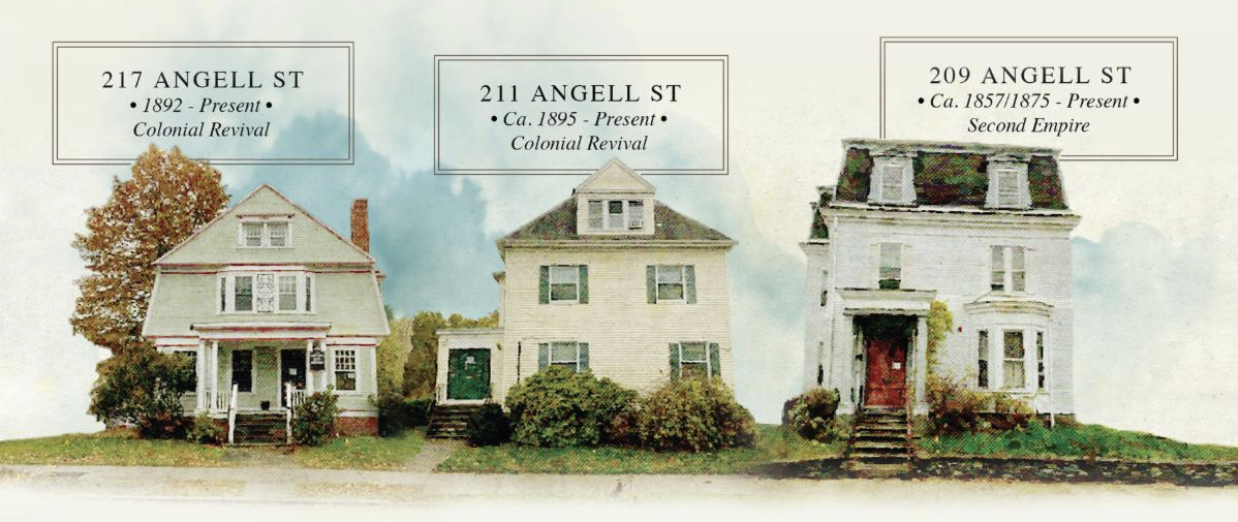
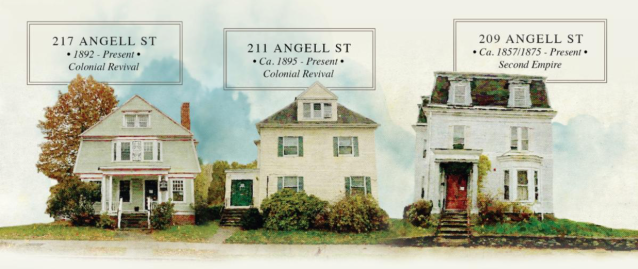
Three houses on Angell Street, in Providence, whose proposed demolition is considered mysterious.

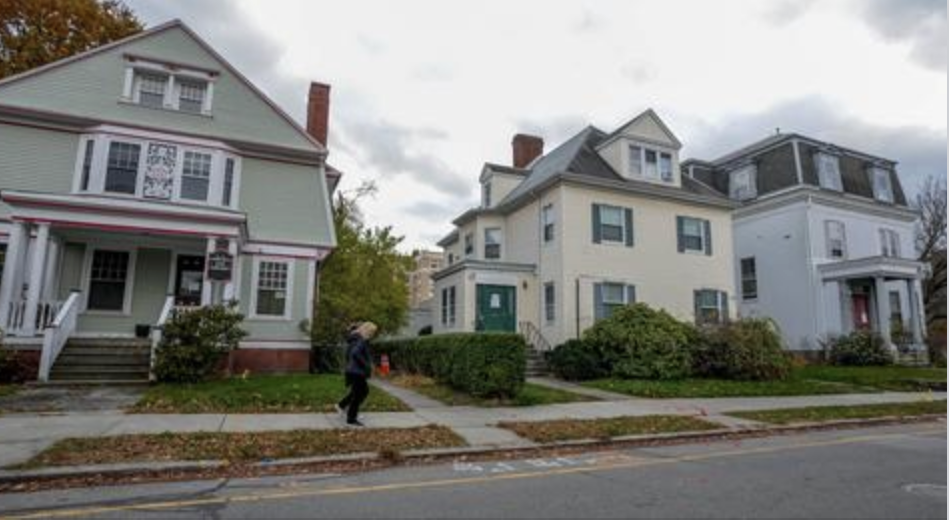
Recent photograph of the three vacant houses whose demolition may be imminent.

Someone has it in for a row of decent old houses on Angell Street. Specifically, they are Nos. 209, 211 and 217. They should be preserved. Their preservation should be second nature at every level of policy in Providence. Yet demolition permits are, according to the Providence Journal, in the works for all three – no one seems to know who applied for them, or for what purpose – and so the houses are sitting ducks awaiting their sad fate.

The three were purchased by 217 Angell Investments II LLC on Oct. 4 of this year for $4.5 million. The firm was registered with the city on Sept. 13. The location had been chosen, according to city records and a report by WPRI Channel 12 News, as the site for a six-story Smart Hotel, with 116 rooms and internal parking for an unstated number of vehicles. Two attempts to develop a hotel were blocked in 2020 and 2022. No proposals have emerged as a possible replacement. … Yet.

Mayor Smiley’s spokesman, Josh Estrella, told Channel 12:

The owner of this private property requested this demolition and has followed all of the necessary processes required by our zoning ordinance. … The City of Providence has a robust process for preserving historic landmarks, however, these properties are not in a historically protected zone.

None of the three is listed in the 1986 Citywide Survey of Historic Resources by the Rhode Island Historical Preservation and Heritage Commission, published in 1986. The illustrator whose nice work sits atop this post is unidentified and unknown to me. Beneath it is a recent photo, artist also unknown. The drawing lists them as Second Empire, Colonial, and Colonial, respectively, built in 1857-75, 1895, and 1892. None of them is an extraordinary example of its style of design. They are all pleasant houses of relatively modest historical and architectural merit in the College Hill/Thayer neighborhood. They are deemed to be “contributing” to their district (in the planning vernacular). There is no particular safety provided for these houses by the status of their district, which is not an official historic district, and even if it were, the protections offered would be minimal.

They are historical houses in the sense that they were built “back in history,” but they are not officially “historic” because there is nothing in their architecture or in broader slices of their history that puts them on the map, as it were. But as “contributing” houses their sheer abundance helps to make Providence the beautiful city it is, with a historical character that is the city’s most valuable attribute.

(That big blue office building off Waterman Street south of Thayer a couple of blocks from the three targeted houses, curiously known as “Bliss Place,” is, I believe, a “noncontributing” building. That’s not just a belaboring of the obvious, it is an understatement of considerable significance. Its very existence stinks up the place. Bliss Place indeed! If Providence had sensible planning, the planners would target 245 Waterman St. for demolition and replacement with something more attractive – except that’s too low a bar.)

The easternmost of the three houses slated for demolition, and the most attractive, is the office of the Bishop Group, whose 2023 and previous “free” calendars for customers sit atop a stack of papers on a stool next to my desk. Ed Bishop is my insurance agent, has been for decades. He is still a friend (I think!), though I have criticized previous development proposals of his, and certainly oppose this demolition – if he has anything to do with it, which has not been officially declared, and which I don’t assume or know for sure, and which mystifies the journalists covering this story (including me). Today all three of the houses are vacant.

The new owners have the right to destroy these houses if they want to do something else on the land, such as build a hotel, assuming that the envisioned use is legal under the zoning of the district. The recently re-elected councilman for this Ward I, John Goncalves, was present at a vigil for the three houses sponsored by the Providence Preservation Society. and had several things to say to reporters (I was not there).

Goncalves wrote and passed legislation that forced the city to inform neighbors that demo permits were being processed for the three houses on Angell. Otherwise, he said, these houses could be demolished “in the darkness of night, on an Easter Sunday,” as occurred on Easter weekend of 2021 when the beloved Duck & Bunny building was suddenly razed on Wickenden Street. He added: “Neighbors need to be briefed and not blind-sided, waking up only to discover a hole in the ground and an empty lot in their neighborhood and community. This is unacceptable.”

Goncalves told the Brown Daily Herald that “with no development plans in place, the demolition and subsequent empty lots here will leave a massive hole and scar in this neighborhood. … Demolition of these properties in these housing units with no plans is a travesty to the community, especially in light of the housing crisis that we face.”

Yes, the owners have their rights, and property rights are important, but the city has a duty to protect the rights of citizens at large, which are enumerated, as far as property and land use are concerned, in the Providence zoning code and comprehensive plan. These documents, made with input from citizens, not just politicians, consider the city’s status as a historic city, a consideration that bears on the value of its historical character. Part of that value is economic, and thus protects aspects of the city that enable it to compete with rival cities that may have been less successful in protecting the historical character they inherited, and which thus lose a considerable amount of business and tourist trade, and have done so over many decades, some of which loss has accrued to the benefit of Providence.

But the zoning and planning functions of the city also protect, or ought to protect, its beauty, not just as a boon to its economy but as an asset for all citizens which they may enjoy freely as citizens. While the city has done a good job protecting its historical character (and thus its beauty) for centuries – indeed, its historic character was not at risk until after modern architecture came into vogue in the 1950s. And since then the city’s dedication to its beauty has flagged, and the rights of every citizen are at risk.

Goncalves was wrong if, in his conversation with the Brown Daily Herald, he was suggesting that the absence of a plan to replace the three houses is why their demolition – they are still up as of today, surrounded by a chain-link fence – would be “a travesty.” No, the travesty is in their destruction, not in the absence of a replacement plan. The travesty would be diminished only if a plan to replace them with buildings of equal or greater beauty had been proposed. Such a prospect is intensely unlikely – not because such a prospect is commercially infeasible but because the minds of Providence planning officials are, and have been for decades, so dim. They are, as it were, stuck in the past. If Goncalves understands this, he has get to make it known to his constituents at large. (He should let me know if I am wrong about that.)

Saving the three houses on Angell Street is part of the way citizens can protect their rights, presumably with the help of elected officials. If elected officials do not think it proper to go to bat for these three houses, they will be demolished and the fight to protect citizens and their rights will continue, either there when a proposal finally emerges, or at other locations, where they may succeed or not. But even if they fail they will slow down the assassination of beauty in Providence. Its prosperous future, if it is to have one, depends upon its beauty.

Posted in Architecture, Development, Preservation | Tagged , , , , , , , | 1 Comment

Attack on downtown beauty

Brick and cobblestone medallion on Westminster Street, in Providence. (GoLocalProv.com)

Providence Mayor Smiley has smudged a frown on the beauty of downtown. He has demolished the decorative brick and stonework at the intersection of Westminster and Dorrance streets. This is the intersection, part of former Mayor Paolino’s excellent redesign of the old “Westminster Mall” as a street in the 1980s, and popularized by network television coverage of the city’s “dancing cop,” Tony Lepore, who used to mix traffic control with dance to entertain pedestrians (and frustrate drivers) at that intersection.

Now that huge brick and stone medallion is gone, torn up, and will soon be replaced with asphalt blacktop. Voters should replace Smiley (if that is his real name) at the next opportunity if this error is not corrected.

“The City,” explained his spokeman Josh Estrella, “is not replacing the center medallion because it was determined that they get damaged too significantly by the bus traffic on Dorrance.” If that is the case, RIPTA should have a budget line item devoted to fixing the damage it causes – and not with asphalt. The fate of the other five medallions along Westminster is uncertain.

But, as noted by the anonymous reporter for GoLocalProv.com, “Over the years, the stone work was repeatedly torn up by utility companies and not properly restored.” If that is the case (and we know that it is), there ought to be a law mandating that utilities return streets to the condition they found when they started the necessary utility work. If indeed there is not already such a law – as there should be – honored in the breach, as they say.

GoLocal’s meticulous coverage of this important news story includes mention of a report featuring eight American cities that still have cobblestone streets.

Providence, Rhode Island, is a hidden gem for cobblestone enthusiasts. Wander through the city’s historic districts and discover cobblestone streets that wind through scenic neighborhoods. One such area is Benefit Street, known as the “Mile of History,” where you can admire beautifully preserved 18th- and 19th-century homes. Providence’s cobblestone streets are not only beautiful but also provide a glimpse into the city’s rich heritage.

As is conventional with such stories, the facts are exaggerated. Most of the few cobblestone streets in Providence are of recent vintage and other genuinely elderly stretches of cobblestone show through where asphalt has crumbled away over time. Either way, they are difficult to find, so when one of the best examples of newly laid cobblestone is purposely eliminated by the city, it is time to turn on the bullshit detector.

Yes, the city has scores of line items every year in its budget that could be zeroed out to cover the repair the downtown medallions on Westminster Street. Even if journalists eager to gild Providence’s lily exaggerate its remaining cobblestones, wasted money in the budget should go to save those medallions at risk.

GoLocal cites the firm Gavin Historical Bricks, in Iowa City, Iowa, on the utility underlying the beauty of cobblestones:

Cobblestones have disappeared from many streets. They played an important role in cities throughout New England. With the strength of cobblestone, no ruts developed in the streets. The surface remained flexible, so it wouldn’t crack during freezes. The stones also wouldn’t easily crack due to any normal movement on the road. Cobblestones prevented a road from getting muddy when it rained or from getting dusty in dry weather.

Maybe we should return to historic brick for street pavement. Toay manufacturere could probably replicate cobblestones that, aside from their beauty, might contribute to traffic calming – a practice that up until now has been performed with supreme ineptitude, what with the growth of speed bumps. Bad idea. Why not try cobblestones modified to be less bumpy but to promote more thrift with the gas pedal?

Historic character is the city’s most valuable trait, and its most delicate. We are losing it faster than we know. When we commit crimes against that trait, as Mayor Smiley has done, the entire city and all of its citizen are made the poorer by it. Wise up, Mayor!

Posted in Architecture, Urbanism and planning | Tagged , , , | 7 Comments