Leon Krier (1946-2025), R.I.P.

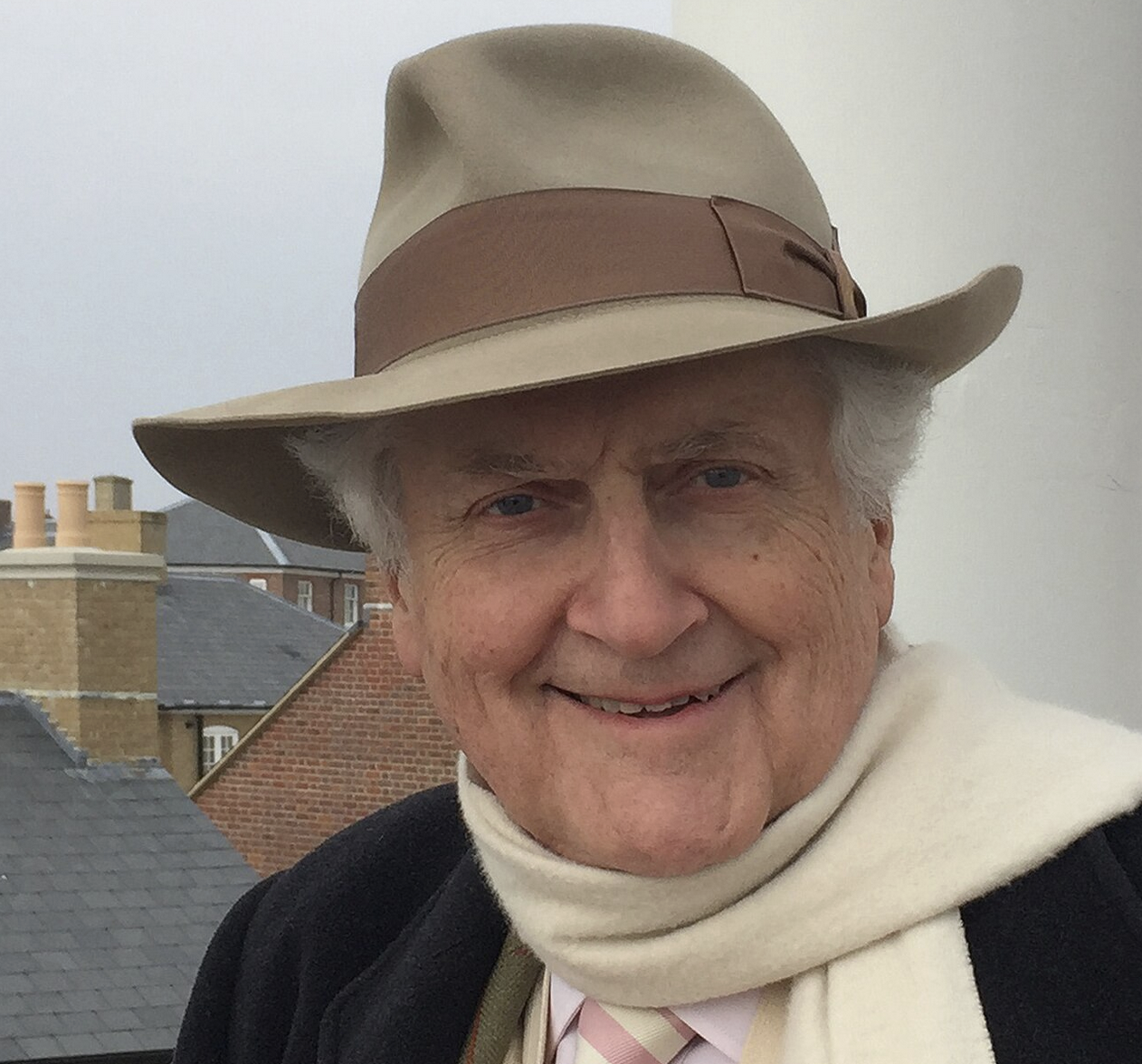
Leon Krier, photographed in 2018 in Poundbury. (Wikipedia)

Léon Krier died Tuesday in Palma de Mallorca, Spain, aged 79. Krier was born in the capital city of Luxembourg after World War II, and observed its degradation thereafter at the hands of modernist architects. His design education was very brief; he left architecture school after one years, hiring on with James Stirling in Britain. He left there swiftly as well. His older brother, the late Rob Krier, was also a classical architect.

Krier spent his life developing an unusual style of classical architecture, which might be described as a mixture of classicism and Art Deco. He tended to think of cities as projects imagined in their entirety. He is most famous for his masterplanning of Poundbury – owned by the Prince of Wales until Charles became King Charles III, and Cayala, outside of Guatemala City. Krier worked extensively on masterplans for Washington, D.C., and Dresden, Germany, where he was the only one of nine experts to vote in favor a citizens’ initiative to rebuild the city’s Frauenkirche and its Newmarkt area after their destruction by allied bombing in WWII. Both were successfully completed.

In 2003, Krier was the inaugural winner of the Driehaus Prize, which today and for many years has been valued at $200,000. Whether he received that amount in 2003 is unknown to this writer.

Krier’s most popular works may be his illustrations of architectural and urbanist principles (see below). His least popular work may have been his book on the work of Nazi architect Albert Speer, a volume that sought to determine whether the work of an artist could subsist alongside the evil of the regime for which he performed that and other work. He was  vilified unfairly for even bringing up the subject, but he does not seem to have cared. Krier wrote that

the whole of Paris is a pre-industrial city which still works, because it is so adaptable, something the creations of the 20th century will never be. A city like Milton Keynes [in Britain] cannot survive an economic crisis, or any other kind of crisis, because it is planned as a mathematically determined social and economic project. If that model collapses, the city will collapse with it.

Wikipedia’s article on Krier has this to say of his city designs:

Krier proposed the reconstruction of the European city, based on polycentric settlement models which are dictated not by machine scale but by human scale both horizontally and vertically, of self-sufficient mixed use quarters not exceeding 33 hectares (82 acres) (able to be crossed in 10 minutes walk) of building heights of 3 to 5 floors or 100 steps (able to be walked up comfortably) and which are limited not by mere administrative borders but by walkable, rideable, driveable boulevards, tracks, park ways. Cities then grow by the multiplication of independent urban quarters, not by horizontal or vertical over-extensions of established urban cores.

My own experiences with Krier came in short, occasional email exchanges over the past decade or so to clarify aspects of his work for my blog posts. Here is my favorite drawing by Krier, which I have reprinted numerous times:

Posted in Architects, Architecture History, Urbanism and planning | Tagged , , , | 4 Comments

CNU returns to Providence

This view of Westminster Street is almost indistinguishable from the period of CNU14, in 2006. Local CNUer Buff Chace has added some new shopping and eating on the street. (Google)

Mark your calendars for June 11-14, which is when CNU-New England returns to Providence for CNU33. A full agenda may be viewed here. (The agenda lacks information of where its sessions will be located.) CNU last landed in Rhode Island’s capital in 2006. That was CNU14. Below is a reprint of my Providence Journal column about that conference:

The New Urbanists in Providence
June 8, 2006 

THE QUESTION most asked at last week’s 14th Congress for the New Urbanism was: If style doesn’t matter, why are we always discussing it? The question answers itself.

The charter of the Congress for the New Urbanism reads, in part: “Individual architectural projects should be seamlessly linked to their surroundings. This issue transcends style.” But of course it really does not. Modernism, as conceived by modernists themselves, cannot link up seamlessly to its surroundings. Modernists are free to try, but those who succeed must abandon their modernist dogma.

The New Urbanism seeks to reconstitute the traditional patterns of living that prevailed before World War II, which have since been overturned by modern planning and design. Traditional styles are not necessarily the key to traditional neighborhood development. Walkability, proximity to shopping and intimacy of scale are more important. But the New Urbanism’s popularity, and hence its power to confront modernism, does hinge on its traditional style.

After all, the public might not necessarily recognize a traditionally patterned neighborhood without a hint from traditional styles. Slide after slide in the seminar “Can New Urbanism Capture the Market for Modernism?” showed modernist attempts at New Urbanist streetscapes. They were uniformly forgettable. Only one slide, of a block of townhouses in Aqua, part of Miami Beach, was attractive. Whether Aqua itself lives up to that slide, I cannot say. Moderne rather than modern, the block’s disciplined hubbub reminded me of the old town in the cartoon below, by Léon Krier. Aqua rejects the “Wow!” modernism that has spent decades trying, with increasing success, to live up to Krier’s wacky stereotypes.

In accepting CNU’s Athena medal honoring the seminal influence of his thinking on the New Urbanism, Krier displayed his unabashed classicism. As a boy, he watched his native Luxembourg being rebuilt in its historic patterns and styles after it was heavily damaged in the Battle of the Bulge — and its later brutalization by modernism. Krier’s influence arises in part from his erudite architectural cartoons of the modernists’ idiotic attempts at urbanism. My favorite, below, from his book Architecture: Choice or Fate (1998), shows a true and a false diversity: a traditional town on one side of a bridge and a modernist town on the other side; or a hodgepodge on both sides. The latter offers no choice.

Even as it handed him the Athena, the CNU appeared to be forgetting why it honors Krier.

In all their innocence, the New Urbanists throw open their movement to the modernists, heedless that highmindedness in modernist circles evaporated half a century ago — to be replaced by the most uncivilized behavior. The viciousness of their attack on New Urbanism following its post-[Hurricane] Katrina success shows that they have not changed.

In a masterful challenge to “classical jihadists” (as the CNU catalogue called people like me), the CNU board’s house modernist, Daniel Solomon, focused at first on the modernists’ transformation of architectural education. He tracked the influence of Harvard’s design school under founding modernist Walter Gropius, who fostered “a widespread cult of unlearning.” Professors purged not just the practice of classical architecture but its history from courses. Texts taught budding modernists that, in Solomon’s paraphrase, “if people don’t like the mechanization and abstraction of our brand of architecture, don’t worry; it’s their fault. As a modern architect and an initiate into the true workings of historical process, you have an obligation not to listen to them.” This “Gropius anschluss” transformed the schools, the firms, and eventually the landscape. Its “smugness” was, Solomon said, “bound to create a merciless backlash,” and it did — most powerfully as the New Urbanism (although the degree of the CNU’s mercilessness is, in my view, suspect).

The rest of Solomon’s lecture, however, called upon the New Urbanists to embrace not “Wow!” modernism but a more nuanced modernism, a “playful eclecticism” patterned after three exemplars of artistic creativity: Coco Chanel’s fashions, George Balanchine’s ballet and Duke Ellington’s jazz. Because they rejected modernist dogma and embraced art history, they can be models for a less staid, more “hip” New Urbanism.

The alluring imagery of Solomon’s proposal has great strength. But he underestimates the creativity of the classical. The New Urbanism is not staid. Like a classical symphonic score, the codes and pattern books of the New Urbanism offer room for delight in the hands of a genius. The mauve curvature, say, of an otherwise straight white picket fence is architecture in the clothing of jazz. But the rules of classicism put a less heroic yet still pleasing beauty in reach of most architects — whose capacity for genius, alas, Solomon overestimates. If architecture with rules is hard to do well, try architecture without rules. New Urbanism’s central insight is that the rules of the old urbanism really do work; they need only be accepted and learned anew.

Traditional architects stand proudly on the shoulders of history. Modernists reject history, and try to stand on their own shoulders. This is contortion, not genius. It cannot fit in. But true urbanism demands fitting in — with panache if possible — something that style can assist, and New Urbanism mustn’t forget.

***

The New Urbanism used to be interested in “building places people love,” but I’m not absolutely certain that this remains the case anymore. I have supported the New Urbanism for years, but am critical of the CNU’s inability to resist backsliding toward modernism, as it seems to me. Maybe I am wrong. Below is a capsule description of this year’s agenda, which revolves largely around climate change:

CNU 33 will allow attendees to examine how the region has adapted, explore the values of interdependence and community, and establish a hopeful vision for the future based on the power of New Urbanist solutions.

Posted in Uncategorized | 2 Comments

Paul Revere’s Ride, on piano

Benjamin Nacar plays the tone poem “The Midnight Ride of Paul Revere” at the Music Mansion on College Hill, Providence, Rhode Island. (YouTube)

William Wadsworth Longfellow’s poem, set to piano music, written and played by the Rhode Island pianist Benjamin Nacar. Ben’s playing brings to life most beautifully the cadence of Paul Revere’s famous ride and its memorialization in poetry. It was performed on the ride’s 250th anniversary at the Music Mansion on College Hill, in Providence, Rhode Island. Here is the YouTube rendition of that performance, accompanied by animated cartography.

I have learned that this event was not, in fact, hosted by the Music Mansion, but by the pianist himself, on his own piano, at home. The concert was not open to the public.

Posted in Art and design, Rhode Island, Video | Tagged , , , , , | 3 Comments

Rebuild Penn Station

Grand Penn proposal for rebuilding Penn Station. (Grand Penn Community Alliance)

Big news: President Trump has agreed to take over the job of building a new, classically-inspired Pennsyvlania Station. He has given the boot to the inept Metropolitan Transportation Authority (MTA), and has put Amtrak – which owns the facility – in charge of rebuilding it, with Madison Square Garden to be demolished and rebuilt across Seventh Avenue.

The new Penn Station would be called Grand Penn. It derives from a plan issued several months ago by what has been known as the Grand Penn Community Alliance. This plan would take the place of Rebuild Penn Station, a plan to largely reconsruct the demolished 1910 Pennsylvania Station proposed by architect Richard Cameron and the Beaux Arts Atelier, who had proposed a more thoroughgoing copy of the original station. Both it and the latest plan are supported by the National Civic Art Society and its president, Justin Shubow. The latest proposal features a public park next to the station along the lines of Bryant Park behind the New York Public Library – at the very dear expense of the huge waiting room from the original station. The original station was demolished in 1963.

I have had a difficult time deciding whether the loss of the waiting room is worth the addition of the park. If you believe the project is much more likely to be completed under the supervision of Trump, as I do, then I think the balance tips to the latest proposal. Except for some horrendous glassy modernist walls above the classical colonnade along Seventh Avenue, and above the passage from the rail hall to the park feature, the latest proposal’s architecture is reassuringly classical. But the loss of the waiting room – such a small phrase for such a grand salon! – is a serious omission, one that negates the imagery made famous by the post-demolition remark of historian Vincent Scully: “One once entered the city like a god, one now scuttles in like a rat.”

I like the latest proposal but have not yet given up on rebuilding the original station.

Others will have a more useful assessment of the proposal’s prospects given the current political and bureaucratic morass. Tom Klingenstein, chairman of the Claremont Institute, has an interesting essay in the NYT summing up the proposal more comprehensively (by far) than this blog post.

Can any project led by Trump be considered rational or doable? Remember that Trump took over the Wollman ice skating rink in Central Park after others had tried and rebuilt it on time and under budget long before he ran for his first term as president. And now, defying expectations, he has won a second term. I am not the first to suppose that if anyone can rebuild Penn Station, it is Trump who can do it.

Posted in Uncategorized | 5 Comments

Our Rube Goldberg world

Typical Rube Goldberg device. (Rube Goldberg Inc.)

Or, the Architecture of our Lives

By this title I refer to the structures of the lives that we Americans, most of us, lead. Notwithstanding all the other things we all have going on in our lives, much of our lives as Americans is lived under a blizzard of mail of all sorts that comes into our mailboxes – digital and snail – almost every day.

Bills and junk are the two categories we have invented to deal with them. Both “bills” and “junk” come in many different forms. Junk consists of touts to get us to buy something in the commercial world. Bills try to get us to pay for what we have already purchased, be it from commercial establishments or from establishments governmental or institutional.

We get “this is not a bill” mail from institutions devoted to our health care, most of which we ignore and that pile up until we chuck them out. Some of this mail, a small proportion of it, is made up of actual bills, some quite hefty. We ignore those at our peril – but ignore them we do. We get mail from insurers, both health and otherwise, each consisting of letters that we can and those that we cannot ignore, including those that we ignore at our peril. Often this affects our dear spouses. Some of this mail contains bills that amount to hundreds or even thousands of dollars. After a while, we start to get bills from collection agencies hired by lawyers hired by firms that do not receive the payments we have not sent them.

For example, mail from the companies to which we pay our monthly mortgage. This includes our monthly mortgage statement, which we ignore, since these envelopes include messages that say the same thing every month – until we have paid off our mortgages. That is, unless our mortgage company is purchased by another mortgage company, which either goes unannounced or is announced or reported in some piece of mail that we typically ignore. This happened to me recently.

To what degree is this sort of nonpayment caused by companies entering the market because of factors that affect their normal profitability, which is affected by acts taken by the federal government – acts of Congress or agencies nominally (but not actually) controlled by Congress, or by judicial review that forces these agencies to change the parameters of what is or is not legal for, say, our mortgage company, to do with the monthly mortgage that we send to them (often by autopay) every month.

If you take these legal parameters that apply to the bill for your mortgage and consider how similar legislative or quasi-legislative/judicial actions affect what you owe but don’t know you owe because you don’t open most of your mail, that might account for a large percentage of the money you owe to institutions that control a huge segment of your debt.

Take, for example, people who write books. They may take quotations or other matter from books whose contents benefit from copyright protection. But the copyright laws are changed by Congress every now and then. A book published in 1909 might have material that has been protected since then – that is, a writer might need to ask its publisher for permission to quote from this book.

But suddenly, the publisher might learn that no books published later than 1870 are copyright protected, so that writers need no longer seek permission to use material from a book written in 1909. It may be that nobody informed either the publisher of that book or the writer who uses material from that book. The publisher probably has a publishers’ association that is paid (in monthly installments that are less likely to be ignored by the secretary who gets the publisher’s mail every morning. But the writer who uses the material may never be informed at all of his dereliction.

My point is that the structures of everyday life are built upon a foundation of sand that shifts unpredictably at unpredictable times – in ways that make life financially hazardous for every American. The next president, who takes office in five days, has pledged to cut the cost of government, part of which is devoted, every year, to promoting hazardous instability in the systems that trickle down from the interstices of our massive federal government.

But those of us who follow the news can already see how the next president’s commitment to budget-cutting is being undermined. They can see how recent rulings by the Supreme Court against growth in the federal bureaucracy are being attacked by the huge forces that protect the complexity of the federal government.

To quote Rule 7 of the rules of bureaucracy:

Anything that can be changed will be, until time runs out and a new change can be proposed restarting the cycle.

It looks like we have two paths forward:

Go bankrupt, or go off-grid.

Or we can spend the entirety of the rest of our natural lives opening, reading, digesting and responding to what we get in the mail. This is our freedom of choice. Have fun!

Posted in Architecture, Art and design, Humor, Uncategorized | Tagged , , , | 10 Comments

Newport Cottages: 1835-90

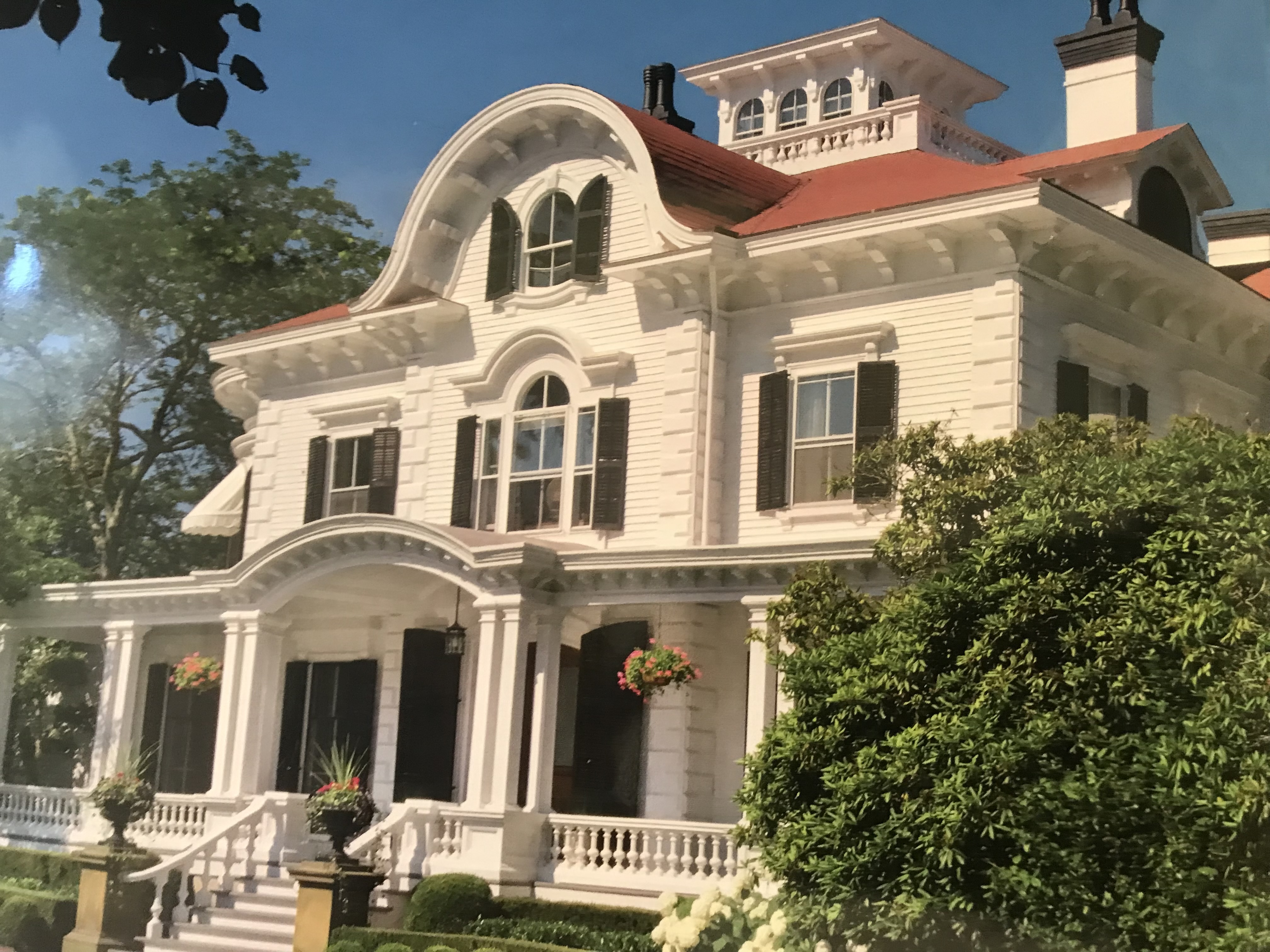
Cover illustration of Cannon Hill (ca. 1850), on the west side of Bellevue Avenue, built by a family from Boston. Photo by Aaron Usher III.

This excellent volume is the second describing the splendid dwellings of the summer colony of the City by the Sea, by architectural historian Michael C. Kathrens. It is subtitled “1835-1885: The Summer Villas Before the Vanderbilt Era.” His first volume describes the even more ambitious “cottages” inspired by European classical styles, and is titled Newport Villas: 1885-1935. The second volume, published by Bauer & Dean of New York, with a Foreword by Trudy Coxe of the Preservation Society of Newport County, is illustrated by 176 color photographs by Aaron Usher III, with 336 black-and-white photos, mostly historical.

The word cottages is something of a misnomer. The earliest of these, built even before 1835, were indeed more like mansions than cottages, albeit smaller in scale than those of the Vanderbilt Era. My impression is that Newport’s summer visitors continued to use the word cottage for its charming irony, as set against the word’s conventional quaintly cozy appeal. There may have been a classist element lurking in this usage. Even the early elite summer colony’s cottages were hardly quaint, let alone cozy – though it is likely that many small summer houses erected by the non-elite did, in fact, qualify as cottages in the normal meaning. But they were never examined historically, and are probably almost all gone by now. Maybe this is not strictly true; I invite the author to disagree in the comments below.

It is often noted that the elite summer colony drew families from the American South, which by 1835 was headed for war with the abolitionist North. Certainly Michael Kathrens takes due note of this anomoly. He writes in his introduction: “Of the twelve private cottages known to be standing in 1852, southern families owned eight. … In fact, more seasonal abodes were constructed in Newport between 1865 and 1885 than in the following decades, during what became known as the European Revival period that lasted almost half a century.” (Of course, many of these were larger and occupied vastly greater acreage.)

South Carolina plantation owner John Rutledge wrote in 1801 to ask a friend to push his agent harder:

I will embark in the first good vessel that offers for Newport. When I heard from Mr. Gibbs last[,] he had not obtained a house for me. I wish you would see him, and, if he has not got one, you will greatly oblige by uniting with him in endeavoring to get a house for me. If I cannot get one I shall be obliged to pass the summer at Boston, and I would not like that …”

In the 1840s, “Alfred Smith, an ambitious,self-made developer, had confidence that Newport’s summer colony lay in the direction of individual cottages.

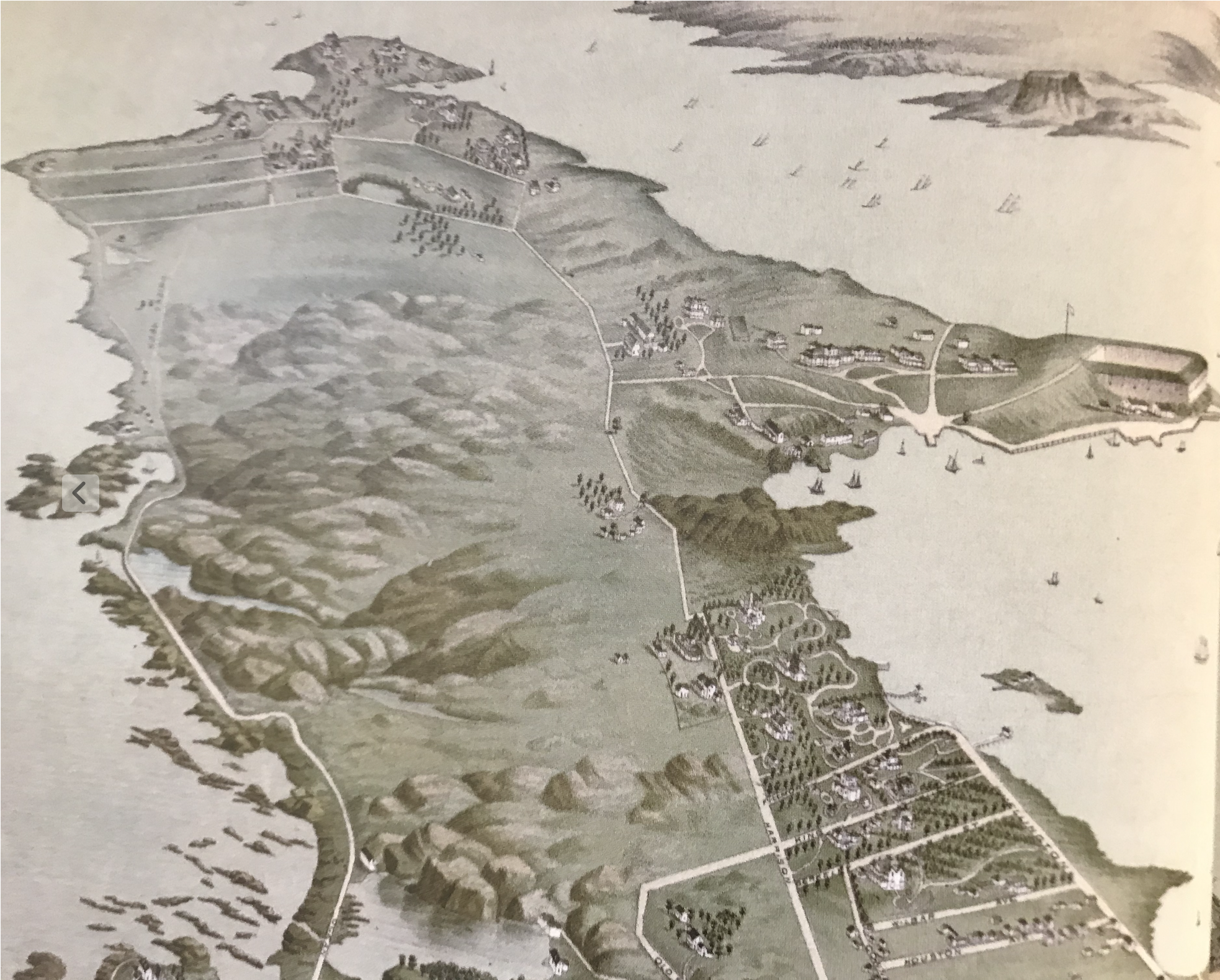
He formulated a plan to convert the open farmland and pastures east and south of town into commodious ocean-view lots that would be accessed by a network of broad avenues. Although there would be many investors involved in this pursuit, only Smith comprehensively grasped the possibilities and carried the plan through to its successful completion.

Born in 1809 on a small farm in neighboring Middletown, Rhode Island, Smith became a cloth cutter in Providence before moving to New York City. There he worked for many years as a tailor in the firm of Wheeler & Co. By the time he was thirty, Smith had saved $20,000, with which he returned to Newport in 1844 to begin a career in real estate.

The following year, Smith formed a syndicate to buy three hundred acres north of Bath Road – now Memorial Boulevard … . He went on to push Bellevue Avenue south to Rough Point, while to the east he created Ochre Point Avenue. … To add cachet, Smith designated each new roadway an “avenue” instead of using a more common-sounding “street” or “road” appellation. … The last leg of Smith’s plan was the creation of Ocean Drive[.]

One wonders whether such a career would be possible in the United States of today.

This hand drawn segment of a larger map, or illustration, shows the extent of Alfred Smith’s completed plan for Newport’s summer colony. Fort Adams is at upper right. (Aerial sketch by Galt & Hoy.)

Multiply the items cited above by a dozen, or a score, and you have some idea of the scope of material covered by Newport Cottages.

That suggests my only problem with this voluminous volume, which is also its greatest blessing: There is too much of it. The book’s 400 pages won’t be carried around easily by sightseers to Newport’s summer habitations. And yet the flow of detail from page to page – of a cottage’s lengthy architectural pedigree in addition to that of its ownership history – seems to invite examination during a walking tour of the neighborhoods described. Don’t lug it along. Lay the book out on a coffee table at home after returning from a tour and see if you can match your own photos or your memories to the photos in the book. Come to think of it, a book any smaller, with much of its text and photos edited out, would clearly be a lesser tour de force.

So buy it for Christmas before it actually shrinks, as everything else seems to do.

Posted in Architecture, Architecture History | Tagged , , , , , , | Leave a comment

Notre-Dame de Weybosset St.

Newly completed reconstruction of the Cathedral of Notre-Dame.

It’s a bit late to be hailing the rebuilt Cathedral of Notre-Dame in Paris. How beautiful it looks, inside and out. For a deeper analysis of both efforts I will await word from those more knowledgeable than I. Still, it was thrilling to see the leaders of the world, including President-elect Trump, gathering for the occasion five years after it was almost destroyed by fire. And perhaps it will not be seen as too far-fetched to wonder how the news of Notre-Dame’s revitalization might affect Weybosset Street, here in downtown Providence.

Weybosset Street expands into a plaza of sorts (similar to the Parvis, as the plaza outside of Notre-Dame has long been known), as Weybosset stretches west from Dorrance. PPAC, the Providence Performing Arts Center, forms what could be deemed the Notre-Dame of this neighborhood. It is just a couple of blocks from Providence City Hall, not far from the Providence River, just as the Hôtel de Ville (French for City Hall) sits in similar proximity to Notre-Dame on the River Seine as it flows past the Isle de la Cité.

Readers with long memories may count how many times this writer has urged city planners here to promote a Parisian ambience outside the doors of PPAC, where people exiting shows would have a veritable European choice of cafés and restaurants (both words are of French origin) to sit down and discuss the show they just saw while waiting for the traffic to dissipate.

Such a tasty plaza does not exist in front of Notre-Dame today. It is at present, I think, a site where the facilities set up several years ago to help reconstruct the cathedral are being demolished now that its reconstruction is complete. If the French planners are savvy (not a good bet, to be frank – its mayor is a Socialist), they will turn the Parvis into a paradise de cuisine. My very recent extraordinarily desultory visit to the web site of the musée Carnavalet revealed no evidence that such a usage had ever been carried out on the Parvis, although it is likely that many places to eat and drink existed, prior to the Parvis’s most recent renovation in 1972, on the ground floors of the hospital, the police headquarters and their predecessors if not the cathedral itself.

It could happen at what I’d like to call Weybosset Square. There are already enough restaurants in PPAC’s immediate vicinity, on either side of Weybosset, to bring such a vision to reality. My family and I have eaten at some of them before attending wonderfully exciting shows at PPAC. All it really needs is some good P.R., such as:

Eat, Drink and Relax until traffic clears and God (George Burns) says it’s okay to go get your car from the garage.

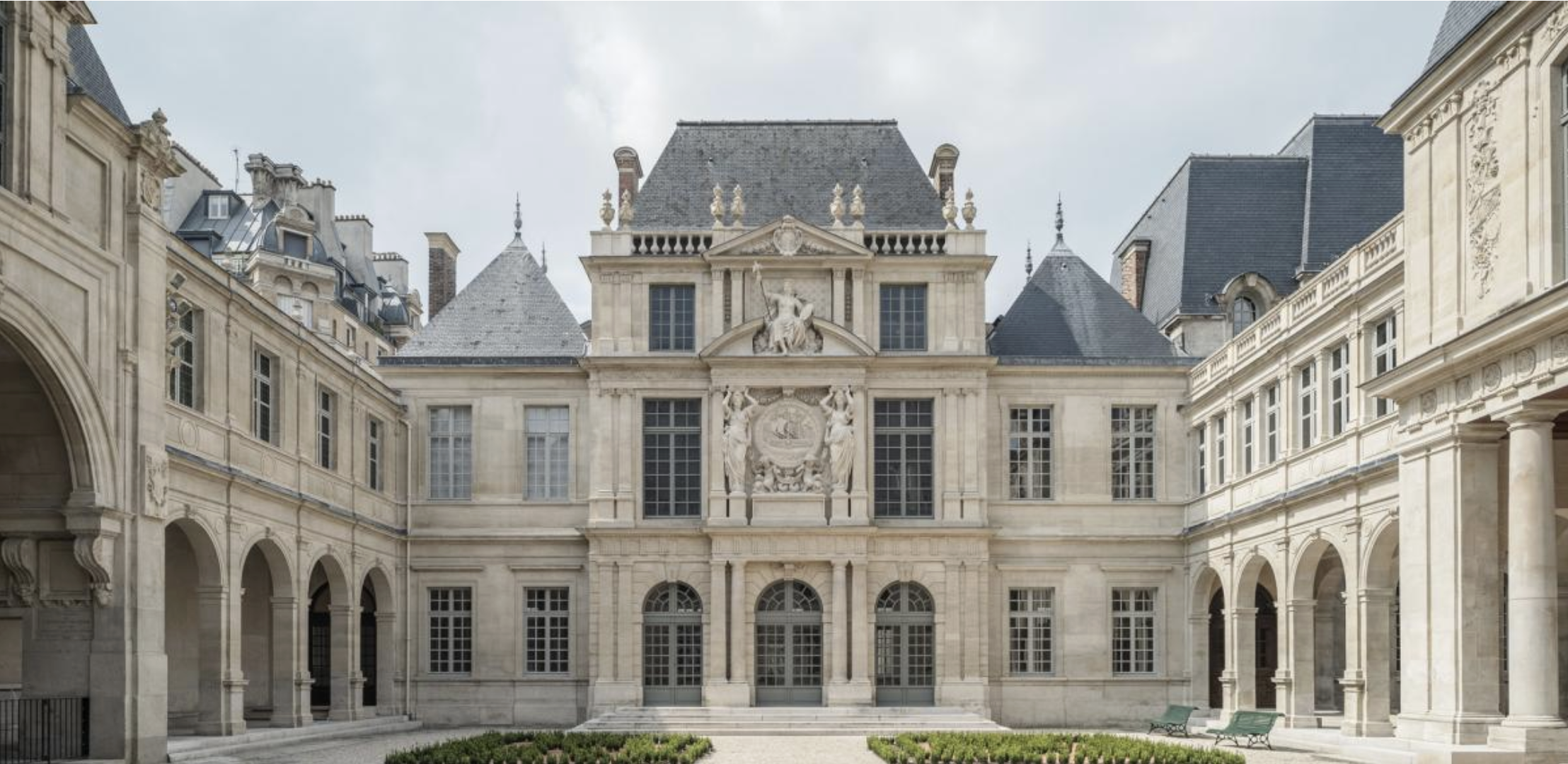
Alternatively, or in addition to that idea, suggestions to build a new structure to house the Providence city archives (several of which have been lately proposed and found wanting for stylistic reasons) could be reproposed. A new building inspired by the architecture of the musée Carnavalet could be built for the archives on the site of the library of Johnson & Wales College, whose campus quadrangle sits just to the east of PPAC. The “East German Embassy.” as the library is known due to its forbidding Stasi-esque appearance, it is sure to be torn down whenver civic leaders decide to develop a spine. The new building could house both the archives and Providence-themed exhibits patterned after those in the museum near the Parvis in Paris. If a new building of such design (see below) is too far beyond the aspirations of the city of Providence, the land could remain vacant until the moxie to build it has been grasped by city fathers, or it could be added to J&W’s excellent quadrangle by the city’s fleet of landscape architects. With a bit of creative thinking, they could be brought into existence again.

Musée de Carnavalet exhibits the buildings that once surrounded the Paris, as the plaza in front of Notre Dame was known for centuries. (carnavalet.paris)

Posted in Architecture, Architecture History, Development, Providence | Tagged , , , , , , | 3 Comments

The Miriam Hospital: 1984

The Miriam Hospital, now Brown University Health.

I was planning such a takedown of Miriam Hospital, known as The Miriam Hospital, or, now, Brown University Health. My hospital system was until recently called Lifespan. Lifespan is now out. It is now Brown University Health.

Well, this was going to be such a stitch, riffing on johnnies and all other things medical that have not been updated in two or three centuries.

But then I had second thoughts. The doctors and nurses Miriam, and, equally, those at the Rehabilitation Hospital of Rhode Island, in North Smithfield (where I was sent next), are so great. Do they deserve this?

No, I decided, they do not.

So I downgraded this post to a notification to readers of this blog of its writer’s officially certified good health after three weeks in two hospitals, including the Miriam (where I was admitted after suffering a small stroke) and the Rehabilitation Hospital of Rhode Island, in North Smithfield, where I was sent after that. Both seemed like a maximum security prisons, with beds alarmed to go off – sirens blaring, klieg lights flashing –  should a patient seek to visit the in-suite bathroom or any other place. Rooms at the Rehabilitation Hospital, or the Fogarty Memorial Hospital, as it was once known, were likewise alarmed, but toned down a notch or two. (“For your own good,” of course, in case you trip and fall on the way.)

In addition to letting readers know I am  now at home and doing fine, I’d like to let my roommate at Miriam Room 351 East know he should email me at dbrussat@gmail.com if he wants to read my manifesto.

Rehabilitation Hospital of Rhode Island, in North Smithfield

Posted in Humor | Tagged , , | 11 Comments

The mush slated for Parcel 5

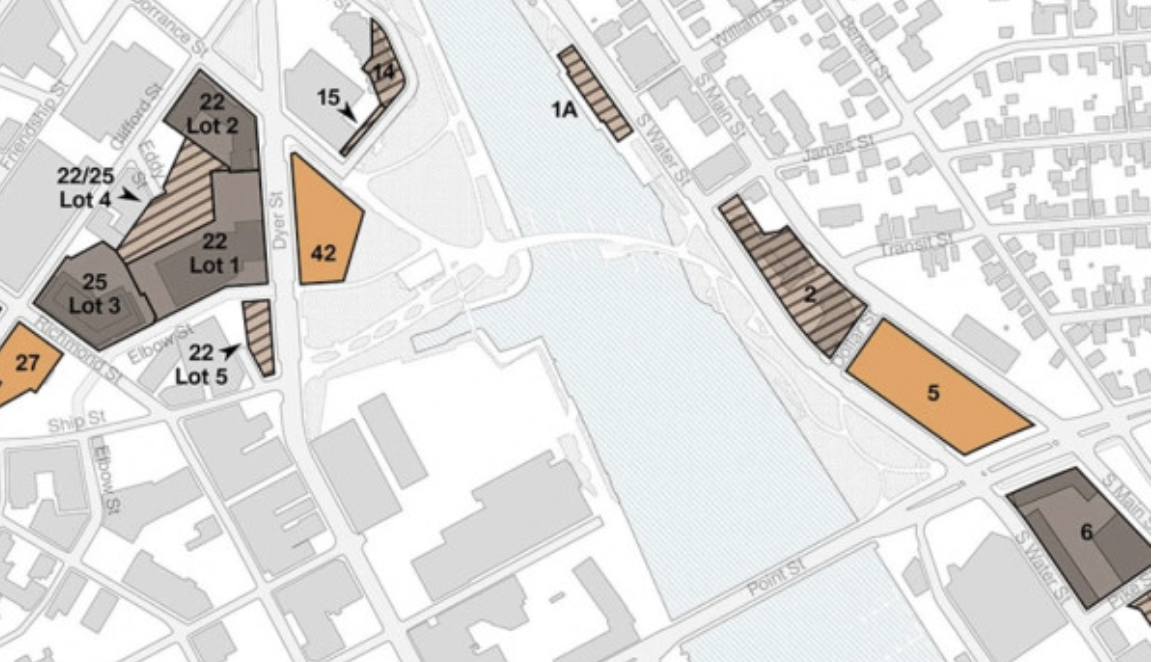
The Route 195 District Development Commission has just released a set of nine proposals submitted at its request for Parcel 5, the largest remaining unbuilt, unsold or not yet “under agreement” bit of I-195 land east of the Providence River, created more than a decade ago by the relocation half a mile south of Route 195. The proposals are all bad. My friendly rival Will Morgan has critiqued them for the website GoLocalProv.com.

Will and I are in agreement on most development proposals for new buildings in old neighborhoods in Providence. They, too, are mostly bad and Will agrees, thinking as I do that developers should do a better job fitting such buildings into the local character.

But on new development generally, we are diametrically opposed. He favors snazzy new buildings and I favor buildings that fit into the surrounding historical character. Even if the historical character has already been destroyed by previous development, it always makes sense to rebuild it, and you gotta start somewhere. If that sounds relatively boring – it involves copying the past, a no-no for the mods – it produces neighborhoods and districts that are healthy and humane in a way that snazzy new buildings never do.

Curiously, the preference for the snazzy new over the healthy, humane old styles has been the establishment view of the stodgy architectural profession for seventy or eighty years now – even though the public prefers the graceful old styles by dramatically large margins, according to every study ever done. People are most confortable with what they are familiar with and understand – and why shouldn’t they be?

Will is an unusually articulate proponent of the snazzy “modernist” styles. Today’s modernism is watered down and might well be called “plasticky,” to judge by what has been built in the 195 District and elsewhere in town. Will normally does not favor this “plasticky” style, and keeps hoping architects will come up with something that’s both snazzy and good, but he is doomed to be disappointed.

Of the nine proposals submitted for Parcel 5, Will seems to like the one by local firm ZDS best. He describes it as “wickedly audacious,” a description that by itself would cause me to assume I will dislike it. It is pictured in the lower left frame of the images up above. It is not the least bit audacious, but is instead a typical layering of flat, glassy elements with no apparent atypical features, other than that ZDS is local. It is not just another Boston firm that farms out its least senior architects to handle commissions in Providence. Will says ZDS is “taking a chance, daring to be bold.” Huh? He then admits that ZDS is a “successful but unimaginative firm that has given the city so many architectural duds.” Its hotel on Parcel 12 at the northeast corner of Kennedy Plaza is its best (and its first) work in Providence, It seems as if it is trying to be historic, but fails to avoid the dread “plasticky.”

Will also likes the proposal by Wade/Keating, which works mostly around Boston. Its proposal for an art and design center at Parcel 5’s corner of South Main and Wickenden is the most unusual of the nine designs, and is at the center of the images up above. It actually has gables, which I thought had been banned half a century ago! Alas, it has all the hallmarks of succumbing to “plasticky” once its slick pallet of materials is revealed at some later meeting.

All the other seven proposals are type-cast refugees from the commission’s 195 playbook, where its yen for bad architecture is laid out for all to see. Will writes that the commission has a “track record in attracting quality architectural design.” No, the commission has a track record of shooing away quality architectural design. This is shocking – because there is so much beauty in Providence for the commission to copy – but it is no surprise.

Map of most of the central I-195 District. Parcel 5, far right. (195 Commission)

Posted in Architecture, Development, I-195 Redevelopment District | Tagged , , , , , | 11 Comments

Rubik’s Cube of life sciences

Proposed life sciences center in Brown’s Jewelry District campus in Providence. (TenBerke)

Brown has released the design of its umpteenth medical research center in Providence’s Jewelry District. It looks just like every other building of its sort, a bland, inoffensive glass and steel nonentity designed by TenBerke, with interiors by Ballinger, encumbered with a bulky name comprising the chief donor and his wife.

The William A. and Ami Kuan Danoff Life Sciences Laboratories building with its seven stories and 300,000 square feet may be nothing to write home about from an aesthetic perspective, but Brown has assembled an announcement that informs readers of the design’s interlocking multiplicity of research purposes and capacities. The announcement is a veritable Rubik’s Cube of medical/administrative rhetoric.

Brian E. Clark, of Brown’s media relations department (the writer, it may be assumed, though it does not say), may be congratulated for the fecundity of his creativity. His first paragraph reveals its flavor. It reads as follows:

Grounded in the concepts of innovation, connection and flexibility, Brown University’s planned facility for integrated life sciences research is designed to convene scientists across multiple fields of study to solve complex, interconnected health and medical challenges.

But Mr. Clark has omitted a few words! No matter, there they are leading off the second paragraph: “state-of-the-art”:

State-of-the-art laboratory spaces illuminated by natural light, a street-level education lab accessible to the public, and plentiful interior and exterior gathering spaces are among its signature elements, as illustrated in architectural renderings released on Thursday, Sept. 12.

That pretty much sums it up, doesn’t it? But wait! There are still 26 more paragraphs to be read!

It is a sad commentary on a building’s design that an architecture critic can find nothing at all to say about it. Maybe the critic is to blame. I presume that my friendly rival Will Morgan will produce a more informative piece shortly for GoLocalProv, which stands in these days for my former employer, the Providence Journal.

Increasingly, the Jewelry District is refashioning itself to look more and more like the Danoff building, and in the not too distant future every building in the Jewelry District will be indistinguishable from the Danoff Building. Kiss the Jewelry District’s historical character goodbye. Is there a process for undesignating a historic district once it has been so designated?

Posted in Architecture | Tagged , , , , , , , , | 8 Comments