Trench of blood and poppies

The poppy memorial to the dead of WWI around the Tower of London.

The poppy memorial to the dead of WWI around the Tower of London.

Among the most moving, impressive and beautiful temporary memorials in recent years is the flood of blood poppies in the moat around the Tower of London. Conceived by artist Peter Cummins to honor the sacrifice of Britons who died in World War I (1914-1918), the 888,246 ceramic poppies will continue at the Tower until the end of this month, to be reinstalled in cities around Great Britain through 2018 and then installed permanently at the Imperial War Museum. (Please don’t let the politically correct pressure the folks at 10 Downing St. to change that name!) The Telegraph’s package, including a time-lapse of the poppies’ glowing evolution under the revolution, so to speak, of the sun, features several memorable photographs. The lovely photo above comes from The Guardian.

Posted in Architecture, Art and design, Other countries | Tagged , , , , , , | Leave a comment

Bulfinch awards Wednesday

Charles Bulfinch (1763-1844)

Charles Bulfinch (1763-1844)

Coming up Wednesday is the ceremony at the Massachusetts Statehouse for the Fifth Annual Bulfinch Awards. The winners are known. You can may see their entries here. But you may applaud them on that evening from 6 to 9 p.m. by clicking here to buy tickets at a price that speaks volumes to the growing popularity and influence of the Bulfinches and the big party where each winner gets a newly struck Bulfinch Medal.

The award program from the New England chapter of the Institute of Classical Architecture & Art aims to reward and publicize the work of regional designers, this year in 11 categories. The ceremony will again take place at the foot of the Grand Staircase, an addition to the Statehouse as first designed by Charles Bulfinch himself back in the 1790s. Aaron Helfand, an architect at the Boston firm of Albert Righter & Tittmann and author of a spectacular design for a classical new Boston City Hall, will present an illustrated lecture, titled “… But Is It Really Classical?” Everyone will be encouraged to nosh on the delightful hors d’oeuvres piled on groaning tables that charmed the palettes of attendees last year.

This year’s Bulfinches will be the first under the presidency of Sheldon Kostelecky, who was elected following the retirement of John Margolis, who took a new job with a firm in Los Angeles, where his influence is sorely needed. The Bulfinches are as much a product of John’s energy and leadership as anyone’s. And the chapter looks forward with confidence to Sheldon’s tenure, as he was among the chapter’s founders a decade ago.

If you think old Boston or old (fill in your city or town) bring more pleasure to you and credit to your community than what has arisen in our built environment over the past half century, you can do something concrete to promote its return in the form of high-quality contemporary traditional architecture, art and urbanism. They are as valid – no, they are more valid – no, they are a lot more valid today and tomorrow than what has been inflicted upon us, with which its advocates vow to torture us all without letup. You can help slow, even stop, even reverse this ugly state of affairs by attending the Bulfinch ceremony on Wednesday, and maybe even by joining the chapter.

No, you need stuff no ballot box to help bring about a more radiant future!

Posted in Architecture, Art and design, Urbanism and planning | Tagged , , , , | 1 Comment

Where the good guys live

TheedMap

Map of city of Theed on the planet of Naboo. (img2.wikia.nocookie.net)

My post “Lucas villain ship to Chicago” sparked a lively back and forth on the TradArch and Pro-Urb listservs about the work of those who create urbanism for the movies. Was Blade Runner filmed in a house designed by Frank Lloyd Wright? Yes, Ennis House, built in 1924. What material was used, and how is it holding up? Or, the idea for the city of Theed on the planet Naboo in the Star Wars series came from Leon Krier’s Atlantis, his ideal town on a hilly isle, according to Andres Duany. (Thanks to Michael Geller for posting the excellent map of Theed atop this post – click then click to enlarge.) Over drinks at a Miami Beach café with the urbanist Demitri Baches and the films’ production designer it was argued (by whom I’m not sure) that “a nice city could not be modernist.” All this recalls a zany essay on the dark side of movie island paradises by Edwin Heathcote of the Financial Times, to which I linked from this post last April.

I believe that if a study were done of cinematic habitations for good guys and bad guys, it would discover a remarkable tendency of the good, the brave and the innocent to occupy traditional architecture – from houses to cities ranging from classical to the vernacular. And vice versa for the bad guys. Whether on purpose or by intuition-inspired accident, it would seem there’s nothing coincidental about this profound dichotomy!

An effort to bring this remarkable filmic truth to the public’s attention might be a coup for the good guys in architecture’s style wars.

Posted in Architecture, Art and design, Urbanism and planning | Tagged , , , | 3 Comments

Legal on Blackstone Blvd.

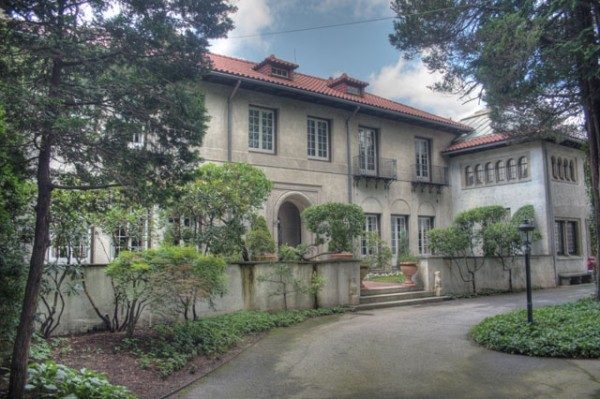
The 1915 Tuscan-style house of Leonard and Paula Granoff. (curbed.com)
The 1915 Tuscan-style house of Leonard and Paula Granoff. (curbed.com)

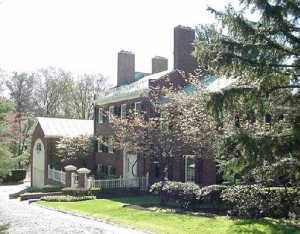
A typical Blackstone Boulevard home. (providenceeastside.com)

A typical Blackstone neighborhood home. (providenceeastside.com)
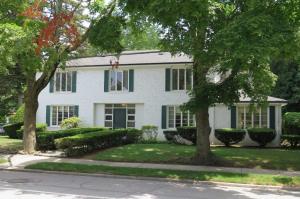
Some modernist houses on Blackstone are better than others. (trulia.com)

Some modernist houses in the ‘hood are better than others. (trulia.com*)
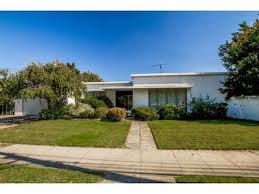
Then there is the mid-century modern

Then there is the mid-century modern. (realtor.com)

Even the Blackstone neighborhood of Providence can be relied on to prove that no place in the city is absolutely stereotypical. I didn’t realize the extent to which this was so until yesterday, when I went, ahem!, “jogging” up and down its sumptuous residential streets. No, there are no slums on Blackstone Boulevard, but the neighborhood of mansions and other opulent abodes in an array of traditional styles, from Neoclassical to Gothic to Victorian, Shingle and beyond, is speckled and besplotched by poor residential architecture. No small bit of it is mid-century modern, notably in the blocks to the north, west and, especially, southwest of the walled Granoff estate along the boulevard immediately north of Rochambeau Avenue.

Notably because the Granoffs are trying to sell their land to a developer who would recoup his investment by subdividing the property at 440-460 Blackstone into up to 12 parcels for single-family residential. One would like to think that the Granoffs would sell only to a developer whose plans would raise rather than lower the local property values. The lots as laid out abide by city code, so there seems to be no legal lever by which the local community can bargain with the family. Their large 1915 Tuscan-style house would be preserved. But they would move out, and nobody knows what a developer will put on the rest of the land once it is no longer under the protective wing of Leonard and Paula Granoff (her family, the Kofflers, founded the American Tourister luggage empire in Warren, R.I., in 1933).

A lively meeting was held on Oct. 27 at the Rochambeau library, and another meeting will be held this Monday, Nov. 10 at 6:30 p.m. in the Central Congregational Church on Angell Street to prepare for a special City Plan Commission meeting at the planning department on Tuesday, Nov. 18.

The community, which has formed the Blackstone Neighborhood Organization to act on its behalf, wants to move the process forward arm in arm with the good Granoffs, whose better angels sit on one shoulder whispering into one ear of their longstanding legacy of stewardship. But the community is also watching the Granoffs’ other shoulder, where a small gremlin whispers into the other Granovian ear that sunny Florida beckons, along with other advice in all probability quite a bit less salubrious. That, at least for now, seems to be what the Granoffs are listening to. After the library meeting the community conveyed its concerns to the Granoffs, but received little in the way of a comforting reply.

Who knows how this tug of war will go. But the fate of the stone wall bordering the Granoff estate along Blackstone and Rochambeau may tell which way the wind is blowing.

The community, which has failed to rally in the past as developers and landowners have degraded the value of the Blackstone neighborhood over the decades, can only hope that the better angels of the Granoff nature will prevail. But angels and gremlins have eyes and ears themselves. A turnout at the Nov. 10 and Nov. 18 meetings as strong as at the recent Rochambeau meeting cannot fail to have a salutory influence.

*Trulia, noting my attributed illustration from its real-estate network, has asked me to offer readers a link to their site, which I do with willingness and appreciation. The site is as follows:

http://www.trulia.com/RI/Providence,5927,Blackstone/


Posted in Architecture, Development, Preservation, Providence, Urbanism and planning | Tagged , , | 2 Comments

Lucas villain ship to Chicago

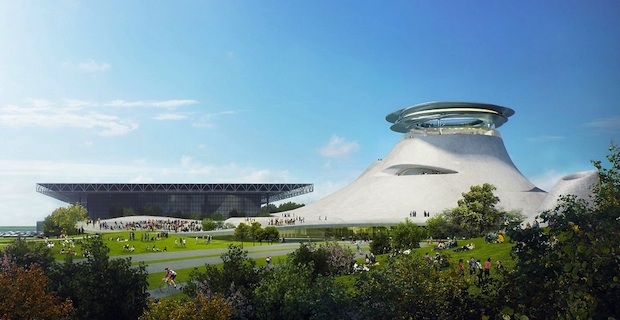
Proposed design by MAD architects for Lucas museum in Chicago. (Crain's)

Design by MAD architects for Lucas museum, at right, in Chicago. (Crain’s Chicago Business)

It’s hard to imagine how distant filmmaker George Lucas of Star Wars fame must be from his project for a museum displaying his collection of “narrative art.” The phrase “billions and billions and billions,” made famous by the astronomer Carl Sagan, pops to mind. After the rejection of his proposed museum in San Francisco, because of its traditional design I am persuaded, Lucas seems to have fobbed the project off to lesser minds, ignoring his own career full of knowing cinematic references to the symbolism of architecture. Not only does the design pick up on his films’ modernist headquarters for evil rather than imagineering a place for people, but it would be sited so as to do incalculable damage to the city’s lakefront classicism – already under sustained attack for decades.

Mars attacks, indeed!

Edward Keegan brings us all the gorey (oops, I mean gory) details in his piece “Dear Mr. Lucas: No weird architecture, please!,” in Crain’s Chicago Business. An even more lurid take on the proposed museum, by political blogger Greg Hinz, also of Crain’s, is “Lucas museum rolls out a design that R2-D2 would pan.” It compares the architects’ proposed alien spaceship with the one that landed nearby on Soldier’s Field, and unpacks the dislike for the design (by the aptly named firm MAD, of Beijing), including apparent concern about the design from Mayor Rahm Emanuel, or at least his office.

(I’d guess that politicians are more likely than their minions to reflect the public’s admirable distaste for modernism. Minions are less likely to be as concerned about votes as their bosses, and more likely to consider themselves as artist-wannabes.)

“It screams and hoots, and yells and carries on,” writes Hinz, “in its own way defacing the city’s lakefront as much as any teenager with a can of spray paint when they come upon a vacant wall. It tries not at all to honor the greenery and museum spirit around it. Instead, as one wag here immediately dubbed it, it’s Greco-Martian.”

Indeed, it looks like a malevolent volcano, a description that would be redundant in any field but architecture. Keegan refers to Chinese President Xi Jinping’s recent warning about “weird architecture.” One must wonder if Xi’s diktat has sent China’s creators of alien spaceships scurrying overseas to scare the citizenry of the United States!

Posted in Architecture, Art and design, Development | Tagged , , , , | Leave a comment

Greek revival democracy

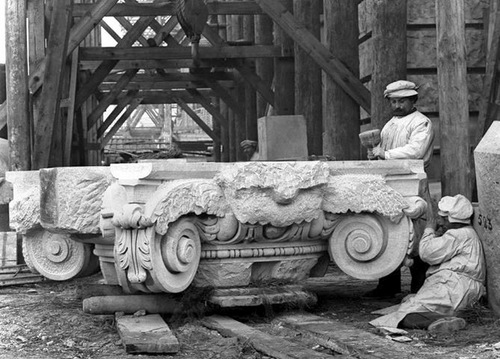
Perhaps a reader is familiar with this photograph that so resonates within our hearts. It is from the "home" section of the website of architect Tim Andersen.

Perhaps a reader can identify this photograph that so resonates within our hearts. It is from the “About us” section of the website of architect Tim Andersen.

Architect Tim Andersen sends an essay, “Next Greek Revival: The Republic Could Rise Again,” that reminds us on this Election Day of the entwining tenets of architecture and democracy. Architecture creates the stage for democracy. Democracy creates a people wise enough to embrace and maintain civilization. Or one would like to think.

“How inspiring it would be today,” writes Andersen, “to see a new Greek Revival meeting house, library or school. … It would be a daily reminder for citizens to rise up and take responsibility for their government.”

Here’s more: “Media scholar Ben Bagdikian observed that ‘fundamental deception damages the public’s ability to maintain a rational view of the world. Once a basic untruth is rooted, it blurs a society’s perception of reality and, consequently, the intelligence with which it reacts to events.”

Andersen’s essay eventually moves from architecture to politics. His slant is, you might say, nonpartisan, but not the vague “middle-of-the-road” milksop politics so popular with many today who fear the need to choose. Toward the end of his essay, Anderson returns to architecture as a reflection of the essential civility of a functioning democracy. “Architecture,” he writes, “mirrors society and represents its aspirations. Historic building traditions embody a society’s long-held meanings and beliefs. Culture in this sense is literally constructed.”

The emphasis on that last word is mine. I see a critique of modern architecture implicit in  Tim Andersen’s essay, embedded in its critique of modern American society. Without really being mentioned, it nevertheless percolates quietly throughout. The essay is a clarion call that merits reading on this of all days.


Posted in Uncategorized | 3 Comments

Intruder at Gugg party

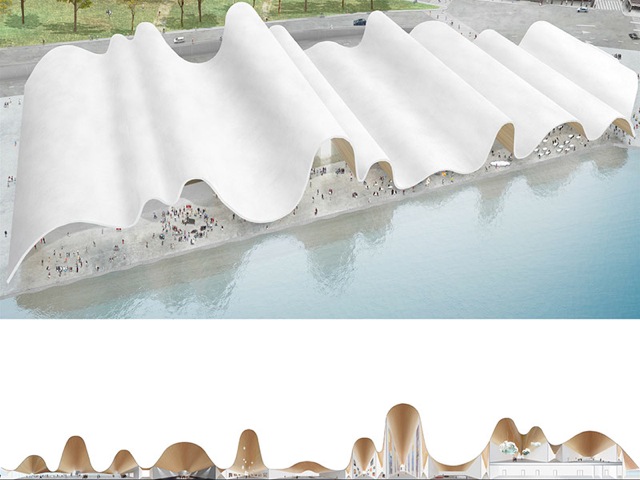
Entry by Nil Buras into the international competition for a new Guggenheim Museum in Helsinki.

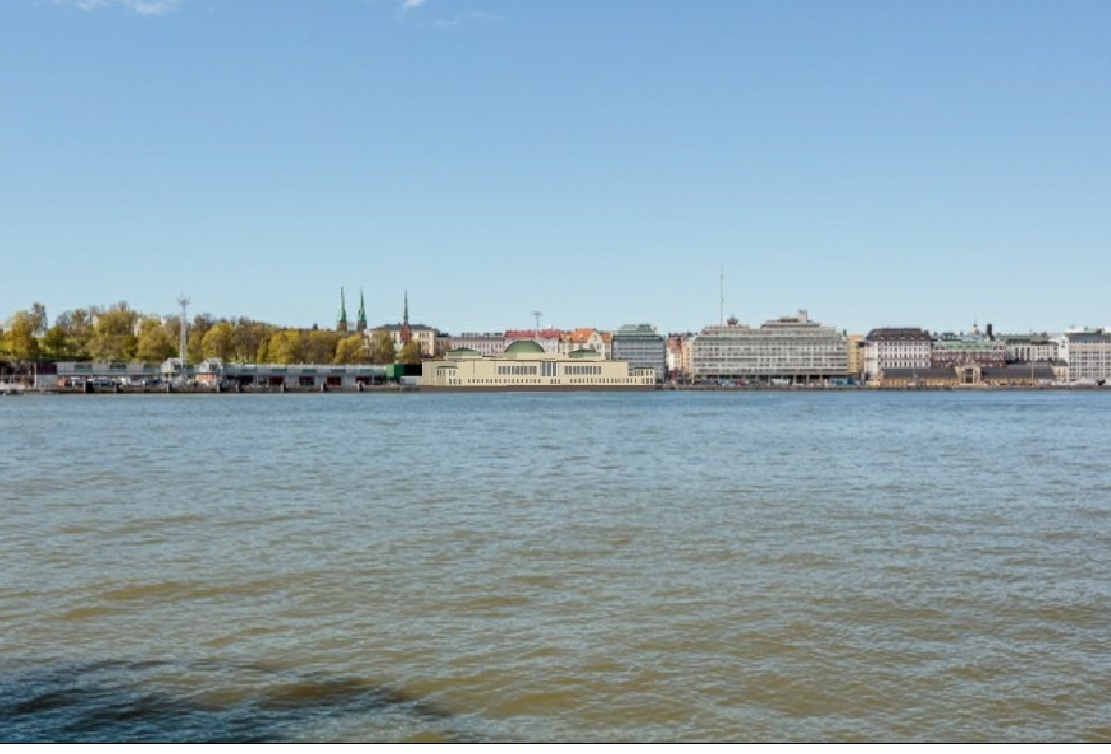
Domed building at center by classicist in competition for a new Guggenheim Museum in Helsinki.

On Halloween I posted a link to all 1,700-plus entries, from 77 nations, in the international design competition for a proposed Guggenheim Museum in Helsinki. I scanned reams of thumbnails, hoping to find among them one that struck me as an entry of classical or traditional style. Each thumbnail being approximately a mere three quarters of an inch square, I had to rely upon a sort of visual speed intuition. I clicked about 30 thumbnails, which expanded to about an inch and a half square, allowing a slightly more detailed look, which could be clicked again for a full view of several images and text from each entry. Few were tempting enough to lure me beyond an initial click – mostly due to a somewhat perverse desire to ascertain the degree of a submission’s outlandishness. Most thumbnails appeared quite evidently so without recourse to enlargement. Reluctant to even begin a full investigation of such infinitesimally small promise of a traditional entry, I left the vast bulk of submissions completely unexamined. I promised myself that I would investigate further at some future but unpinpointed time. And I may even do so.

Meanwhile, I have learned that at least one renegade classicist has infiltrated the Guggenheim screening process. Entry GH-2344762056, submitted by a resident of one of the 77 nations, is titled “Ceci n’est pas une pipe” (referring to Magritte’s pipe painting) and is thematically described thusly:

Synonymous with the interplay between architecture and art the Guggenheim Foundation reaffirms that art effects change. Facing the greatest change in its history, Helsinki can reinforce its identity not just for a “cool” tomorrow but through long-term sustainable placemaking: less by outside avant-garde and more by an expression of civic values and true democracy.

There is no progress in building “yet another Guggenheim” when society knows that technology and modernization’s negative impacts can no longer be remediated by “technological fixes.” The Guggenheim must innovate. This project exemplifies how innovation ventures into the borderline to find the edges that others may not see, including redefining our “old” and “new.”

This building humbly relies on master craftsmanship and skillful engineering, on understanding “what is” and new potentials. Depending on the sun and moon, it dramatically varies from minimalism to expression to delicately balance Time’s transitions.

I have no comment, except to speculate whether a tincture of irony has made it into the architect’s discourse, irony that soars well above your dutiful correspondent’s head. The link above takes you to the illustration that tops this post, then to a rendering of the interior of the building’s domed central space, and then to the just-recited thematic description. One wishes our intruder the best of luck. Yet one also inclines to note that one enters his entry, as one enters the rest of this competition’s first round, at one’s own risk!

Posted in Architecture, Development, Other countries | Tagged , , , , , | Leave a comment

‘Our Vanishing Legacy’

The New York skyline circa, I would imagine, 1950. (hdc.org)

The New York skyline circa, I would imagine, 1940. (hdc.org)

Making the revival rounds of historical organizations in New York City is a fascinating film not shown in decades. Originally released on Sept. 21, 1961, “Our Vanishing Legacy” was the first documentary promoting historic preservation in the city. This was after the demolishing of Pennsylvania Station was announced but before it was accomplished. Produced by Gordon Hyatt and narrated by Ned Calmer, the 32-minute film will rouse sad memories in many old enough to rue what was being inexorably lost in that era. Penn Station and Grand Central are featured here, but several other historic buildings at risk then (and surely long gone) are also shown. The sad tone raises memories a well. There are some brief but excellent remarks, too, on what was tending to replace them.

My thanks to Kristen Richards, maestro of ArchNewsNow.com, for sending the video to me.

Posted in Architecture, Architecture History, Old Video, Preservation | Tagged , , , | Leave a comment

Spookitecture! Oh my!

An entry in the design contest for the proposed Guggenheim Helsinki.

An entry in the design contest for the proposed Guggenheim Helsinki.

Today is the perfect day to post images of more than 1,700 entries for the proposed Guggenheim Helsinki museum, generated by an international competition, that have been released to the public. The exercise reminds me of a phenomenon that goes by the name of another great Scandanavian city. The Stockholm Syndrome is when a captive begins to empathize with his captor. The Helsinki Syndrome is what afflicts a victimized city that craves the sort of building that will exacerbate its victimization. So, recoil in horror all ye who enter here!

Posted in Architects, Architecture | Tagged , , | 2 Comments

Traditional or modernist?

Addition to a cottage in Brittany, France. (NeM Architectes, Paris)

Addition to a cottage in Brittany, France, rear view. (Photo: NeM Architectes, Paris)

A reader has sent me an article called “Before and After: A Charred Wood Cottage on a $45k budget,” by Michelle Slatalla, from Issue 42 of the online journal Dark Shadows. My correspondent, who enjoys claiming that my usual modernist targets are not examples of modern architecture, assures me that the featured architecture is “real traditional work.”

The gabled guest house of blackened wood added to a small white cottage in Brittany seems instead to partake of a contemporary sensibility, given the clearly intended contrast. While a gable certainly counts as a typically traditional element, the stark white interior fits awkwardly inside the charred black exterior, which itself sits awkwardly next to the stark white house. They do not contrast, really; they clash. This is in no sense “bad trad,” or “lean” classicism or even “heterodoxia,” as some might suggest. It is modern architecture. The giveaways to the intention of the architects, NeM Architectes, of Paris, are the floor-to-ceiling sliding glass doors off the bedroom, the vertical slit window cut into a single board of the blackened siding, the platform “roof” of the entry to the connecting passageway, and the white pebbles of the cottage’s garden

Aside from the gable, the supposedly “traditional” element is the exterior wood, which uses an old Japanese wood-burning technique to achieve its darkness – dear to the theme of Dark Shadows. But since a Japanese technique is not widely associated with coastal France, the regionalism presumably implicit in “real traditional work” is lacking.

The line near the beginning of the piece, that the architects wanted to “add a bedroom without sacrificing any of the quaint atmosphere,” is sufficiently contrary to the obvious intention as to be hilarious. Maybe the architects, their client and the writer of the article are so marinaded in Gehry swirly whirly or Zaha zig-zag that something as modest as this little structure, which is not entirely despicable, actually seems traditional to them.

I imagine that my correspondent intended to shock me with his predictable absurdist definition of the word traditional, so conventional in the modernist lingo. He continues to imagine that I will find his missives of this sort startling, but I am hard to shock in that way. I’ve seen it all. Still, it is very entertaining.

Posted in Architecture, Humor, Other countries | Tagged , , , | 1 Comment