Feel it, be it, don’t teach it!

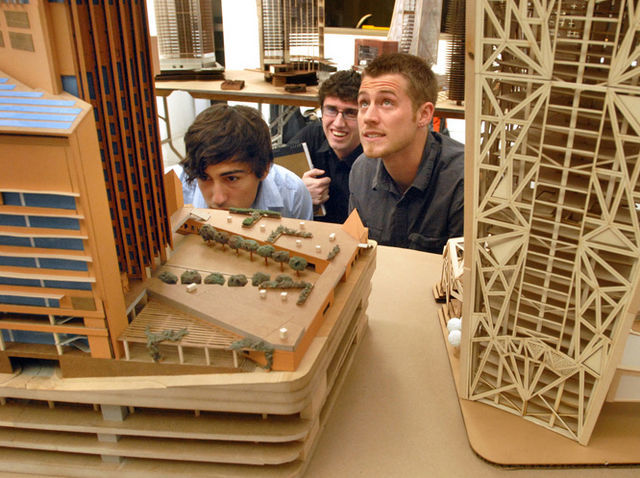
Architecture students at Univesity of Arizona. (tucsoncitizen.com)

Architecture students at Univesity of Arizona. (tucsoncitizen.com)

According to a report in ArchDaily.com, the Royal Institute of British Architects has released a survey that supports the contention that students graduating from architecture school do not know how to practice architecture. This comes as no surprise to anyone who has walked down most streets lately, in Britain or America. That architects don’t know architecture is rapidly becoming a tautology.

Students of architecture study theory in school. They are generally discouraged from studying the techniques required to sustain a practice, whether that be getting clients, arranging to get and carry out commissions, or even to integrate the types of knowledge required to design a building or to translate a design into an actual building.

An architect used to be someone you hired to design a building and then superintend its construction. Today, an architect is someone you hire to trot out before the local press to impress the public that your institution is thinking outside the box.

Students are further discouraged from studying the history of architecture. They are encouraged to follow the design inspiration of their teachers, who have often “graduated” to teaching even before completing a career in architecture.

It is a wonder that most buildings get built at all. As it is, they get built only by stretching the definition of that word, and hiring a lawyer.

So it is also no surprise that the American Institute of Architects recently surveyed its members to find a better word than intern for student working for free or next to it at the lowest level of an architectural office. Intern is, it seems, a dissatisfying name for young people trying to enter the business. Well, at least they are thinking about important things.

(Only 1.8 percent thought they should be called apprentices instead. Chew on that!)

I keep hearing that graduates of architecture school emerge with such recondite abilities that they end up designing crappy traditional houses since they cannot find work designing the really idiotic buildings they pretended to learn to design in school.

This would all be very funny if it were not so tragic.

Posted in Architecture, Architecture Education | Tagged , , , | Leave a comment

Buda + Pest = Budapest x 3

Budapest, looking across Danube toward Parliament at dusk. (it.wikipedia.org)

Budapest, looking across Danube from Buda toward Pest. (it.wikipedia.org)

Here are three videos of Budapest, “Gay and Beautiful Budapest” from 1938 of 10:28 minutes in length; the second a Rick Steves travel TV episode from 2004 of 26:08 minutes; and, finally, from 2014, “AMAZING Walking Tour!!!” of the Hungarian capital of 37:15 minutes, with no commentary, just street sounds as the documentarian strolls by, directing his camera with admirable patience, fluidity and, mostly, deft aim.

My wife Victoria has been there. She is the daughter of native parents raised there who fled after the Rising and tragic invasion by the Soviets in 1956. I have never been there, though I am a quarter Hungarian. I recommend viewing all three videos. All three show the city’s enchanting hot baths cloaked in the Baroque. The Steves video boasts an extraordinarily witty segment on the Soviet occupation. A ridiculous Soviet-era building is shown, and described as evidence of the result when design is the job of bureaucrats and not artists. Modern architecture is largely absent, though it’s not clear whether, in the last two films, this does not merely reflect the aversion of the filmmakers. Or maybe the camera lens kept breaking, or something like that.  Anyway, although the politics in Hungary is dicey today, as it surely was in 1938, Budapest is worth it.

Posted in Architecture, Architecture History, Art and design, Blast from past, Other countries, Urbanism and planning | Tagged , , , , , | Leave a comment

Petition the mossback AIA

MRDV twin Seoul tower design at left; image of Twin Towers under attack at right. (latimesblogs.latimes.com)

MRDV twin Seoul tower design at left; image of Twin Towers under attack at right. (latimesblogs.latimes.com)

John Massengale has a great post called “I am not a fashionista” on his blog. At its conclusion is a link to a petition to ask the American Institute of Architects to diversify the architects and architecture it promotes. At the bottom, click on the link that says “I am not a fashionista.” Or click on the link at the bottom of this post.

John refers to a proposed building in Seoul that looks like the Twin Towers blowing up, and notes that it received positive reviews in many corners of the architectural establishment. I recall writing about it and noting the defensive crouch assumed by MRDV after the resemblance to 9/11 (which was unavoidable) was noted. Who, us? We had absolutely no idea!

The AIA recently hosted its monthly online “#aiachat.” It was about diversity – of the gender and racial variety, not whether more types of architecture should be represented in AIA advocacy. Even though I’m not in the AIA (and am not an architect), I was permitted to join the chat, notwithstanding my ignorance of the style of diversity under inspection. The moderator politely set me straight. But others under the same delusion who had joined the chat earlier and tried to clarify the topic or bend it toward a broader diversity had the impression that their comments were studiously ignored.

AIA’s new president, Elizabeth Chu Richter, probably would not want to think that it is a stick-in-the-mud that represents only the most regressive of agendas. She would be horrified, and rightly so. Well, it is just as bad to discriminate against a belief as against a gender or a skin color. If I thought all architects should be shot, that would be a belief worth discriminating against. But the organization representing the interests of all architects should obviously advocate all valid architectural styles. That is basic.

Of course, there’s a cottage industry of architectural history the purpose of which is to demonstrate that all architecture but modern architecture is invalid. Right. Which is just as valid as believing that all baseball players should be white and all presidents should be men.

Get with the program, AIA! Sign the petition. It is here.

Posted in Architecture | Tagged , , , , , , , , | 1 Comment

Online photo credit sourcing

If readers have braved the less than “Sex and Violence” allure of this post’s headline, they are about to indulge me in some inside online baseball. It has to do with the touchy subject of properly crediting the sources of posted images and their artists.

I inform readers of the source of every image I use. Often, that’s the name of the website from which I drag it onto my computer screen. Frequently, the name of the actual artist or photographer is not available. While with the Journal, I had to spend a lot of time tracking down permission to use images, except for shots by myself or Journal photographers. Of course, a photo that runs in a newspaper can’t be removed. Fortunately, images I on my blog can be easily removed if the source discovers it and wants it to disappear.

This morning I got a polite email from Michael Cain of Destination360.com, who asked me to correct the credit line and link it to its website or remove the photo. This is the second time such a request has come in. The only other had to do with a post on an exhibit of photos of Brutalism. The credit line I had used was “destination360.com,” the name of the site. I suggested writing this blog post as an alternative, since it was unlikely that many people would be revisiting that post. He asked me to do both, and that is why this post is here for you to read or pass on. The lovely shot of the Jefferson Memorial above, used to illustrate my post “A Gehryesque critique,” about the starchitect’s proposed Ike memorial, is credited according to the preferred parameters of Michael Cain and Destination360.com.

In a digital world, a blogger has gazillions of images available on the web. Why are they there if not to be used? This blog makes no money, but the source of a photograph I use gets publicity, and the artist gets a wider audience for his or her art. I think this is a fair trade. If I had to get specific permission for every image I used, I would simply use no images. I am sure that’s true of most bloggers. The reading public and the public discourse in America and the world would be poorer for it.

Notwithstanding all this, readers of this and other blogs should realize the gratitude they owe to those whose work they see here, and those who own it and distribute it. Consider this post a big wet kiss to them all.


Posted in Architecture, Art and design, Photography | Tagged , , , , , , | Leave a comment

Better lights for Providence

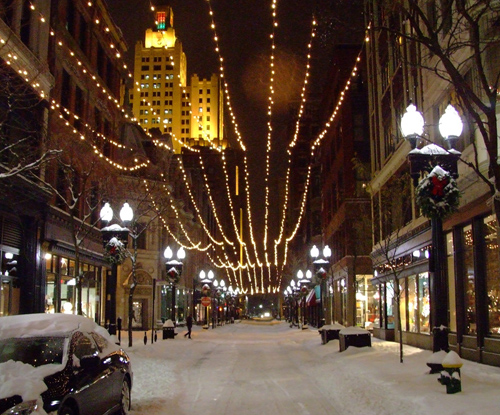
Amber lights on Benefit Street. (motifri.com)

Amber lights on Benefit Street. (motifri.com)

Not long after starting to write about architecture in 1990 I would occasionally hector the city fathers in Providence to use sodium vapor bulbs in downtown’s historic lamps, as was and still is done on Benefit Street. That, I thought, would cast the street in a romantic glow, throwing an amber tint that would caress your optic nerve into imagining that modernity’s aesthetic confusion was still a figment of the distant future. In short, the ambiance would reflect the gentleness of the architecture of the old buildings that lined Westminster and its neighboring thoroughfares.

Period lampposts on Westminster Street. (forum.theppk.com)

Period lampposts on Westminster Street. (forum.theppk.com)

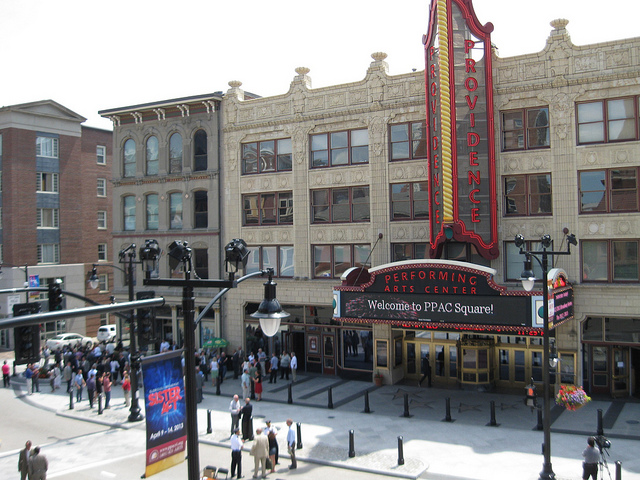
Period lamppost on Weybosset Street, across from PPAC. (gcpvd.org)

Period lamppost on Weybosset Street, across from PPAC. (gcpvd.org)

It was perhaps my first crusade, and it went nowhere. For some reason it never occurred to me that Job One was not to choose a nicer color for the historic lamps already installed but to add more historic lampposts around downtown and on College Hill (and elsewhere). My friend Lee Juskalian, a former architectural historian for the city who follows development issues here from California, has apprised me of my dereliction of duty.

The city did install period lamps on Weybosset Street a couple of years ago, but wimped out, using the sort of quasi-historic posts similar to those installed in the 1990s along the city’s new waterfront, the tepid style of whose lamps was among the very few missteps of the late Bill Warner’s design for the river walks, parks and bridges.

I hereby, forthwith and henceforth rectify my error by calling upon the city to make amends. These posts aren’t inexpensive. Perhaps a local provider such as the Steel Yard, which was founded by Clay Rockefeller, could help. Perhaps Providence could partner with the contractor Boston uses to get new historic lampposts in bulk.

However expensive, lining Providence’s best streets, and those that aspire to be good streets, with traditional lampposts would be economic development on the cheap. Brick sidewalks are another form of design intelligence that can be baked into the fabric of growth for cities such as Providence.

The idea is to create a sense of place that makes people feel that where they live or work is special. If you live or work in such a place, it adds value to your lifestyle and is likely to generate profit for your employer and the owner of your residence (especially if that is yourself). Every form of evidence demonstrates that people prefer a historic ambiance to a sterile evocation of modernity. People – and leaders responsible for the built environment – should understand that whereas modern design based on novelty dates itself instantly, a historic ambiance is timeless, and a perfectly valid design strategy for the future.

In addition to installing historic lampposts in existing historic districts, they should be installed on the new roads and sidewalks of the I-195 Redevelopment District land. I hope the new governor and mayor incorporate this easy idea in the new strategy for developing the Route 195 land (if there is to be a new strategy, and not just new words).

Benefit Street’s lampposts, redolent of the 18th century, differ from the historic lampposts of Westminster Street, which hark back to the 19th century. The lamps of Benefit were criticized in the early ’60s by the Ada Louise Huxtable, who called them “faux historic.” Getting criticized by such a national thought leader was a feather in their cap.

Huxtable, who died in 2012, was a fine prose stylist during her years as architecture critic for the Times, but over the years she became more and more bitter as modernism’s failure became more and more clear. She had a hard time adjusting to reality. She refused to see the appeal of traditional design principles as anything other than regrettable nostalgia. Today we know that traditional design patterns appeal to the biological urges of all people – except for those who have allowed graduate design education to purge their instincts of the natural attraction to beauty.

City and state officials continue to hobble economic development here by refusing to build upon the value of Rhode Island’s beauty. This post addresses one of the easiest and least expensive ways to strengthen one of the Ocean State’s most obvious strategic advantages.

Posted in Architecture, Art and design, Providence, Urbanism and planning | Tagged , , , , , | 22 Comments

Design a living planet

Paris along the Seine. (swide.com)

Paris along the Seine. (swide.com)

One of the delights of blogging is the ability to insert a couple of paragraphs from what you’re reading as you go along. So here’s another set, on pages 144-45, from Design for a Living Planet, by Nikos Salingaros and Michael Mehaffy. After a passage describing the implications for architecture and urban design of algorithms, they write:

But let us not discount the vital importance of design creativity and freedom. Art plays an essential role in illuminating the rich complexities of this generated urban structure, as the great urbanist Jane Jacobs famously pointed out. What matters is not the particular “style” or form language that we use, but the degree to which it is adapted through the kind of process we are describing. As the process of adaptive computation proceeds (unconcerned with a pretty pattern on the ground but really generating an intricate socio-geometrical configuration), it produces aesthetic results that are rich and complex. The aesthetics are not applied as a veneer of self-conscious abstract compositions, but emerge much more powerfully from the deep structure of the process.

By the time I reached the end of this paragraph I was formulating internal objections. I feared that Mehaffy and Salingaros were about the suggest a new form language that would throw all styles, traditional and modern, out the window. No (said I to myself), the algorithms were precisely what led unconsciously to classical design principles in the first place. We don’t want to abandon them but return to them! … I read on.

Thus we have hopefully lain to rest the common error that traditional form languages restrict architectural creativity and aesthetic sophistication. As the logic of this process should suggest, that statement is mathematically false. We can certainly use an adaptive design algorithm with a traditional form language to design very different buildings depending upon different initial conditions. The best classical and traditional architects have always known this, and have exploited it in the past to build the world’s most loved and sustainable cities by re-using much older form languages in their own day: Paris, London, Rome, and many others.

Ah! Vindication in the space of two paragraphs!

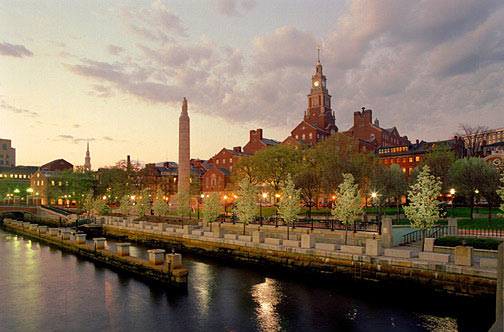
Providence along the Providence. (peacemaripo.com)

Providence along the Providence. (peacemaripo.com)

Posted in Architecture, Architecture Education, Art and design, Urbanism and planning | Tagged , , , , , | Leave a comment

Architecture in the crosshairs

Business school by Frank Gehry for University of Technology, in Sydney. (No source given)

Business school by Frank Gehry for University of Technology, in Sydney. (No source given)

Steve Hansen captures valuable territory in the recent Bingler, Pedersen, Betsky style-wars skirmish. His essay “Architecture Should Be Functional, Not Merely Daring,” is on the website Sourceable.com. But while Hansen puts some good wood upside Aaron Betsky’s head, he ignores one of the chief points made by Steven Bingler and Martin Pedersen in their Dec. 15 New York Times oped “How to Rebuild Architecture.” Hansen writes:

Betsky’s viewpoint deserved the criticism, but it doesn’t really matter. His elite cohort will continue to manufacture righteous indignation at the banality of architecture that the general public actually likes. They’ll continue with the high-priced commissions and their “thought leader” status. They have little effect outside their bubble.

But as Bingler and Pedersen point out, that last assertion is not so:

The problem isn’t the infinitesimal speck of buildings created by celebrity architects (some arresting, some almost comic in their dysfunction), but rather the distorting influence these projects have had on the values and ambitions of the profession’s middle ranks.

Modern architecture is the only kind built by 99 percent of architecture firms, the only kind that wins 99 percent of commissions for major public buildings, the only kind taught at 99 percent of architecture schools, the only kind praised by 99 percent of architecture critics, and the only kind eligible for 99 percent of architecture prizes. I could go on. The figure of 99 percent might in some cases be a slight exaggeration, but the overwhelming lack of stylistic diversity in the profession can have only a profound effect.

Having overlooked all of that, Hansen is capable of writing this:

… [C]riticism of a particular style is really not very interesting. Bingler and Pedersen ding modern architecture for its disdain for the less avant garde style, but demerits should go out regardless of style if a building suffers from a lack of functionality.

Of course. But modern architecture prides itself on its rejection of precedent whereas traditional architect embraces precedent (disdained by modernists as “copying the past”). Every field of human endeavor recognizes the wisdom of building on past success and learning from past mistakes. But unlike every other field, modern architecture, for all its jabber about utility, turns that wisdom on its head. It thus tends to make buildings that are far less functional, whether for their intended purpose or for adaptive reuse.

The resulting cost in time and energy over decades of this lack of functionality may not make criticism of modernism very interesting, but it does make such criticism vital to the success of cities in our future. Standards must be set. Distinctions must be made. When they are not, architecture fails. That is the situation today. Still, leaving aside these minor concerns, I must nevertheless commend the courage of Steve Hansen for taking the orthodoxy of architecture’s establishment to task. Read the entire article.

Posted in Architecture, Architecture Education, Development | Tagged , , , , , | Leave a comment

Grr! Paul Rudolph cat fight

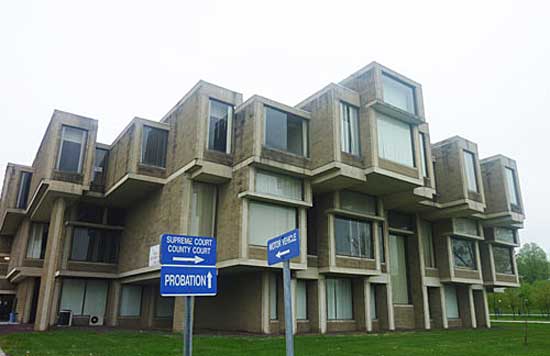
Orange County Government Building. (culturegrrl.com)

Orange County Government Center. (culturegrrl.com)

Goshen, N.Y., is up in arms again as the city enters a new phase of combat over saving the Orange County Government Center (1967), designed by iconic modernist Paul Rudolph in the Brutalist style. Most of the public wants it torn down; most architectural historians want it preserved. This battle, like other similar battles, strips bare that modernism, which continues to hum the utilitarian dirge with a straight face, is really still all about style – that is, an aesthetic whose central purpose is to reject tradition.

Lee Rosenbaum, of the CultureGrrl blog, wrote of her dismay at the latest round of this contretemps in “Goshen Commotion.” The New York Times’s architecture critic Michael Kimmelman recently wrote about it in “A Chance to Salvage a Master’s Creation.”

Kimmelman’s piece supported a compromise that would have preserved the building, readapting it as an arts center while a new county building could arise in its parking lot. He was accused by CultureGrrl of undermining the goal of preserving the building by misdescribing the rehab by Gwathmey Siegel of Rudolph’s more famous Art & Architecture Building at Yale.

It also conspicuously featured a “drop ceiling” that was not “stripped away,” as Kimmelman reported, but had been added to the monumental central space, as part of its 2008 Gwathmey Siegel re-do. A discordant bright-white glossy grid, the drop ceiling concealed the heating and cooling apparatus. As I suggested in [a post], this dispiriting result bespeaks an uneasy fit between the form of Rudolph’s structure and its function — a criticism that has also been leveled at his Goshen edifice.

Quite so. Why should a drop ceiling be used to hide the heating and cooling apparatus? Is not the exposure of such functions the very definition of honesty in modernism?

The only answer is an uncomfortable one.

The problem here is not confusion in the deployment of modernist orthodoxy. Modernism is used to that, and the rest of us must put up with its erosion of utility in buildings whose appearance we already find easy to dislike. One cannot expect modernists to stoop to the learning of lessons. Now Gwathmey Siegel might be tapped to renovate the Rudolph building in Goshen as an arts center, and various supporters of just saving the building for its original use as county offices are not highly amused. But I am.

Posted in Architecture, Architecture History, Development, Preservation | Tagged , , | Leave a comment

Modernism’s “Deflategate”

Vienna. (eventinbus.com)

Vienna. (eventinbus.com)

The BBC documentary Vienna: City of Dreams is about as entirely marinated in modernism’s institutional bias as it is possible for a film of an hour and a half to be. And yet it is beautiful in spite of itself. In spite of itself, even as it describes the various births of modernism that the city has inflicted upon the world (also in spite of itself!), it focuses the viewer’s attention on its classicism, which refutes every “modernismism” uttered by narrator Joseph Leo Koerner, of Harvard, whose Viennese father, after immigrating to the United States, took his family back to Vienna regularly. His son cannot resist doing the same, though by the end of the documentary one questions the narrator’s own Freudian analysis of why. Very entertaining, in spite of itself. Very lovely, in spite of itself, too.

Especially endearing is a passage where Koerner is in the modernist house designed by the philosopher Wittgenstein. The narrator describes a door handle that took Wittgenstein a year to design. “It is a door handle that shows what it is,” says Koerner. “The functionality is obsessive here.” He struggles to latch a nearby window, pauses, then adds, “There’s nothing more deflating to modernism than when its purified forms don’t actually function.” This is the most direct apology for modernism in the film, but there are many more of greater subtlety and unintentionality that offer a greater sublimity of satisfaction to those of us not as besotted as Koerner. (The window segment is at 1:03:40.)

Posted in Architecture, Art and design, Books and Culture, Other countries | Tagged , , , , , , | 2 Comments

Stewardship at Downton

Downton Abbey. (downtonabbeycooks.com)

Downton Abbey. (downtonabbeycooks.com)

Steve Lawton sent to the Practice of New Urbanism list a few choice lines about recent scenes from Downton Abbey. He notes the care with which an aristocrat addresses the proposals of a developer, circa 1922 (I think), to build houses in Downton village. Keep in mind that Lord Grantham’s family owns the village, and like many noble families of the era was heavily in debt with the cost of maintaining estates like Downton. Many, even then, would have leapt at the chance to make money without investment.

Lord Grantham’s deep concern for creating value into the future was quite instructive.  Here stands before you a man who is the living example of a quasi-feudal institution of landholding.  His concerns are those of the institution: a sincere desire and absolute ability to prevent short-term profit extraction. There he is, in the flesh, annoyed, asking questions and sending the fast-talking developer away.  He will be sure that any houses here will be well-built.

In contrast, of course, is the American experience of land holding.  Land rights here did not descend from aristocrats, lords or dynasties.  We simply took it and used it, without reference to any larger institution.  It is a textbook, in a few scenes, of how the American experience in settlement was literally ungoverned by concern for the future.  

I learned a lot from just those few scenes of the man in the very nice hat.

The idea is not to put aristocrats up on a pedestal but to learn from a segment of society that has all but disappeared. I think that the new book by Nikos Salingaros and Michael Mehaffy has something to say on this score, which is not a little bit Burkean – his famous passage on “little platoons” relates to how society functions primarily by interaction at its most intimate scales. Our 1 percent has nothing to teach the Downton clan. It’s not just the beauty of Downton’s classicism, but the wisdom of its stewardship that impresses.

Posted in Architecture, Architecture History, Development, Preservation, Urbanism and planning | Tagged , , , , | 1 Comment