Chapter 19, “We hate that”

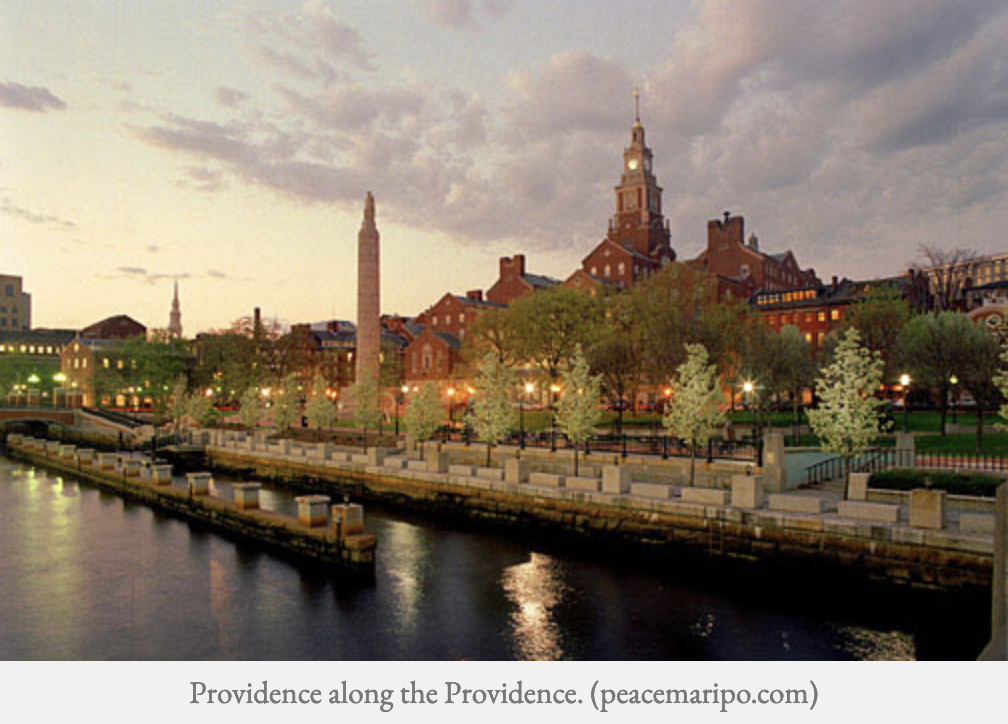
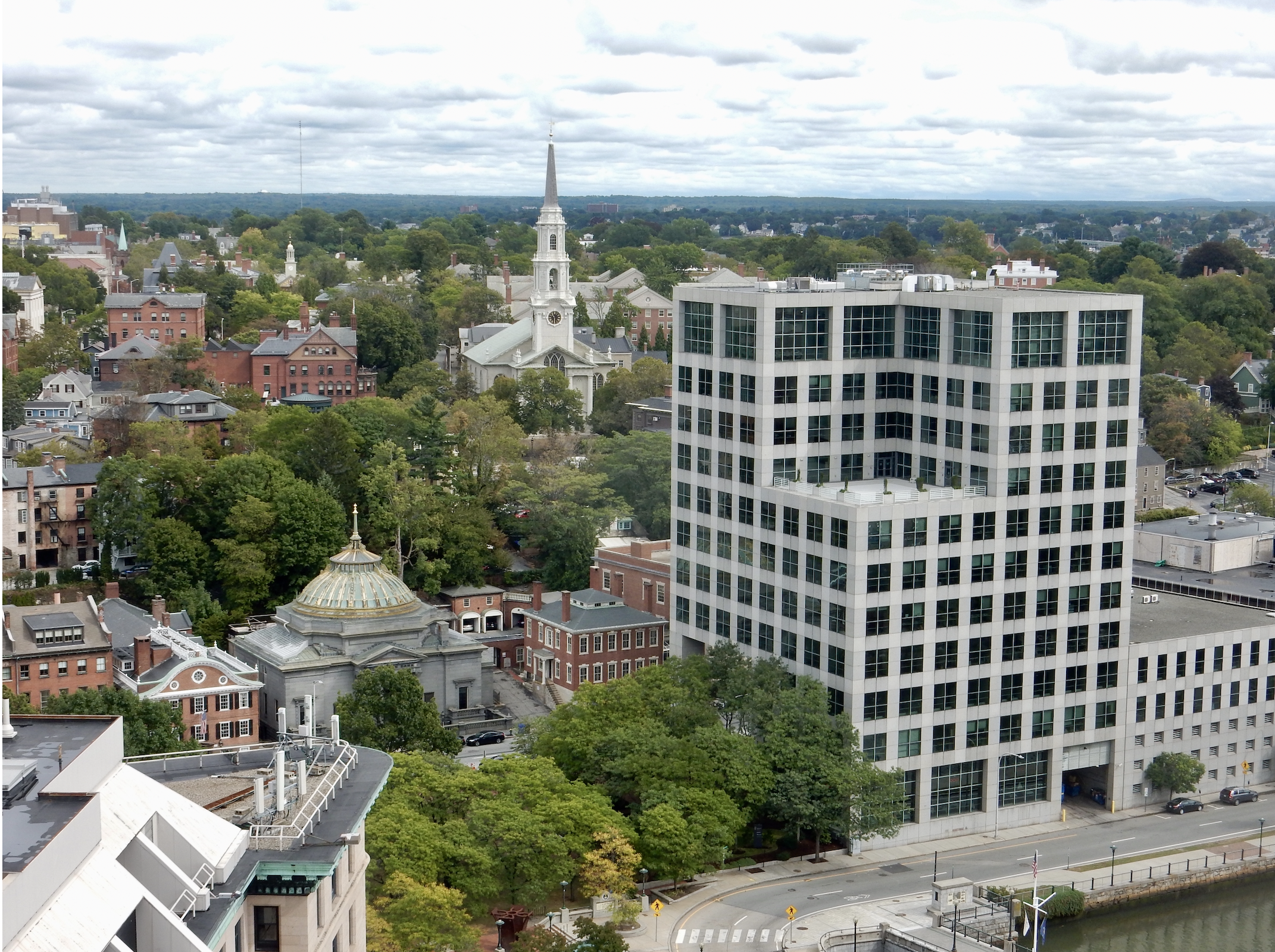
View of Old Stone Square (1984) from Turk’s Head Building (1913), site of author’s Turk’s Head Club luncheon with Journal publisher Michael Metcalf in 1984. (Photo by author)

I decided to go with Chapter 19, “We Hate That” because how could you tease readers with such a headline and then go with Chapter 18, “Capital Center Plan”? Well it would have been wrong. So this is the first half of “We Hate That,” and let’s get right to it to find out what “that” might be, as if one could not guess from the photo above, not to mention if not if not from foreknowledge of my own hatred for a certain building – overtaken, in time, of course, by the GTECH building.

***

In the fall of 1984, I was standing next to Michael Metcalf, publisher of the Providence Journal, at a window looking east toward College Hill from the Turk’s Head Club, on the eleventh floor of the Turk’s Head Building, erected in 1913. It was the day Metcalf offered me a job on the newspaper’s editorial board. He pointed out the window and, in his gentle voice, said, “We hate that.”

I did not need to be told what “that” referred to.

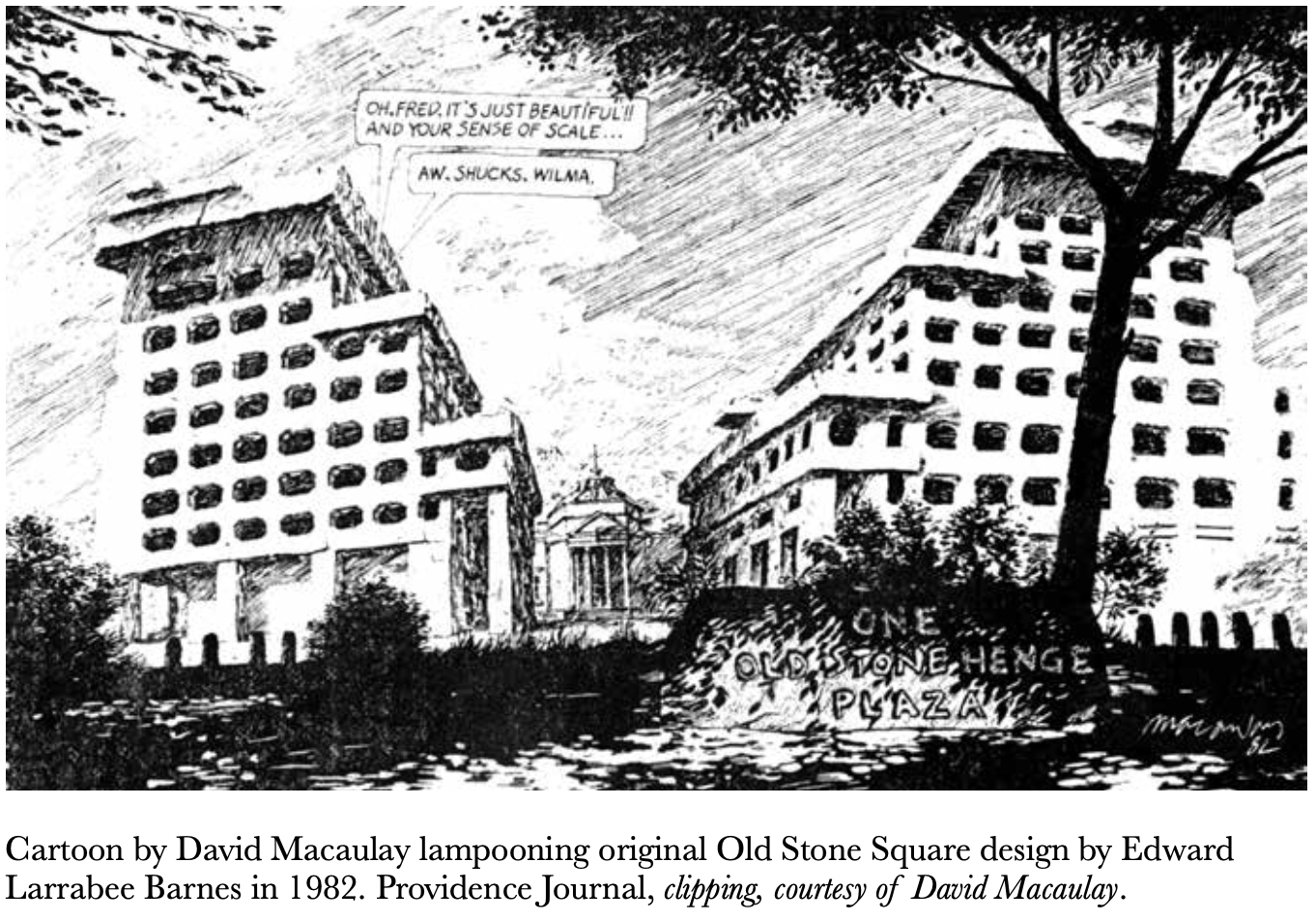
It was Old Stone Square, newly erected by the development arm of Old Stone Bank and designed by celebrity architect Edward Larrabee Barnes of New York. Metcalf pointed at the eleven-story square building looming against the backdrop of College Hill, with big square spaces cut out of its huge square mass from the lobby entrance and from the opposite upper quadrant of the building. It stuck out like the proverbial sore thumb. It did not start out this way. It was originally to be a pair of shorter buildings flanking a plaza, through which would be visible the dome of the Old Stone Bank. Its look was to have been postmodern, somewhat squishy but identifiably traditional, even Georgian. Its key defect in the eyes of its leading opponents, however, was to mask views of all but a sliver of historic South Main Street as seen from corporate suites on the upper floors of downtown towers across the river.

The Providence Preservation Society, by then a recognized pillar of the city’s business establishment, vociferously opposed the initial postmodernist design but, after some Old Stone pushback and a redesign of the building, became more ambivalent.

David Macaulay, an author and illustrator of books on architecture, spoofed the design in a cartoon published on June 13, 1982, in the Providence Sunday Journal, riffing off Old Stone’s new corporate brand, Fred Flintstone.
Mayor Cianci stepped in to negotiate a compromise, which involved the new design by Barnes. The result was not as wide but much taller than the two buildings of the original design. It sits on the southern half of the lot with a park on the northern half. It did not hide as much of South Main Street’s historic frontage as the original proposal, but it was starkly modernist. Squares of light and dark gray gridded its square façades, not unlike the pattern on a box of Ralston-Purina cat chow. Why suddenly such an angry confrontation with its historical context? It seemed to me that a desire on the part of the Old Stone rainmakers for revenge against the preservationists might have been part of the answer.

In 1999, after years of failure to ferret out an admission of revenge as a factor in the design of Old Stone Square, I visited Old Stone’s lead developer, Scott Burns, at a café in the Chelsea district of London. He, too, refused to confirm my suspicions, and I have allowed them to fester undisturbed ever since.

And yet, the years following Old Stone Square’s erection saw an efflorescence of new traditional architecture that seemed to come out of nowhere. It did not come out of nowhere. I cannot pinpoint the wellspring of this shift, but I can point to evidence of its appearance on the Providence stage.
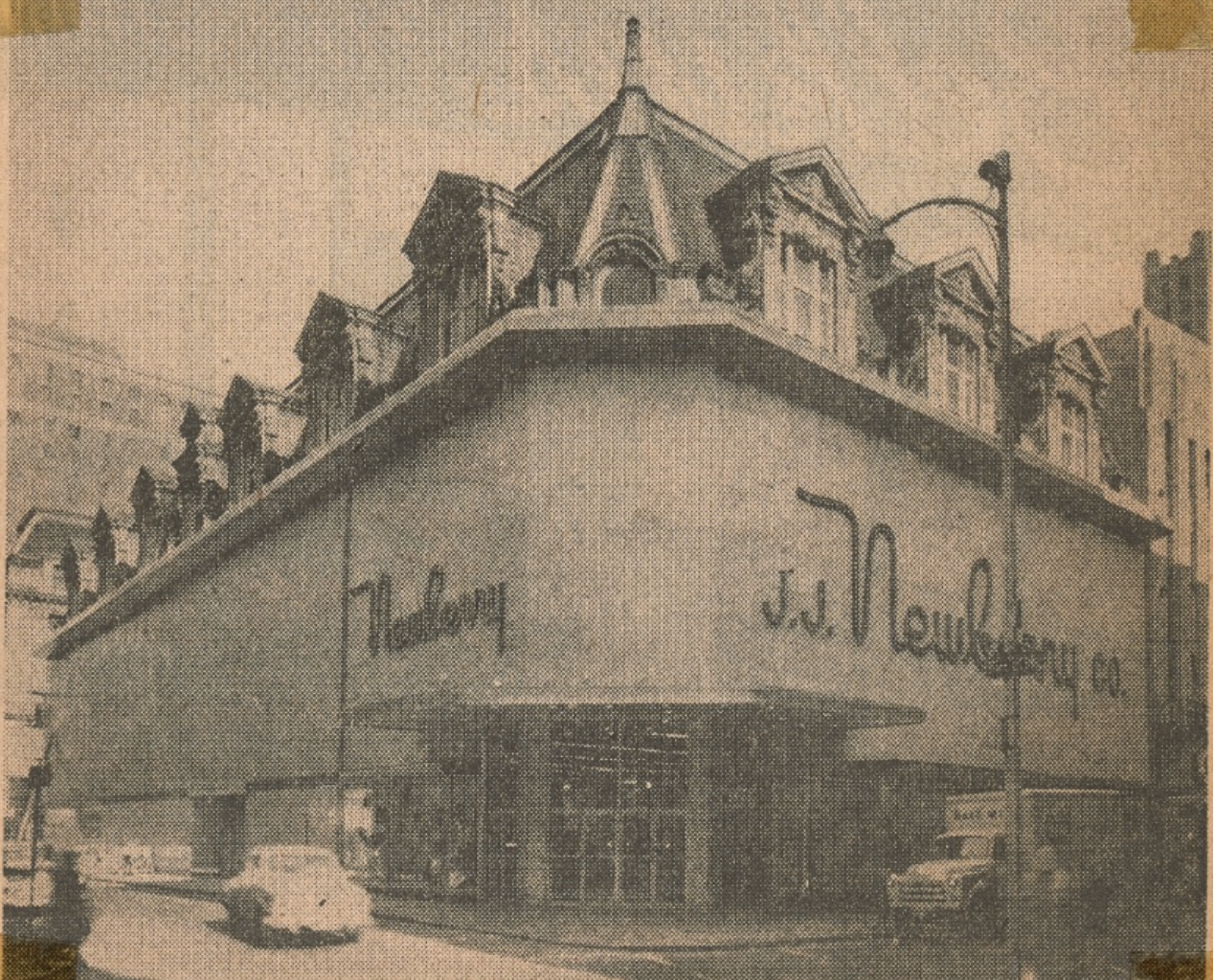
Old Journal Building (1908) covered in modernist faux facades circa 1955. Originally a J.J. Newberry Co. atore, thereafter a Thom McAnn shoe store. (Providence Public Library)

Strong hints of a reaction against the modernist conceits of the downtown Providence 1970 plan and the College Hill study came one after another in the 1970s and 1980s. The mayor’s Office of Community Development instituted a program to finance small projects, such as helping building owners remove faux modernist (“ugly is just skin deep”) façades erected in the 1950s and 1960s, especially along Westminster Mall, the Old Journal Building being a prime example. The Providence Preservation Society expanded its attention to preserving historic fabric throughout the city, but focused even more on downtown. Mayor Cianci joined preservationists and the business community to ensure that the Wilcox Building – one of the grand dames of Weybosset Street – was restored after a fire in 1975. Cianci, Outlet chief Bruce Sunlun and publisher Metcalf of the Journal managed to resuscitate the Biltmore Hotel (1922) in 1979 after three years of closure. Cianci also led an effort to block the demolition of Loew’s Theater (1928) and then to restore it as the Providence Performing Arts Center. The Majestic (1917) was renovated as the Lederer, a live venue for the Trinity Square Repertory Company.
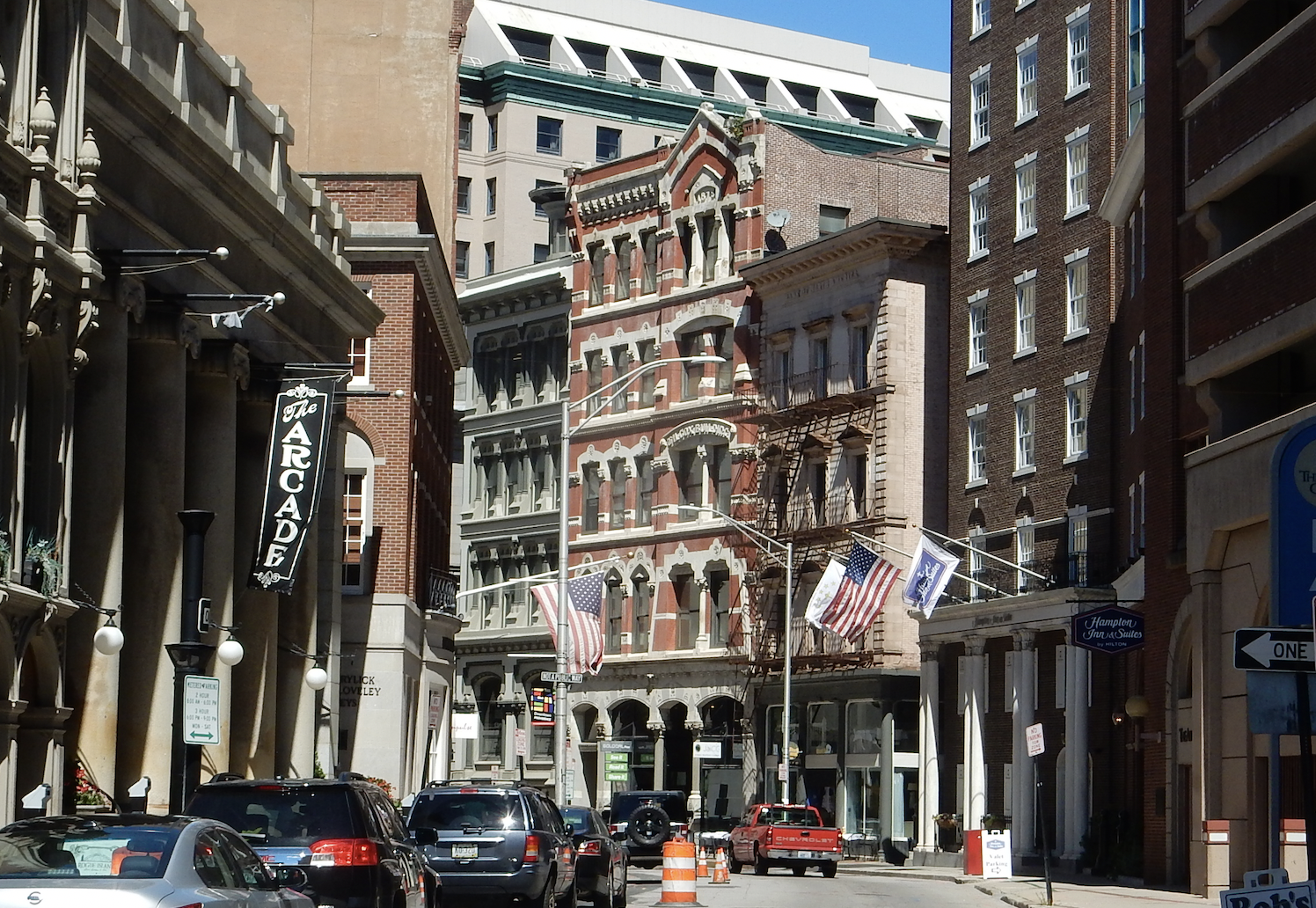
Wilcox Building, center, was restored after a fire in 1975. See Arcade at left.  (Author’s photo)

The Arcade (1828), which had almost been razed in 1944, was purchased by Gilbane Properties and restored in 1980 by Irving Haynes, who had just restored City Hall and was present for the famous napkin doodle of 1981. Johnson & Wales College started buying and fixing up old buildings for its widely dispersed downtown campus, including the Burrill Building (1891), long the Gladding’s department store. Paolino Properties, after demolishing the Hoppin Homestead Building, turned from whacking old buildings for parking lots to renovating old buildings for new and more hopeful pursuits. In fact, despite their good works, J&W and Paolino Properties vied in the public mind for the role of “evil landlord,” alleged nefarious owners of the entire downtown.

Mayor Cianci, who died in 2016, may be the most controversial figure in Providence’s history since Roger Williams, or at least since Thomas Dorr. His two administrations straddled a 1984 conviction for assault. Still, he would kiss a pig for a vote, attend the opening of an envelope and was tops at talking up Providence or locating hidden pots of money for this or that project. And yet, the civic renaissance gathering steam during Cianci’s second administration (1991–2002) made progress as much in spite of as because of his leadership. Keeping Cianci’s hand out of a project’s pocket made already complex developments harder to manage politically. His reputation alone probably kept some entrepreneurs from investing in Providence. his shady dealings, suspected by many, emerged only during his 2002 corruption trial, where he was convicted of conspiracy, a single count among a score or so of charges. It may be fair to say that, in spite of his professed love for the city and his adept cheerleading for its revival, he hurt it as much as he helped it.

But as the city entered the 1980s, all that was in the future.
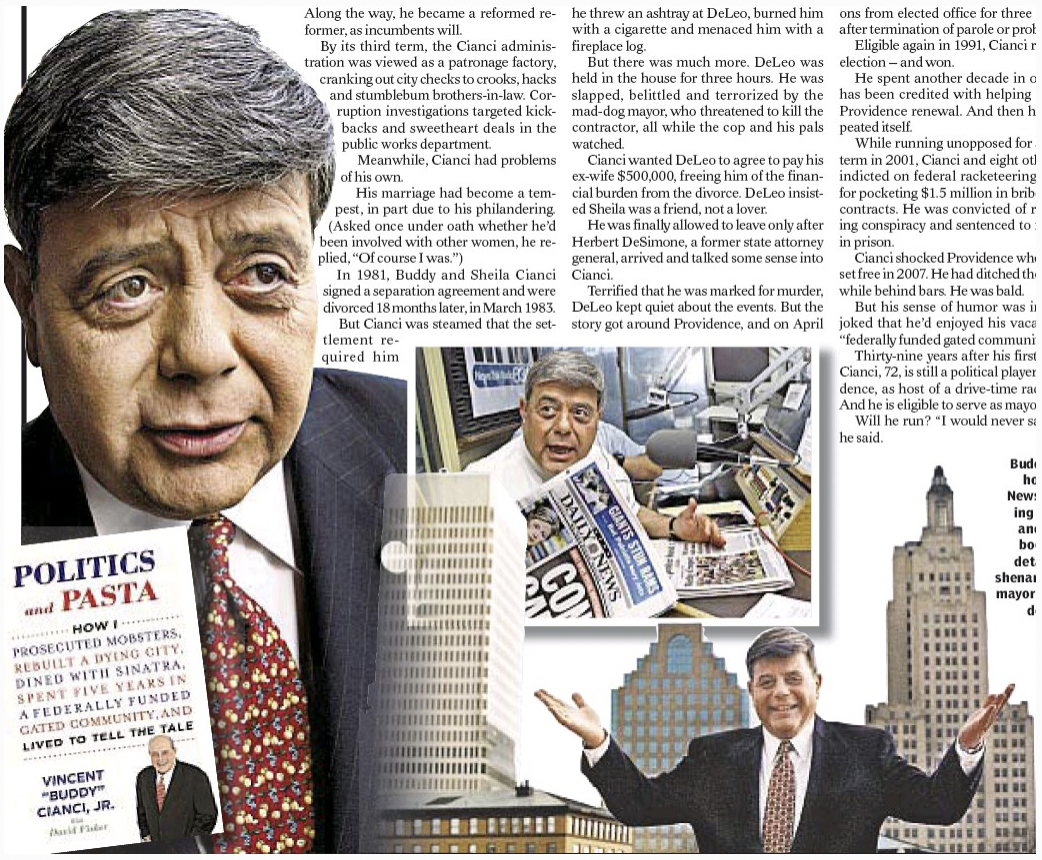
Vincent A. “Buddy” Cianci Jr., mayor, 1975-1984, 1990-2002, with and without his famous “rugs.” Lower left, Cianci gestures to “his city” in iconic photograph.

***

And the next post, the remainder of Chapter 19, “We Hate That,” will describe the buildings and civic architecture saved and restored in the 1970s and ’80s, including Westminster Street, which was beautifully renovated by Mayor Paolino in the late 1980s.
Posted in Architecture, Lost Providence | Tagged , , , , , , , , , | Leave a comment

The Interface Plan, cont.

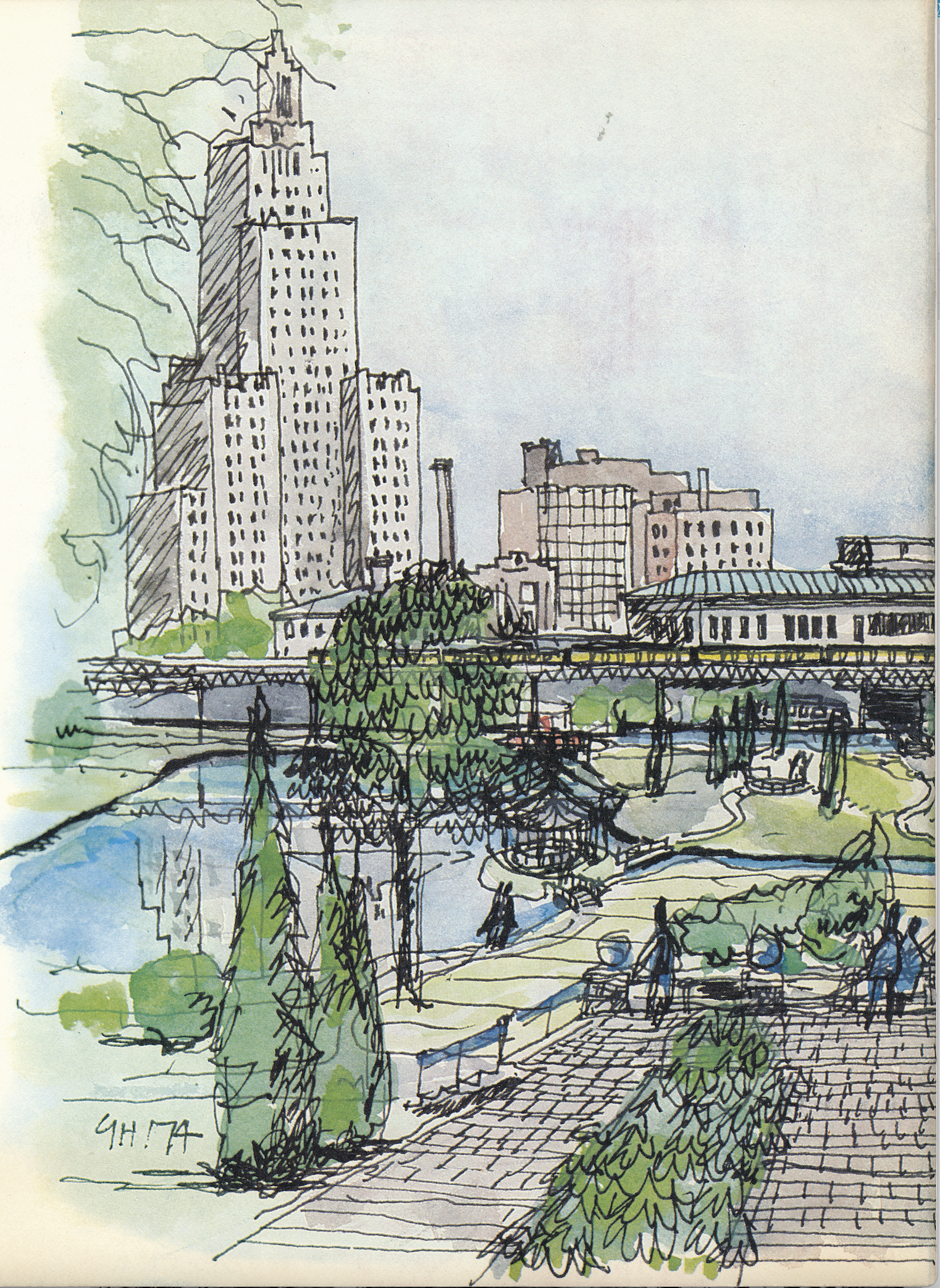
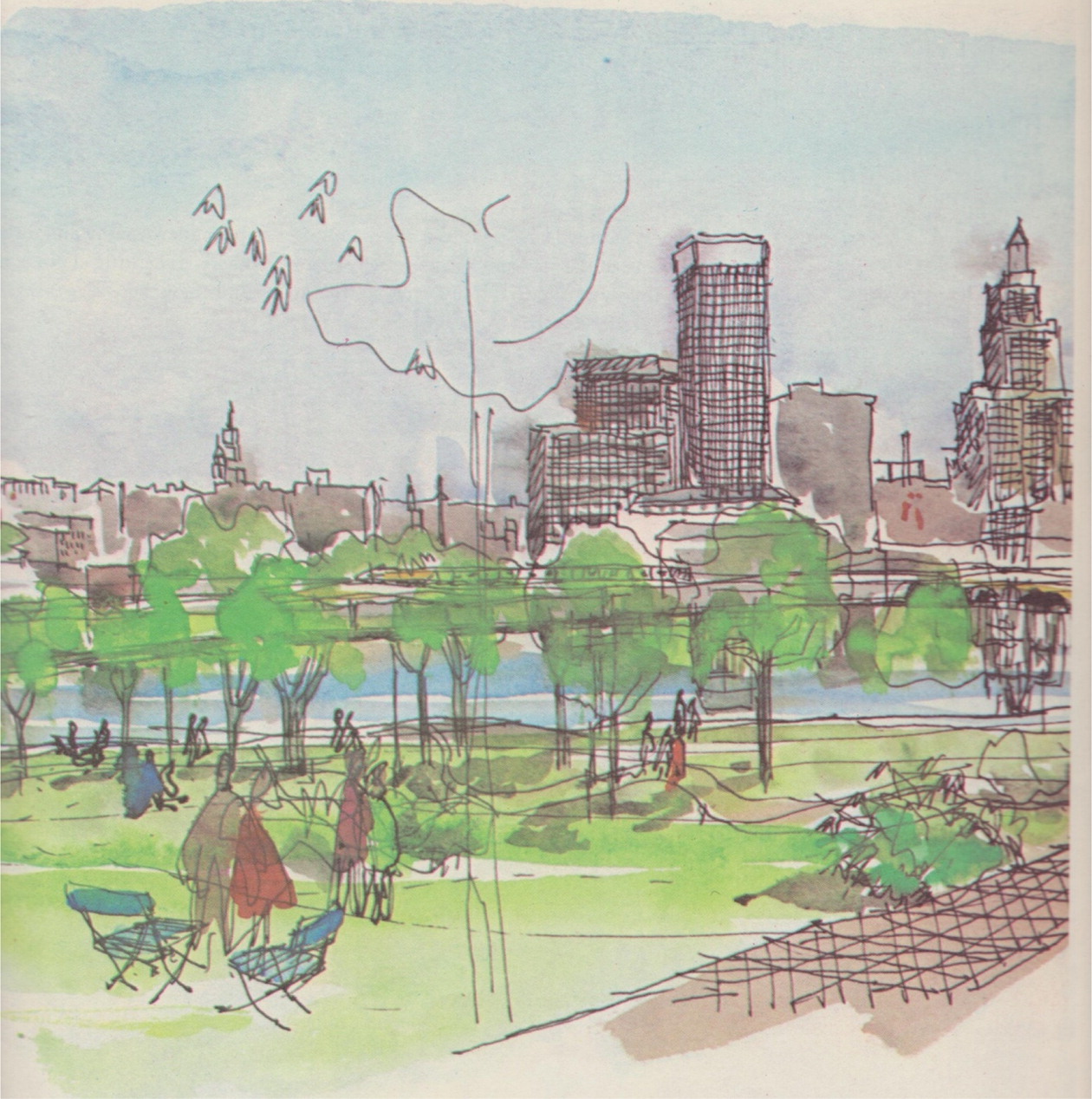
View of downtown from north of water feature near State House. (Author’s archives)

The second half of Chapter 17, “The Interface Plan,” opens with a continuation of comments on architectural trends in the early 1970s and then describes the Interface: Providence plan at some length, including several illustrations not included in Lost Providence. The “turmoil” referred to in the opening sentence below refers to the accurate critique of modernism by postmodern theorists, who nevertheless refused to follow up their critique with anything beyond a sort of cartoonish classical decoration of modernist boxes.

***

Amid the turmoil, which lasted for about a decade and amounted to nothing, the postmodernists’ assault on modern architecture did create a small opening for architects interested in reviving the traditional building practices that had been declared null and void by the modernists.

The history and technique of classical architecture and its traditional brethren had been expunged from the curricula of every school of architecture in America, but even as late as 1970, the growing accumulation of built modernism was surrounded by reminders of what might have been. Organizations arose to oppose modern architecture, such as Classical America, cofounded in 1968 by Central Park curator Henry Hope Reed, author of The Golden City. His book paired photographs of comparable modernist and traditional architecture; no words were required (not that he didn’t provide them anyway).

Penn Station in New York was demolished while jaws hung open among the elite in Manhattan. The preservation movement went on high alert. In 1976, the year of America’s bicentennial, the Providence Preservation Society celebrated its twentieth anniversary. But from the National Trust for Historic Preservation on down, they hesitated to challenge the reigning modernist orthodoxy.

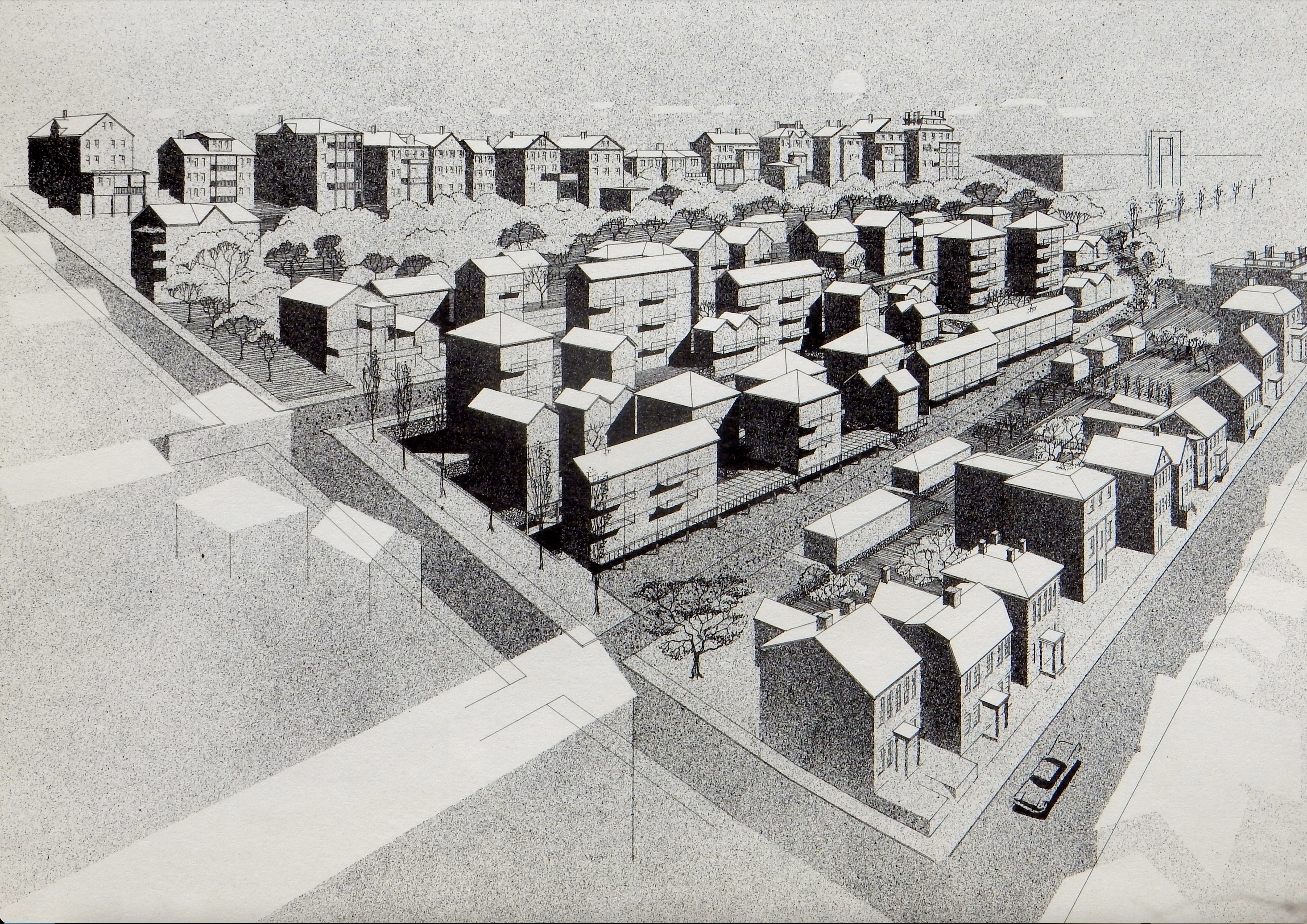
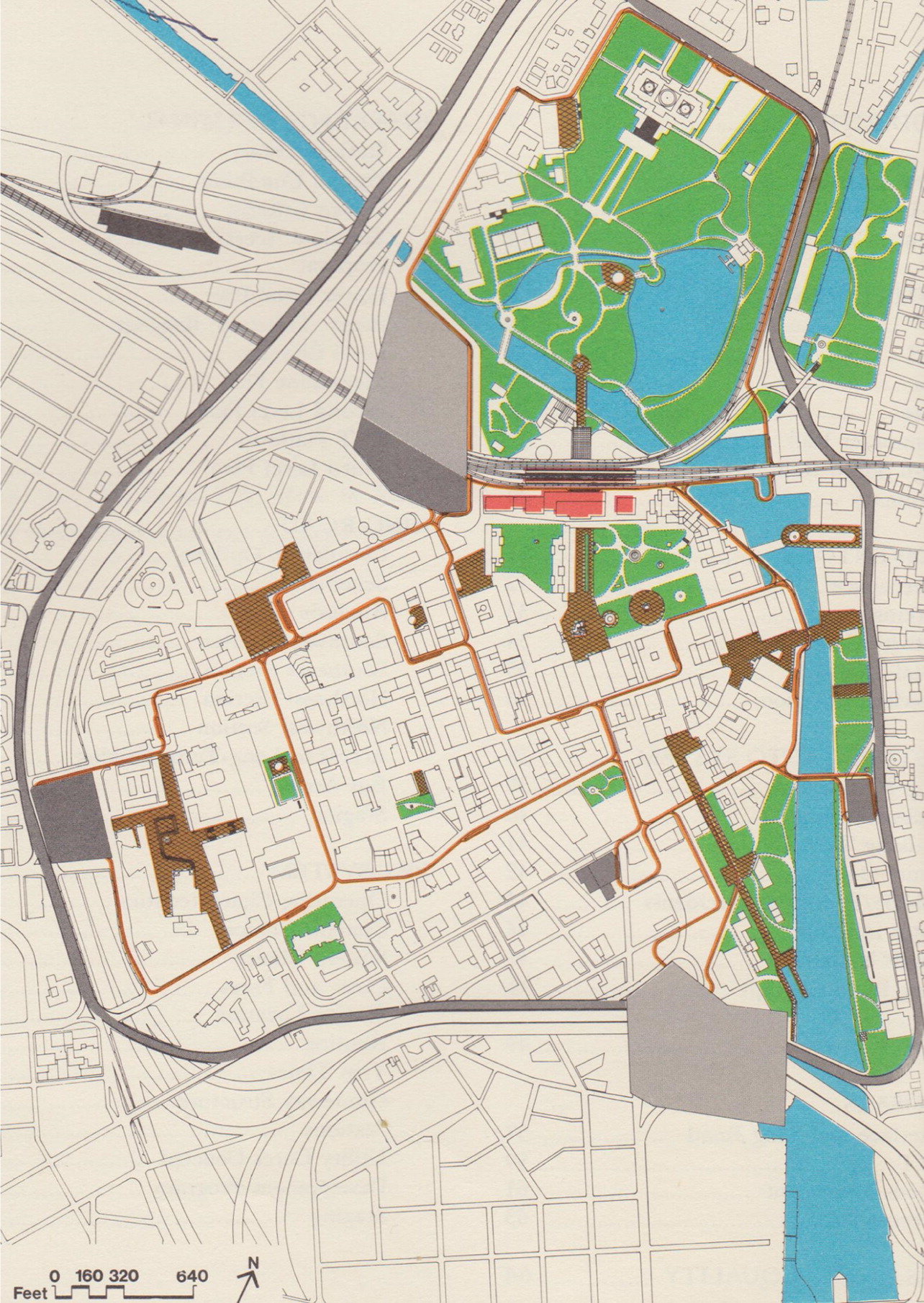
Map of Interface:Providence Plan, from 1974. (Author’s archives)

Both major plans for the two most celebrated historic districts in Providence, downtown and College Hill, were steeped in modern architecture. Not so with the next major plan to emerge, “Interface: Providence,” published in 1974 after a study led by RISD professor Gerald Howes. Although initiated as a transportation study by way of a class project, it eventually became the first plan to uncover the city’s downtown rivers. Thus did it foreshadow the River Relocation Project of the 1990s.

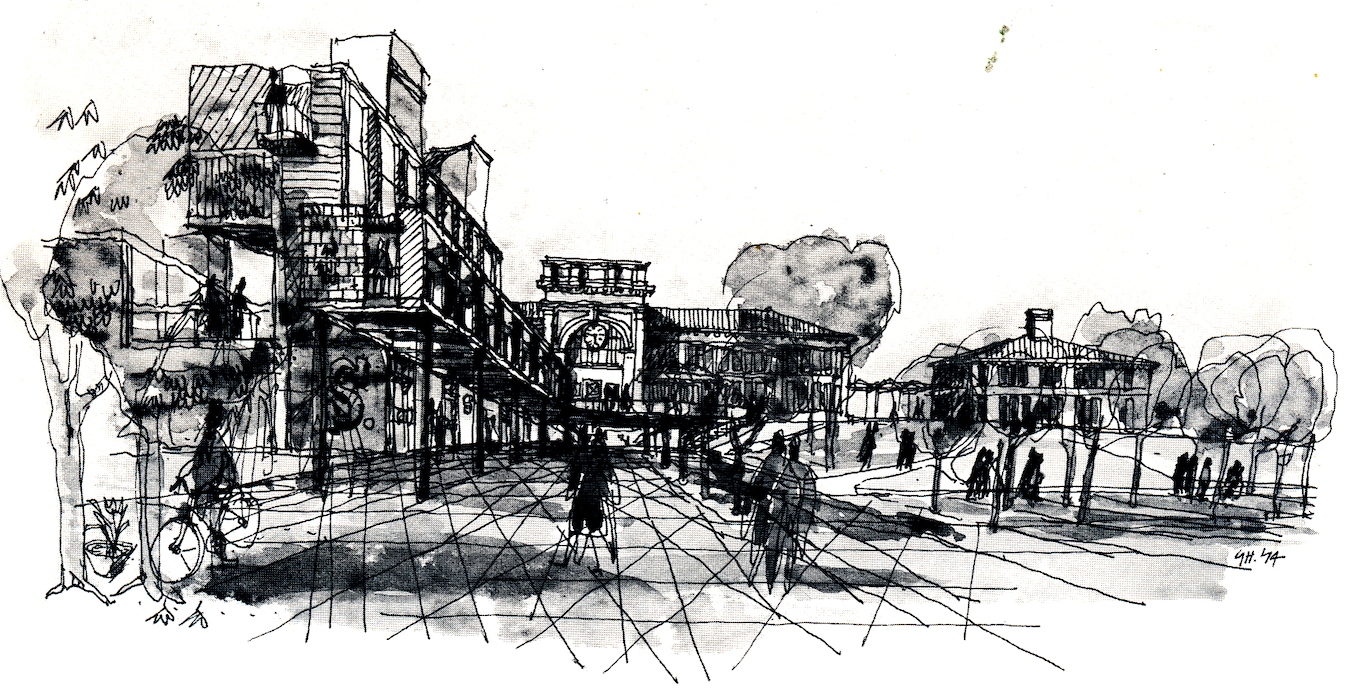
Modernist residences and shops in Kennedy Plaza. (Author’s archives)

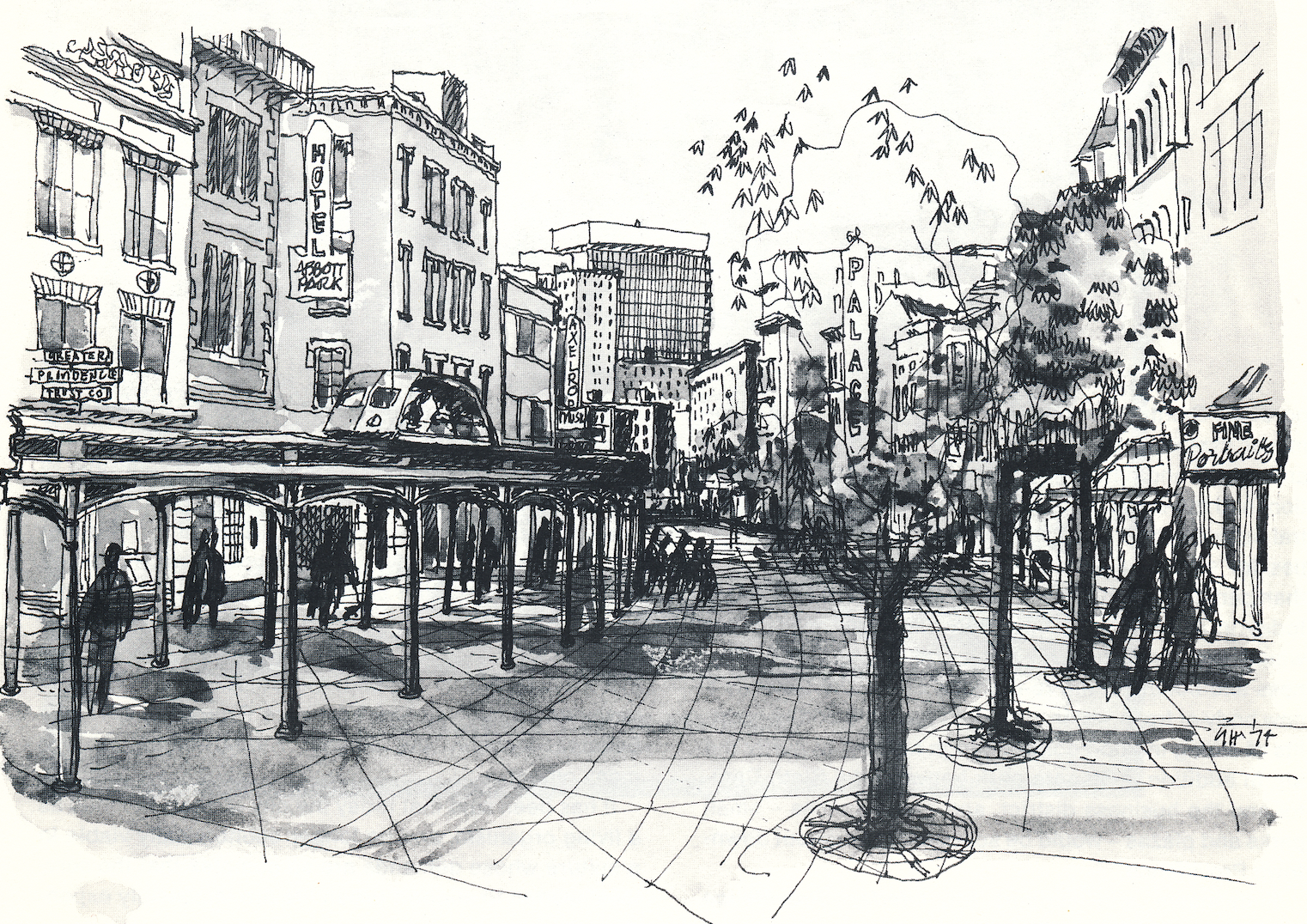
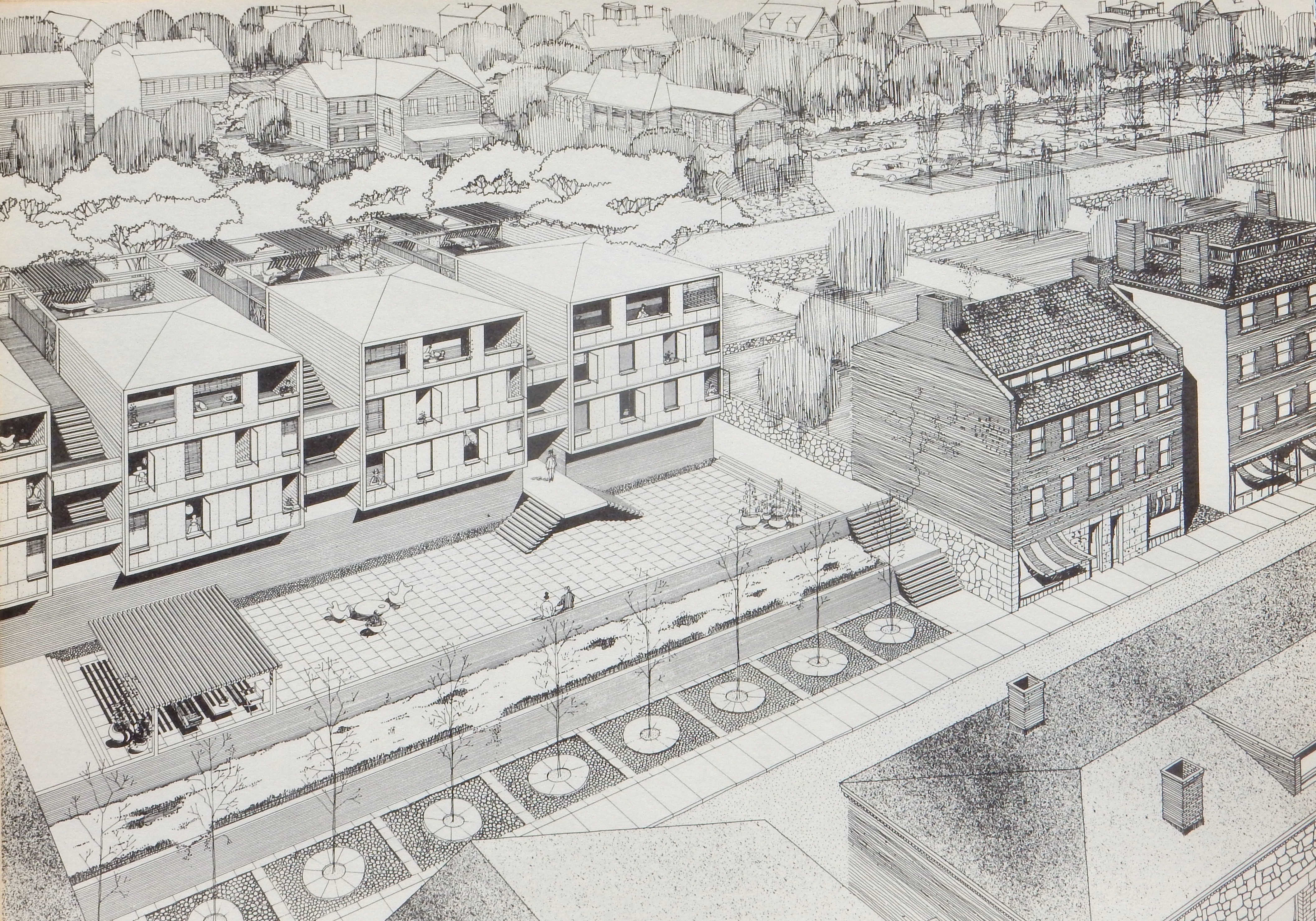
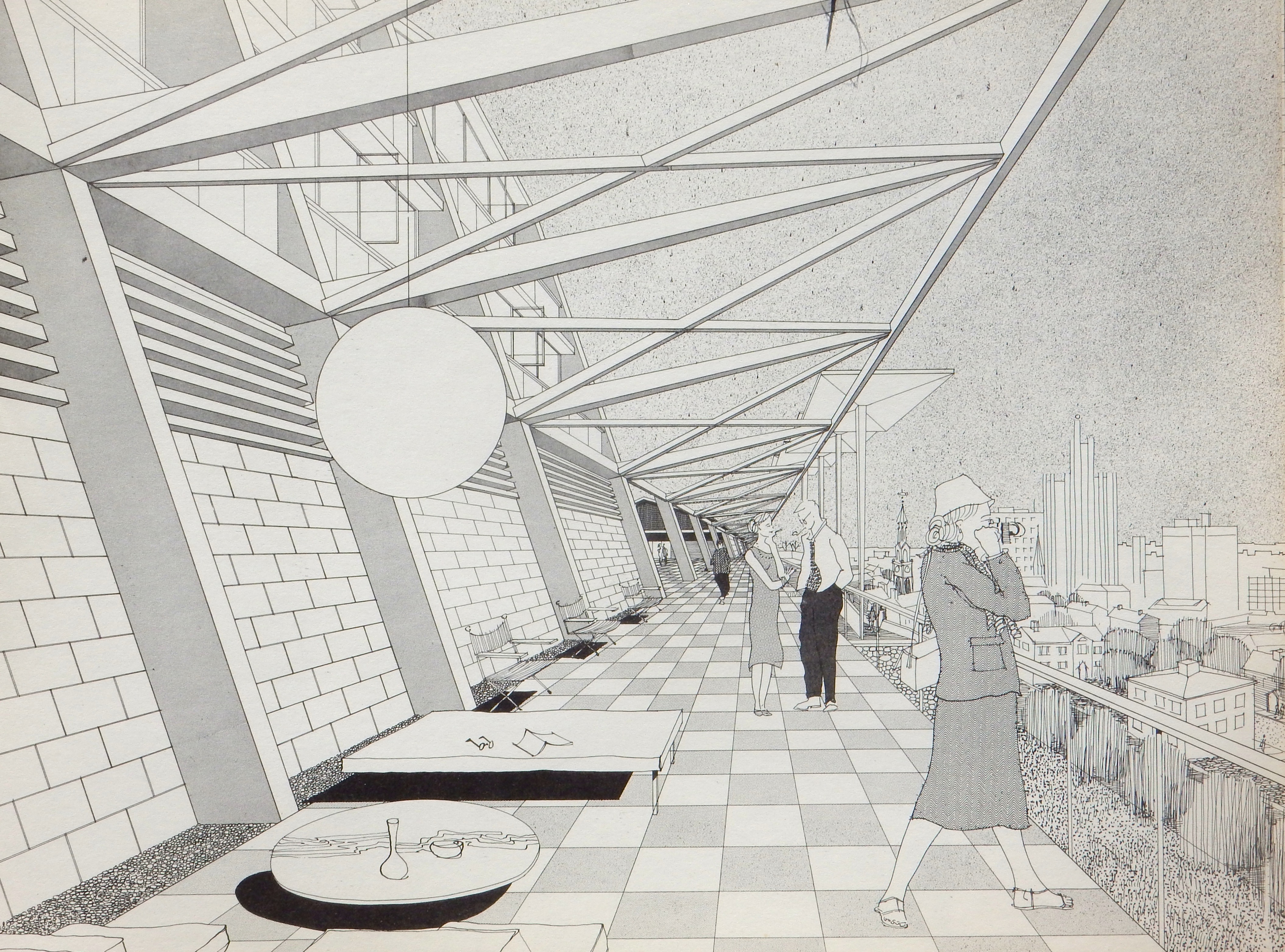
The Interface plan might also be characterized as neutral on the question of architectural style. That was a big step in the proper direction. Yes, it featured, in Kennedy Plaza, a small version on stilts (page 88) of Montreal’s Habitat ’67 – the stacked modular residential development designed by architect Moshe Safdie. But it also proposed a PRT – personal rapid transit – circulating through downtown on tracks raised above the street level by a “colonnade” of clearly traditional design (page 120). The plan’s gently quavering illustrations express a pleasure in the city’s built environment that is incompatible with plans to remove or cover up its longstanding architectural delights.

Personal rapid transit collonade on Weybosset Street. (Author’s archives)

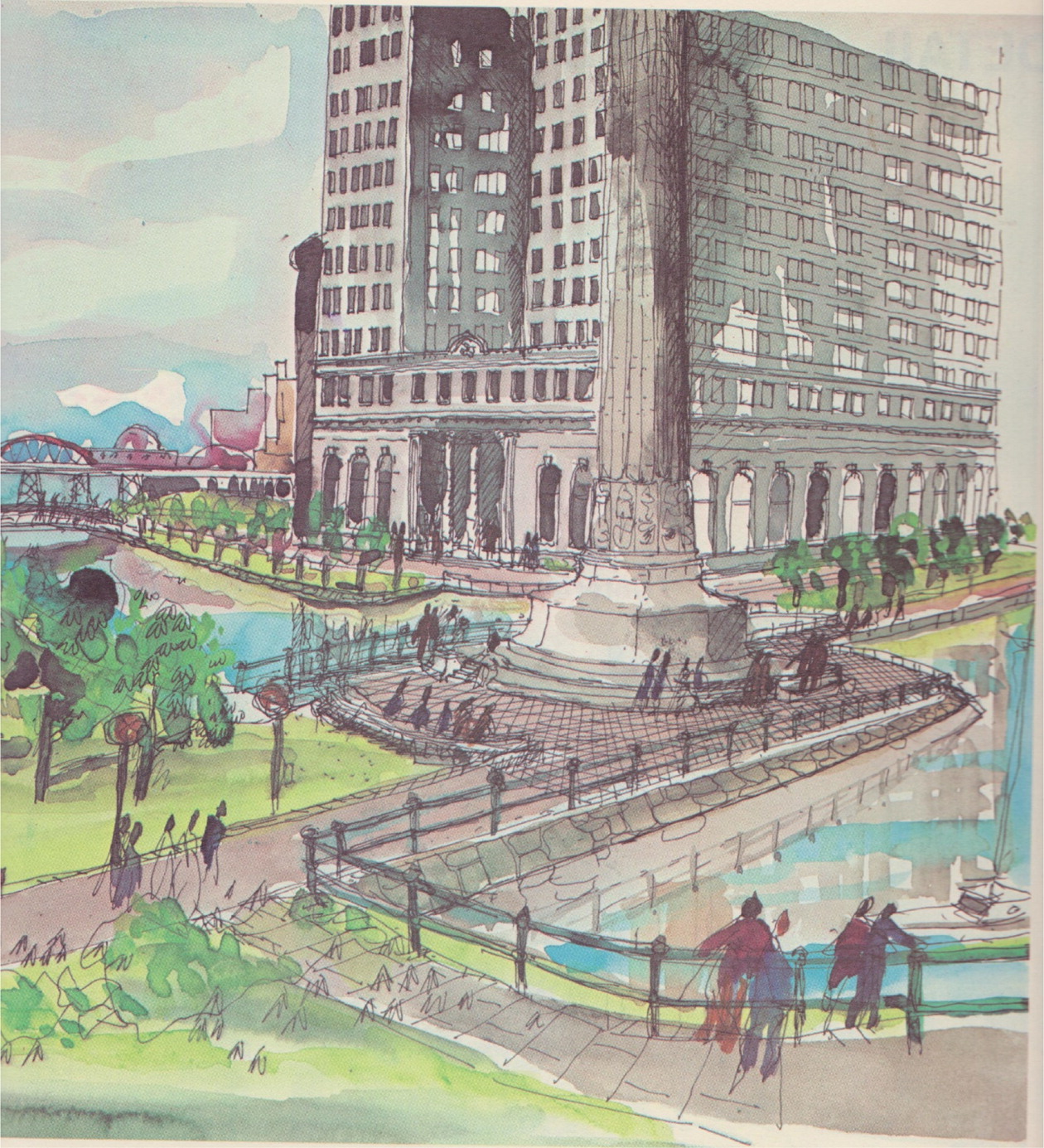
The plan would not have removed the Chinese Wall. It would, however, have removed automobiles from downtown streets. Its two parking megastructures go unillustrated in the study, for some reason, though each multilevel parking garage was the size of the Financial District. Together they were to provide, at opposite edges of downtown, what curbside spots and sixty acres of existing parking lots provided in 1974. Those lots would have been re-dedicated as infill development opportunities but also as pocket parks in the plan’s extensive proposal for more green space. Above all, the plan would have daylighted the downtown rivers, even adding a large pond (called the “Cove Pond”) on the leafy grounds around the State House.

View of downtown from water feature near State House. (Author’s archives)
View of Hospital Trust Building over Providence River at base of College Hill. Note that WWI memorial remains at original location, with Suicide Circle removed. (Author’s archives)

After commenting on the extraordinary ability the downtown layout affords the average person to orient themselves geographically and to identify primary uses of downtown areas by their appearance, the authors state:

Few cities have this clarity of definition. Also the town has not prospered in the last forty years to a similar extent as other cities, and, while one might think at first sight that this is an unfortunate factor, it has not suffered within its business area from the mad scramble for land with its concomitant high- rise construction.

And while the Interface plan certainly has a “feel” congenial to those who consider the city’s historic architecture to be among its most important advantages, that quote is about the closest it comes to commenting on matters of architectural design. Because we all know about urban renewal and the towering sterility to which the words refer. And Rhode Islanders of that day – more than forty years ago now [in 2017] – had had these connotations pounded into them by a pair of earlier civic plans astonishing in their insensitivity to the city’s architectural heritage.

By 1974, downtown had been built black and blue by the brutal (and occasionally Brutalist) buildings of the period. Beginning with the Fourth Howard Building in 1959, there were in quick succession Dexter Manor (1962), the (Sabin Street) Bonanza Bus Terminal (1963), the Regency (1966), the Blue Cross-Blue Shield (now city planning) Building (1966), the Fogarty Building (1967), Beneficent House (1969), the Textron Building (1969), One Weybosset Hill (1971), the Civic Center (1972), the Hospital Trust Tower (1973) and the Civic Center (1973), with the Garrahy Judicial Complex (1978) and Broadcast House (1979) soon to follow.

View down College Street over river into downtown. (Author’s archives)

Perhaps Interface reflected the dismay that must have been in the air after such a bout, however much people welcomed the attendant jobs and spending. In fact, the Interface plan’s reputation, like that of so much else, comes down to us as a single idea. For the College Hill study, that has been “Saved Benefit Street.” For the downtown Providence 1970 plan, that has been “Never Happened, Thank God.” For Interface, it is “First to Uncover the Rivers.” Reputation does not always align with actual legacy, but in the case of Interface (virtually none of which was implemented) it did. And too bad it was not implemented. Without assessing its practicalities – especially the PRT and the elimination of cars from the central business district – it was an alluring plan.

***

Still trying to decide what chapter from Lost Providence to reprint next, whether to reprint Chapter 18, “Capital Center Plan,” or skip to Chapter 19, “We Hate That.”

Posted in Uncategorized | Leave a comment

The Interface Plan of 1974

The second half of Chapter 17, “The Interface Plan,” from Lost Providence, tells the story of the plan produced by the Rhode Island School of Design students under Prof. Gerald Howes. It was the first plan to open up the city’s rivers. But the first half of the chapter sets the stage for the second half. It describes the activity of Providence in the 1950s, and speculates that suburban flight might have been caused as much by the steps proposed by the city to stop it as by anything else.

***

The failures of the College Hill and Downtown Providence 1970 plans instituted a decade or two of chin-pulling among the civic elites charged with doing something about the exodus of business and shoppers from downtown, and of residents from the city. Its population had declined from a historic high of 253,504 in 1950 to 179,116 in 1970. [It was 190,101 as of 2020.] Yet look at 1953, not long before planners began to contemplate ripping the core out of downtown and building it anew. Reporter Thomas Morgan of the Providence Journal looked backward to 1953 from the perspective of 1993. He described the vigor of downtown life in one one of those memorable articles that feature lists of old restaurants, clubs, movie houses and stores long gone. Writing of that year’s Christmas season, Morgan paints a lurid scene of downtown activity:

They came from the north. They came from the south. The result was a seething, pushing, creeping, jostling mass of humanity that choked the revolving doors, elevators and escalators and set up a continuous ringing of cash register bells.

Truly? In downtown Providence? Many Rhode islanders still recall “going down city” to shop. Granted, the streets may have been too crowded with cars, but isn’t that the sort of problem many cities today wish they had? Well, if Providence did have such a problem, it embraced a solution that created far worse problems.

It is always assumed that the decline of Providence resulted from the movement of families into the suburbs, who were then followed by business, shopping, industry and other commerce, which further fed the population exodus. More than a kernel of truth exists in that scenario, but it is possible that urban flight was intensified rather than diminished by the steps taken to resist it by the city, state and federal governments.

Clearance for Route 95 edges past the Rhode Island State House in 1963. (segregationbydesign.com)

By the middle of the 1940s, plans were moving forward to clear large residential districts encircling most of downtown to make way for highways. These plans were not secret. Battalions of bulldozers tend to concentrate the minds of homeowners. With cheap federal mortgages and G.I. loans to help families relocate, with highways planned to make it easier to commute to and from downtown, and with well-publicized plans to demolish much of downtown and refurbish the remains in unfamiliar ways, it might be a bit of a surprise if, by the 1950s and 1960s, the suburbs were not gaining population at the expense of the city.

About the only migration into the city was from Boston. The Raymond Patriarca crime family made Providence the headquarters of the New England mob, run for thirty years out of a vending-machine company on Federal Hill. The mob’s grip on the city was rubbed out by the state police in the 1980s and ’90s. “Mobsters and Lobsters” remains a popular Rhode Island sobriquet.

Again, it may be easy to hypothesize in retrospect, but might the various plans and prospects for downtown and College Hill have seemed sufficiently dodgy, in the non-expert mind, to cast a pall over expectations for Providence? To imagine so is not far-fetched.

By the early 1970s, it was long clear that what had been done to implement the downtown and College Hill plans was not reversing urban out-migration by people or institutions, and that most of what had been planned was not going to happen. At that point it might have been difficult for most people to perceive that this was a good thing.

How to stop suburban flight was a topic facing the nation. And yet the conversation seemed to reflect rather than to resolve the problem’s complexity. But one discussion, seemingly unconnected, would prove very helpful. On a national level, many architects could see that their industry was creating products that were failing to win the hearts and minds of the public. Under the banner of the postmodern movement, practitioners and theorists challenged the modern movement’s shibboleths, including the inelegant architecture that arose from its “form follows function” mantra. In the 1970s, Robert Venturi, Vincent Scully, Michael Graves and other renegades rejected the academic formalism of the International Style, as early modernism was known. Their arguments were sound, even obvious, but they had no effect.

Tom Wolfe, acclaimed originator of “the New Journalism,” in the introduction to From Bauhaus to Our House, tries to understand how a form of architecture so widely disliked could gain a chokehold on elite society in America. Why, he wonders, do the top executives of growing companies move into modernist buildings they dislike: “Without a peep they move in! – even though the glass box appalls them all.”

Every great law firm in New York moves without a sputter of protest into a glass-box office building with concrete slab floors and seven-foot-ten-inch-high concrete slab ceilings and plasterboard walls and pygmy corridors — and hires a decorator and gives him a budget of hundreds of thousands of dollars to turn these mean cubes and grids into a horizontal fantasy of a Restoration townhouse. I have seen carpenters and cabinetmakers and search-and-acquire girls hauling in more cornices, copings, pilasters, carved moldings, and recessed domes, more linenfold paneling, more (fireless) fireplaces with festoons of fruit carved in mahogany on the mantels, more chandeliers, sconces, girandoles, chestnut leather sofas, and chiming clocks than Wren, Inigo Jones, the brothers Adam, Lord Burlington, and the Dilettanti, working in concert, could have dreamed of.

Wolfe proceeds to describe the debate among architects about what to do, writing with his patented verve:

In any event, the problem is on the way to being solved, we are assured. There are now new approaches, new movements, new isms: Post-Modernism, Late Modernism, Rationalism, participatory architecture, Neo-Corbu, and the Los Angeles Silvers. Which add up to what? To such things as building more glass boxes and covering them with mirrored plate glass so as to reflect the glass boxes next door and distort their boring straight lines into curves.

The postmodernists did not follow the obvious alternative of returning to the traditional vernaculars and classical orders of the architectural establishment the modernists had overthrown. Instead, they decked out the modernists’ glass-and-steel boxes with cartoon renditions of traditional ornament and called the result “ironic.” The modernist establishment easily squelched the revolution with a jujitsu move of sublime panache: architects twisted their principles (such as remained after the postmodernist assault) from the tedious to the ridiculous, trading in their supposedly functionalist conceits for wacky new designs seemingly intended to astonish the public (or at least the editors of architecture magazines) by appearing to challenge the laws of nature, physics and gravity.

And yet, groans Wolfe, the CEOs kept coming back:

All at once they are willing to accept that glass of ice water in the face, that bracing slap across the mouth, that reprimand for the fat on one’s bourgeois soul, known as modern architecture.

And why? They can’t tell you. They look up at the barefaced buildings they have bought, those great hulking structures they hate so thoroughly, and they can’t figure it out themselves. It makes their heads hurt.

***

The next installment of this series will reprint the second half of Chapter 17, which deals more directly with the Interface: Providence plan. It will include images from the plan not included in the book.

Posted in Architecture, Lost Providence | Tagged , , , , , , , | 2 Comments

Delay foils NYC megaproject?

rendering of proposed Eighth Avenue facade of Penn Station. (Nova Concepts/Richard Cameron)

Crain’s New York, the financial newspaper, reports that Vornado Realty Trust has announced it is delaying its plan to build ten skyscrapers in the near vicinity of Pennsylvania Station. “The headwinds in the current environment are not at all conducive to … development,” Vornado’s Steven Roth told Crain’s yesterday. That is a delay, not a cancellation, to be sure, but today’s delay often becomes tomorrow’s cancellation.

Because that news is so good, I have interrupted this blog’s reprinting of chapters from my book Lost Providence. The series will resume with my next post.

The Empire Station Complex project, as the state megaproject is known, would use lease money from ten new towers to raise money to pay for renovating Penn Station. The plan has raised almost universal opposition by those in the city who see it as urban renewal most New Yorkers thought had disappeared in the 1960s and 70s. As such, it would demolish at least a dozen historic buildings and displace thousands of workers and residents. However, it had been considered a done deal in the real-estate community. Yesterday’s news may change that.

The delay certainly must improve chances that the state will entertain alternate proposals to the so-called  Empire Station Complex. Perhaps the best plan, known as ReThink Penn Station, would rebuild along the lines of Charles Follen McKim’s original Penn Station design, completed in 1910 and demolished in the 1960s. The underground station that resulted from that blockhead decision has served passengers and New York poorly for decades. The ReThink Penn Station plan would relocate the Madison Square Garden sports arena from atop the station and adopt a modern “through-running” regional rail system to end its current terminal status, which hinders system efficiency.

Sixty percent of New Yorkers prefer a plan that would include rebuilding Penn Station, just as two of three (or more) American prefer traditional design. As historian Vincent Scully said after the original station was demolished, “We entered the city as gods; now we scuttle in like rats.” A more uplifting entry into the world’s greatest city can happen if we want it to. It is above all a political decision. Yesterday’s news may help promote that possibility.

Posted in Architecture, Development | Tagged , , , , , , , , | 5 Comments

The College Hill Study, cont.

Illustration of proposed modernist infill development on College Hill. (Author’s archives)

Here is the second half of Chapter 16, “The College Hill Study,” from Lost Providence. The study’s proposals, released in 1959, would have replaced much of the fabled district’s historical houses with modernist infill, although most of the houses condemned as examples of “blight” were eminently salvageable, as history demonstrated. Many now sell for millions. Yet the study has been mischaracterized for decades to disguise its true identity as more of the failed conventional wisdom of urban renewal – also proposed simultaneously for downtown Providence and cities throughout the nation.

***

The history of extensive private investment in restoring old houses on College Hill puts the lie to claims in the College Hill study, backed by supposedly detailed analysis, that many old houses were not worth saving. Maps on pages 98 and 100 of the study show specific structures and specific areas that were judged, respectively, to be “substandard” and “slum.” That these were eventually fixed up and rose in value suggests a bias in the study’s assessment of “blight.” The language of the assessment criteria is extensively couched in terms of rehabilitating structures; it is largely left unsaid that those structures that did not rack up enough points were likely to be targeted for clearance – and replaced with structures entirely insensitive to their surroundings.

Beatrice O. “Happy” Chace led an effort to buy fifteen and, eventually, forty old houses on and near Benefit, fix up their exteriors and sell them for a song to families who would restore or renovate the interiors according to their own preferences. Others followed her lead. Antoinette Downing, even as she helped to develop the analytical tools whose use is pilloried in this chapter, advised the private preservation effort. By 1980, some $20 million had been invested in restoring about 750 old houses on College Hill, more than half of the total number of houses in the study area.

Downing and Happy Chace are the real heroes of Benefit Street and College Hill, with a supporting cast drawn from the city’s leading preservation organizations, including many members representing Rhode Island’s first families. How a plan so contrary to their belief in preservation managed to be written and adopted beggars the imagination. Eventually, under Mayor Cianci’s first administration in the mid-1970s, the municipality turned against urban renewal and toward preservation. It created, for example, a new program in the mayor’s office of community development to help building owners undo the faux façades that the downtown Providence 1970 plan and earlier municipal policies had urged or inflicted on that district.

College Hill study’s proposed redevelopment east of South Main Street. (Author’s archives)

The downtown plan was coy in its textual references to the architectural shift it had in store, not seeming to mind that its illustrations let the cat out of the bag. Likewise, the College Hill study’s text was coy in describing the aesthetic shift it was recommending and equally unconcerned about illustrating it. The study’s summary points out that “the architectural designs of the planning proposals attempt to show how contemporary design can complement existing groupings of buildings of a past era.” It is difficult to reconcile the illustrations in the study with that goal. No reconciliation of old and new is shown, let alone explained or justified in words, except by naked assertion. Perhaps the closest the study comes to an attempt to justify such a goal is in a description of the South Tower planned for Benefit Street:

In the conception of this building, the project makes a break with the past in such a way that the structures of each era are clear expressions of individual integrity. (Page 148)

So the tower and its traditional neighbors express a sort of complement-by-contrast? Only in its condescension to the public’s continuing reverence for historic styles does the study abandon generalities. Regarding the scarcity of contemporary design on College Hill, the study is unable to resist thumbing its nose:

Most of the twentieth century domestic building [on College Hill] has been of mixed character with Colonial Revival predominating. Only one or two houses have been designed in the contemporary idiom. (Page 35)

Rhode Island building of the twentieth century continued in an eclectic path and in this respect is not representative of contemporary architectural concepts. (Page 38)

A few rather minor College Hill buildings have been executed in the contemporary idiom, although contemporary building modes are still suspect in conservative modern Providence. (Page 39)

A new Computing Laboratory at Brown is currently being designed by Philip Johnson. It will be the first Brown University building to reflect today’s approach to architectural concepts. (Page 70)

Get with the program, Providence! A passage from the study on page 187 reads:

Detailed studies of the structures in the area confirm the fact that College Hill does not have a concentration of any one style as is the case in many other cities that have enacted historic area controls. This fact emphasizes the validity of the statement that it makes no sense to prevent the design and construction of any one style of architecture.

And yet every style except for contemporary modernism had been excluded from recommendations by the study for new infill construction.

The passage quoted from page 187 is entirely incoherent. The fact is that the design element of the plan as a whole did not, in the eyes of the planners, need to make sense. It was assumed that there would be no critical analysis of any aesthetic judgment in the study from the design community, let alone civic leaders or the public – the latter were clearly expected to remain mute in the face of all this expert opinion. These expectations were largely borne out.

Proposal, for the renovation of the Golden Ball Inn was clearly modernist. (Author’s archives)

The planners’ attitudes resulted in errors of assessment. The errors fall into two main categories. First is the exclusion of houses built after 1830 from consideration as of primary or even secondary importance, as described in the “Categories of Building Priority” on page 80. This omitted many historic Victorian and revival-style buildings from the primary and secondary lists of buildings worth preservation rather than clearance. The second error is the grouping together of two necessarily separate categories of twentieth- century architecture. On page 78, a chart codes as blue all structures in the final category of architectural periods “modern: 1900 to date.” This lumps six decades’ worth of traditional buildings in a range of styles – neoclassical, eclectic, revivalist, regional, etc. – together with contemporary modernist styles, mostly of later vintage. More and more modern architecture had been popping up in Providence for three decades by the time the study was published in 1959; more and more, to be sure, but given the tut-tutting by the study’s authors, not nearly enough.

The production and public release of the College Hill study were generally coterminous with the production and release of the downtown Providence 1970 plan. Both plans embraced the conventional wisdom of their time. Both sacrificed patterns of urbanism and design that had evolved incrementally over centuries in favor of massive experimental dislocations based on untested planning and design theories that are viewed with suspicion by most people and had, by then, generally failed at every level of implementation over half a century. Both plans would have continued to deck over the Providence River.

The redevelopment proposals of both plans were abandoned with little or no acknowledgment of error. And redevelopment proposals that were implemented had minimal impact on Providence – almost all of which was detrimental to the city and its residents. But without diminishing the College Hill plan’s accomplishments outside the realms of planning and design, it has, unlike the downtown plan, a much better reputation in today’s public consciousness than it deserves.

In the early 1970s, the city sought to burnish the tourist allure of Benefit Street by bricking its sidewalks and replacing its highway-style steel cobra-head lampposts with historic posts reminiscent of gas lighting. “This is not preservation,” wrote Ada Louise Huxtable after a visit to Providence, “this is Las Vegas.” As the architecture critic of the New York Times, she was entitled to her opinion, but clearly she lacked the will to acknowledge traditional architecture’s potentially constructive role in a historic city. One naturally harks back to H.P. (“I am Providence”) Lovecraft’s letter to the editor of the Providence Journal in 1929 defending the Old Brick Row. Of the tendencies that dominated the currents of change even then, he wrote:

The side of tradition, which finds the soundest beauty in the retention of forms and proportions evolved from the continuous history of a proud old seaport, is well-nigh unrepresented; all the commentators apparently taking for granted the cruder, flashier ideal of a stridently modernized city of pompous vistas and spruce, mid-Western architectural luxury—not a haven to charm the connoisseur of richly mellow old-world lanes, but a tungsten-drenched midway to lure the hard-boiled buyer from Detroit, or a scenic flourish in deference to Seattle and Los Angeles aesthetes attuned to a futuristic Chicago.

Posted in Architecture, Lost Providence | Tagged , , , , , , , , | 5 Comments

The College Hill Study

This is the first half of the second chapter in this series, which reprints segments from Part II of Lost Providence, published in 2017 by History Press. Chapter 16, “The College Hill Study,” looks at how the city intended to “preserve” College Hill using methodologies meant to designate for slum clearance areas that history shows were eminently suitable for preservation and sale by private interests.

***

While city officials, federal bureaucrats and business leaders were preparing the plan to save downtown Providence by destroying it, another massive redevelopment proposal emerged alongside the Downtown Providence 1970 plan. It was based on a study called “College Hill: A Demonstration Study of Historic Area Renewal,” actually announced in June 1959, a year before the downtown plan. In the plan to save the city’s fabled College Hill, the recently founded Providence Preservation Society joined hands with the City Plan Commission and the U.S.Urban Renewal Administration.

The planning stages for both plans overlapped, as did some project staff, including William D. Warner, who worked briefly for the downtown plan but was project director of the College Hill study. Both positions were among his first jobs after graduating in 1957 with bachelor’s and master’s degrees in architecture from MIT. Members of the City Plan Commission took part in both plans. State planning officials seem to have been largely uninvolved in either, or at least unrepresented and unacknowledged in the lists of contributors, sponsoring agencies, task force members and such that commence each plan.

The motive, at least as far as the College Hill plan’s historical reputation is concerned, was to preserve Benefit Street and nearby streets from demolition and to institute an administrative infrastructure to protect College Hill going forward.

Both of those goals have been achieved in spectacular fashion. Since 1960, almost no historical buildings on Benefit Street and its residential environs have been knocked down. Within two decades, Benefit Street itself became fashionable, unapproachably so for most families. Following the enactment of federal enabling legislation, the General Assembly created the Rhode island Historical Preservation Commission to oversee a state historic preservation office to establish, survey and monitor developments in historical districts statewide. (The words “and heritage” were added after the Rhode Island Heritage Commission was merged with the RIPHPC.) The Providence Preservation Society was founded in 1956 and became one of the nation’s pre-eminent preservationist organizations, lobbying to save the city’s architectural heritage through government bodies it was itself instrumental in creating.

Benefit Street today, with period lampposts erected in the 1970s, exciting the disdain of New York Times architecture critic Ada Louise Huxtable. (Photo by author, circa 2013)

The College Hill study fails, on one hand, to identify any imminent threat of large-scale demolition on Benefit or its environs. On the other hand, from page 101 of the study, “Previous Planning studies,” it is clear that the idea of tearing down parts of Benefit Street had been circulating amid various local and state agencies since 1945, if not before. After mentioning a number of these instances, the section cites “basic statistics” that point to “some degree of housing blight. Approximately 140 acres, or 35% of the College Hill study area, is included within two of the 17 Redevelopment Areas designated by City Council action in July 1948.” The report adds that in 1951, “three proposals … have been the subject of serious review: (1) South Main, (2) Cohan Boulevard, and (3) Constitution Hill. None of these are currently active.”

This is not to suggest that fears of wholesale demolition on Benefit Street were unwarranted. After all, before the study, in the early 1950s, Brown University had razed a couple score of old houses to create its Henry Wriston residential quadrangle. (Fortunately, its design, unlike most later buildings at Brown, was sympathetic with its historic institutional character.) Opposition to that project’s demolitions germinated the Providence Preservation Society and led to its participation in the College Hill study.

Within a few years of the study’s release, major urban removal and insensitive redevelopment occurred in Weybosset Hill downtown, spurred by the 1970 plan, and in Lippitt Hill for University Heights. The latter was a private project designed by noted shopping center designer Victor Gruen that combined shopping and a residential center just north of the College Hill study area. This obliterated parts of a black neighborhood once called Hardscrabble, where a race riot erupted in 1824 (another race riot occurred in Snowtown, a black neighborhood on the east slope of Smith Hill, in 1831).

In fact, urban removal is still happening on College Hill. Two sets of deteriorating but clearly useful old houses, sixteen in all, on or near Thayer Street (Brown’s “main street”) were recently razed, one for a private graduate housing complex, the other for a “temporary” parking lot. “Demolition by neglect” is the common term given to this process, which may have played a role before 1959 in the deterioration of housing at either end of Benefit Street.

Yet it is reasonable to suggest that the federal definitions of slum housing that influenced the College Hill study’s expansive plans for new development were wildly out of sync with reality – although perfectly simpatico with the conventional wisdom of the postwar architectural and development establishments. It is not difficult to suppose that much housing labeled substandard was so designated in order to justify tearing it down. Assumptions regarding the economic and social benefits of “slum clearance” trickled down from federal to local agencies and hardened into dogma.

Cleared area at lower left was Boston’s West End, demolished in the late 1940s to make way for high-rise (“If You Lived Here You’d Be Home By Now”) apartments. (Boston Globe)

Perhaps the most famous victim of this policy trend was the West End of Boston, a vibrant neighborhood of mostly Italian and Jewish immigrants that was replaced with residential high-rises for middle- and upper-middle-class families. Part of Boston’s North End was razed to make way for the Central Artery, an elevated highway that sliced between downtown Boston and its harbor. Other sections of the North End were also threatened with demolition but spared; today, the North End’s good health points a stern finger at the policies that doomed the West End.

And Boston’s Scollay Square was demolished for a new city hall and federal government center designed in the Brutalist style used more modestly in Providence’s Fogarty Building (see chapter 6). The public in Boston has been clamoring for City Hall’s demolition for years. In 2006, Mayor Thomas Menino proposed razing the monstrosity, but he never followed through.

Scollay Square, in Boston, seen in 1906 was demolished to make way for Boston City Hall.

The wholesale demolition of historic settings around the nation was typically followed by an urbanism designed not to engage but to rebuke the historic settings that remained nearby. Urban renewal blighted many downtowns and is continuing to do so, though at a much diminished rate today: thanks to the preservation movement generated by the widespread anxiety caused by urban renewal and modern architecture. Jane Jacobs examined and sharply criticized planning practices that had grown common in the 1950s in her 1961 bestseller The Death and Life of Great American Cities.

Almost all of the College Hill housing labeled “slum” or “substandard” by the study and slated for renewal was later privately repaired, restored and sold to private buyers. This happened largely outside the context of the College Hill study and its seemingly precise methods of surveying and assessing the quality of housing stock. The study devotes several sections to explaining the opportunity for private investment by individuals and groups in the restoration and renovation of dilapidated properties:

It is recommended that attempts be made to stimulate private investment in College Hill by alerting certain individuals and groups to the opportunities for investment in the area. Stimulation of the investment of private capital to renew the historic College Hill area is one of the goals of the proposed program.

The second edition of the study, published in 1967, has a Part IV that addresses its impact, called “Progress since 1959,” noting that private investment had been substantially stimulated:

Publication of the study report, the publicity given to it, and the support of city agencies did much to generate confidence in the area and to change the attitudes of mortgage agencies to investment in this older section of the city. Several private companies were organized for the purchase and restoration of historic buildings.

So the study did give brief encouragement – lip service, some might say – to the private investment and rehabilitation strategy that almost totally eclipsed the study’s urban-renewal strategy. Perhaps it is only fair to give some credit to the study for not entirely dismissing a far more effective and far more obvious course of action. But it is also fair to wonder how much of the subsequent several decades of private activity was stimulated, contrarily, by local fears of what the study proposed for College Hill. Was the study’s proposal to erect two residential towers of nineteen and twenty-two stories at either end of Benefit Street likely to allay such fears? The question answers itself.

***

The second half of Chapter 16, “The College Hill Study,” will appear in the next post on this blog. It will include a detailed examination of the foundation for claims that much of College Hill was unworthy of preserving.

Posted in Architecture, Lost Providence | Tagged , , , , , , | 5 Comments

Downtown Providence 1970

This image of the proposed Westminster Mall is from Downtown Providence 1970. (Author’s archives)

This is the second half of Chapter 15 from Lost Providence. Chapters leading up to “Downtown Providence 1970 Plan” in Part II of the book are: “Cove Basin and the Railroads,” “The World’s Widest Bridge” and “New Courthouse and Old Brick Row.” The subsequent chapters, from which I will select for reprinting, are: “The College Hill Study,” “The Interface Plan,” “Capital Center Plan,” “We Hate That,” “The Capital Center Build-out,” “Waterplace and WaterFire” and “The Downcity Plan.” The book can be purchased by clicking on the link above.

***

Chapter 15 (second half)

Downtown Providence 1970 Plan

Even from the vantage point of more than half a century, it seems the height of arrogance to have argued back then [in 1960] that the 1970 plan was about “the beautification of urban ugliness.” After two decades that forced every U.S. city to defer maintenance pending the outcome of economic depression and world war, why did this plan call for the demolition of City Hall, Union Station and other old buildings and their replacement with dozens of new ones radically different in appearance, along with the renovation of many old building façades in this same contrasting aesthetic?

Would not the cleaning, maintenance, repair, renovation and restoration of old buildings have served the city better – and obviously so? Would that not have represented a more achievable, bit-by-bit approach capable of fitting within fiscal constraints that had challenged the city for decades – obviously so now, to be sure, but just as obviously so even then?

One part of the 1970 plan was the proposal to “improve” the city’s “ground floor.” The idea, not a new one, was that better landscaping, lighting and street furniture could work wonders. But in practice this ground-floor plan amounted to covering up the ornamental first- and second-floor façades of downtown commercial buildings with faux modernist siding, especially on Westminster, and installing light fixtures, benches and other street furnishings radically different in style. The plan’s authors describe the concept as part of the plan’s proposal to pedestrianize the city’s main shopping street (“Westminster Mall”):

Many of the stores fronting on the Mall are old-fashioned and the façades above them are blighted and dirty. … The store fronts have been given a handsome, unified treatment and the irregular and competitive “stickout” signs have been replaced by a row of dignified “flat” signs.

And some of that faux siding was already applied before the 1970 plan. The chief example of this was the Old Journal Building, completed in 1906, and described in the RIHPHC’s 1981 downtown survey: “Originally one of the most elaborate Beaux-Arts buildings in downtown Providence, the Journal building was most unsympathetically altered in a clumsy attempt at modernity.”

The ornamental capitals of its colossal engaged Corinthian columns were sawed flat to make way for aluminum sheathing of pale green below the building’s cornice, covering the first two stories and housing a Newberry’s five-and-dime store. Above the cornice, thirteen dormers encrusted with swags, scrollwork, florid brackets and other detail remained visible, peering down forlornly from the third story at its ugly new skirt. That this desecration was performed in the 1950s, before the 1970 plan was announced, suggests that the attitudes that led to the plan already infested the city’s planning apparat.

In 1983, the sheathing was removed and the original façades were meticulously restored by the Estes Burgin Partnership. Interestingly, the language of the entry quoted above from the RIHPHC’s 1981 survey was dropped from the 1986 Citywide Survey of Historic Resources. The “clumsy attempt at modernity” became “This change, much admired at the time, was consonant with the modernization goals espoused by the city planning department.”

Top: Old Journal Building (1906), with sheathing applied in the 1950s. Here it is being removed in the early 1980s. (Photo by John Lovell for Estes Burgin Partnership) Bottom: Old Journal Building as restored in 1984 to the splendor of its original design by Peabody and Sterns. (Photo by © Douglas Dalton for Estes Burgin Partnership, now Burgin Lambert Architects)

Clearly, however, by the 1980s, the plan first announced in 1960 was in bad odor. Westminster Mall had been partially completed, and so had the Weybosset Hill Project. It sequestered the Roman Catholic Cathedral of Saints Peter and Paul behind modernist low-rise apartment blocks for the elderly, creating a plaza that few people actually visit, today or back then. Three huge residential tower blocks known as The Regency required eradicating the entire fabric of buildings at the western end of the “bow” where Westminster rejoins Weybosset. No other major downtown portion of the 1970 plan was ever attempted, although some assert that the clunky Civic Center is attributable to the 1970 plan.

There was a lot of self-congratulation when the 1970 plan was announced, but then silence – decades of silence. Mayor Joseph Doorley, who succeeded Walter Reynolds in 1965, loved federal urban renewal and the Model Cities program – that is, he loved buckets of federal money – but he failed to push for a revitalized Providence with the sort of vigor unleashed two decades later by his successor, Mayor Vincent A. “Buddy” Cianci Jr., when his turn came around.

In Providence: The Renaissance City, Francis Leazes and Mark Motte put their finger on a salient truth:

The failure of the Downtown Providence 1970 plan to generate interest contains an important early lesson concerning renaissance activities: sometimes the decision not to do something is more important than actions undertaken. … It was a fortunate inattention to downtown renewal planning and the eventual demise of federal urban renewal that would mark the 1960s as a critical epoch in the future of renaissance Providence. Downtown Providence remained intact.

But maybe even the movers and shakers in Providence really thought the 1970 plan was wrong, or that the public believed it was wrong or a waste of money. Mayors do not normally hold a press conference to announce the failure of a redevelopment project or to answer questions why it failed. It just peters out.

In the 1950s, before the 1970 plan was announced, the railroad tracks between the State House and downtown had largely completed their conversion to parking lots. A parking slab jutting out into Burnside Park from Union Station replaced its front canopy, which was dismantled. The station was painted gray. Buildings were being demolished to create parking lots. The wharves that still slanted out into the river now hosted parking, not rail spurs. A few modernist buildings had arisen, but property owners lacking the ambition to raze and roll the dice on a newfangled replacement instead slicked over their ground-floor façades. It is possible the “visual identity” created by this “hodgepodgization” of downtown in the 1950s paved the way for the aesthetic incongruities of the 1970 plan.

In addition to its ban on all curbside parking, the 1970 plan proposed building up to eleven new parking garages downtown. One, considered of the highest planning priority, would have required demolishing several of downtown’s most cherished commercial buildings – the Equitable Building, the Wilcox Building and the Bank of North America building – along that astonishingly beautiful stretch of Weybosset as it curves to meet Westminster near the river.

Above: View of garage on Weybosset Street that replaced historic row. (Author’s archives). Bottom: Weybosset Street avoided this proposed demolition. (Photo by author)

So on top of all this, on top of its eager assault on much of the city’s loveliest architectural heritage, the 1970 plan might have seemed to some civic leaders like piling on. One thing’s for sure: it did not take off. It may be supposed that Mayor Reynold’s successor, Mayor Doorley, in the back of his mind, even as obstacles and opponents emerged to complicate the 1970 plan, was feeling that enough was enough. The least of his worries might have been the refusal of the railroads – there they go again! – to cooperate with the idea at the heart of the plan: the relocation of the railroad tracks that formed the so-called Chinese wall.

***

The next segment of Lost Providence will be the first half of Chapter 16, “The College Hill Study,” which purportedly saved Benefit Street.

Posted in Architecture, Lost Providence | Tagged , , , , , , | 1 Comment

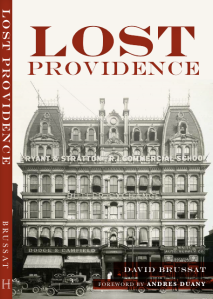
Reposting “Lost Providence”

Click to enlarge.

Five years have passed since the publication of Lost Providence, so there is no better time than now to re-introduce my book to readers of my blog. In 2015, the History Press asked me to expand one of my last Providence Journal columns, “Providence’s 10 best lost buildings,” into a book. I persuaded my editor to let me add 11 chapters on economic development projects, whether “lost” or completed, as far back as the early 19th century. Several chapters from the second half of the book, broken up into smaller bits, will serve to emphasize that traditional architecture served Providence well for three centuries and should be embraced to solve problems the city faces in its fourth century, which begins only 14 years from now.

***

Chapter 15

Downtown Providence 1970 Plan

This account of Providence’s storied architectural history has already hinted strongly that even before the 1950s, mistakes were made. Decking over the rivers between downtown and College Hill was one error. Neglecting the void between the State House and downtown was another. Decisions to route a pair of federal highways through the city so as to cut off downtown from districts to its north, west and south are today considered a serious error by almost all sensible people. However, the City Plan Commission had proposed, in the early 1940s, to run a highway right up the middle of the Providence River between the old East Side and West Side. A 1947 report written for the state department of public works by the Charles A. Maguire & Associates engineering firm describes the plan:

A part of the [option] 6 scheme considers the use of the open area of the Providence River, where a depressed highway would be built from Fox Point northerly through the present congested area at Crawford Street, Memorial Square and along the general line of Canal Street. … The present Providence River, often called an open sewer, being enclosed in conduits, would be eliminated from view, greatly beautifying the City.

The “Up Yours with a Concrete Hose” highway option was rejected as too expensive, a rejection that is easy to applaud in retrospect. In the following decade, the “eradication of history as a development strategy” urban removal plan picked up where “Up Yours” left off.

The Downtown Providence 1970 plan, announced in May 1960, looked forward a decade, but for inspiration it looked backward a decade, to the period when an already entrenched conventional wisdom in architecture and planning dictated a new master plan for downtown that directly and aggressively challenged the validity of Providence’s architectural heritage. Most of this plan for downtown was not carried through, another decision whose wisdom is said to reside in retrospect. Today it is hard to imagine city officials taking this plan in stride. It should have been no more imaginable at the moment of its announcement than it is today.

“Downtown Providence 1970: A Demonstration of Citizen Participation in Comprehensive Planning” describes a project announced after three years of research, begun in 1957, sponsored by the City Plan Commission and backed by the U.S. Urban Renewal Administration. The project study recognized that downtown had become run-down and proposed to spiff it up with new design that supposedly respected existing architecture. At the conclusion of the study program, its “Citizen Task Forces” were, the study’s foreword asserts, “assured that this plan is tailor-made for their City.”

The wording leaves it unclear whether citizens were assured – or merely informed that they were assured.

In their comprehensive book on The Renaissance City, Francis Leazes and Mark Motte describe the 1970 plan much more straightforwardly than what is stated anywhere in the plan itself. They write:

At the heart of Downtown Providence 1970 was a classic, 1950s-style urban renewal: wholesale redevelopment of the urban core by demolition of the historic commercial center, including the French Revival-style Providence City Hall. The new central business district would become a single-use environment focused on office development, punctuated by pedestrian zones, parking lots, large public spaces, a heliport, and numerous Le Corbusier-inspired modernist office and residential towers linked by multilevel walkways, plazas and acres of satellite parking lots.

Le Corbusier is often considered the founding theorist of modern architecture and is today most widely known for his 1925 plan to demolish central Paris. Massive concrete public housing projects for the poor are considered his major legacy. They degrade cities around the world. The study’s summary states:

Beauty is as important as any of the other considerations that we apply to the rebuilding of the city. Without beauty we cannot evoke the civic pride which assures continued interest and participation by the community. … Careful placement of [new] buildings where they can be seen from afar will lend visual identity to the total Plan. Historic continuity has been emphasized in special treatment for great buildings of the past. … It is concluded that a highly coordinated professional effort is needed, if we are to turn the tide of urban ugliness and make Downtown once again a place of beauty.

“Words, words, words! I’m so sick of words!,” Eliza Doolittle’s line from My Fair Lady leaps to mind.

The introduction to the study’s section “Design in the City” opens with a seemingly introspective set of passages regarding the role of aesthetics in the sensibility of cities. None of it makes any sense in light of what the plan proposes. The section following the introduction, entitled “A New Direction,” states:

If we are to realize the potential of our abundant economy and create a community of abundant beauty, we must make a concerted effort in this period of widespread urban redevelopment to apply new and truly enlightened principles of planning and design. These new principles, embodied in what Morton Hoppenfeld has called “a higher order of design,” are primarily concerned with the relationship of one building to another, and to the natural and manmade environment, and have evolved from a study of the ways in which man uses and perceives his world.

Apparently, the importance of what a building looks like in and of itself does not count for much compared with its relationship to other buildings. At no place in the study is there any attempt to explain or defend or even admit to the existence of the plan’s ambitious, indeed radical, conception of how the appearance of the city must change. It seemed entirely sufficient to declare that the changes will “apply new and truly enlightened principles of planning and design” and “what Morton Hoppenfeld has called ‘a higher order of design.’” They are not further described, explained or justified. And who was this Hoppenfeld? The plan does not say. It was just as Tom Wolfe put it in his 1981 bestseller From Bauhaus to Our House. Describing the sly manner by which European modernists who fled Nazi Germany overturned tradition in postwar American architecture, Wolfe writes, “All architecture became nonbourgeois architecture, although the concept itself was left discreetly unexpressed, as it were.”

Hoppenfeld, by the way, was “a young visionary,” an urban planner who “shared a desire to create new kinds of American communities,” according to a 2001 book, Suburban Alchemy: 1960s New Towns and the Transformation of the American Dream. In 1960, shortly after he was cited in the 1970 plan, he was hired by James Rouse, a developer of new towns such as Reston, Virginia, and Columbia, Maryland, in suburban Washington. In the 1980s, after a career designing new towns and “destination centers” such as Boston’s Faneuil Hall Market, Rouse visited Providence and urged the city to open up its rivers.

Again, the 1970 plan says virtually nothing about what the “higher order of design” intended for downtown would look like, but it certainly is not shy about showing it off in the plan’s architectural renderings. Such drawings were not intended to represent the final designs of buildings but rather to give a general sense of their likely appearance. When the plan was announced in May 1960, the city’s two television stations gave the event wall-to-wall coverage. Illustrations from the plan were printed in the Providence Journal.

The citizens of Providence could not claim to be ignorant of what was coming down the tracks.

***

Stay tuned for the second half of the 15th chapter, and for subsequent chapters in Part II of Lost Providence.

Posted in Architecture, Lost Providence | Tagged , , , , , , , , , | 4 Comments

Better lights for Providence

Providence’s Benefit Street, with its amber lamps redolent of the 18th century. (motifri.com)

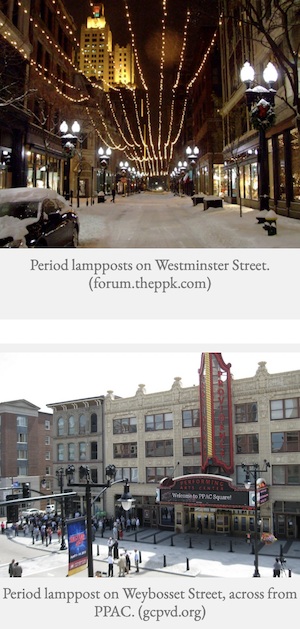
Getting into the Wayback Machine, I alight on this blog post from February 6, 2015, called “Better lights for Providence,” atop of which is a beautiful photo of Benefit Street and its lovely, faux-18th century amber lights. I thought that I was about to read another of my occasional columns and posts hectoring city fathers to install the amber (sodium vapor) bulbs as well in the 19th century lampposts of downtown. But, reading further, I found that in this post I wimped out. Instead, I argued that I should refocus on urging more historical lamps downtown and, supposedly, abandon ye olde crusade for the amber color of the existing historic lampposts. In the blush of time passed, I wonder why I did not argue for both? Allow me, therefore, to correct myself and urge that the city add more historical lampposts in downtown and elsewhere, and that their bulbs be amber as well.

Of course, I suppose I need not add that city leaders continue their refusal to urge developers of new projects to promote our historical character. I hope the new mayor, Brett Smiley, will not continue the idiotic, unnecessary but decades-long practice of disobeying laws set out clearly in its master plan and zoning ordinances.

At the end I have added a photo of College Hill, beyond Memorial Park, taken from downtown. It is all the lovelier because it was taken before the rude modernist Rafael Moneo extension of the RISD Art Museum of 2008.

***

Better lights for Providence

February 6, 2015

Not long after starting to write about architecture in 1990 I would occasionally hector the city fathers in Providence to use sodium vapor bulbs in downtown’s historic lamps, as was and still is done on Benefit Street. That, I thought, would cast the street in a romantic glow, throwing an amber tint that would caress your optic nerve into imagining that modernity’s aesthetic confusion was still a figment of the distant future. In short, the ambiance would reflect the gentleness of the architecture of the old buildings that lined Westminster and its neighboring thoroughfares.

It was perhaps my first crusade, and it went nowhere. For some reason it never occurred to me that Job One was not to choose a nicer color for the historic lamps already installed but to add more historic lampposts around downtown and on College Hill (and elsewhere). My friend Lee Juskalian, a former architectural historian for the city who follows development issues here from California, has apprised me of my dereliction of duty.

The city did install period lamps on Weybosset Street a couple of years ago, but wimped out, using the sort of quasi-historic posts similar to those installed in the 1990s along the city’s new waterfront, the tepid style of whose lamps was among the very few missteps of the late Bill Warner’s design for the river walks, parks and bridges.

I hereby, forthwith and henceforth rectify my error by calling upon the city to make amends. These posts aren’t inexpensive. Perhaps a local provider such as the Steel Yard, which was founded by Clay Rockefeller, could help. Perhaps Providence could partner with the contractor Boston uses to get new historic lampposts in bulk.

However expensive, lining Providence’s best streets, and those that aspire to be good streets, with traditional lampposts would be economic development on the cheap. Brick sidewalks are another form of design intelligence that can be baked into the fabric of growth for cities such as Providence.

The idea is to create a sense of place that makes people feel that where they live or work is special. If you live or work in such a place, it adds value to your lifestyle and is likely to generate profit for your employer and the owner of your residence (especially if that is yourself). Every form of evidence demonstrates that people prefer a historic ambiance to a sterile evocation of modernity. People – and leaders responsible for the built environment – should understand that whereas modern design based on novelty dates itself instantly, a historic ambiance is timeless, and a perfectly valid design strategy for the future.

In addition to installing historic lampposts in existing historic districts, they should be installed on the new roads and sidewalks of the I-195 Redevelopment District land. I hope the new governor and mayor incorporate this easy idea in the new strategy for developing the Route 195 land (if there is to be a new strategy, and not just new words).

Benefit Street’s lampposts, redolent of the 18th century, differ from the historic lampposts of Westminster Street, which hark back to the 19th century. The lamps of Benefit were criticized in the early ’60s by the Ada Louise Huxtable, who called them “faux historic.” Getting criticized by such a national thought leader was a feather in our cap.

Huxtable, who died in 2012, was a fine prose stylist during her years as architecture critic for the Times, but over the years she became more and more bitter as modernism’s failure became more and more clear. She had a hard time adjusting to reality. She refused to see the appeal of traditional design principles as anything other than regrettable nostalgia. Today we know that traditional design patterns appeal to the biological urges of all people – except for those who have allowed graduate design education to purge their instincts of the natural attraction to beauty.

City and state officials continue to hobble economic development here by refusing to build upon the value of Rhode Island’s beauty. This post addresses one of the easiest and least expensive ways to strengthen one of the Ocean State’s most obvious strategic advantages.

Posted in Architecture, Art and design, Blast from past | Tagged , , , , , , , | 5 Comments

Imagine reimagining Capri!

Midjourney AI program renders Capri with few of its manmade features. (Architect)

Aaron Betsky, long the essayist of Architect magazine, remains on top of his game at gaming the future of architecture. It has been far too long since I got to bastinado Betsky. In his latest piece, he describes using artificial intelligence, and specifically the AI platform Midjourney, to reimagine the island of Capri. But of  course the famous resort does not need to be or want to be reimagined.

Even officials of the municipality of Capri urged Betsky and his workshop attendees not to do research on “how can Capri develop in a more sustainable and diverse manner.” That is Betsky’s summary of his goal. The city preferred that Betsky be “tasked” – again in Betsky’s words – with

producing what has been the engine for Capri’s development over the centuries: images that attract, evoke, and set a model for a kind of small-scale urbanism that integrates public space and agriculture into its winding streets.

That must have irked Betsky, whose métier is quite the reverse. What I really enjoyed was how his workshop’s “participants immersed themselves in life on Capri in May and then discovered Midjourney.” Ah! May in Capri! Wish I’d been asked to go, but no invitation was forthcoming. Rats!

As the dean of the school of architecture at Virginia Tech, Betsky wants the next generation of architects to create an even weirder kind of architecture than what current and previous generations have been creating for many decades. Here he insists that his Capri workshoppers’ products evoked a more fantastical version of a place that is already fantastic:

What happens when you ask a computer to make a fantasy retreat even more fantastical? You get a series of postcards of a sun-drenched Mediterranean island, complete with images of piazzas that don’t exist, cracks in the vine-draped walls along the winding streets that grow into inhabitable spaces, and underground caves and houses for the workers who allow the fantasy to operate. At least, that was what a group of architectural designers produced this summer during a speculative design workshop to imagine a future form of habitation on the island of Capri.

Sounds lovely. But to judge by the images that illustrate Betsky’s article linked to above, that’s not what the workshoppers produced. Atop this post is what seemingly was Betsky’s preferred image from among those produced, which evokes the form of the Capri we all (wish we did) know and love, or at least its natural features. This choice was disingenuous. As for the manmade features – which really make Capri what we know and love – those are largely omitted from the Midjourney excursions into Betsky’s preferred topsy-turvy version of reality. The ones he did not choose to run may be even more revelatory of his warped vision of reality. Abetted, of course, by modernism’s preference for computer-“enhanced” architecture rather than traditional hand-drawing of designs.

I prefer Betsky’s description of what Midjourney produces from his last article in Architect about the platform, written before he visited Capri. This description may be found by clicking on the link to that article in his latest article for Architect. Here it is:

The images produced by Midjourney … have a degree of realism, a range of painterly effects, and a way of plugging into the history and traditions of architecture that cloaks their novel mode of production with disarming familiarity. The images also often beat those arguing for hand-drawing and modeling techniques at their own game. The work looks more hand-made, more realistic and more crafted, more knowing in its references, and grander in its ambitions than the collection of swoops and swerves we have come to understand as the marks of computer technology.

Nice, huh? Midjourney seems to be pushing back against Betsky himself. For what he really likes about Midjourney, and which he sees as at its best in Italian architect Cesare Battelli’s work using Midjourney (just below), is its ephemerality. This basically equates to the opposite of the whole idea of architecture, which has to do with solidity (“commodity, firmness and delight,” as Vitruvius described it). Here is one example of Betsky’s preferences, but this earlier article too is worth reading in its entirely for the amusement factor.

The best of them, like the series that ensued from Battelli prompting the software to render the “Tower of Babel under construction,” show a world in which scaffolding and the fragments of finished forms wrap around each other to produce buildings that change from solid objects to ephemera as they rise up into the sky. The scenes Battelli produces almost always consist of such unfinished structures, all loosely connected and spreading out across the virtual page in a sepia-tinted continuum.

Cesare Battelli’s typical “fantastic” imagery as preferred by Aaron Betsky. (Architect)

This, whether in its quoted form or its image, is apparently what Betsky thinks not just Capri but the world should look like. Unfortunately, what we have around the globe is the fully realized version of Battelli’s and Betsky’s dystopia.

The reality, at least in Capri, again, does not need or want to be improved upon (let alone diminished by modernist intervention). This reality is pictured below. If you plow through screen after screen of Capri images on Google, you will see that no architect been allowed to reimagine Capri, or to plop a modernist pile of poop upon its winding and paradisical streetscapes. But is Capri truly free of the infernal modernism?

I fear that behind every streetfront is a hidden example of Betsky’s ridiculous dream reality. No doubt Google, by omitting modernism from its own Capri algorithm, is merely following the diktat of the Capri government! And who could blame the city for that? I sincerely hope I’m wrong. Reality, at least the one we see, can hardly be improved upon.

Scene in Capri, could serve as the design for wallpaper, yes? (wallpaperaccess.com)
Another scene of the colorful traditional imagery of Capri. (wallpaper.com)
Posted in Architecture | Tagged , , , , , , | 3 Comments