
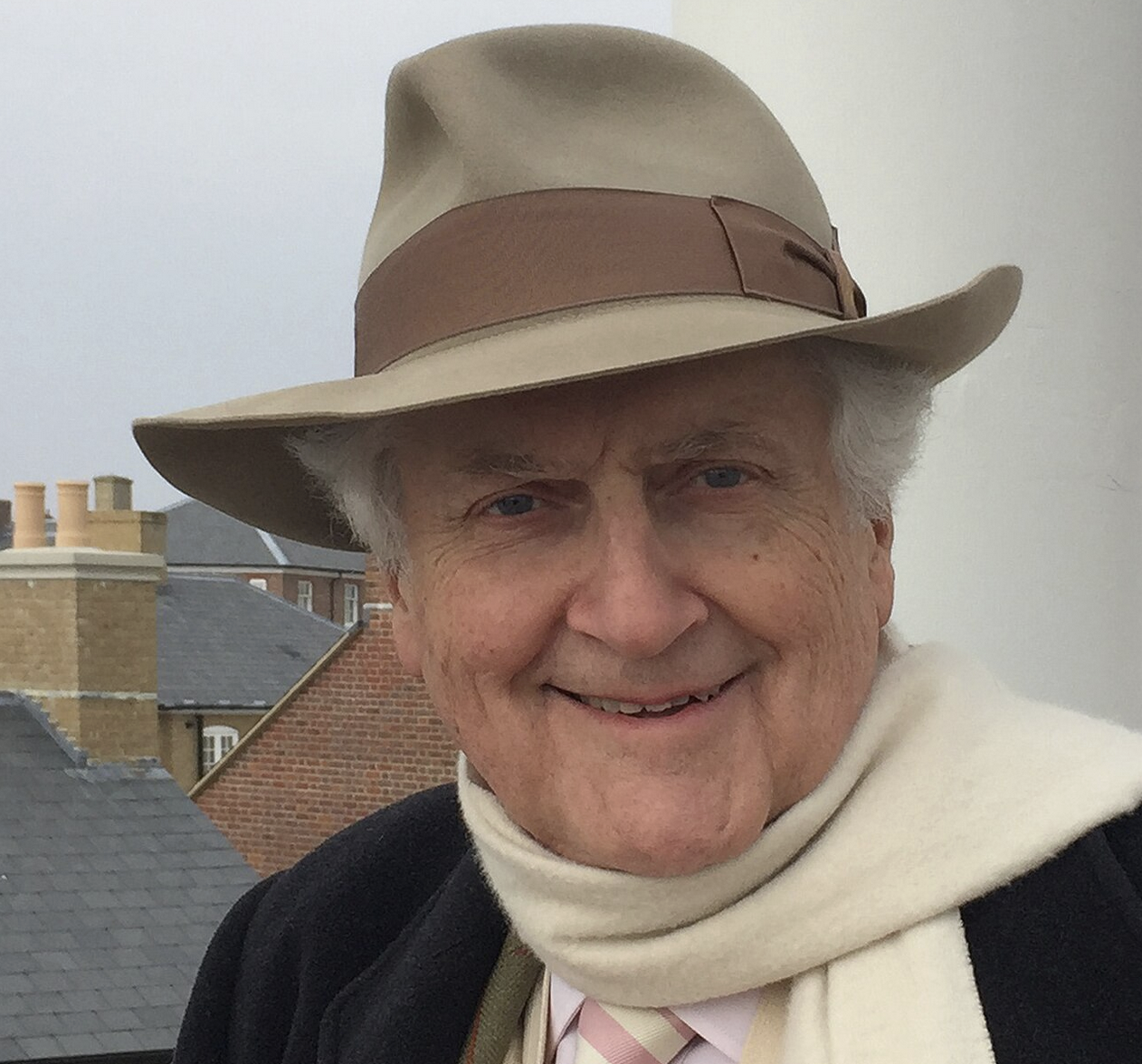
Leon Krier, photographed in 2018 in Poundbury. (Wikipedia)
Léon Krier died Tuesday in Palma de Mallorca, Spain, aged 79. Krier was born in the capital city of Luxembourg after World War II, and observed its degradation thereafter at the hands of modernist architects. His design education was very brief; he left architecture school after one years, hiring on with James Stirling in Britain. He left there swiftly as well. His older brother, the late Rob Krier, was also a classical architect.
Krier spent his life developing an unusual style of classical architecture, which might be described as a mixture of classicism and Art Deco. He tended to think of cities as projects imagined in their entirety. He is most famous for his masterplanning of Poundbury – owned by the Prince of Wales until Charles became King Charles III, and Cayala, outside of Guatemala City. Krier worked extensively on masterplans for Washington, D.C., and Dresden, Germany, where he was the only one of nine experts to vote in favor a citizens’ initiative to rebuild the city’s Frauenkirche and its Newmarkt area after their destruction by allied bombing in WWII. Both were successfully completed.
In 2003, Krier was the inaugural winner of the Driehaus Prize, which today and for many years has been valued at $200,000. Whether he received that amount in 2003 is unknown to this writer.
Krier’s most popular works may be his illustrations of architectural and urbanist principles (see below). His least popular work may have been his book on the work of Nazi architect Albert Speer, a volume that sought to determine whether the work of an artist could subsist alongside the evil of the regime for which he performed that and other work. He was vilified unfairly for even bringing up the subject, but he does not seem to have cared. Krier wrote that
the whole of Paris is a pre-industrial city which still works, because it is so adaptable, something the creations of the 20th century will never be. A city like Milton Keynes [in Britain] cannot survive an economic crisis, or any other kind of crisis, because it is planned as a mathematically determined social and economic project. If that model collapses, the city will collapse with it.
Wikipedia’s article on Krier has this to say of his city designs:
Krier proposed the reconstruction of the European city, based on polycentric settlement models which are dictated not by machine scale but by human scale both horizontally and vertically, of self-sufficient mixed use quarters not exceeding 33 hectares (82 acres) (able to be crossed in 10 minutes walk) of building heights of 3 to 5 floors or 100 steps (able to be walked up comfortably) and which are limited not by mere administrative borders but by walkable, rideable, driveable boulevards, tracks, park ways. Cities then grow by the multiplication of independent urban quarters, not by horizontal or vertical over-extensions of established urban cores.
My own experiences with Krier came in short, occasional email exchanges over the past decade or so to clarify aspects of his work for my blog posts. Here is my favorite drawing by Krier, which I have reprinted numerous times:





 Architecture Here and There
Krier’s drawing is odd. “False Plurality” illustrates willfully formed architecture on both sides of the bridge. The buildings on the left side have a lower skyline, indicating a town rather than a city, which must be what the buildings on the right side of the bridge represent. If small gable roofed forms are meant to illustrate residential buildings then there are residential buildings on both sides of the bridge. “True Plurality” shows traditional architectural forms on the left side of the bridge only. In the False Plurality drawing the left side skyline is lower and the right side higher, in analogy to the True Plurality drawing. On this side in addition to gable roofed forms there are traditionally massed towers as well that seem to represent either religious or civic buildings. On the right side of the bridge in True Plurality there are no gable roofed structures.
False Plurality seems, then, to represent a mixture of building uses, residential and non-residential, on both sides of the bridge whereas True Plurality points to a segregation of residential buildings to only the left side. Non-residential (and perhaps high-rise residential? though to make that clear putting a gable on a tall building would represent that better) are segregated to the right.
False Plurality is, we are given to assume, a caricature of the modern urban dichotomy (sans 21st century developments in building forms) as eclectic in form and undisciplined in planning and zoning. True Plurality’s right side is just as eclectic in form but seems in its planning and zoning to disallow small scale residential forms. In True Plurality the left side of the bridge seems to represent the tradition of the small town or village in say, New England or northern Europe. The right side is, as in False Plurality, a Wild West of, shall we say, ego-driven forms.
Is the left side of False Plurality, presumably a critique of the contemporary small town, a fair representation? I’d say contemporary small towns have a good deal more small gables and a good deal fewer “zooty” buildings. In fact, they by and large look very similar to the left side of True Plurality. One can web search images of, say, Coventry, RI and find it compares more favorably with the left side of True Plurality than the left side of False Plurality.
With regard to the right sides of both drawings it seems Krier has no dog in the hunt regarding the forms of large cities as both right sides of the two drawings are the same in terms of eclecticism. In terms of planning however no small scale residential forms are represented in the right side of True Pluralism, but I doubt Krier is advocating the demolition of existing small scale residential buildings in large cities. Is he is against building new small scale residential buildings in them? The right side of the True Plurality drawing does not show any.
If contemporary small towns conform more closely with the left side of True Plurality than with the left side False Plurality what are we to make of that? A warning? It seems small town governments *do* try, through zoning, planning and historic preservation to maintain their fabric. No easy task, to be sure. But it is being accomplished.
Where we might find failure to maintain that desirable small town fabric is when small towns grow due to economic circumstances. I think of my own hometown, more than double its size when I was a teen. It looks very different to me. It’s a city now for good and/or ill. Does it really deserve the mantle of False Plurality? And what about the even larger Stamford, CT? That must be the kind of urban fabric that Krier would decry: too big to be quaint anymore and too small to be a metropolis of “zoot.” People seem to like it; Fortune Magazine ranks it in the top 50 family-friendly cities in the US. (Krier would now doubt approve of that.)
The right sides of the drawings are the same- no quibble from Krier there. Contemporary small towns already were- and are- in consonance with the left side of True Plurality, and small and medium size cities are, well, what they are- take them or leave them. If this bus is bound for making medium size cities look like small towns then this is my stop. Thank goodness for public transportation.
LikeLike
Léon Krier was for me the greatest inspiration in the creation of architecture.
He designed buildings and outdoor spaces of such beauty and civility.
He spoke truth against the architecture profession. He was a maverick
and his fight for beautiful architecture was an uphill battle because in general,
most people believe what most people believe because most people
believe it, and you will be hard pressed to ever convince them otherwise.
To convince most architects to not believe what most architects believe
is nearly impossible. Try to convince anyone of the truth of 911; good luck.
Best wishes Léon . Enjoy all the glorious architecture in the spirit world.
LikeLike
For Poundbury, don’t you mean Duke of Cornwall, not Windsor?
LikeLike
I was very sad to hear of the death of Leon Krier. His influence in promoting, in every way, humane architecture was outstanding, both his writing, his talks, his own buildings and his masterplans.
He was unique in rejecting the standard process of producing ‘modern’ architectural robots. He had however a long career as an architect and planner.
For me, his book The Architecture of Community, is one of the best ever, and should be read by anyone interested in architecture and urban spaces, which must be, well, everyone…especially politicians.
He will be sorely missed
Malcolm Millais
LikeLike