
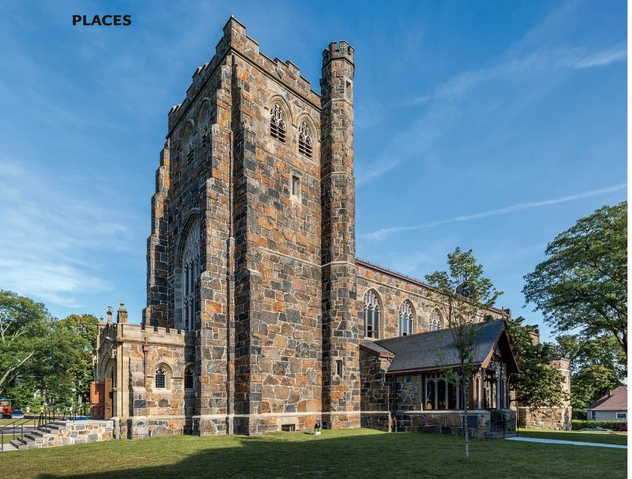
Ralph Adams Cram’s All Saints Church in Dorchester, Mass. (Design New England/Peter Vanderwarker)
I direct readers to William Morgan’s splendid review in Design New England of the restoration of Ralph Adams Cram’s All Saints Church, in Dorchester, Mass. In part, I suppose, this post makes up for (and yet does not apologize for) my recent semi-rough handling of my friend’s review (in the Providence Journal) of Brown’s new math building (see “Handsome rectangular box?“). Aaron Betsky should not expect similar kid-glove treatment.
But Morgan manages to describe the restoration by John G. Waite Associates, of Albany, with a minimum of his usual mod-symp tics, which he knows drive me nuts. He writes that Waite managed to “recapture the original intent without any specious historicism.” I don’t even know what that is supposed to mean! “Specious historicism”? I will just have to await Morgan’s enlightenment in the no doubt ensuing email rejoinder.
No rejoinder came from him after my Brown applied math post. Perhaps Morgan was out of town, or in a sulk. He did re-initiate contact soon, though, wondering why Jasper Fforde did not spell his last name fforde, as, he said, correctness required of an English surname of Norman French derivation. (See my post “Lost in a Good Book.”) An odd query, but I was glad we were back in contact. He next sent me his “All Saints Be Praised” piece in Design New England, which I was happy to receive. I commend it to readers.
The piece describes how the church’s restoration was accomplished without “spoiling its well-worn patina.” The description of that process is interesting, and is followed by an even more intriguing passage:
To worship at All Saints is to enter another world, one predicated on the romantic notion of what an Anglican church would have looked like had the development of Gothic style not been interrupted by the Italian Renaissance.
Ah, what if! Which brings to mind a sultry “if only!” If only the evolved and evolving architectural tradition of the early 20th century, with cities enriched by building practices that heaped beauty upon beauty, no holds barred, had not been so rudely interrupted by soulless modern architecture.
What then, Will Morgan?
If you ask me, the world would be a happier place. Still, read Morgan’s piece and luxuriate in the building through the photos of Cram’s church by Peter Vanderwarker. They will make readers happy, at least for a while.




 Architecture Here and There