
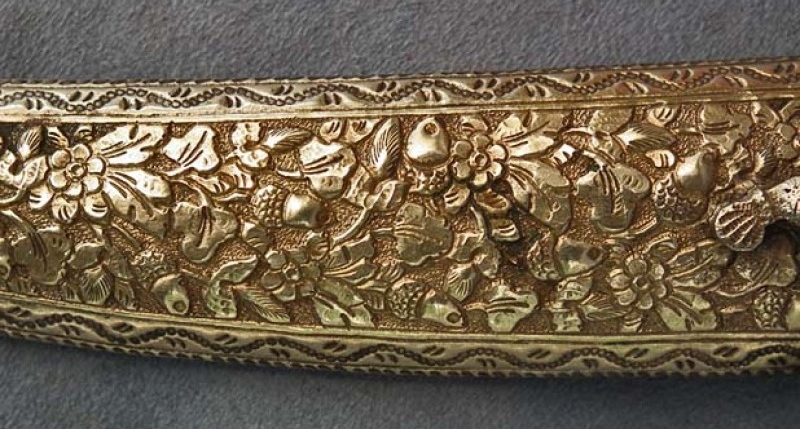
Antique Turkish Imperial Dagger sheath, circa 18th century. (101antiquesword.com)
I recently began to read the famous autobiography of the goldsmith Cellini (1500-1571), which he wrote from age 58 but concluded about a dozen years before his death. From the pages of the rambunctious Florentine artist we get perhaps the most vivid picture of life in Italy during the Renaissance. Here is ruminates on his attempt to outdo the Turks at daggers, from which he digresses into a discussion of intercourse among flora and fauna.
It was about that time [after months of plague in Rome] that some small Turkish daggers fell into my hands. The handles, as well as the blades, were made of iron, and even the sheaths were. They had been engraved by iron tools with patterns of beautiful foliage, in the Turkish style, which were nicely filled in with gold. I was seized by a burning desire to try my hand at that kind of art as well, which was so different from the others; and when I found that I could manage perfectly well I made several daggers of that sort. For a variety of reasons these were much finer and far more durable than the Turkish ones. One reason was that I cut much deeper and my undercutting was far wider than that of the Turkish craftsmen. And again, Turkish foliage work is only based on arum leaves, with a few small sunflowers, and although this is quite pretty, unlike our designs it soon loses its charm. In italy we have several kinds of foliage design. The Lombards do very beautiful work by copying the leaves of byrony and ivy, in magnificent loops which are very pleasing to the eye. The Tuscans and Romans improve greatly on this because they copy the leaves of the acanthus, commonly known as bear’s foot, and show its stems and flowers all twisting and turning. It gives a charming effect if one has some birds and various kinds of animals engraved on the work as well; and his choice here shows what sort of taste the artist has.
The design for some of these animals can be found by the artist in nature, in wild flowers, for example, like those known as snapdragons; and a skilful artist can work in various beautiful ideas derived from other flowers. People who are ignorant about such matters call those artistic fantasies “grotesques,” This name has been given them in modern times from their having been found by students in certain underground caves in Rome, which in ancient times were used as dwelling-rooms, bath-houses, studies, halls, and so forth. These places are underground, because they have remained as they are while the level of the ground has risen over the years; and in Tome such underground rooms are called grottoes. That, then, is the origin of the name “grotesques.” But that is not the right names; because, just as the ancients loved to create monsters by having intercourse with goats, and cows, and horses, and calling their hybrid offspring monsters, so our artists create another sort of monster by mingling different kinds of foliage. So monsters, not grotesques, is the correct term. I designed my foliage in this way, and when it was inlaid in the work I produced was much more impressive than the Turkish.





 Architecture Here and There