
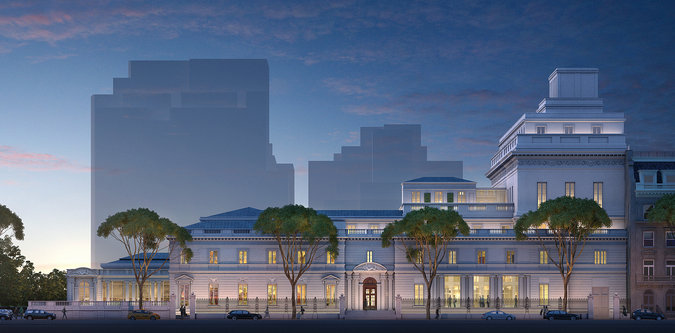
Cancelled plan for addition to Frick Museum. (Frick)
The news reported by the New York Times’s architecture writer, Robin Pogebrin (“Frick Museum Abandons Contested Renovation Plan“), leaves me with mixed emotions.
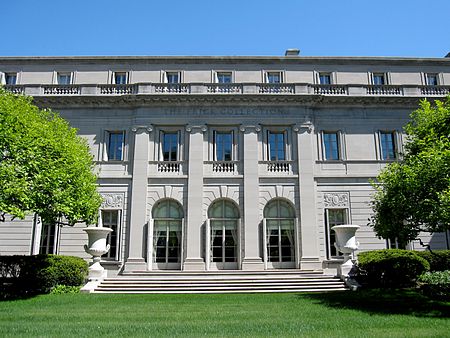
The Frick Collection, on Fifth Avenue. (Wikipedia)
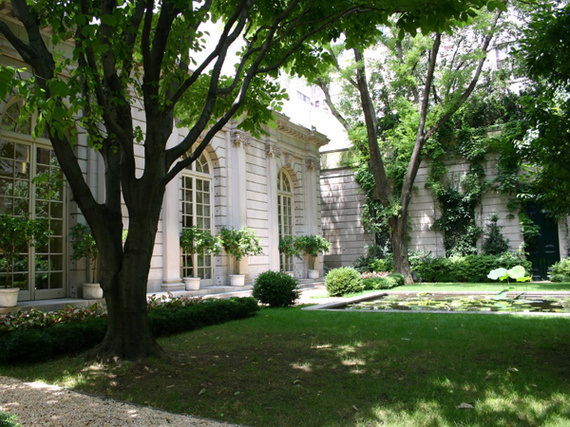
The Viewing Garden, by British landscape architect Russell Page. (From “Gardens of Russell Page”)
Over time, my skepticism grew regarding the traditional addition proposed for the Frick. The house was designed in 1914 by Carrère & Hastings, for industrialist Henry Clay Frick; an addition by John Russell Pope opened in 1935. Eventually, I signed a petition against the latest proposal, largely because it would have demolished classical additions to the building in the 1970s, including one by John Barrington Bayley, one of Henry Hope Reed’s associates in starting Classical America in 1969.
My skepticism remains sizable. Still, my initial support for the expansion arose because classical additions to classical buildings are so rare these days. A highly visible demonstration such as this addition to the Frick would help the public understand how the city’s beauty can be augmented by such a strategy. That strategy would have seemed obvious half a century ago, but today the obvious is what most bears – indeed requires – repeating.
And yet … and yet. Eyebrows could only arch upward at the identity of the firm selected for the design – Davis Brody Bond, which was responsible for the modernist interior of the underground 9/11 museum at the World Trade Center memorial. Plus, while the project’s initial rendering looked very nice, the devil is in the details – and maybe the program really was too large for the institution’s own good.
It is not just the beautiful classicism of the Frick that the public loves, but the intimacy of the place. It is an enchanting residential space imagined by a connoisseur of the arts – a tradition also exemplified by the Isabella Stewart Gardner Museum in Boston and the former Barnes Foundation, now removed to Philadelphia.
Indeed, it is the example primarily of the Barnes that is worrisome in light of what is to come of the Frick. Abandoning the Frick expansion plan does not end the project, it only forces it into a new configuration, smaller and classical, one expects … but maybe not.
The Barnes had been located in a lovely classical building in Lower Merion, Pa., designed by Paul Philippe Cret and completed in 1922. The will of its founder, Albert C. Barnes, insisted that the museum was to remain as it was at his death, to be curated as a house museum with an extraordinary collection. Yet in the 2012, a huge new museum opened in central Philadelphia, designed by Tod Williams and Billie Tsien, whose 2001 folk art museum, demolished by MoMA, resembles the Barnes’s fraudulent fractal texture.
If the future of the Frick in any way resembles that of the beloved old Barnes, heads will roll, if not in reality then on this blog. “Quit while you’re ahead” may not be the best solution to the problems facing the Frick, but let’s hope classicists do not rue the day they ganged up on what seemed like a potentially great addition. Let us hope that the Frick’s board finds an answer that avoids damaging a great institution.
Let me suggest that a new classical building be erected on land nearby to hold offices and collection overflow from the Frick. I’m not sure that’s feasible, financially or otherwise, but it would solve the existing problem – if indeed there is a problem and not just a board of directors filled with the need to demonstrate the importance of their existence.





 Architecture Here and There