
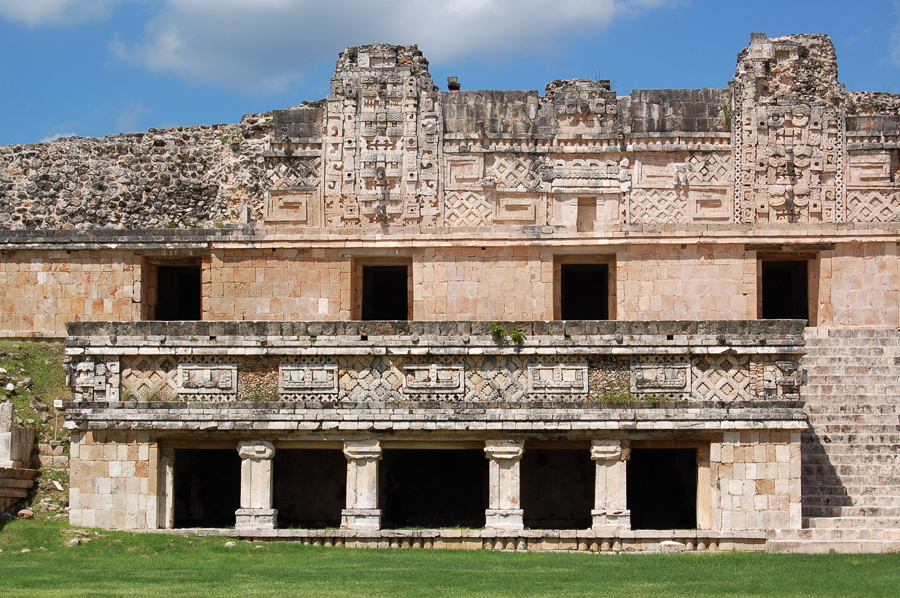
Pavilion at Uxmal, possibly a Maya royal residence or building of state. (Photo by Nathaniel Walker)

Commercial row houses in Malaysia. (Photo by Nathaniel Walker)
Nathaniel Walker, newly minted architectural historian and professor of same at the College of Charleston, recently joined the TradArch list and launched into debate on the vital issues facing architecture’s future. In discussion with others on the list, who were contemplating aspects of classical architecture in countries far from the roots of Euroclassicism, Nathaniel posted some photos he’d taken at a recent symposium in Malaysia and another he’d taken a while back of a Mayan structure – distinctive in this context because it predates contact with Western influences. The talk went back and forth about these examples, during which Nathaniel made a particularly interesting point, which I here share with non-TradArch readers of the blog He was discussing how classicism differs between that of Europe and of other continents, but that we must recognize that it has more in common than not – as is the case, he points out, with humans:
I think the DNA of Western Classicism was able to graft onto local traditions because all of these humanist architectural traditions were, despite their superficial differences in detail, of the same species – just like humans themselves. And modern humans are, of course, also the same species. If one can demonstrate that Chinese Classicism is inherently compatible with Western Classicism, the inevitable, logical conclusion is that Classicism is not a product of history or culture, but is intrinsically dialed into what it means to be human.





 Architecture Here and There
For the readers’ benefit, I have just finished reading Nikos’s latest book (with Michael Mehaffy) and will be reviewing it shortly.
LikeLike
Dear David,
We have already done exactly what you and Nathaniel Walker suggest. With the formulation of architecture in terms of coupled form language plus pattern language, the overlap in the DNA of Greco-Roman Classical, Chinese Classical, and Maya buildings, for example, is mathematically evident. This is all published in Christopher’s and my books. I realize that not many people know about this framework in which to analyze — and design — buildings. But there is lots of material available free on the web, including my recorded videolectures.
Best wishes,
Nikos
LikeLike