

Paris along the Seine. (swide.com)
One of the delights of blogging is the ability to insert a couple of paragraphs from what you’re reading as you go along. So here’s another set, on pages 144-45, from Design for a Living Planet, by Nikos Salingaros and Michael Mehaffy. After a passage describing the implications for architecture and urban design of algorithms, they write:
But let us not discount the vital importance of design creativity and freedom. Art plays an essential role in illuminating the rich complexities of this generated urban structure, as the great urbanist Jane Jacobs famously pointed out. What matters is not the particular “style” or form language that we use, but the degree to which it is adapted through the kind of process we are describing. As the process of adaptive computation proceeds (unconcerned with a pretty pattern on the ground but really generating an intricate socio-geometrical configuration), it produces aesthetic results that are rich and complex. The aesthetics are not applied as a veneer of self-conscious abstract compositions, but emerge much more powerfully from the deep structure of the process.
By the time I reached the end of this paragraph I was formulating internal objections. I feared that Mehaffy and Salingaros were about the suggest a new form language that would throw all styles, traditional and modern, out the window. No (said I to myself), the algorithms were precisely what led unconsciously to classical design principles in the first place. We don’t want to abandon them but return to them! … I read on.
Thus we have hopefully lain to rest the common error that traditional form languages restrict architectural creativity and aesthetic sophistication. As the logic of this process should suggest, that statement is mathematically false. We can certainly use an adaptive design algorithm with a traditional form language to design very different buildings depending upon different initial conditions. The best classical and traditional architects have always known this, and have exploited it in the past to build the world’s most loved and sustainable cities by re-using much older form languages in their own day: Paris, London, Rome, and many others.
Ah! Vindication in the space of two paragraphs!
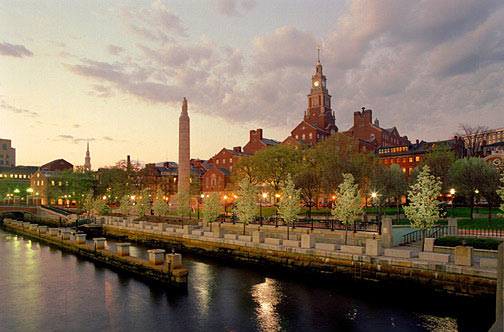
Providence along the Providence. (peacemaripo.com)


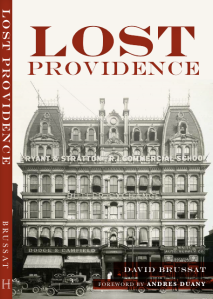


 Architecture Here and There