
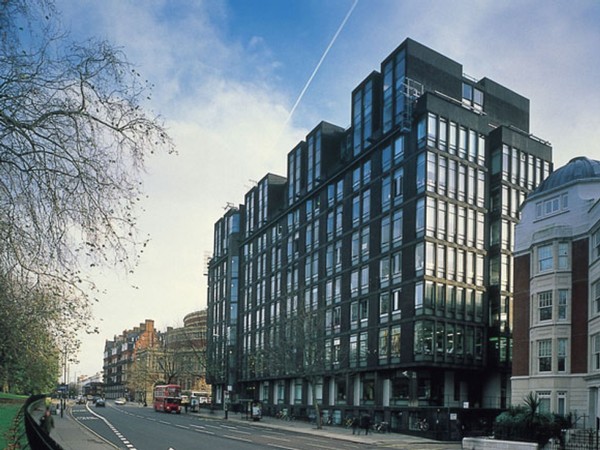
Royal College of Art, with Royal Albert Hall just beyond. (guialomejordelmundo.com)
Roger Scruton’s 1995 collection of essays, The Classical Vernacular: Architectural Principles in an Age of Nihilism, begins with an essay, “Reflections on a Candlestick,” in which he describes an objet d’art sitting in a Brutalist conference room:
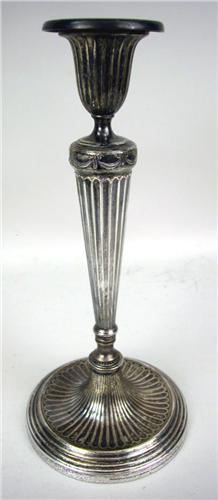
Not the same candlestick, but of the general idea. (icollector.com)
My eye came to rest on a Regency candlestick, part of the legacy of beautiful things which the [Royal] College [of Art, near London’s Albert Hall] is still able to display. … The ruling idea of the candlestick can be summed up in two words: dynamic and detail. Its form springs from the combination of bold movement and delicate ornamentation. The fluted oval column rises on a firm architectural base and supports an urn of exquisite outline, in which the candle rests. the beaten silver makes quiet reflections, while the innumerable lines and mouldings cast small soft shadows into every silver pool. There are no edges, only lips, where the structure, having extended itself in one direction to the limit of usefulness, relinquishes its claims to the neighboring space and folds over. The base, too, is without an edge: its oval rim is brought to a conclusion by a ridge of mouldings. It neither bites the surrounding space nor presses against it. The base of the urn is slightly pinched, marking the point where the vertical thrust of the column expires. At every pause and juncture some simple and effective embellishment provides a commentary on the underlying dynamic of form. The whole is harmonious and restful and at the same time energetic, confident in its movement, abundantly alive.
The surrounding architecture is the opposite of all that I have just described: static, harsh, without detail (except the arbitrary detail provided by the imprint of rough-hewn boards). It presents itself to the observer as a series of edges, without softness or movement. Its forceful denial of life, its absence of language, of correspondence, of drama, its inability to move, to yield, to dance – all this is experienced as a denial of the observer’s presence.
This is the difference between traditional architecture and modern architecture. Society has chosen to build the one and suppress the other. That is why the world is so ugly today. That ugliness has consequences, entirely inimical to joy and life, though science has not really set itself to examine those consequences. Nikos Salingaros and a few others have begun what deserves to be a much more comprehensive investigation. Whatever is discovered about the degree of negativity that oozes into our mood, our being, our spirit, from the harsh lines of modern architecture is, in its essence, a belaboring of the obvious to all who have not had their instinctive respect for beauty (and its positive influences) purged by a modernist education in what Scruton, wrinkling his nose, would call “design” (his quotes). Only by such purgation is modern architecture capable of being produced and appreciated.
That beauty has been expurgated from much of life around the world is the bad news. The good news is that compared with most other problems facing humanity, such as war, crime, poverty, hunger and disease, the solution to the problem of ugliness is easy. It is a simple replacement of the dominant aesthetic with a past aesthetic that is struggling to emerge from suppression. We know what to do because human societies did it for two or three millennia until not even a century ago.
The how of resuming a civilized architecture is more complex but still relatively easy compared with other challenges. However suppressed, traditional ways of forming our built environment remain as models. They are our nice neighborhoods, pricey because establishment architecture and planning regimes have made them difficult and often illegal to replicate, and our favorite places to go on vacation, in America and abroad. The traditional ways are gaining adherents, and more people are seeking to learn how to create beauty the old-fashioned way – a way that constantly grew and evolved, applying advances in materials and techniques to reflect the needs of society for thousands of years until the stillborn, lifeless revolution of modern architecture. Its vision of a lifeless civitas of blankness and edges survives the widespread natural resistance to its dominance only because of its establishment’s willingness to embrace a totalitarian cult business model. This cult may, at least in theory, be pushed over with a finger.
Perhaps the evil, stupid starchitect Frank Gehry’s own finger has sparked that push. It may light a candle to be set in the candlestick described above by Roger Scruton.




 Architecture Here and There