
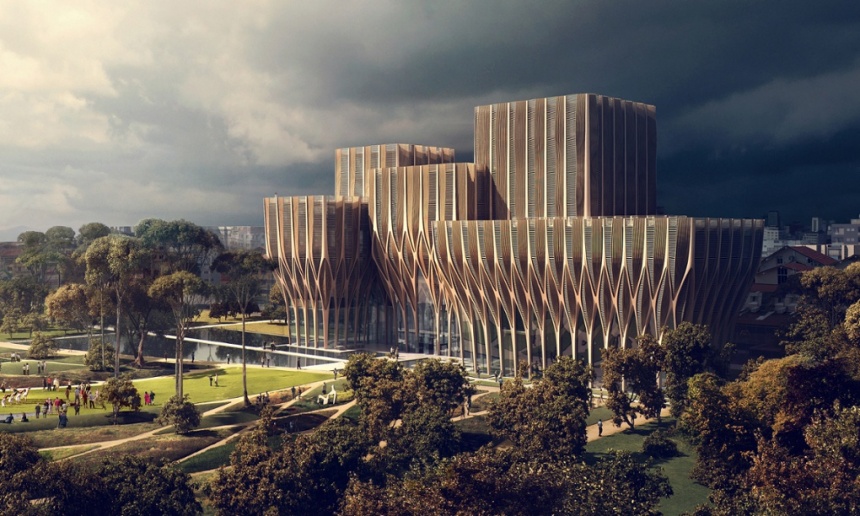
Proposed genocide museum in Cambodia by Zaha Hadid. (The Guardian)

Ankor Wat. (ngm.nationalgeographic.com)

World Trade Center, circa 1997. (mlive.com)
Lightening up on her typical aesthetic slash-and-turn violence, Zaha Hadid has designed a genocide museum and institute south of downtown Phnom Penh to honor the dead of Pol Pot’s savage regime. The commemoration has inspired Guardian architecture critic Oliver Wainwright to pen another item, “Zaha Hadid’s soft hymn to Cambodia’s fallen,” for my collection of pieces that unwittingly brag on the ghoulishness of modern architecture.
“Zaha Hadid has brought her trademark language of sinuous lines,” he writes, “but she has consciously eschewed some of her more violent geometries, making a building that promises to be unusually attuned to its context” For most people, this would be damnation by faint praise of an architect’s body of work. It suggests that her style is normally violent and alien to its context. And indeed, perhaps Hadid’s usual violent zigzags would have been more appropriate for this job.
Wainwright perceives Ankor Wat in the five buildings of Hadid’s design. I do not see it. But I do see a nearly perfect recapitulation of the almost Gothic ground-level sinuosities of the World Trade Center. What Osama bin Laden did to a pair of buildings in New York City, Pol Pot did to a swath of his nation’s entire population. What Daniel Libeskind did (or sought to do) to commemorate the more recent atrocity, Zaha Hadid does to commemorate the earlier one: Both designs did not so much commemorate as recommit genocide, albeit not of population but of culture.
Modern architecture has no problem with cultural genocide. That is what modernism is all about, whether in its Jacques Derrida deconstructionism, targeting the structures of human institutions, or in modern architecture’s attack on the evolutionary structures of the built human environment.
The blame in this case belongs less to Zaha, however, who’s just trying to make a buck, than to the brainwashed human-rights activist Youk Chhang, who, for all his brave archival work, is so focused on making a big splash with his institute that he overlooks the impact of its design on his nation’s already beyond sufficiently throttled culture. “Many of these memorial museums are depressing, and you leave with a sense of anger, not forgiveness,” he told Wainwright. “They are usually designed by men, so I thought maybe a woman could do it better.” There you have it.
Wainwright doesn’t mention let alone applaud cultural genocide. Most modernist architecture critics do not even begin to imagine that the starchitects they revere are committing it. (I’ll say that for them!) But this piece still deserves a place in my collection of architectural criticism that unwittingly damns modernism.





 Architecture Here and There
I constantly spent my half an hour to read this web site’s articles daily along with a cup of coffee.
LikeLike