
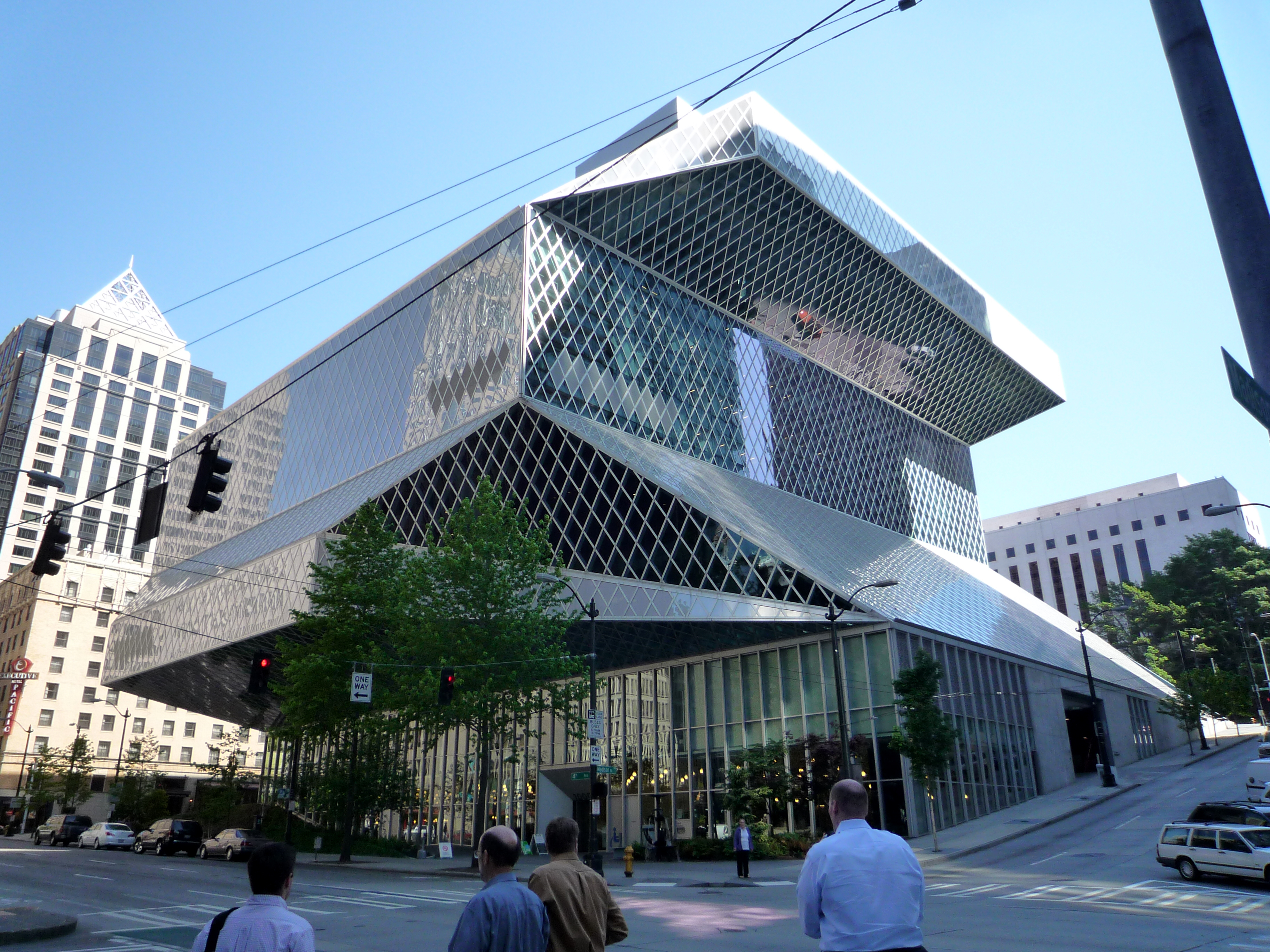
Seattle Public Library, by Rem Koolhaas. (geek.do206.com)
After reading my blog post on the destruction of Mecca, Nikos Salingaros sent me Chapter 9 from his book A Theory of Architecture, in which, writing with Michael Mehaffy, he describes modern architecture as a phenomenon parallel to religious fundamentalism. He uses the novel term geometrical fundamentalism to stand in for modern architecture. Henry Hope Reed, also trying to use a more astute understanding of modernism to replace the act of theft that constitutes its name, embraced the phrase Picturesque Secessionism. But modern architecture is a perverse childishness, a dangerous simple-mindedness, and through the theft of the word modern conveys unwittingly its inherent insecurity. So modern architecture should visit its psychiatrist. (After that, society should introduce modernism to its jailor.) To tease readers into the entire chapter, in which profundity vied with profundity for selection as the teaser in this blog, I offer the passage in which the concept of insecurity is introduced:
Fundamentalism in architecture is no different from religious fundamentalism. One might associate the drive to a fundamentalist belief with the need to establish an identity in the face of complexities of human culture. Those who have difficulty coping with urban complexities — as, for example, Le Corbusier — would prefer to eradicate them. His horror of and hysterical aversion to the hustle and bustle of lively street life are well documented.
We interpret this abhorrence of complexity as the manifestation of a basic insecurity. It represents a profound lack of confidence in oneself, which would otherwise anchor a person’s psyche to human society. Without such confidence, one feels lost unless there is something else to which one can attach. Insecure persons need something stable to cope with uncertainties in their own identity. A simplistic ideal — particularly if it is of a utopian nature — offers a readily recognized alternative to the complexity of real life.
Read the entire book.




 Architecture Here and There
Thank you. Yes, two things that I detest – modernism and fundamentalist religion – aptly linked.
LikeLike