

The name of the narrow building in front of the Hotel Dorrance, razed in 1920. remains a mystery. (Journal archives)

Hotel Dorrance and Dorrance Court Building. (Cliff Coutcher, John O. Pastore Collection, Providence College)
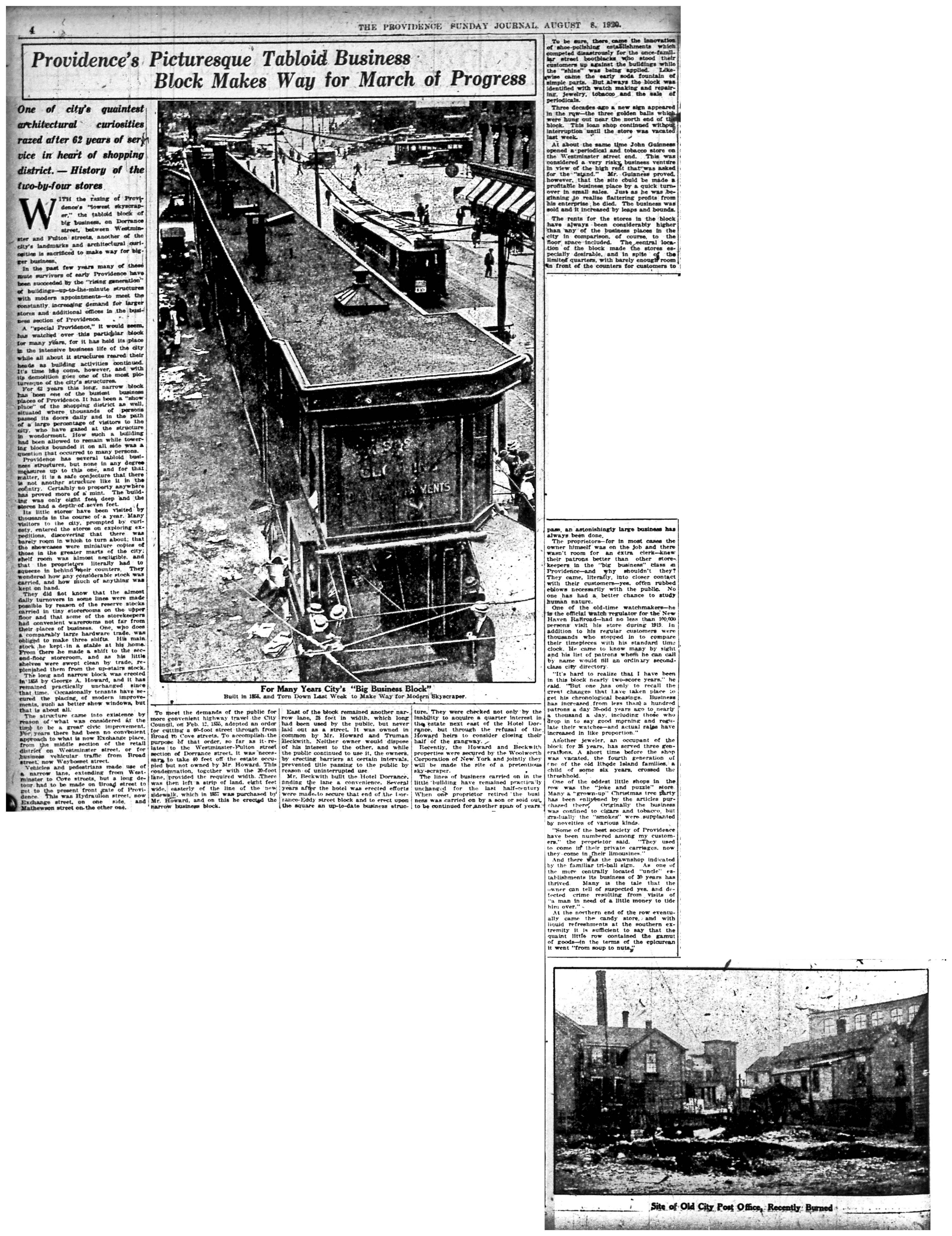
News story of buildings’ demolition in 1920. (Journal archives)

Postcards of old Hotel Dorrance. (Larry DePetrillo)

Dorrance Street, looking south, circa 1920. (Journal archives)

Plat map, segment, downtown Providence, 1875. (Brussat archives; all maps, click to enlarge)

Plat map, segment, downtown Providence, 1895. (Brussat archives)

Plat map, segment, downtown Providence, 1918. (Brussat archives)

Plat map, downtown Providence, 1875. (Brussat archives)
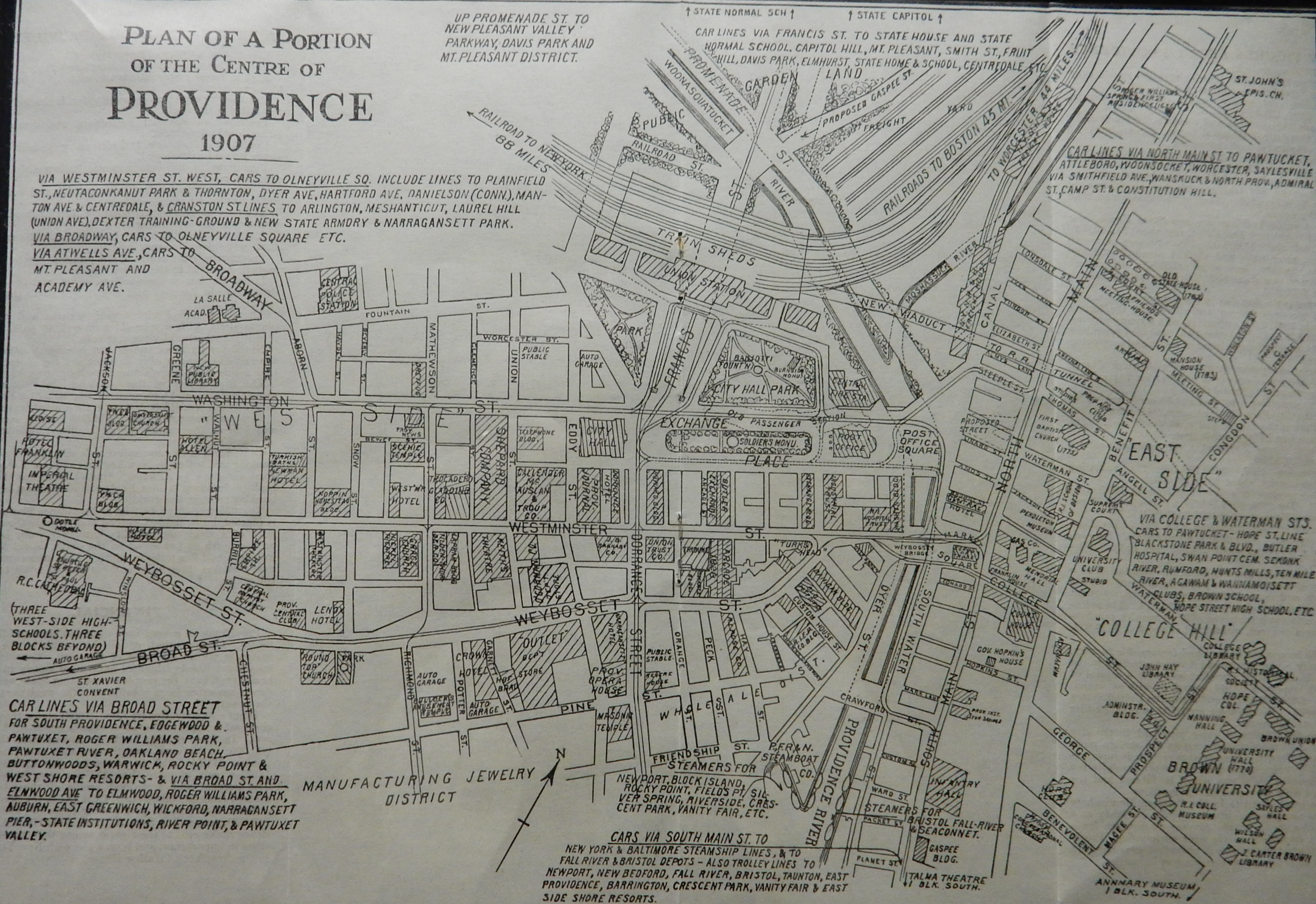
Tourist map, downtown Providence, 1907. (Brussat archives)
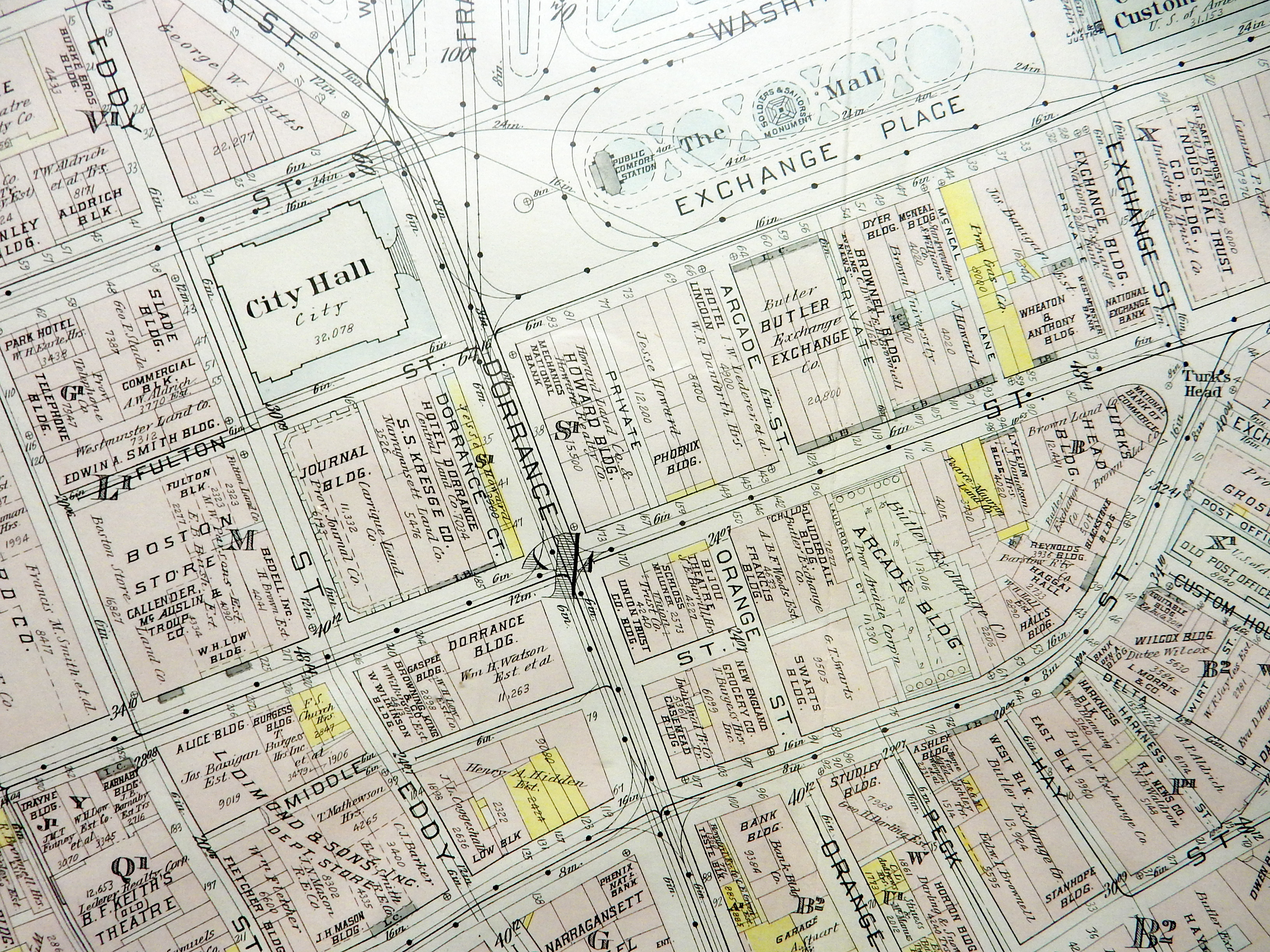
Plat map, downtown Providence, 1918. (Brussat archives)
Last week’s column, “The mathematician vs. the modernists,” was my last hurrah as an employee of the Providence Journal. I didn’t know that as I finished writing it around 9 on Tuesday morning. Otherwise I might have written something decked out more aptly in sackcloth and ashes. At 4 in the afternoon I was handed my walking papers from HR, and my 30 years (minus two months) at the Journal were history.
So a column on a historical curiosity of downtown Providence might be a good way to ring in the continuation of the old column at my Architecture Here and There blog. Now that I no longer have the vast archival resources of the Journal at my disposal, I am glad to have Sheila Lennon’s “Time Lapse” Journal blog, which I can get without having to cross the threshold of the oldest continuously published daily newspaper in the United States.
Sheila’s “Time Lapse” blog has delighted this investigative pundit for years. Her modus operandi is to challenge readers of the newspaper to identify a scene from an old photo of a building and reveal the answer in the Sunday paper. On Aug. 2, she took a different tack. This time she told readers exactly where the scene was – but asked us to provide the name of the long, extremely narrow two-story retail building in downtown Providence, a sort of shopping mall, razed in 1920, that once stretched along Dorrance Street, parallel to the Hotel Dorrance from Westminster Street to City Hall.
“This week,” Sheila wrote, “Time Lapse is very different. We won’t be back Sunday with the answer because we don’t know the answer! We hope you do.”
Since the Brussat Archives, almost 30 years worth of books and papers from the shelves and cabinets of my Journal office, are now in 45 cardboard boxes and postal containers stacked in our basement, my only hope of finding the name of this building was to examine the collection of framed Providence plat maps that used to hang on the walls of my downtown loft and are now also stacked in our basement.
My 1875 plat map listed the owner of the building, Jesse Howard, a descendant of George A. Howard who built it, but not its name. My 1895 plat map listed the owners as “Mj. [major?] E. Harrington, E.L. Howard & Jesse Howard.” A 1907 tourist map, not an official plat, outlined the building but printed no information about it. My 1918 plat map listed its owners as “Harrington, Howard & Slade” but did name the narrow lane that ran between it and the hotel. The lane was called Dorrance Court.
I’m afraid I still do not know the name of the narrow building, which may have been erected in 1858, or in 1855, but was certainly demolished in 1920, not long after the top photo here was snapped.
A relatively large proportion of buildings downtown have their names emblazoned on their façades. The most elegantly inscribed name is the Callendar, McAuslan & Troup Store (now the Peerless Lofts) with its moniker carved in an almost unreadably ornate font onto the Westminster Street façade between the second and third stories.
But many buildings downtown don’t have names, and never did, only numerical street addresses. That may have been the fate of our commercial building, which I will take the liberty of designating the Dorrance Court Building. Today, at a mere eight feet wide, the Dorrance Court would be the narrowest building in Providence; the Teste Block at Dorrance and Weybosset (15 feet wide) and the soon to be restored George C. Arnold Block (12½ feet wide) – both on the Providence Preservation Society’s list of endangered buildings in recent years but now thankfully off of it – were built in 1860 and 1923 respectively.
The building that replaced both the Hotel Dorrance and the Dorrance Court survives to this day, the Woolworth Building, completed in 1922. Its description in the 1981 downtown architectural survey by the Rhode Island Historical Preservation & Heritage Commission says that in addition to the hotel it also replaced “a narrow, 2-story frame building (1855)[,] and the gangway between these two structures.”
No name is given. Nor does the survey describe the architectural style of the Woolworth Building beyond referring to its “Chicago-type” windows. But if you look at the decoration, it sings of Art Deco, making it possibly the first building of that style in Providence. Next door up Westminster is the Kresge Building (1927), which is undeniably Deco, as is the Industrial Trust (“Superman”) Building (1928). As can be seen in some of Sheila’s photos, the Hotel Dorrance was originally built in a Gothic style but its gables were sliced off at some point to add a sixth story, giving the building a stumpy look around the time it was torn down.
Some of the photos in Sheila’s post suggest that the Dorrance Court originally featured stone quoining on its second-story corner piers, though the quoins may have been wood carved to look like stone – as on a number of ritzy houses on Benefit Street.
I see I have transgressed a length limit that I am no longer bound to respect. I only want to add that I was once invited to write a series of columns about great Providence buildings that had met their demise. I passed because it would just have been Sheila Lennon lite.
I will continue to write my weekly column on architecture, as I have for 24 years in the newspaper, on this blog. It will be about the style wars, of course, but also about Providence’s history and the development issues that will carry Rhode Island and its capital city into the future. If the modernists who put that future at risk year after year think that I am finally out of their hair, they will have to think again.




 Architecture Here and There
I’m sorry to hear that the paper let you go. I admired your column from afar, even though I rarely agreed with it. (Consider me a modern partisan in the Style Wars.) I hope that the transition affords you time to write a book on the architecture of Providence. I’m certain you know more than you’ve ever fully committed to print.
LikeLike
Kriston, that’s a most kindly note, and I appreciate it. How wonderful it would be if partisans on either side of an issue like this could be as civil as you. I hope to write that book about Providence someday. Now I at least have more time!
LikeLike
Its not just the buildings that are gone, its Providence as the center of things, the Hotel Dorrance is not the only hotel on the plat map, there is a Park Hotel and just off the map wasn’t there a Narragansett Hotel? We went thru an era of motels but maybe downtown hotels are making a comeback?
David, please continue writing about this stuff.
LikeLike
Oh, David – a loss. I am sure I will join you soon. —Christopher Gray
LikeLike
Writing about buildings that are gone has a certain painfulness to it, doesn’t it, given that you’ll never really “know” them… Hope the PJ handed you that $1 million severance check as you left.
LikeLike
I wonder if a gentle “heh-heh” would violate the nondisparagement clause of our severance release?
LikeLike
Great piece Dave! I never knew about the “Dorrance Ct” building. It was quite nice. I bet it would be a great hit if it was still here.
LikeLike