

Boston Public Library and Old South Church on Dartmouth and Boylston streets.
When you arrive at the Back Bay station of the MBTA (and the T) you emerge onto Dartmouth Street and head toward Copley Square. Before you turn down Stuart Street to the Traditional Building Conference you behold this stretch, above, of classical buildings that bookend Boylston Street at Dartmouth. But first you must behold a far less edifying stretch of facades, below, that represents one end, the dominant end today, of the arc of architecture. Boston’s beauty is marred by such juxtapositions. For example, take another. Peer down Huntington Avenue from Dartmouth, through the Copley Place complex and its associated modernist mash, almost a sinister experience, whereas to stand at the corner of the Copley Plaza Hotel’s al-fresco scene – merely looking in the opposite direction – is to behold a vision that takes your eye from the hotel itself, sweeping with joy across Copley Square and then back down to Richardson’s Trinity Church (whose tower was done by Charles Follen McKim before he started his own firm). In short, your eye travels from hell to heaven. Of course, the Hancock Tower obtrudes. And there are enough other obtrusions – the hyper-modernist garage structure that hovers ominously, with its concrete tower, over the entry to the Boston Common Hotel as you enter the conference – to make you wonder at the sanity of the city over the past several decades. It could have been so easy to continue to build architecture that represents beauty rather than ideology.
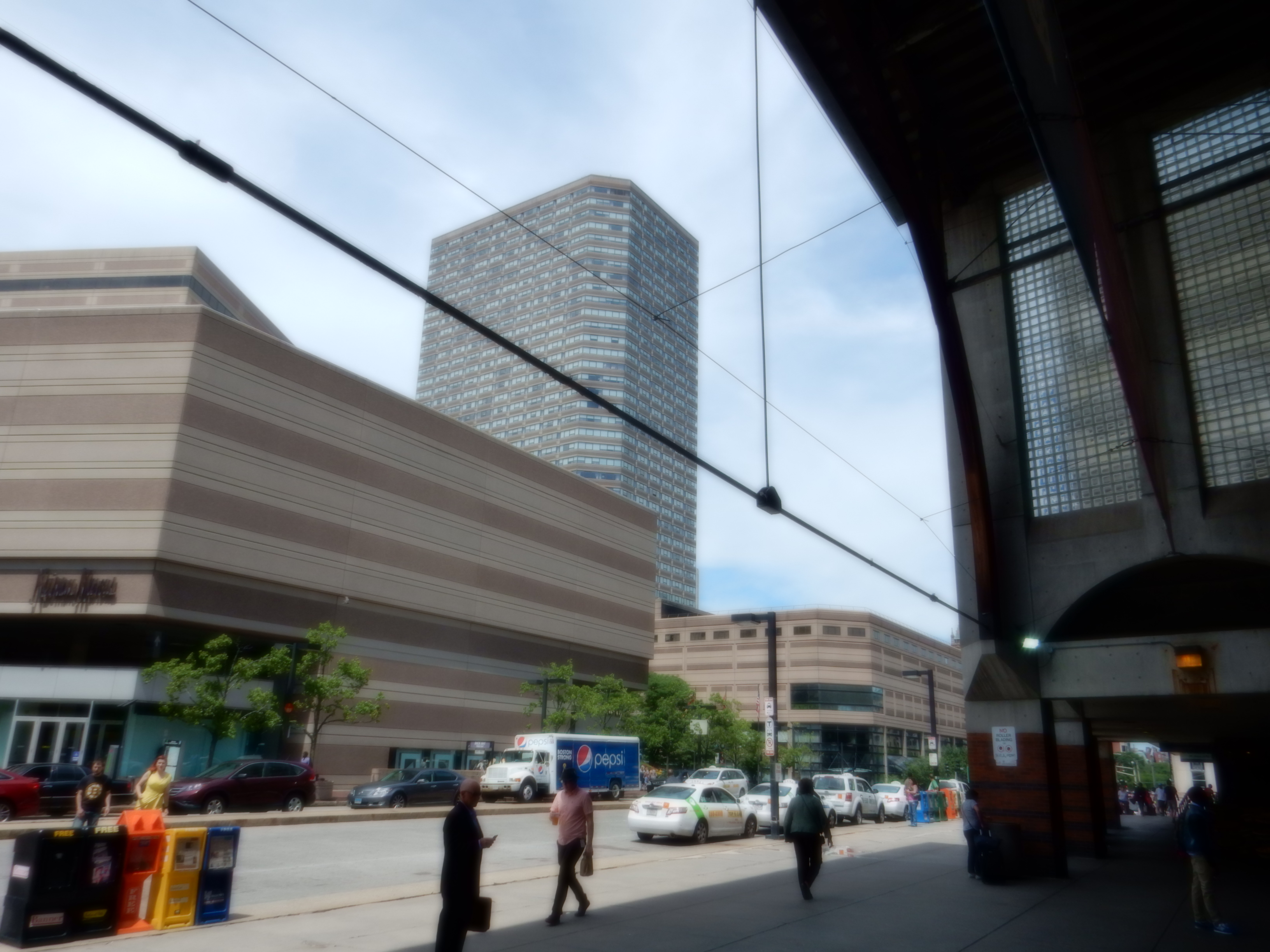
Desultory modernist structures across from MBTA’s Back Bay station on Dartmouth.
It should not be difficult to bend society back toward the better end. But it will be. The Traditional Building Conference takes that as a given, and marshals considerable resources toward that goal. It is a blessing, and more architects and allied craftsmen and professionals should take advantage of it. (This is just an overture to the concerto of your correspondent’s reportage on the conference and its sessions, which I hope will adequately reflect their contribution.)




 Architecture Here and There
Having just returned from the Traditional Building Conference myself, I concur 100% with David Brussat’s observations about Copley Square. Standing on the steps of McKim’s great Boston Public Library, one is struck by the cohesiveness of the buildings at enclose the Square. Even though of varying architectural styles, they comprise a harmonious urban ensemble because they are of similar scale and stem from the same historical building tradition. The glaring exception, as Brussat notes, is the Hancock Building: Not only is its all-glass facade in adverse contrast to its neighbors, but also its Brobdingnagian height detracts from the gravitas of the rest of the Copley Square buildings. The Hancock Building is living testimony to the way money and political power often trump rational urban planning.
LikeLike