
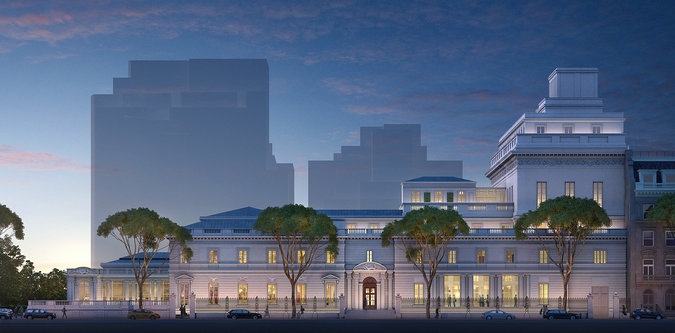
Proposed addition to Frick rises gently from center right of image. (NYT)
Plans emerged yesterday for an expansion of the Frick Collection. an addition reverent, it seems, in its devotion to the sensibility of the mansion built in 1913-14 for Henry Clay Frick by Carrere & Hastings, expanded by John Russell Pope in the 1930s, expanded again by John Barrington Bayley, and finally yet again by the firm doing the proposed six-story addition, Davis Brody Bond – the firm responsible for the new 9/11 museum.
Although it saddens me that the Bayley addition would be sacrificed – he was the great good friend of the late Henry Hope Reed, leader of today’s classical revival – this newly proposed addition seems to be about the best one could hope for. So far, though the devil is in the details, it seems downright lovely. It adds to the sense one gets – and I went for the first time last month – as one walks around its perimeter of a village of smaller buildings that have grown organically from the original.
One would surely like to see the existing delicate accretion of additions preserved, but an institution often needs to expand. I’ll leave to others whether that is so here, but the case made in Robin Pogrebin’s New York Times article seems powerful.
Already the usual suspects are pooh-poohing the proposal’s extraordinary sympathy – see “Beaux Arts Botox,” by Culturegrrl – so at odds with much recent practice. The modernist addition to the Morgan Library several years ago is an abomination, but the old library survives it better than, say, the Brooklyn Museum, the addition to which, as Steven Semes points out, looks as if an alien space ship had landed on its beautiful face – a bigger-than-life carbuncle that nowadays is the norm.
So if the addition here proposed emerges from the fusillade unscathed and is not watered down to suck up to the powers that be, or to save money, then it should provide a stellar example of what genuine architecture means by the word “addition.” Addition – to add on, to make better, quoth the dictionary. Sounds like a good idea.





Lew, you remind me of the proponents for the GTECH building who promised that its reflectivity would render it virtually invisible.
LikeLike
The addition to the Morgan Library an abomination?
What would you have liked them to do… build a duplicate mausoleum? The reason the original building “survives” the addition is because the in-fill structure is virtually invisible. For once a modernist architect chose not to trash up the joint with a “statement.” Piano added transparent rooms to the Morgan, so as a visitor goes in the new main entrance, he sees the old buildings glowing in their undeniable beauty. In fact, Piano reveals MORE of the old buildings than it was possible to see in the past. An abomination? A triumph!
LikeLike