
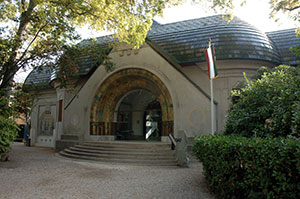
The Hungarian pavilion at an old world’s fair. (Financial Times)
Rem Koolhaas is director of the latest Venice Biennale of Architecture, the big cheese of international architectural exhibitions, which begins on Saturday, June 7. Predictably differentiating himself from his ridiculous predecessors by using the biennale to do something intelligent, he has made it a forum for discourse on nationality in architecture – or, as he himself admits, how nationality (and not a few other even more beloved things) have utterly disappeared from today’s design world.
Koolhaas sees the trees (the flaws of modernism) but not the forest (the fatality of those flaws, and the obvious solution of a return to traditional practices that worked for thousands of years). He is seconded in a good piece by Edwin Heathcote, architecture critic of the Financial Times. Heathcote seems to see the trees instead of the forest, too, although he articulates the trees so well that they sound like the forest. But does he take the obvious next step? Of course not. Here are a couple of passages from his piece. After describing several old pavilions from exhibitions (not the Biennale) of the past, Heathcote writes:
Each pavilion tells us about the desire to express something of the national character – and the prevailing political aesthetic. And it is this idea – and what happened to it – that is at the heart of the theme set by this year’s curator, Rem Koolhaas. The question is posed through the juxtaposition of cities a century ago – with their distinctive, bustling streetscapes, busy with architectural detail – with shots of contemporary central business districts, the anonymous cityscapes of glass towers and urban freeways that could be Houston or Dubai, La Défense or Doha. The question Koolhaas poses is: How did this happen? How did these diverse cities absorb this idea of modernity in such a homogenous way, how did one type of architecture attain such hegemony?
It is, in its way, an obvious question. And superficially at least, it addresses a taboo subject in architectural discourse – style. That’s because modernism, which started as a radical, often political idea about remaking cities for a technocratic, classless age of automobiles and sun terraces, was almost immediately co-opted as a style, a way of expressing taste, fashion and a perceived modernity. The most enduring monuments of modernism are, you could argue, not communal housing blocks or private villas but the elegant mid-century commercial office slabs that inspired the “blandscapes” of the contemporary city.
The entire article is very intelligent and worth reading, but sad in that the obvious stares both Koolhaas and Heathcote in the face every day, and they either cannot see it (nah) or ignore it.




 Architecture Here and There
Reblogged this on Disconnected Landscapes.
LikeLike