
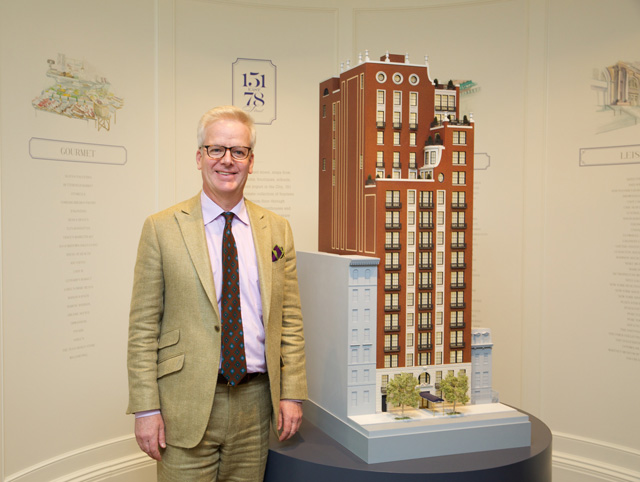
Peter Pennoyer stands next to model of 151 E78th St. (Julie Skarratt/YIMBY)
Some classicists are up in arms over an interview with Peter Pennoyer by Nikolai Fedak on the web site YIMBY – Yes In My Back Yard, as opposed, I suppose, to NIMBY. But I don’t think Fedak phrased his questions in order to imply any disrespect for Pennoyer, who will be speaking in Boston on June 12. Rather, Fedak has such a profound ignorance of architecture that what Pennoyer designs just seems slightly weird to him, as if, since we live in modern times we must have “modern” architecture, and any design that doesn’t belong in a Jetsons cartoon is there only by accident. You see, it’s the cartoon rooted in the second half of the 20th century that is normal; an authentic building rooted in the architecture of the last 2,000 years is some sort of curious alien interloper.
I would no more think of getting mad at Fedak for asking whether Pennoyer’s penchant for Federal and Regency architecture “is rooted in the time frame following the Revolutionary War” than I would get mad at my son, age 5, for thinking that ninety-twelve is a number. It’s what happens when, like almost anyone writing about architecture these days, you know as much about the subject as a 5-year-old does about mathematics – including the most noted architecture critics.
Pennoyer’s 17-story residential building at 151 E78th St. is enormously attractive. If such buildings had been the norm in Manhattan for the past 70 years, New York would be not just a great but a beautiful city. Imagine how New York would look today if the energy that has gone into its glass boxes and its increasingly cartoonish evocations of “the future” had instead continued to infuse the eclectic creativity of traditional design. Imagine if advances in materials and engineering had been devoted to bringing greater and greater virtuosity to the ancient forms of beauty in architecture. Instead, energy has gone to escalating accomplishment in the realms of the tedious and the ridiculous. Instead of a succession of beautiful facades on the streets of New York, we have what were once lovely streetscapes pockmarked by large and fugly carbuncles that are aging badly. Very sad.
Pennoyer will speak at the Boston Atheneaum at 6 p.m. on Thursday, June 12, along with his co-author, the historian Anne Walker, who have written New York Transformed: The Architecture of Cross & Cross – a largely forgotten firm whose work dominated the streets of Manhattan in the 1920s and ’30s. In short, they designed many of the buildings that leave the impression, today, that New York is beautiful. No, New York has many beautiful buildings but is not a beautiful city. It is a great city but not a lovely (or, some might say, a lovable) city. Sorry. That is the fact. Blame modern architecture. The event (without the histrionics) is sponsored by the New England chapter of the Institute of Classical Architecture and Art.




 Architecture Here and There
Hi,
I’m not sure *what* interview you read, but the entire commentary on YIMBY was exceedingly positive and supportive of Pennoyer’s fantastic work. Otherwise I would not have interviewed him. The comments re: federalist inspiration were refuted WRT 151 E 78th as well, if you read the entire piece; but the majority of his work (small-scale) most definitely *is* rooted in the Federal style, as he literally told me.
Thanks!
-Nikolai (aka Mr. Fedak)
LikeLike
Nikolai, thanks for responding. I believe that the objections of some classicists on the TradArch list referred to the extent to which your interview questions seemed to root Pennoyer’s work in the past rather than the present. There was a feeling that you do not believe that classical and traditional design is as appropriate for the 21st century as for earlier centuries, that a Federal or Regency revival is somehow less appropriate to our time than, say, a Gehry wiggle or a Zaha zig-zag. I do believe that your interview was a genuinely friendly interview, but your ideas about architecture are marinaded in principles that are unfriendly to new traditional work. You may not even realize this. I don’t think your questions were meant to be unfriendly, and Pennoyer certainly did not react as if they were. But some classicists apparently felt that the questions were intentionally dismissive of new classical architecture. I think they were dismissive, but possibly not intentionally so.
LikeLike
Nicolai, in rereading your interview with Peter Pennoyer, I think I overreacted to some comments among classicists, who themselves may have overreacted to the tone of your questions. Again, upon rereading, I find your questions and their tone to be genuinely unobjectionable, and largely innocent of reflecting the usual “marinade” of ignorance that underlies most critical commentary about new traditional architecture. Your thinking may indeed be marinaded in those lazy, wrongheaded ideas, and maybe you do not believe that new traditional work is as appropriate for our time as modernist work, but I do not think those conclusions may be drawn from your questions to Pennoyer. I was wrong to draw them and I hope you will accept my apology.
LikeLike