
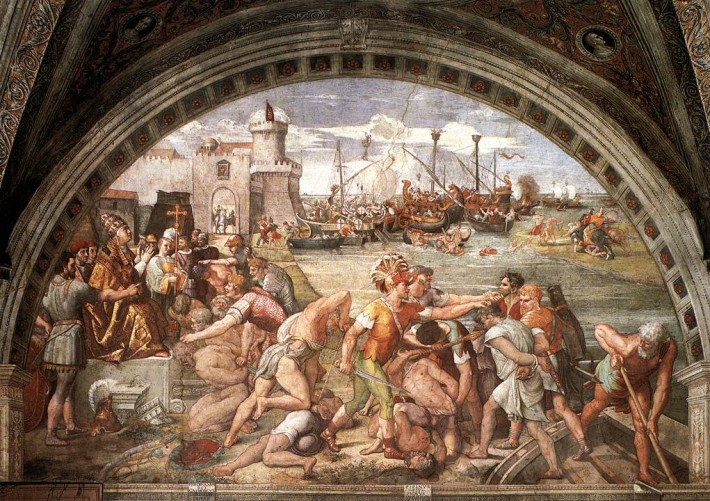
This is not the “document” referred to in the Pencil Points editorial. I could not find that. This is a painting by Raphael, which does show the lighthouse (200 B.C.) at Ostia harbor, not far from ancient Rome. (wattsupwiththat.com)
Yesterday I opened my Princeton selection of reprints from Pencil Points, the journal for architectural draftsmen, to an editorial from the January 1925 issue on the new modern architecture, entitled “Living Architecture.” Here are a couple passages from it:
When we review the architectural styles … [long clearing of editorial throat] …
That great changes in our architecture have taken place in the past few years we all recognize, but upon the question of the worth of the innovations and of the success with which the new problems have been met there is, naturally, disagreement. We are so close to the work that it is difficult to see the thing as a whole.
The important thing is to try to create living architecture. … There is, in many quarters, too much tendency to copy instead of drawing inspiration for new designs from old works. There are on the other hand a few men who show either a willful disregard for or ignorance of traditional design.
We are clearly in the midst of great confusion here. I found myself arrested by the following passage, part of a more general (and generally feckless) elucidation of the idea of copying versus drawing inspiration:
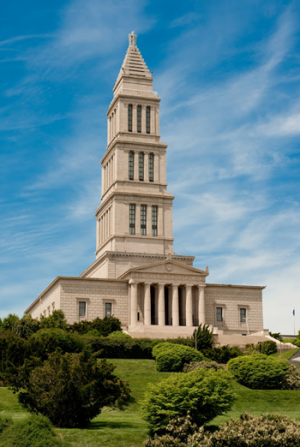
Masonic Washington Memorial, in Alexandria, Va. (mason2b1ask1.com)
… In the July issue was shown the document given by Harvey Corbett as the inspiration for his design for the Masonic National Washington Memorial at Alexandria, Va., namely the lighthouse at the ancient port of Ostia, as shown in a restoration in D’Espouy. While Mr. Corbett’s Washington Memorial bears a resemblance to the design shown in the document in that he kept the idea of this beacon in mind while designing the memorial and the general plan of the grounds is similar in shape to that of the harbor at Ostia, as shown in the restoration, there is no very close resemblance between Mr. Corbett’s design and the document to which he attributes his inspiration. The big conception of the lighthouse and harbor at Ostia happened to fit in with the architect’s idea of the right kind of memorial to Washington and he availed himself of so much of the documentary material as seemed useful.
What stopped me, however, was not its fecklessness but that it called to mind that my mother had once told me, as we drove by Corbett’s memorial, that my father did not like it. He never expressed any of his architectural likes or dislikes to me, perhaps because he died in 1978, long before I ever expressed any interest in architecture. But he was a city planner for part of his career, so he probably had his own thoughts on the subject of style. I like to think he was quietly dismissive of what was being built in his heyday, but I don’t really have any sure idea, and this instance hardly bodes well. In any event, that stopped me and so I stop here.
I will be coming back to Pencil Points in future posts, mainly to wonder about why the traditional status quo seemed to surrender to the modernists without a fight in the years after World War II.




 Architecture Here and There
Pingback: More Semes on modernist “coup d’etat” | Architecture Here and There