
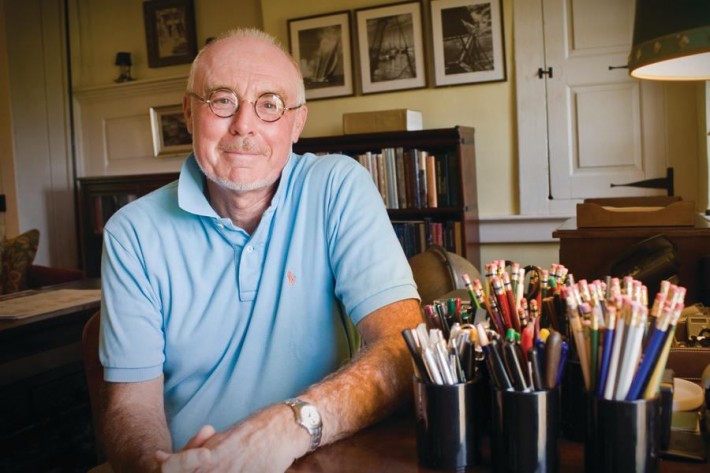
Russell Versaci
My blog on how to resolve the difficulty of finding an old house to buy mentioned Russell Versaci’s prefab houses, but I was unable to access my review of his book from 2008. Here it is, reprinted courtesy of The Providence Journal:
New old houses on the march
By David Brussat
The Providence Journal
August 21, 2008
LIKE A SILVER LINING that eventually brightens a whole depressing horizon of dark clouds, the foreclosure crisis could seed the nation’s future with a suburbia of new old houses.
In the person of Russell Versaci, this pleasant possibility had breakfast with me on Monday morning at McCormick & Schmick’s, the Biltmore Hotel’s lobby restaurant. Versaci designs new houses in the traditional vernacular of regional American architecture. His book Roots of Home, following his 2003 bestseller Creating a New Old House, will be published in October. Versaci, who grew up in Rhode Island, described how across the nation, suburban developers facing the housing meltdown are having to sell millions of acres at pennies on the dollar. This opens the door to better architecture.
Poised to take advantage are developers – including Versaci himself in his latest incarnation – who embrace America’s longstanding love affair with its own architectural tradition and want to help make well-designed traditional homes more affordable to a wider range of families.
Versaci has made a name for himself as the guru of the New Ruralism, a countryside outgrowth of trends toward traditional town planning known as the New Urbanism. Both pick up on a widespread desire to live in communities that hark back to the past, to what America was like before modern architecture and planning began to ruin the full spectrum of manmade places. Now Versaci has combined his finely detailed period designs with new techniques for the production, in factories, of whole segments of houses that can be bolted together on site.
This prospect horrifies many architects, especially those with a modernist bent. The idea of new buildings in historical styles drives them nuts to begin with. That they might now believe their careers are threatened by the idea of fine houses built on the factory floor tickles me to pink. If, finally, the tide is turning against modern architecture, then its practitioners have only themselves to blame. The profession have spent decades spurning Americans’ architectural preferences – which are more refined than “educated” tastes precisely because they are not tainted by modernist aesthetic propaganda.
Architecture schools in America have long been a closed shop, intolerant of diversity. As a young student at Harvard’s Graduate School of Design in the 1970s, Versaci recalls being in class, drawing classical columns, when his instructor came over, ripped out his page, crumpled it up and said he could not do that there, and that if this is what he wanted to do, he should go elsewhere. Other instructors derisively called him “sculptor” (revealing, by the way, their own ignorance of modernism’s essentially egotistical aesthetic). Over the years, I’ve heard this sort of story again and again. Intellectual depth is not the long suit of modernist design pedagogy.
Eventually, Versaci joined the fraternity of architects (such as Robert A.M. Stern) who design high-end traditional homes for wealthy clients. His understanding of the subconscious allure of tradition encouraged him to believe that a wider market for houses in revivalist styles could be generated. He started planning rural communities in exurbia, designed with pattern books modeled on those of Asher Benjamin, whose 19th Century drawings helped build Providence’s College Hill and neighborhoods throughout America. Such historic districts are now this country’s most popular neighborhoods.
Versaci’s new venture brings the pattern book into the 21st Century, combining popular taste with contemporary household amenities.
The market for new old houses rests on aesthetic preferences that literally reflect the patterns of the mind. The science of perception and its connections to urban design have been mapped by the noted architectural theorist Christopher Alexander, whose work has been refined by Nikos Salingaros, of the University of Texas. Salingaros proposes that architectural preferences echo deep cognitive biases in the brain’s highly evolved survival mechanisms. In other words, it is not just “a matter of taste” after all. Traditional architecture embraces these preferences; modern architecture rejects them. This, he says, is why modernist buildings disorient most people while traditional buildings please them.
I will explain these theories soon. Meanwhile, having breakfast with Russell Versaci was like dining with dawn’s golden rays as they embraced the bright sunlit uplands of a nonmodernist future.




 Architecture Here and There