
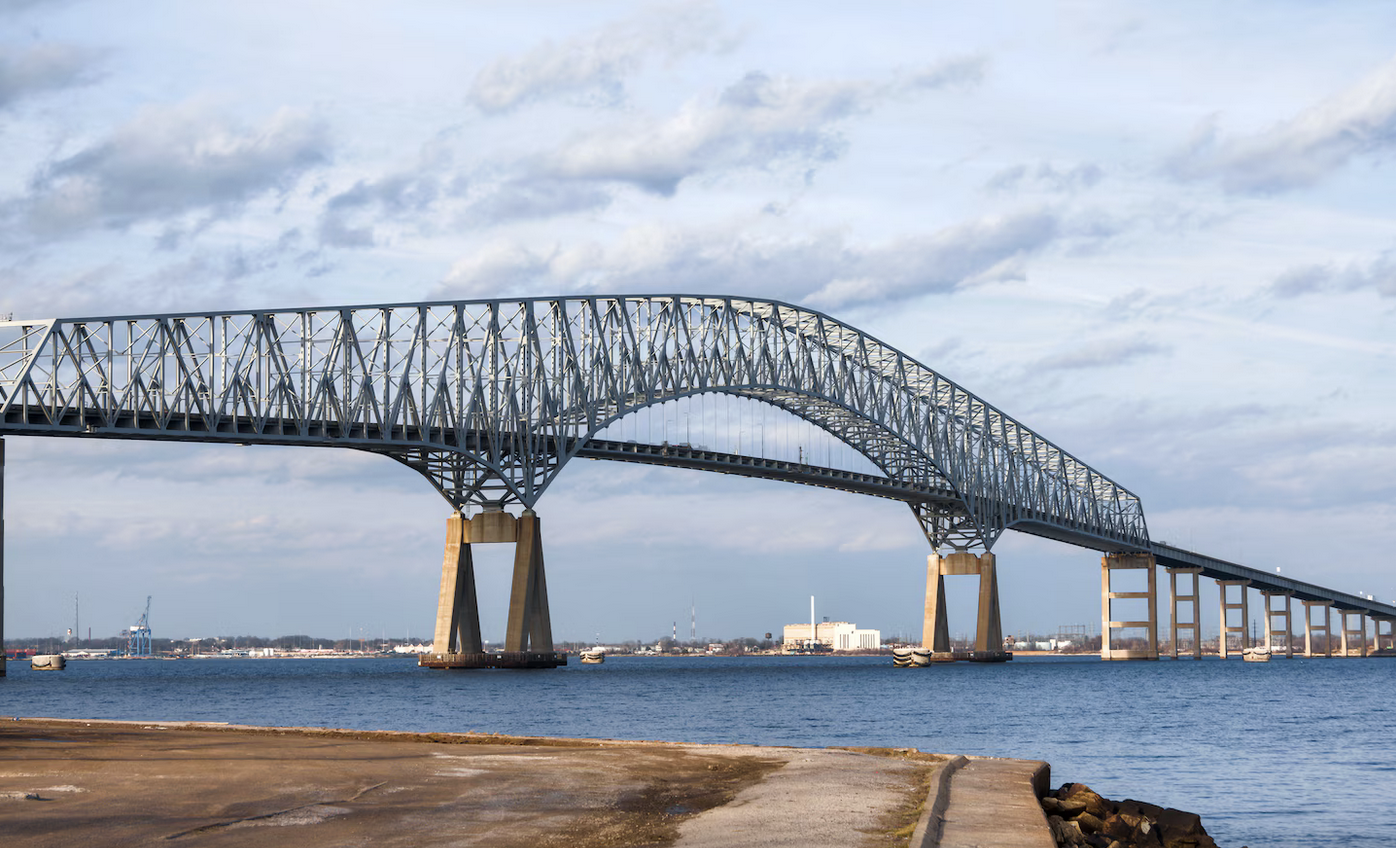
Key Bridge before it was struck by a huge freighter in March 2024. (William Sherman:Getty Images)
President Biden has said he will rebuild the collapsed Francis Scott Key Bridge, over the Papatsco River leading into the Port of Baltimore, at the mouth of the Chesapeake Bay. The bridge, completed in 1977, was hit by a freighter that lost its steering on Monday night. As of this writing, six men filling potholes on the bridge are still missing and, sadly, presumed dead. The Key was a queen of the art of infrastructure, a demonstration that utility can be beautiful. And so the president should see that it is rebuilt, as it was, to teach that very lesson.
As we all know by now, the bridge is named for Francis Scott Key, who wrote the words to what became our national anthem after seeing that our flag still flew after the failed British assault on Fort McHenry, in Baltimore Harbor, leading to the end of the War of 1812.
Curiously, the Key Bridge, 1.6 miles in length (not including some nine miles of access roads), reaching a height of 185 feet, was built to take the overflow from the Baltimore Harbor Tunnel after the latter had reached its traffic capacity. The tunnel was completed in 1957, the bridge in 1977. The bridge cost $66 million, has four lanes, to the tunnel’s two. Now it is gone, and while vehicles, including freight-hauling megatrucks, still have alternative routes in and around Baltimore. The Port of Baltimore handled 847,158 cars and light trucks last year, leading all other ports in the nation for 13 consecutive years. Cargo ships, which of course carry far more than the most humongous of trucks, will not be able to travel in or out of the harbor for many months, probably years.
Transportation Secretary Pete Buttegieg, no doubt repeating the magnificent phrase of some rhetorician long past, referred to the Key Bridge as “a cathedral of infrastructure.” That no doubt it was.
Examine the interplay of the bridge’s steel strutwork. The intricacy of its design undermines the idea that modern structure needs to be ugly. The collapse of the bridge shocked the civil engineering community, for which its design is iconic. It is the second-longest continuous-truss bridge in the United States, the third-longest in the world. The longest is the Ikitsuki Bridge, in Japan. (A truss, in engineering, is a structure whose “members are organized so that the assemblage as a whole behaves as a single object”).
Its beautiful intricacy belies its strength, and speaks to that quality vis-á-vis beauty and commodity in the famous Vitruvian triad of utilitas, firmitas and venustas (stability, usefulness, and beauty). The bridge’s firmitas withstood the stress of its utilitas – all that traffic! all those huge mack trucks thumping along its tired pavement – until three days after its 57th anniversary. Its beauty, venustas, may have been an afterthought, but it will be in the memories of all who mourn the bridge’s loss.
Engineers have been designing beautiful bridges of iron and steel for more than a century and a half. I have seen no mention in any of what I’ve read to source this post of the designer of either the bridge below (Abraham Darby?) or of the Key Bridge itself.
Key Bridge failed yesterday after suffering the massive affront of a massive cargo ship, but that does not diminish the beauty of its glorious infrastructure – which should be rebuilt to its historic design by the Biden administration.

The Iron Bridge at Colebrookdale, 1780, by William Williams. (Mutual Art)





 Architecture Here and There
No that is a stupid idea and shows your opinion holds no value. We need a new modern bridge that can handle the traffic of the 21st century, and build with buffers and dolphins to protect it a Cable-stayed bridge, fan design would be best. Not the ugly 1970s load of garbage.
LikeLike
not rebuild the same crap with no safety island… build a proper new bridge properly…
LikeLike
You might want to check your math. March 23rd was the 47th of it’s opening anniversary March 23,1977. I know, because I rode over it after it’s opening in 1977.
LikeLike
Better idea, rebuild Key Bridge as Single tower Cable stayed bridge.
But add a second pedestrian span to connect to the walk of Fort Carroll
LikeLike
Why aren’t we seizing the ship and its 10,000 containers? Buttigieg, that weakling, said that the feds will pay for everything. 10,000 containers at a low estimate of $10,000 apiece in contents is $100,000,000. Maybe the containers hold even more than $10,000 apiece. Send some Marines to grab it and pull it to a Navy base.
“That wouldn’t be nice” they’ll say.
LikeLike
Yes, Robert, I agree. Seize all of it – boat & cargo, and sell it to the highest bidder. Then use the proceeds to help fund the new bridge. I would do this precisely in order to NOT be nice! (And let it not be the monstrosity shown above by Lazy!) – David
LikeLike
This makes no sense to rebuild a bridge that used a 1970’s design and built to codes that were current over 55 years ago. All for a beautiful bridge but utility, safety and function comes first.
LikeLike
a new bridge to replace the Tappan Zee bridge over the Hudson river took five years to build. Take the plans from that bridge, the equipment, and the workers, and you’ll have a new key bridge in no time.
LikeLike
Baltimore engineering firm J. E. Greiner Company was selected as the primary design consultant, with only the side approaches being handled by New York City’s Singstad, Kehart, November & Hurka in joint venture with Baltimore Transportation Associates, Inc. Construction was performed by the John F. Beasley Construction Company with material fabricated by the Pittsburgh-Des Moines Steel Co.
-Wikipedia
In 1773, Thomas Farnolls Pritchard – an architect from Shrewsbury – had a bold idea. Combining engineering expertise and new iron-casting techniques, he proposed the world’s first iron bridge.
Pritchard’s designs were approved by Act of Parliament and in 1777 construction began. Overseen by Darby’s grandson Abraham Darby III after Pritchard’s death, it was to be a cast iron single-span bridge of 30 metres, with five main semicircular ribs.
The radical new structure formally opened on New Year’s Day 1781.
https://www.english-heritage.org.uk/visit/places/iron-bridge/history/
LikeLike
Thank you very much for this information. I wonder why it was not included in any articles written about the bridge collapse. The bridge was so beautiful: its designer ought to have been personally recognized.
LikeLike
My father, Frank Hurka was a Baltimore native, (Poly High School and Johns Hopkins graduate) although the primary company was located in New York. There was also an office in Baltimore. I was 13 when I joined my father on the Key Bridge site (Turner Station) in the summers and often on weekends. It was a remarkable and beautiful structure that defined Baltimore. It was his crowning glory. He was the only partner that remained. The sadness of the lives lost and our Baltimore treasure gone. Thank you for the mention of his name. Leslie Hurka
LikeLike
When the bridge was finished, was there always the risk that large ships would find the space too narrow or too low to sail through confidently? It is possible that the freighter really did lose its steering at the last second, or that the captain might have fallen asleep at the wheel or that the weather was impossible. But surely the spaces in the re-built bridge should allow plenty of leeway.
LikeLike
Sorry for the anonymous
Hels
Art and Architecture, mainly
LikeLike
Yes, Hels, enough room should be built into the bridge elements to ensure safety, but above the span and its supports, the superstructure should be designed the same way, if feasible, to uphold those elements of the bridge that carry vehicles across the span. I don’t mean to say that it should be built exactly as it was before, without considering improvements, only that its appearance be as much the same is before. We want to avoid the look of the Jamestown-Varrazano Bridge in Rhode Island that replaced the old jamestown Bridge, which had a somewhat elegant superstructure.
LikeLike
Or at least the Jamestown Bridge was better than nothing. Jamestown Varrazano has nothing, and looks like a highway overpass with a body of water beneath it. Yawn! – David
LikeLike
Ironic: Bridge as transportation infrastructure; it’s beautiful
But if it stack that same erector set and put floors it’s “Modern Architecture” and is ugly.
JOkes aside, Under Buttigieg, Trains derailed, planes fall out of the sky, now ships hit bridges. And this Token Diversity hire, only excuse for his intepitude is “I’m Gay”
Why wasn’t this bridge equipped with caisson protectors to stop impacts? Especially since this bridge was designed to address hits from ships built back then. Average Container vessel weighed 25-30 thousand tons, vs. Todays ships that are 4x HEAVY.
The Francis Scott Key bridge is a erector span truss bridge; the 3rd longest of it’s type in the world, an Obsolete and largely vulnerable design. But because it’s basically welded and nuts and bolts it’s easy to repair. Rule of cubic proportion, larger a geometric size, the surface area increases exponentially, leaves huge amount of steel to look after. The Key Bridge should be replaced by modern Concrete Arch bridge or a single tower Cable stayed bridge, protected by an sunken caisson against future accidents.
LikeLike
Lazy, you forget that stacking the erector set and adding floors is not enough. You have to put walls on the building. That, usually, is what make it ugly, and why your “joke” flops. With the rest I probably agree, but I doubt that your concrete span would feature the requisite beauty. – David.
LikeLike
You are probably right, Steve. Attribue the “years” we’re hearing from the TV correspondents to their need to make it seem as bad as possible. – David
LikeLike
It will not take years for ships to resume using the harbor. They can remove the bridge debris in the channel and get back to work.
Sent from the all new AOL app for iOS
LikeLike