
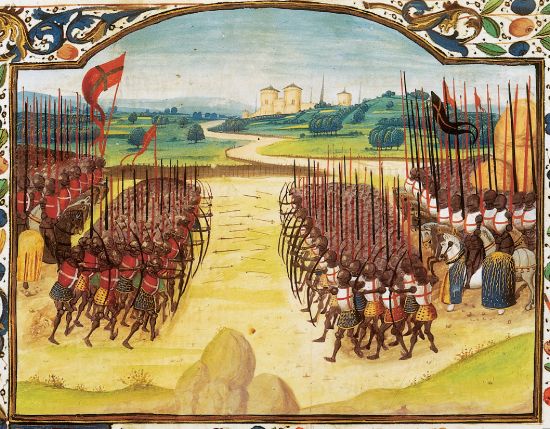
Tapestry of the Battle of Agincourt, Nov. 4, 1415. (herodote.net)
Two days after Halloween and and two days before the 600th anniversary of the battle of Agincourt on Wednesday*, my reading list runneth over with coincidence. Apropos of nothing to do with this blog about architecture – hence the castle of Agincourt in the background of the tapestry above – I cannot resist shouting boo at this evidence of a certain symmetry in the architecture of happenstance, which spans my three latest-read books.
First I read, or reread from decades ago, George MacDonald Fraser’s Flashman at the Charge, in which our heroic poltroon manages to survive the Charge of the Light Brigade at Balaclava (I almost wrote Calatrava), in the Crimean War of 1854. I then read half of Lost in a Good Book, a sci-fi romp through literature by Jasper Fforde, whose characters venture in and out of old books to solve various crimes therein. His heroine Thursday Next marries a man who lost a leg in a modern Crimean War. Then I stopped in the middle of Lost to read Agincourt, a historical novel by Bernard Cornwell, and then returned to Lost just as Next’s lawyer boasts, “They said I couldn’t get Henry V off the war-crimes rap when he ordered the French POWs murdered, but I managed it.” This was an allusion to Henry’s order amid the slaughter at Agincourt when a third French attack was expected. (It never came and Henry cancelled the order.)
Well, I don’t usually notice this many coincidences in what I read, but they coincided with my blog production at a point where I was flailing around for a topic more directly related to my usual theme. My next post will be, not coincidentally, about architecture.
*By Oct. 25, St. Crispin’s Day, which was the 600th anniversary of the Battle of Agincourt before the adoption of the Georgian calendar shifted it to Nov. 4, I had experienced the first and second coincidence related above, but not the third. Oddly enough, the Charge of the Light Brigade was on Oct. 25, 1854.




 Architecture Here and There
Agincourt was actually my first Cornwell, Eric. It was a riveting account of the battle but I thought the story seemed of too contemporary a literary construction, without quite enough of a taste of the historical era in its prose or even in the words of its characters. O’Brian does a much better job of that, and so does Hilary Mantel in the first two of her intended trilogy of Thomas Cromwell and Henry VIII. On the other hand, Cornwell’s marriage of history and story is a most enchanting way to learn of what life was like in an era so far different from our own.
LikeLike
David, I am not surprised you are a Cornwell fan, given our past discussions of Patrick O’Brien. I have read everything he’s written and remain a devoted fan.
LikeLike