
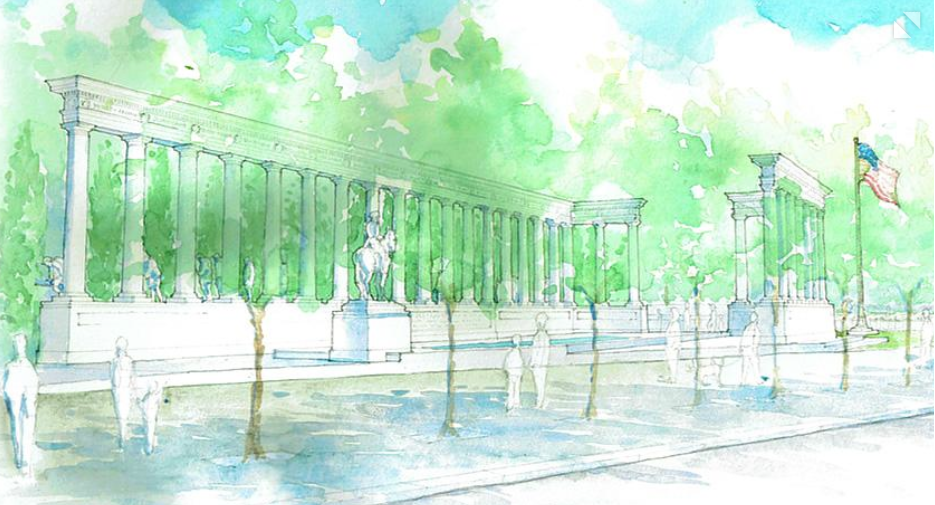
The Washington critic Catesby Leigh has an excellent write-up of the World War I memorial designs in the National Review, “National World War I Memorial: The Judges Got It Wrong.” He mentions two proposals that were entered but for various technical and/or rules reasons did not make it into the first round’s more than 350 entries. Both designs are by major classical practitioners and, as Leigh suggests, it is helpful to take note of them and, possibly, learn from them.
Leigh also discusses the heterodox entry by Roy Lewis that didn’t make the second cut that left five finalists standing – he says it should have – and also the classical entry (a second was traditional but arguably not classical) that did make that cut, by Annapolis architect Devin Kimmel, which features a tower of some 50 feet, with too much writing on its walls. Leigh does not think Kimmel’s design should have been the one classical entry to make the cut, but he does say “we can learn from Kimmel’s design,” adding:
Like Lewis, but in a very different way, he’s trying to rework canonic architectural elements into a new synthesis. That’s what’s so important about the tradition. It provides objective criteria as well as an enduring formal vocabulary that allow the architect’s body of practical knowledge to expand with every solution to a particular design problem. The tradition thus builds on itself rather than continuously disintegrating into a theoretical miasma.
Leigh’s remarks about the flexibility of classicism and its ability to learn identify the vital core of this ancient architecture’s modern-day superiority.
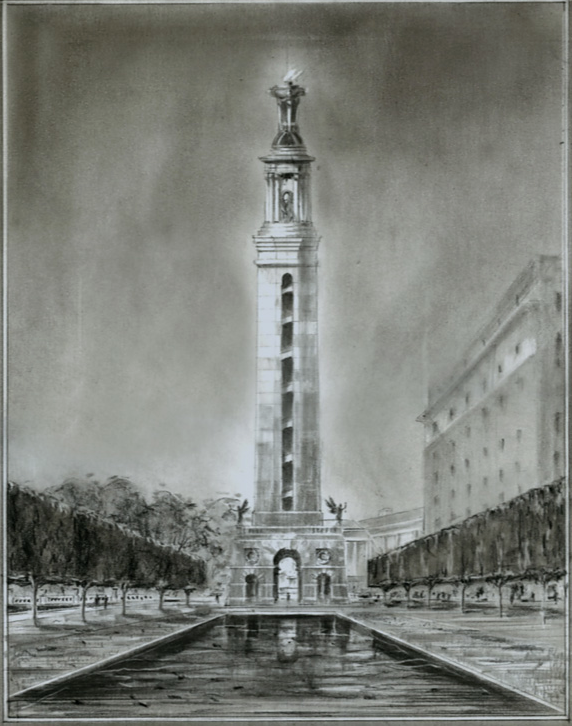
WWI memorial design by Richard Cameron and Michael Djordjevitch. (NR)
I like Kimmel’s design, and have written that the tower’s symbolic descent toward the physical and moral savagery of war could be improved. (Kimmel, I should say, read that and then phoned me to ask me to write his press releases.) But maybe the tower should also be taller. Leigh liked Lewis’s design partly because its own tower, of 92 feet, presents a more monumental contribution to this segment of Pennsylvania Avenue. One of the two entries he brings into the discussion, by Richard Cameron and Michael Djordjevitch, features a 225-foot bell tower. The other, by architect James McCrery and sculptor Chas Fagan, features a pair of L-shaped colonnades without any monumentally vertical element – but with lots of excellent orthodox classical pizzazz.
Leigh’s thoughts on these and other entries into the memorial competition are, as one might expect from the nation’s most erudite analyst of classical architecture, well worth reading in their entirety. But he has the most fun with the modernist entries (one of which I would consider traditional if not classical). One wishes he’d allowed his literary cat more time to toy with these poor mousy creatures.
Meanwhile, I hope the entries by Roy Lewis, architect Michael Imber and sculptor Sabin Howard, plus the Cameron/Djordjevitch, McCrery/Fagan entries, and other fine classical entries (or even non-entries) become the core of an exhibition of alternative proposals not unlike the one sponsored by the National Civic Art Society and the Mid-Atlantic chapter of the Institute of Classical Architecture & Art to rebut the Eisenhower memorial design by Frank Gehry. Devin Kimmel must win this competition if excellence plays any role in the judging. The caveat argues for a Salon des Refusés.




 Architecture Here and There
Pingback: More on WWI competition | Architecture Here and There