
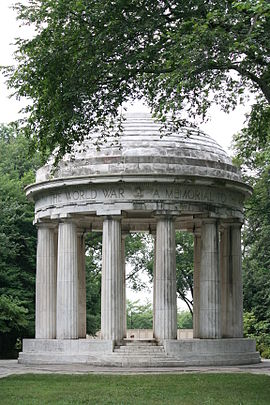
D.C.’s WWI Memorial on Mall. (wikipedia)
An international competition will be held to design a memorial for World War I – the only major U.S. conflict without a national monument on the Mall. The memorial would not be federally funded. The $20 million or so cost would be privately funded, and the design, unlike the one proposed by Frank Gehry for an Eisenhower Memorial, would be chosen fairly.
Thankfully, the World War I Centennial Commission was persuaded to avoid having the U.S. General Services Administration run the competition. The GSA ran the Ike competition and allegedly steered the job to Gehry.
The Eisenhower Memorial Commission has spent scores of millions in taxpayer dollars, and its proposal is so unpopular that the start of construction is nowhere near. The Gehry proposal has not been officially killed yet but its prospects for doing much beyond wasting more federal money seem very poor.
The National World War II Memorial, which sits directly on the Mall between the Lincoln Memorial and the Washington Monument, was designed by Rhode Island architect Friedrich St. Florian. The memorial, which is very popular, especially with old soldiers, last year celebrated its 10th anniversary. Its classical design was chosen in an open competition with over 400 entries, and built almost entirely with private money.

Eisenthower memorial counter-competition’s winning entry, by Daniel Cook. (huffingtonpost.com)
GSA, which is in charge of all federal construction and building maintenance, has a modernist agenda. When a classicist, Notre Dame professor Thomas Gordon Smith, was nominated by President George W. Bush to be its architect in chief several years ago, all hell broke loose in the profession and the nomination was withdrawn. A modernist, Les Shepard, with 18 years at GSA under his vociferously modernist predecessor Edward Feiner, was appointed instead. Smith was given the consolation prize of a federal architecture fellowship.
World War I is commemorated on the Mall by a District of Columbia memorial, a lovely classical temple circular in form and designed by Frederick Brooke. It was completed in 1931 and was recently restored to its original splendor. The national WWI memorial is expected, or rather is hoped, to be completed by Nov. 11, 2018, in Pershing Square Park, a District-owned plot near Pennsylvania Avenue and the White House administered by the U.S. Park Service. Dedicated in 1981, it has a statue of General Pershing, the Allied commander in the war, and a pond. The memorial would become part of this park.
That is an ambitious schedule, but fairness in the design competition should enable the process to proceed more smoothly. Unlike the Ike competition, which invited only a few big firms, who did not even have to submit designs before being selected, the competition for the national WWI memorial will be open to modernist as well as traditional entries, as it should be.
Maybe its participants will include some of those who entered a counter-competition for the Ike memorial sponsored in 2011 by the Mid-Atlantic chapter of the Institute of Classical Architecture & Art. It was won by Daniel Cook.




 Architecture Here and There
Let’s not forget the beautiful official National WWI Museum & Memorial in KC: http://content.mediastg.net/dyna_images/agents/94/42967/20150402101959.jpg
LikeLike
Remember, this arch was a proposed commemoration of Ike, not WWI.
LikeLike
I think the Greek doric tholos in the photograph is better and more appropriate than the corinthian triumphal arch. More reserved and contemplative, with formal roots closely tied to fallen warriors, and by not featuring any individual figures it speaks more to the huge number of forgotten individuals who died in the war. That said, anything that gets designed and built NCAS and ICAA will be immesurably more appropriate than a modernist design, which would surely emphasize the chaos of war by being chaotic, rather than honoring the gravity of the loss to civilization in a civilized and sombre way.
LikeLike