
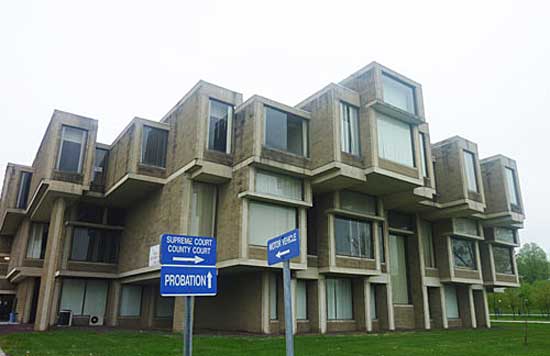
Orange County Government Center. (culturegrrl.com)
Goshen, N.Y., is up in arms again as the city enters a new phase of combat over saving the Orange County Government Center (1967), designed by iconic modernist Paul Rudolph in the Brutalist style. Most of the public wants it torn down; most architectural historians want it preserved. This battle, like other similar battles, strips bare that modernism, which continues to hum the utilitarian dirge with a straight face, is really still all about style – that is, an aesthetic whose central purpose is to reject tradition.
Lee Rosenbaum, of the CultureGrrl blog, wrote of her dismay at the latest round of this contretemps in “Goshen Commotion.” The New York Times’s architecture critic Michael Kimmelman recently wrote about it in “A Chance to Salvage a Master’s Creation.”
Kimmelman’s piece supported a compromise that would have preserved the building, readapting it as an arts center while a new county building could arise in its parking lot. He was accused by CultureGrrl of undermining the goal of preserving the building by misdescribing the rehab by Gwathmey Siegel of Rudolph’s more famous Art & Architecture Building at Yale.
It also conspicuously featured a “drop ceiling” that was not “stripped away,” as Kimmelman reported, but had been added to the monumental central space, as part of its 2008 Gwathmey Siegel re-do. A discordant bright-white glossy grid, the drop ceiling concealed the heating and cooling apparatus. As I suggested in [a post], this dispiriting result bespeaks an uneasy fit between the form of Rudolph’s structure and its function — a criticism that has also been leveled at his Goshen edifice.
Quite so. Why should a drop ceiling be used to hide the heating and cooling apparatus? Is not the exposure of such functions the very definition of honesty in modernism?
The only answer is an uncomfortable one.
The problem here is not confusion in the deployment of modernist orthodoxy. Modernism is used to that, and the rest of us must put up with its erosion of utility in buildings whose appearance we already find easy to dislike. One cannot expect modernists to stoop to the learning of lessons. Now Gwathmey Siegel might be tapped to renovate the Rudolph building in Goshen as an arts center, and various supporters of just saving the building for its original use as county offices are not highly amused. But I am.




 Architecture Here and There