
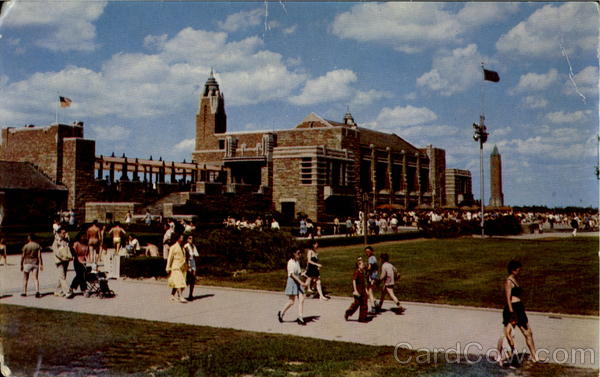
West Bathhouse Pavilion, Jones Beach, Long Island. (cardcow.com)
Since I expect that my reading of The Power Broker (1974), by Robert Caro, about Robert Moses, New York’s master builder, will summon up more to criticize than praise in its 1,162 page vastness of biography, I will begin with the quote that follows. Caro describes the rhapsodic public reception for the design of his Jones Beach. This was before Moses, the most powerful man in New York, city or state, for almost five decades, became enamored of Le Corbusier and before he began to inflict his Radiant City on his subjects.
Robert Moses. (wikipedia.org)
The praise wasn’t only for the size of the park’s buildings; it was for the taste with which they had been designed and the ingenuity with which there had been worked into their steel and stone delicate details which the eye, to its delight, was endlessly discovering. Visitors could see that the nautical theme has been carried out everywhere. Walking along the mile-long boardwalk connecting the two bath houses, they noticed that the boardwalk railing was a ship’s railing. Bending down to drink from a water fountain, they found that the fountains were turned on and off by ships’ pilot wheels. Looking for trash cans, they found them concealed in ship’s funnels. Looking up, visitors saw on the flagpoles crow’s nests in the yardarms, and halyards decorated with long rows of bright semaphore signals. They saw ship’s lanterns swinging on davits from the lamp posts. Looking down, expecting paved walks in the park to be standard gray concrete, they were surprised by mosaics – of compasses, maps and the gay seahorse that Moses had chosen as the emblem of Jones Beach – set into the concrete. The games along the boardwalk were ship’s games: shuffleboard courts, deck tennis, Ping-Pong. Even the pitch-and-putt golf course was made maritime by replacing near every hole some reminder of the sea – a rusty anchor, the keel of an ancient boat, old rum kegs retrieved from the Great South Bay. All Jones Beach employees were garbed as sailors, complete with sailor caps, and their supervisors wore officer’s uniforms, complete with gold braid. And every button on the uniforms was engraved with a seahorse.
Architects exclaimed over the long, low sweeping lawns of the bathhouses and restaurants, their medieval and Moorish cast, the combination of Ohio sandstone and Barbizon brick (“Perfect!” exulted one architect. “Perfect!”) with which they were faced. They were startled when, searching for the water tower, they realized that it was concealed in the 200-foot campanile. They described with delight the diaper-changing rooms, the cutouts of bowmen crouching against the dune that formed the background for the archery range, the symbolic ironwork cutouts on the directional signs, the gay devices of stone and brick – all the touches that Robert Moses, standing alone on a deserted sandbar, had decided he must have in his great park. “It is in the smaller things that Mr. Moses is at his very best,” Architectural Forum was to say. “Usually a public institution of any kind in this country has been the occasion for especially dull architecture and walls of cheerless dimensions which invite only the scribbling of small obscenities. But Mr. Moses, being essentially a romanticist, has revived the handicraft spirit in his designers, with the result that the equipment at Jones Beach exhibits irrelevant [sic, irreverent?] and endearing good spirits. The architecture has the great virtue of “scaled down to the size of a good time.” Even the Herald Tribune could only wax rhapsodic over this “most prosaically named, most beautifully landscaped of beaches.”
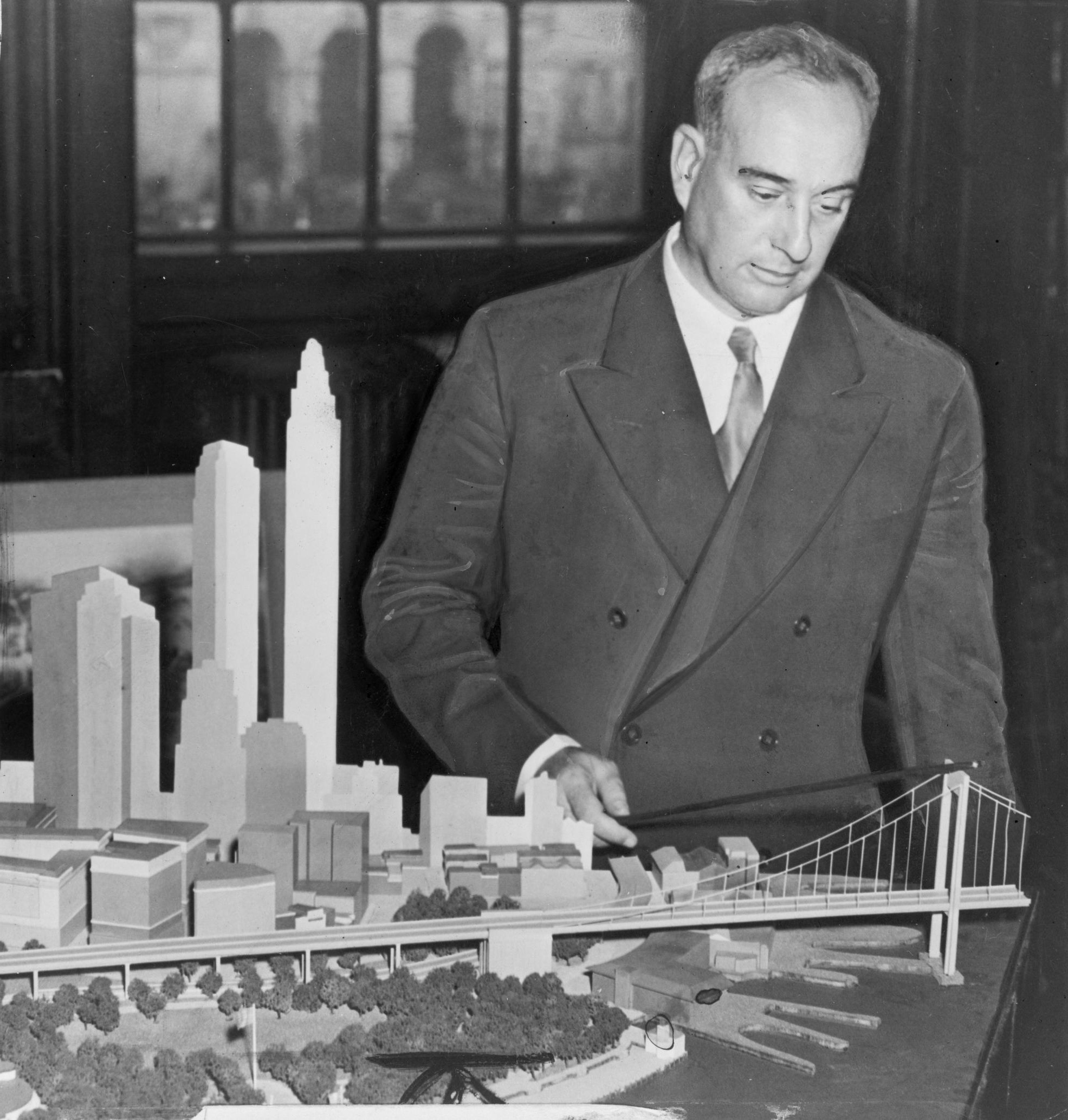
“It is in the smaller things that Mr. Moses is at his very best” is a remark that would turn out to be heroic in the degree of its understatement.





 Architecture Here and There
No mention of who the architects that designed the water tower or other buildings at Jones Beach were?
LikeLike
Good question, Maria. Here is a paragraph from a historic structures and cultural landscape report by the state parks department:
“Jones Beach was designed by a core team of architects, engineers and landscape planners working under Robert Moses. The team included Herbert Magoon (architect), W. Earle Andrews (supervising architect/engineer), A. E. Howland (engineer) & Clarence Combs (landscape architect). Robert Moses was a demanding and active participant in the Park’s design; providing design ideas and granting final approval. Almost all major project architectural drawings from the 1920’s through the 1960’s featured Moses’ signature.”
LikeLike