
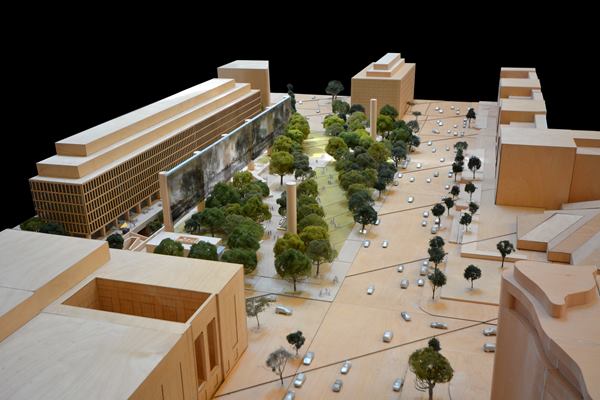
Latest rendition of Frank Gehry design for Eisenhower memorial, minus two minor “tapestries.” (Eisenhower Memorial Commission)
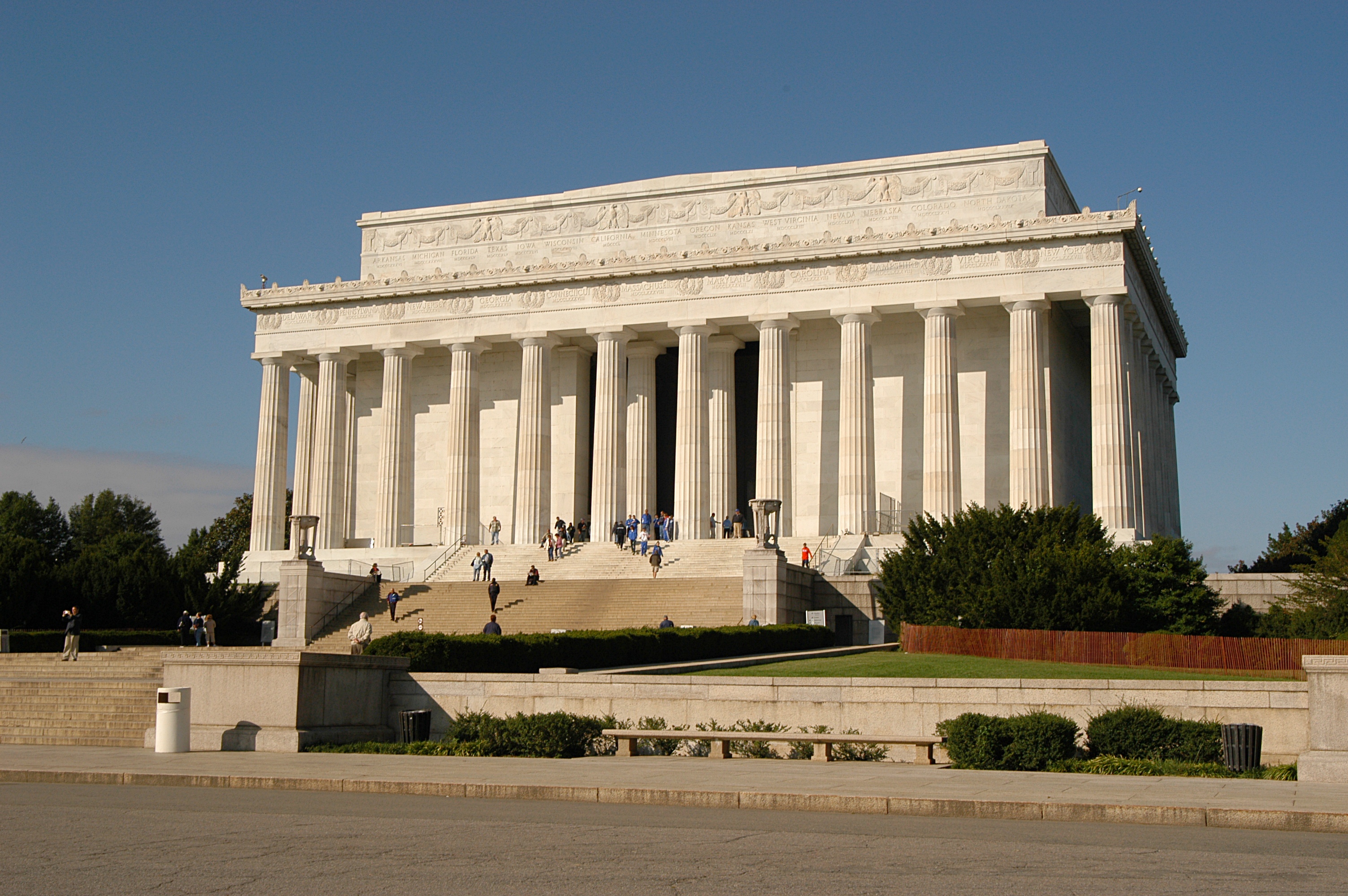
Lincoln Memorial. (ca.wikipedia.org)

Jefferson Memorial. (Photo credit Destination360 Jefferson Memorial)
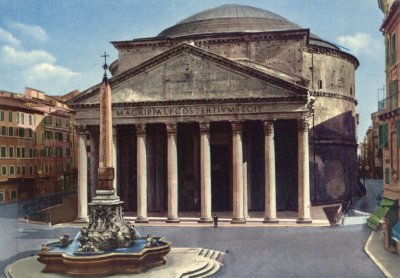
The Pantheon in Rome. (globeriders.wordpress.com)
This critique of the critique of the Gehry design for a memorial to Dwight Eisenhower, “An Eisenhower Impasse,” by Ned Cramer in Architect, the journal of the American Institute of Architects, is so twisted that it merits the sobriquet Gehryesque.
Gehry’s “giant rectangle of columns and tapestries is a lineal descendant of the agoras and forums of western antiquity,” writes Cramer, “just as John Russell Pope’s Jefferson Memorial recalls the Pantheon in Rome.” But assertion is not proof. The two lineages are not the least bit comparable.
Cramer correctly notes that next to Gehry’s typically twisted designs, his memorial for Ike is sober, but he is wrong to trace it to the classical tradition. That is absurd. Just because it is rectangular and has posts (they don’t qualify as columns) does not mean it is classical, or bears any meaningful relation to the classical tradition.
Modernist critics say this all the time, and some modern architects are familiar with the classical tradition, but modernism is a reaction against tradition and a denial of the classical as valid for our time.
Gehry once wondered what Lincoln has to do with a Greek temple, and said, “Life is chaotic, dangerous and surprising. Buildings should reflect that.” His Ike memorial purposely rejects the tradition of classical memorials in Washington that his advocates (though not he himself) claim prefigures his design. They can say what they want, but they can’t have it both ways.
Gehry’s advocates have also tried to root opposition to Gehry’s memorial in politics, as if a disinclination to pay millions of tax dollars for a memorial that slaps the public (not to mention Ike) upside the head is liberal or conservative. A hint that the dislike is bipartisan (or rather nonpartisan) is that more funds have been spent by a PR firm to raise money to build it than the amount of money raised itself. That amount is negligible, half a million, unlike the large swig of taxpayer money appropriated by Congress so far for a project estimated to cost as much as $144 million.
A key line in Cramer’s essay is this: “Critically approved progressive artists don’t do straight portraiture, any more than their architect counterparts do straight classicism. Those who do, do so at their peril.” I’m not sure how to react to that. It is merely a statement of fact. No, Gehry was not knuckling under to the design apparatchiks of the AIA, but younger architects might understandably read it as a threat to anyone who contemplates wandering off the modernist reservation.
“Apotheosis isn’t part of the creative vocabulary anymore, at least not without a big dose of irony.” The culture that Gehry represents doesn’t understand that irony is not an appropriate tool for memorializing an American hero.
“In this tale of two cultures colliding,” writes Cramer of the debate over Gehry’s design, “the architect’s viewpoint deserves as much respect as the Eisenhower family’s.” Really? Well, what is the architect’s viewpoint? And why does the Eisenhower family oppose his design? Perhaps it is because the family believes that the memorial should be about Ike, not Gehry.
This piece demonstrates that like the classical architects of long ago, modern architects today have held power in their field for so long that they’ve lost the capacity to argue the case for modern architecture. Faced with a classical revival that could well knock Gehry out of the National Mall, their most trusted spear-carriers can chuck only nonsense.




 Architecture Here and There
Pingback: “Tear Down This Wall!” | Architecture Here and There
Pingback: Online photo credit sourcing | Architecture Here and There
Very good piece, David. However, having read a great many anti mod essays from the 20’s and 30’s, I dispute your assertion that they lacked the capability to defend traditional architecture.
Their defenses were eloquent, witty, urbane, forbearing, and gentile. The latter may have been their problem. They were really too kind and indulging of these “wild new grafts”, and not taking the full measure of modernism’s demonic nature. The allure of the new was irresistible from the 20’s through the 60’s. My late parents of blessed memory could never understand why I would practice traditional architecture. To them I seemed hopelessly quixotic.
LikeLike
Milton, my particular example was Harold Van Buren Magonigle of Pencil Points, but my survey was not exhausive. I’m sure you are correct that there were those who pegged modernism insightfully and trenchantly. I will read more. However, the ease with which modernism took the establishment away from tradition suggests that tradition’s defenders were somehow not up to the task.
LikeLike