
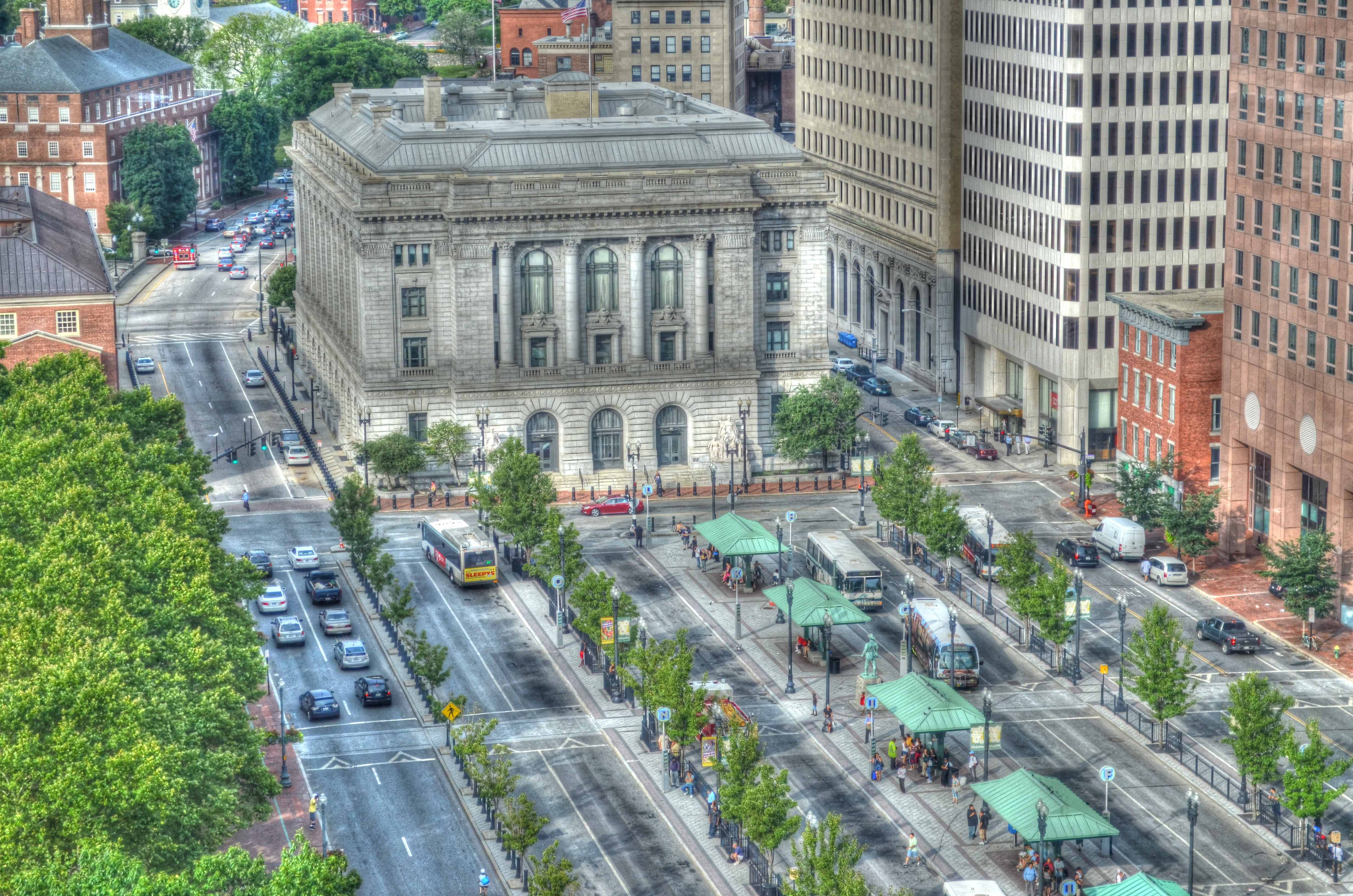
This half of Kennedy Plaza was demolished over the summer. (brendaleetroiaphotography.com)
My last post may have unintentionally dissed Burnside Park and Kennedy Plaza, leaving readers with the impression that they were failures, and that Providence civic leaders and city officials, along with the state transit authority, were valiantly riding to the rescue of the latter. No. Both KP and Burnside Park would qualify as reasonably close to successful under Jane Jacobs’s arithematic. Kennedy Plaza was a successful bus hub until it was emptied out in July to make way for a rushed and poorly conceived attempt at redesign. A time-lapse video made from City Hall shows it operating at peak efficiency.
I also did not leave a clear enough impression that both the park and the plaza are (or in the latter case was) very attractive, the plaza spectacularly so in comparison to most such modern-day transit hubs. But the plaza’s lovely bus waiting kiosks have been ripped out and even the park, which features a beautiful Beaux Arts fountain and an equestrian statue of Gen. Ambrose Burnside, is slated to receive a clunky “arch.”
The park is and the plaza was occupied, in part, by people whom many might call riffraff, at least some of them. I have used KP and the park frequently during my 30 years in Providence, 11 of which were spent (until five years ago) living downtown right behind the Plunder Dome (City Hall). I walked through the park and the plaza many time and was never accosted by anyone more threatening than a panhandler. The denizens of these public spaces had been sequestered mainly in the plaza and, to a lesser extent, in the park. With the temporary closure of the plaza many of them have been, to use Jacobs’s word, dispersed. Now, to the extent that they inspire anxiety, that anxiety has also been more widely dispersed downtown.
In the spring of 2013, at the ballroom on the top floor of the Biltmore Hotel, 400 people attended a formal announcement of the reformulation of Kennedy Plaza as more of a civic square than a bus depot. The redesign, by Union Studio Architects, was splendid. It picked up on the traditional features of the plaza. It appears, however, to have been frog-marched out of the picture. The windswept plaza that remains, with sterile modernist bus kiosks from Job Lot (only kidding) waiting to be installed, looks foreboding in the extreme.
Here are new renderings of the section of Kennedy Plaza being rebuilt. The illustrations seem to be stretched at least 150 percent beyond their proper verticality.
The curious thing about last year’s Biltmore announcement party is that the plan to redevelop the Industrial Trust Building next door to the plaza went unmentioned by all of the speakers. Might this reticence have arisen from embarrassment at the goal of the plan – to turn public space for people of lower income into public space for people of higher income?
In any event, a plan that requires a delicate phasing in of its segments, and the forbearance of a public rendered skeptical by other fiascos in recent memory, is likely to be even more difficult to achieve when civic beauty comes under attack from the plan itself – in this case involving a 180-degree shift from classical beauty to modernist sterility.
The plan ranks as one of the nation’s most poorly conceived efforts of city planning, in both its conception and its execution, during the last half century. The redesign of Kennedy Plaza and the dispersion of its bus users nevertheless seems, so far, to reside under the radar of the current mayoral campaign in Providence. What’s up with that?




 Architecture Here and There