
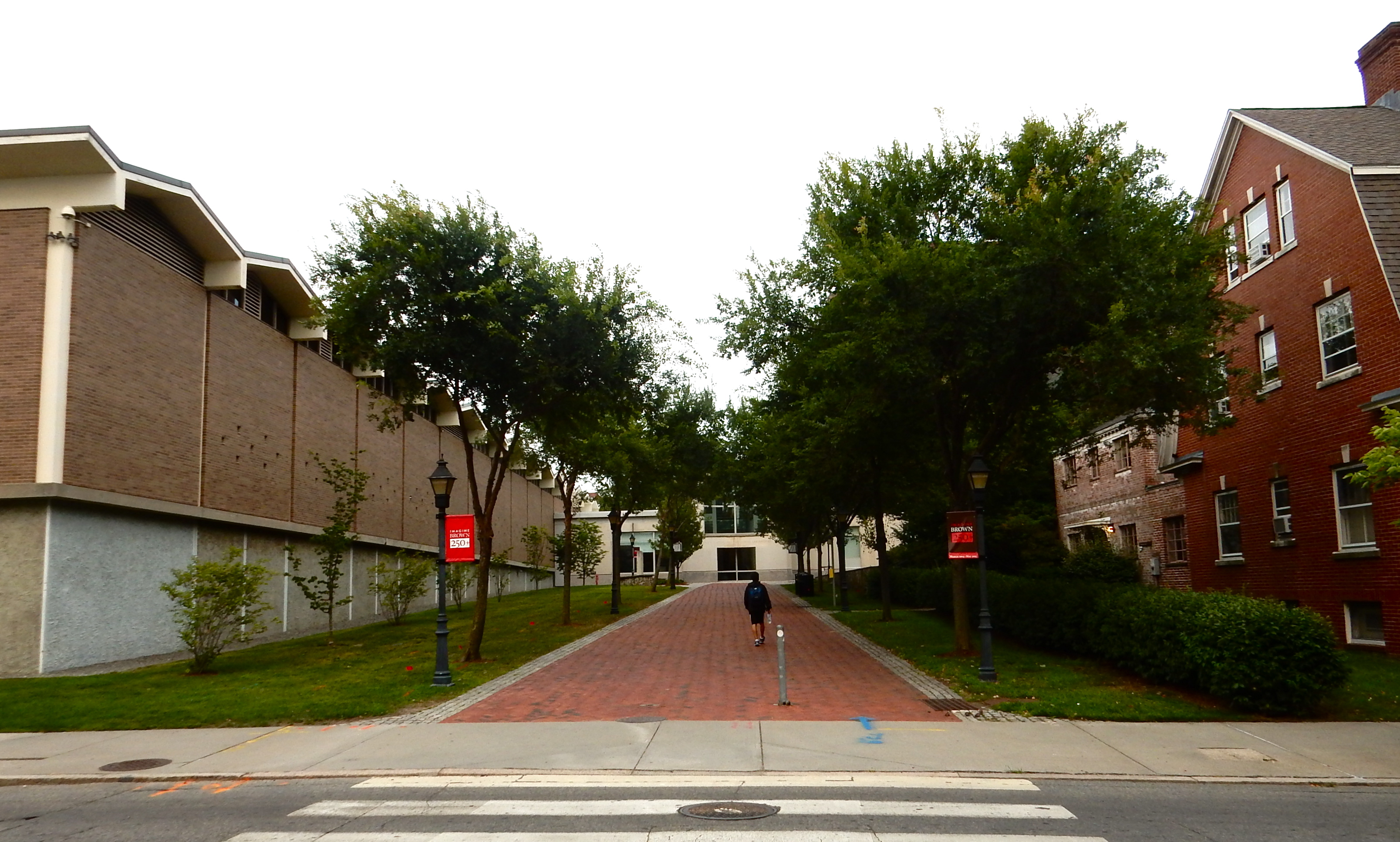
Prince Laboratory, part of Brown University’s School of Engineering, is at left.
In the misty past I would cue readers of this blog – or was that its predecessor? – that my Thursday column was coming up. For some obscure reason I’ve decided that’s appropriate for tomorrow’s column about the School of Engineering at Brown University, which is in the process of expansion. It’s unclear just what will be added, but Brown has hired the Philadelphia architectural firm KieranTimberlake, which designed the ridiculous new U.S. embassy in London. No word yet what specifically they plan to do to Brown.
Still, Brown is taking down four nice old houses and not taking down two, arguably three regrettable modernist buildings, including Barus & Holley Hall, the main engineering building. In my column, for space reasons, I left out Prince Laboratory (1962), one of the apparent survivors, designed by Sherwood, Mills & Smith. Raymond Rhinehart had some choice things to say about it in his Campus Guide to Brown University:
Although fashions come and go – Victorian architecture was once roundly despised – it is difficult to imagine a day when Prince Engineering Laboratory will inspire wonder, much less affection. An isolated stand-alone shed with no urban aspirations, it is representative of an era when architecture, like much of what was created in the postwar consumer society, was considered disposable.
I doubt that Victorian architecture was ever “roundly despised,” even by the architectural historians in bed with the modernists to whom Rhinehart, as an architectural historian himself, has little option but to listen. That’s neither here nor there. He is right on the money about Prince.
He also had something equally on point to say about Barus & Holley, designed by the same firm and completed in 1965:
Although Sherwood, Mills & Smith had developed a positive reputation as a firm that produced handsome contemporary homes, here at Brown they designed a facility that, however functional inside, has no street presence and is strikingly insensitive to context. In today’s high-performance architecture, the envelope, or facade, is just as important a part of a building’s mechanical systems as it had been in the nineteenth century. At Barus and Holley it is not. Thermal massing, natural ventilation and evaporative cooling towers may make a building enclosure work as a passive mechanical system when power is not available. None of these are part of the design of Barus and Holley. If the power goes out, the building is inoperable. Barus and Holley is a creature of cheap fossil fuel.
Rhinehart is channeling Jim Kunstler, whose third “World Made by Hand” novel I’m a halfway through. It is called The History of the Future (not to be confused with Steven Semes’s The Future of the Past). And of course in my column tomorrow, I channel Kunstler (who coined the word “crudscape”) big-time.
The column will show up at http://www.providencejournal.com at about 2 a.m and will be linked to from this blog around 7 a.m. or so.





 Architecture Here and There
Why would Brown care about buildings when they don’t even respect free speech, unless of course, it’s liberal baloney. Still waiting (how long has it been?) for them to punish the ignorant people who shouted down Commissioner Ray Kelly when he tried to speak at Brown. Paxson appointed a committee of faculty who, as far as I know, haven’t done anything except support the disrupters. Sorry…this doesn’t have much to do with design.
LikeLike