
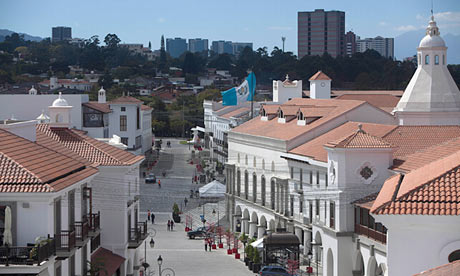
Cayala’s main street, with Guatemala City, the capital, in the background. (theguardian.com)
Here’s a detailed report from INTBAU, the International Network for Traditional Building, Architecture & Urbanism, on Cayalá, the new traditional town in Guatemala. Its master plan was the work of Lèon Krier and the major civic building, its Athenaeum, was designed by Richard Economakis, of Notre Dame’s School of Architecture. Two ND grads heavily involved in the planning process are Pedro Godoy and Maria Sánchez. I gave Cayalá a rose in last year’s global roses and raspberries, handed out by “Dr. Downtown,” this reporter’s occasional alter ego, and later that year devoted a column to it. Here is INTBAU’s Cayalá update.
Here is a passage from the report, which was sent to the TradArch listserv by Audun Engh, a member of INTBAU’s board of directors, a role he also serves for the Council for Europen Urbanism.
Other nods to local traditions include ‘figural’ windows (octagonal or rosette), stepped tiled cornices, corner bollards, ball finials, consoles, and occasional “mudéjar” (Moorish) details like wall fountains, wooden window lattices, and chamfers. These motifs are adapted and used to punctuate elevations, establish formal rhythms and alternation along streets, and create textures that enrich the streetscape and enhance the human scale. Classical detailing in the more important buildings is derived from Renaissance and Baroque sources of Guatemalan civic architecture. Though treated individually, buildings are designed to work together like good ‘urban neighbors’, the overriding effect being one of variety within unity. At Cayalá streets are made of elevations which, to use one of Lèon Krier’s analogies, “are aligned so that they make sense, like the words that form a coherent sentence.”




 Architecture Here and There
Hi David,
I looked at an aerial photo of Cayala, and it looks like a campus. It’s all “much of a muchness.” I know you don’t like jumbles of different styles higgledy-piggledy, but that’s really what tradition is: a growth over a period of time, and a lot of contrast within the whole. Cayala looks over-designed, and the small details, while they may distract the eye, don’t compensate. Go to any other Guatemalan city – Antigua being the best known among foreigners – and you won’t see anything that remotely resembles Cayala. This is an academic’s idea of what we’re supposed to think Central American tradition looks like.
LikeLike
Interesting comment. I don’t know enough about Guatemalan vernacular to disagree. What you say aligns with what I see in photographs, with not enough detail. However, tradition is not quite different styles higgledy-piggledy but different styles that all pick up on the same or similar theme. All traditional and vernacular styles are related in some degree to the classical orders. It is the mixture of modern and traditional styles that I do not like, and which actually reflects the phrase higgledy-piggledy. Notwithstanding that, you may be right about Cayala reflecting an academic’s idea of what Central American tradition looks like. And there has been some question over whether Cayala is or had been a gated community. Still, Cayala is much, much better than any modernist “campus” would be, whether well or poorly designed.
LikeLike
Yes but classicism is in retreat.
LikeLike
Erik, since many readers of this blog are not on TradArch, permit me to explain that some in that online discussion group, such as Andres Duany, have accused members of the list, along with members of the Institute of Classical Architecture & Art, of being in retreat because they respect the classical orders – when in fact he does not seem to understand that they are a tool to foster creativity, or not, as wanted. Classicism is not in retreat.
LikeLike